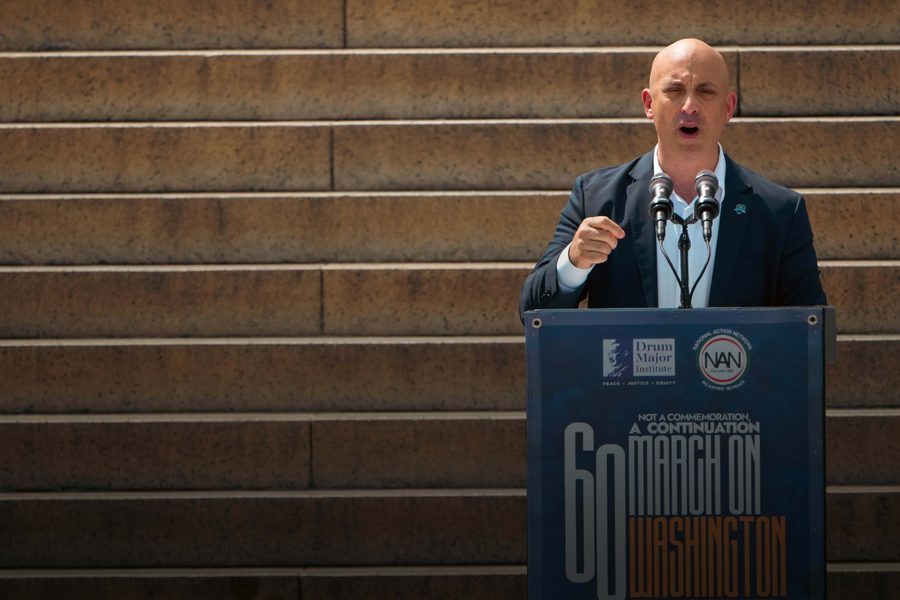
ADL CEO Jonathan Greenblatt speaks in Washington, DC, August 26th, 2023.
The ADL Tried to Appease MAGA. The FBI Cut Ties with Them Anyway.
The Jewish defense group—whose partnership with federal law enforcement goes back decades—has never been more isolated.
In the weeks after a gunman killed conservative activist Charlie Kirk, influential right-wing figures searched for culprits to blame. Many of those upset about the murder of the Turning Point USA founder zeroed in on one target in particular: the Anti-Defamation League. Critics, including high-profile conservative accounts like Libs of TikTok, highlighted the ADL’s inclusion of Turning Point in its Glossary of Extremism and Hate, containing more than 1,000 terms, groups, and individuals the ADL considers extremist. The short glossary page on Turning Point mentioned connections between the group and “known extremists,” as well as past scandals with employees making “racist or bigoted” remarks. “Even after Charlie Kirk was assassinated, the ADL still lists Turning Point USA as a hate group. They have blood on their hands,” wrote an X user named Pericles Abbasi on September 27th, in a post viewed by 6.5 million. In response, Elon Musk wrote that “the ADL needs to change this now.” The billionaire and X owner would go on to tweet at least nine times about the organization over the following four days, calling the ADL a “far left hate propaganda machine” that “hates Christians.” Musk claimed the FBI had been “taking their ‘hate group’ definitions from ADL,” which had led the bureau to investigate “Charlie Kirk & Turning Point, instead of his murderers.”
A former staff member at the ADL Center on Extremism (COE), who requested anonymity because they signed a non-disclosure agreement upon leaving the organization, called the glossary “one of the best assets and resources” offered by the ADL—a public resource to help people “understand extremist activity in their community,” and a tool for extremism researchers and law enforcement as well. When it launched in 2022, the ADL had boasted of a “first-of-its-kind” database that joined “a body of online research tools at the cutting edge of exposing hate.” But on September 30th, Jewish Insider reported that the organization had decided to take down the entire glossary from its website. To justify the move, the ADL told the news outlet that “an increasing number of entries in the Glossary were outdated” and that “a number of entries” had been “intentionally misrepresented and misused,” though the former employee said COE staffers had been “tasked with keeping it updated and added to it regularly.”
The ADL also made several tweaks to a separate, longer “backgrounder” page on Turning Point—removing language about Kirk creating a “platform for extremists and far-right conspiracy theorists,” for instance, and adding that he had publicly condemned some “extremists”—before deleting that page, too, on October 1st. (Other backgrounder pages, on groups ranging from the Palestine solidarity group Jewish Voice for Peace to the white supremacist Goyim Defense League, remain on the website.)
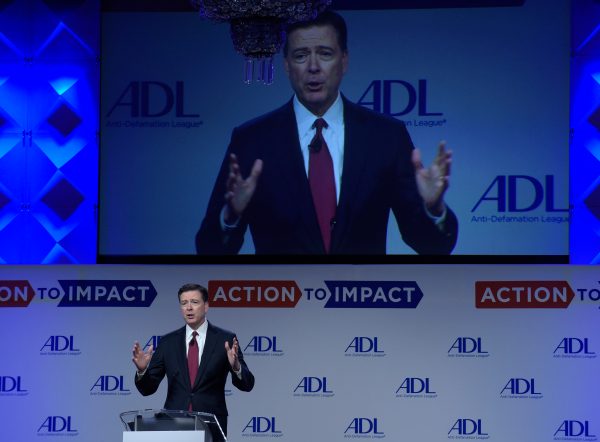
FBI Director James Comey speaks to the ADL National Leadership Summit in Washington, DC, May 8th, 2017.
These hasty efforts to mollify MAGA were too little, too late. The same day that Turning Point’s backgrounder came down, FBI Director Kash Patel announced, first on Fox News, and then on X, that the bureau would cut ties with the ADL, which had been a longtime partner. Patel framed the decision as a rebuke of former FBI Director James Comey, who became a target of the MAGA movement thanks to his bureau’s investigation into Trump’s ties with Russia, and who has long maintained close ties to the ADL. In a statement shared with Fox News, Patel described the ADL as “an extreme group functioning like a terrorist organization,” running “spying” operations on Americans. “That era is finished,” Patel declared. “This FBI formally rejects Comey’s policies and any partnership with the ADL.” (Two days later, the bureau announced it would also cut ties with the Southern Poverty Law Center, which tracks right-wing hate groups.)
The practical impact of Patel’s announcement remains unclear. Neither the FBI nor the ADL responded to questions about which programs the bureau would no longer participate in. (The ADL also declined to respond to other questions for this story.) “I think any threat information that the ADL provides will still be treated appropriately as a tip as it would from any American citizen,” said Kenneth Gray, a former FBI agent who spent 24 years at the bureau. “I think what it does break is the access that ADL previously had by providing things like training to the FBI. That is now dead.”
No matter how the specifics play out, it’s clear that the ADL’s efforts to appease Trump and MAGA have backfired—failing to pacify the right, while further alienating liberals. Longtime critics on the left have mixed feelings about the FBI’s jilting of the ADL: “To get to a place where the FBI would say, ‘this is a non-governmental organization that we cannot rely on in this way,’ is a positive development,” said Maya Berry, executive director of the Arab American Institute. “But the idea that it would be done by a government that has white supremacists and antisemites actually within the government is deeply problematic and equally harmful.” Yet, despite such concerns, few liberal or progressive groups rallied to the organization’s defense after Patel’s announcement. (A notable exception was the Jewish group J Street, which said that despite its “differences” with the ADL, it was “deeply concerned” by the FBI’s decision.) Former ADL employees—some of whom requested anonymity to protect their professional standings—said the organization had distanced itself from liberal allies so much that few are eager to stick up for it, even against an administration they oppose. “The retreat from the broader civil rights work that the ADL has done for generations diluted coalitional strength and has seemingly isolated the organization,” said Robert Sills, the ADL’s former national director for state and local government affairs.
“The retreat from the broader civil rights work that the ADL has done for generations diluted coalitional strength and has seemingly isolated the organization.”
Indeed, six former ADL staffers told Jewish Currents that under CEO Jonathan Greenblatt’s ten years of leadership, the organization’s attention has shifted to focus primarily on the alleged threat that Palestinian solidarity activists pose to the Jewish community—an evolution that accelerated after the October 7th attacks. Greenblatt has praised Trump’s crackdown on campus Palestine activism, including the attempted deportation of Columbia activist Mahmoud Khalil, while applauding the withholding of funds to universities accused of failing to crack down on antisemitism. “No one should have been surprised that this FBI would sever ties with the ADL, and that the vocal elements of the MAGA base that vilify the ADL and harbor and foment antisemitism would demand that,” said Sills. “But the organization wasn’t well-insulated against that kind of threat because post-October 7th, senior leadership, for a variety of reasons, moved rapidly away from continuing the civil rights work that previously made it integral to the broader social justice movement and anti-extremism movement.”
The relationship between the ADL and the FBI began decades before Comey professed his “love” for the antisemitism watchdog on the stage of its 2014 leadership summit. The organizations’ ties date back to both of their early days, when the fledgling Jewish organization began investigating Nazi-sympathizer groups popping up across the United States in the ’30s. Throughout the decade and into World War II, the group cultivated working connections with FBI officials, frequently forwarding pamphlets and information it had collected on Nazi and America First groups. FBI staffers replied to the ADL’s letters and took meetings with its leaders, though the bureau’s priorities did not always align with those of the Jewish minority; in the early ’40s, for instance, the ADL pushed to free German Jewish refugees from the constrictive status of “enemy aliens,” while the FBI sought to maintain national security restrictions on them.
Beginning in the mid-’40s, the ADL expanded beyond investigating white supremacists and started keeping tabs on Arab and anti-Zionist groups. One 1946 edition of “The Facts,” a research newsletter that the group sent to the FBI, included a report on the activities and personnel of the Arab League’s “Arab Office,” the Institute of Arab-American Affairs, and the League for Peace with Justice in Palestine. These groups “are not immediately recognized as our enemies, because they avoid invective and the brazen lie,” the report said. “Their ulterior motives are not readily detected because of their subtlety. Thus, their propaganda, apparently plausible and reasonable, is the more effective and consequently the more dangerous.”
Throughout this period, the ADL worked to smooth over disagreements and pacify FBI officials. During the debate over refugee status, for example, the FBI told the ADL it had caught wind that one of its co-founders was criticizing the bureau’s anti-refugee position. The ADL’s Washington director wrote to the critical colleague, defending the FBI and reminding him that “the director of the FBI, as well as the Bureau, have given us the friendliest cooperation.” Such efforts paid off over time. By the late ’60s, the scholar Emmaia Gelman writes in a forthcoming book titled The Anti-Defamation League and the Racial State, the FBI’s mutual appreciation for the ADL had been solidified: In a 1968 memo, director J. Edgar Hoover instructed all the bureau’s field offices to connect with the ADL divisions in their regions, noting “the Anti-Defamation League receives considerable information of interest to this Bureau.” The following year, the ADL sent the FBI information from its undercover investigation of the Organization of Arab Students.
Around this same time, according to historian John Drabble, the far right became particularly fixated on the ADL, which they framed as a subversive Jewish influence controlling the government. When files on the FBI’s Cointelpro—a covert operation that targeted activists and groups deemed “subversive”—were made public in 1977, they showed that the ADL and FBI were indeed collaborating to disrupt “white hate” groups, intensifying the suspicions of the far right.
The ADL maintained its close relationship with the FBI through the rest of the century, even during moments of tension—as in 1993, when the FBI’s search for a stolen FBI file in the Jewish organization’s possession eventually led to a San Francisco Police Department raid on ADL offices. Police wound up discovering an ADL surveillance operation targeting a host of leftist organizations—including Arab, Black, Jewish left, and anti-apartheid groups—and the FBI briefly investigated the matter before closing its inquiry in 1994. By 2000, the ADL and FBI were regularly hosting joint training sessions for law enforcement. In his 2014 speech, Comey noted that FBI personnel had participated in more than 105 ADL-sponsored training sessions since 2010. “We would always have law enforcement come by and visit the office—the FBI was there quite often,” said Vegas Tenold, who worked at the COE from 2018 to 2020.
This arrangement became a selling point for the ADL, a way to boast of crucial contributions to preventing antisemitic attacks and other bias-motivated violence; its website touts the ADL’s “unrivalled experience in equipping agencies and officers with resources and professional development.” In 2019, Cosmopolitan profiled an ADL researcher who spent her time undercover in online extremist communities, developing an apparent knack for predicting when trolls would actually become violent. In one anecdote, the researcher’s information helped the FBI prevent a man from blowing up a federal office building in Springfield, Illinois; in another, her information led law enforcement to seize guns from an alt-right man who posted about plans to kill Jews. “They sent me that article when they wanted to hire me,” said Tenold. “They send that article to everyone as far as I know.” (The story has now been adapted into an Apple TV miniseries with actor Jessica Chastain, though its release was put on hold after Kirk’s death.)
But outside of a few instances like those captured in the article, Tenold said that the ADL has been less indispensable to the FBI than the organization wants its donors and political contacts to believe. “The sense I got from the FBI is they never really listened to the ADL anyway,” he said. “You would give them a presentation, but the presentations were mostly stuff that you could just find on Wikipedia. If you spent a day researching any given group, you could probably get the kind of information the ADL had.”
Others have seen the ADL’s role as more consequential. A former regional staffer said that he believed the group’s contributions to FBI intelligence had “probably saved hundreds, if not thousands, of lives.” The staffer said that after the Charlottesville “Unite the Right” white supremacist rally in 2017, the ADL was able to name at least 85% of the participants to the FBI. Daryl Johnson, a former senior domestic terrorism analyst for the Department of Homeland Security, said the ADL has been broadly useful to the bureau because of its internet research, an area that’s “touchy for law enforcement and the intelligence community. We cannot go out there and just monitor the internet at a whim. You’ve got to have a criminal nexus, probable cause, things like that.” The ADL, without such constitutional constraints on its evidence-gathering, is freer to infiltrate online communities and pass along actionable intel to the FBI.
This kind of “usefulness” to the bureau, as well as other law enforcement agencies, has fueled criticism of the ADL from civil libertarians and the left alike. It has also stirred debate within the organization. According to a former ADL staffer who advised senior leadership on law enforcement issues in the mid-2010s, staffers were split between two general views: One side saw the partnerships as an important way to protect Jews from antisemitic violence, while the other worried that aligning with agencies that have harmed other minority communities would drive a wedge between Jews and others. The internal friction became more urgent after the police killing of George Floyd in 2020 sparked a national uprising against police brutality. “After the murder of George Floyd, I got increasingly uncomfortable with doing any kind of thing with law enforcement,” said Tenold. He and some colleagues wrote a letter to Greenblatt and other top leaders, advising them to end the collaborations. Tenold said he got “almost everyone” at the Center of Extremism—where staffers were considered more liberal than others at the ADL—to sign. But management responded to the letter, he said, by arguing that “the ADL needed to leverage their relationship with law enforcement to effect change.” On a call with an ADL vice president, Tenold noted that the letter’s signatories “were saying that we should speak out [about police violence] as a civil rights organization,” and the VP responded that “in times like these, there’s wisdom in such a thing as strategic silence.” That was the last straw for Tenold: “I remember hearing that and thinking, I gotta get out of here.”
The Floyd protests did briefly prompt ADL leaders to reflect on whether some of its law-enforcement programs should continue. In June 2020, Jewish Currents and The Guardian reported that senior ADL employees had recommended that the group end its practice of sending police and federal law enforcement, including FBI agents, on delegations to Israel—a program that had long been protested by pro-Palestine groups like Jewish Voice for Peace. In a memo sent to Greenblatt, the senior employees wrote that “in light of the very real police brutality at the hands of militarized police forces in the US, we must ask ourselves difficult questions, like whether we are contributing to the problem.”
But soon after this moment of reflection, the ADL became only more defensive against its left critics. At the organization’s annual summit in 2022, Greenblatt delivered an address in which he unequivocally defined all anti-Zionism as antisemitism and cast critics of Israel, particularly the groups Students for Justice in Palestine (SJP), Jewish Voice for Peace, and the Council on American Islamic Relations, as dangerous threats on par with the right. It was a marked shift in tone for an organization that had, under the first Trump administration, consistently blamed the far right for most extremist attacks on Jews. Going forward, Greenblatt said, the organization would devote “more concentrated energy” to research, political advocacy, and litigation aimed at countering anti-Zionist groups on the left.
The address caused another uproar inside the organization. Greenblatt’s claim that the left and the right were equivalent threats—the “photo inverse” of one another, he said—was especially controversial among COE employees. “This was something that within the COE we flatly said was inaccurate, but leadership did not take our expertise into consideration,” said the former COE staffer. Another former ADL staffer told New York magazine that Greenblatt’s new approach could place more activists under surveillance and lead law enforcement to treat students advocating for Palestinian rights as if they’re on par with neo-Nazis.
The October 7th attacks, and Israel’s destruction of Gaza in their aftermath, made such a prospect suddenly real. As the civilian death toll mounted, Palestinian rights activism surged on college campuses. That same month, the ADL teamed up with the Brandeis Center for Human Rights Under Law, a pro-Israel legal advocacy organization, to send a letter urging university presidents to investigate their campus’s SJP chapters for potentially violating laws against “material support” for terrorism. The following spring, Greenblatt called for the National Guard to break up Columbia University students’ Gaza solidarity encampment.
“My entire portfolio was focused on white supremacists and violent extremists. After October 7th, it was exclusively pro-Palestine.”
During this time, the ADL was moving away from its work combating bias in all forms. Before October 7th, Sills, the former national director for state and local government affairs, said, “my entire portfolio was focused on white supremacists and violent extremists. After October 7th, it was exclusively pro-Palestine, though I think it’s evident that the other threats have remained if not strengthened.” The pivot in his role was not unique. “We were told the organization was not going to respond to Texas Governor Greg Abbott’s demonization of immigrants. We were told we were backing away from LGBTQ issues,” Sills said. “Jonathan and senior leadership made clear that they felt that we had spread ourselves out into policy spaces that were not material to the mission, despite the ADL mission statement continuing to read ‘to secure justice and fair treatment for all.’”
Sills said that after Congress began to hold hearings into alleged antisemitism on college campuses in December 2023—sessions that fueled a right-wing attack on universities around the country and led to the resignations of the University of Pennsylvania and Harvard University presidents—senior leadership at the ADL wanted to “pursue these types of hearings at every state-level higher education committee in the country.” That effort, he said, would have “empowered right wingers who don’t believe in public higher education but would gladly use antisemitism as a pretextual cudgel toward their own ends that have nothing to do with protecting the Jewish people.” Sills ultimately resigned in 2024 after the ADL began to push for anti-masking statutes—intended in part to target pro-Palestine protesters who hid their faces—that he feared would violate the First Amendment and harm marginalized communities.
A similar dynamic played out in the ADL’s education work, as Jewish Currents reported earlier this year. In December 2023, the ADL eliminated A World of Difference, its flagship anti-bias program in schools; staffers were told to pivot to antisemitism education. Meanwhile, the ADL cozied up to luminaries in the Trump orbit, honoring Jared Kushner for his work on the Abraham Accords in March 2024, and, after Trump’s election in November 2024, hiring a lobbying firm with close ties to Trumpworld. After Elon Musk gave what looked like a Nazi salute during an inauguration-day speech, the ADL came to his defense, saying that Musk “made an awkward gesture in a moment of enthusiasm, not a Nazi salute.”
The group also hailed the detention and attempted deportation of Khalil as “bold.” After the decision to strip billions of dollars from Harvard over its response to pro-Palestine protests, Greenblatt celebrated the decision, saying he was “really glad that the Trump administration is leaning in,” although he had previously raised concerns about “the extent and scope” of the approach Trump had taken toward Harvard.
At the same time, the ADL refrained from commenting on other Trump administration moves on issues it had previously spoken out about—the administration’s attacks on diversity, equity, and inclusion policies, for instance, along with its crackdown on immigrants and new restrictions on refugee entry. The organization “made a decision that by severing its focal energies from larger social issues and narrowly focusing on antisemitism, and on Israel, it could maintain an impactful voice and a place at the table,” said one former ADL regional staffer. “Many of us inside tried to raise the warning flag as often and as loudly as we could, to say that antisemitism was clearly being used to give a veneer of credibility to the sledgehammer attack on civil liberties and constitutional protections. But that was not heard and was discarded by leadership.”
Despite its efforts to curry favor with the Trump administration and its right-wing supporters, the ADL has been unable to get past its reputation as a foe of the far right. The organization’s reputation among Trump officials remains “thoroughly left wing,” New York magazine reported in August. “The ADL, they’re very quick to condemn conservatives for some stupid shit,” said one administration official.
The group has, at times, called out the administration: In mid-November, the ADL criticized Trump for refusing to condemn antisemitic white nationalist leader Nick Fuentes after Tucker Carlson hosted Fuentes on his podcast. It has also said that Trump administration official Paul Ingrassia—a Republican recently appointed to a position within the General Services Administration who’s acknowledged that he has a “Nazi streak”—has “no place in government.” Such denunciations provide fuel for continued right-wing attacks on the ADL. “Despite its sharp rightward bent, the ADL does come from a legacy of liberal advocacy, and they had been a major voice in combating radical right-wing movements,” said Ben Lorber, a senior research analyst at Political Research Associates who focuses on white nationalism and antisemitism. “The MAGA movement sees this kind of work as an attack on white Christian America.”
The ADL’s break up with the FBI came as a blow to an organization that has long touted its access to public officials. “The ADL’s relationship with the FBI gave them considerable cachet and prestige,” said the former regional staffer. “Not only was the FBI’s decision to sever its relationship a predictable political outcome—this administration takes a grievance-based approach and holds any past criticism as means for disqualification—but it was embarrassing for ADL.”
By the end of October, the ADL had entirely removed a “Protect Civil Rights” section from the “What We Do” page of its website.
The ADL’s response has been notably muted. The organization’s brief public statement responding to Patel, released on October 1st, acknowledged only that the ADL had “seen” the FBI director’s statement, and said that the organization maintains “deep respect” for the FBI and law enforcement. JTA reported that the ADL asked other Jewish organizations not to speak up publicly on its behalf after Patel’s announcement. Instead, it made more concessions to its detractors on the right: By the end of October, the ADL had entirely removed a “Protect Civil Rights” section from the “What We Do” page of its website.
The organization reacted with greater zeal when Zohran Mamdani, an Israel critic and Boycott, Divestment, and Sanctions supporter, won the New York City mayoral election on November 4th. The day after the election, the ADL announced that it was launching a “Mamdani Monitor” initiative, which would involve a “citywide antisemitism tipline,” research on Mamdani’s appointees for evidence of antisemitism, and a public-facing tracker synthesizing and displaying the ADL’s research on the mayor-elect. The initiative spurred backlash even from centrists who had previously supported the organization, including MSNBC host and frequent Greenblatt interlocutor Joe Scarborough, who accused the ADL CEO of ignoring Mamdani’s outreach to New York Jewish groups. A coalition of progressive Jewish groups, including IfNotNow, Bend the Arc, and J Street NYC, called the program “Islamophobic and racist.” “The fact that no such monitor exits for a Trump regime full of people who regularly fuel and use antisemitism is all the proof we need that the ADL has abandoned marginalized communities in order to join in with the right in the name of defending Israel for anything, and at any cost,” said Jamie Beran, the head of the progressive Jewish group Bend the Arc.
For some, like Maya Berry, the ADL’s differing responses to Patel and Mamdani exemplify its pro-right drift. “They shut down the Glossary of Extremism the moment that it got dinged by white supremacists and far right groups,” she said, but they didn’t respond to the backlash that resulted when they listed Arab American individuals or Muslim groups, or when they named other Jewish organizations whose politics they didn’t agree with. “It’s quite telling that this is when it went too far,” she said. The ADL’s decisions to abandon its former civil rights commitments and tie itself to the right will likely have far-reaching consequences, according to the former regional staffer. “Even if the ADL wanted to course correct,” they said, “at this point it likely cannot do so.”

I’m Arielle Angel, editor-at-large of Jewish Currents. Before you go, there’s something I need to ask.
We’ve seen over and over how the mainstream media falters in telling stories on our beats—whether it’s antisemitism, Israel/Palestine in American politics, Jewish identity, or the American left. At Jewish Currents we’re committed to uncompromising analysis and longform reporting on these issues and more—stories you won’t find anywhere else. In a media landscape that obscures injustice and flattens discussion, we’re changing the conversation. But we need you.
If you believe in this work, please consider making a donation—or even better, a recurring one—to ensure that we are able to keep publishing stories like this one. We can’t do it without you.

Mari Cohen is a senior politics editor at Jewish Currents.