The War on Palestinian Schools
Schools across the West Bank have slashed instruction as Israel withholds billions in Palestinian tax revenues.
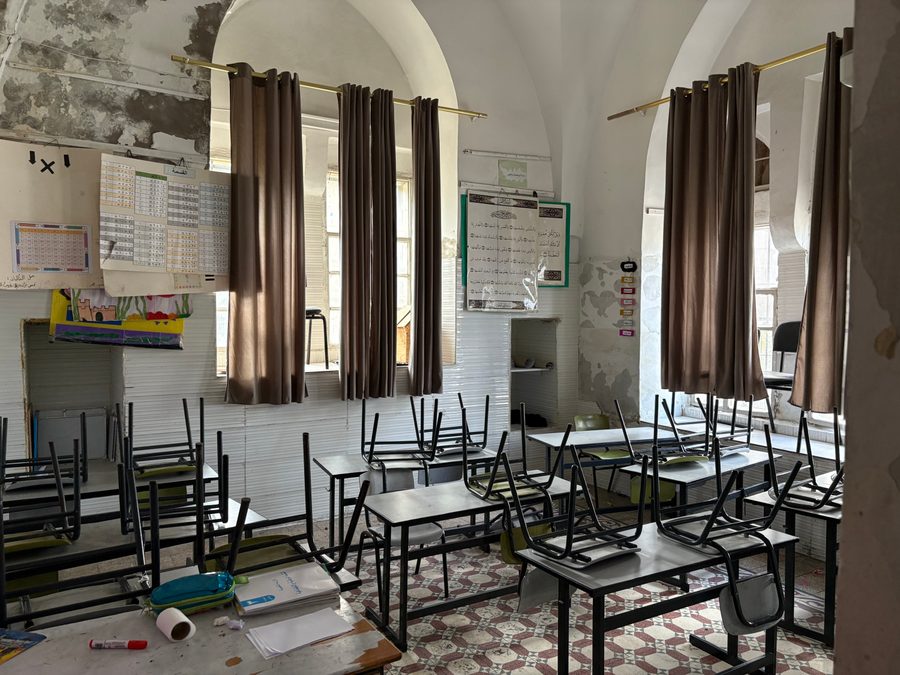
An empty classroom in the Zenabia Elementary School in Nablus, February 2026
On a February afternoon in downtown Nablus, I watched as men trudged through the streets with carts heaped high with strawberries, and taxis honked at pedestrians jaywalking in the central roundabout. Large billboards memorializing leaders of the al-Aqsa Martyrs’ Brigades killed during the Second Intifada hung above the market’s entrance, while nearby street vendors hawked their small wares. It was a typical scene in this crowded West Bank city—except alongside the usual fruit vendors were children selling candy, flowers, and toys. One boy who I spoke to, 15-year-old Talal Adabiq, told me he had been in school until about a year earlier, but had since dropped out to work and help support his family. Adabiq is one of thousands of West Bank students who has left school in the past two years as reduced instruction hours and disrupted routines have meant that schools cannot provide a strong enough education to compete with the necessity of making money. Instead, explained Aisha al-Khatib, the principal of the Zenabia Elementary School in Nablus, students “go to work to bring money to help their families pay for the costs of living.”
While Israel has long targeted Palestinian education, the confluence of attacks on the system over the past three years has weakened it to an unprecedented degree. Since October 7th, the vast majority of public schools in the West Bank have operated just three days a week, often for just four or five hours a day. Because the Palestinian Authority (PA) cannot pay the full salaries of teachers—or any public sector employees, including doctors, who went on strike in May—hundreds of thousands of children have had their education cut in half, leading many, like the former students selling goods in the street, to drop out altogether. Al-Khatib suspects that at her school as many as 10% of students have dropped out because of the closures. In small towns like Aqraba, a community south of Nablus, a local education official estimated that more than 20% of students have dropped out this year.
The closures have had ripple effects throughout the entirety of Palestinian society and its economy. Parents of young children cannot go to work without the childcare school provides, teachers stretch themselves thin across multiple jobs to supplement their meager salaries, and teens like Adabiq have too much time on their hands, opening up increased opportunities for getting into trouble. By targeting education, Israel has struck the heart of Palestinian life, undermining the economic and social stability required for maintaining and advancing Palestinian society. “Destroying educational infrastructure and continued attacks on teachers and learners impacts communities from developing and building identity,” Yusuf Sayed, a professor of global education policy at Cambridge University and co-author of a January 2026 report on the destruction of Palestinian education, said. “An attack on education is an attack on the ability of a society, a community, or a nation to reproduce itself in various ways: through its ideas and identity, but also through the doctors, lawyers, engineers, and teachers needed to reboot,” Sayed explained.
After October 7th, Israel’s Ministry of Finance, led by far-right Member of Knesset Bezalel Smotrich, ramped up its systematic withholding of the tax revenue it collects on behalf of the PA, an arrangement established by the Oslo Accords. At various points since then, the Israeli government had suspended the transfer of funds to the PA, but in 2019, Israeli officials announced that they had systematized this practice through a new policy that deducts the amount the PA compensates families of Palestinian prisoners and those killed by Israeli forces from the transfer total. Still, the amount that Israel withheld on these grounds—some one billion dollars between 2019 and the middle of 2024—is nothing close to today’s amounts. Estimates suggest that Israel refused to distribute some $4.5 billion between October 2023 and the end of 2025. Further, over the last several years, the PA has received the lowest levels of foreign aid in recent memory—in no small part because of Trump’s cuts to international assistance. Aid to the PA came in at just $358 million in 2025, compared with $2 billion in 2008.
The PA has been forced to cut its services as a result, including in the realm of education. At the end of 2023, teachers began to be paid only 60% of their salaries, and often inconsistently and months late. This policy has continued since then, and according to al-Khatib, the highest teacher salaries are now some 1,500 NIS ($500) a month. As a result, teachers strikes have spread across the West Bank—the most recent one in January managed to close half of the West Bank’s schools.
The lost wages have been devastating for teachers, many of whom “cannot pay for transportation to come to school,” al-Khatib said. The cost of gas, bus fare, or childcare is significant, especially when making it to school is not guaranteed. “Some teachers pass through checkpoints daily, and if they cannot pass, they miss work,” al-Khatib explained. Given Zenabia is open only three days a week, “teachers search for extra work, but in the meantime they cannot find it,” she added.
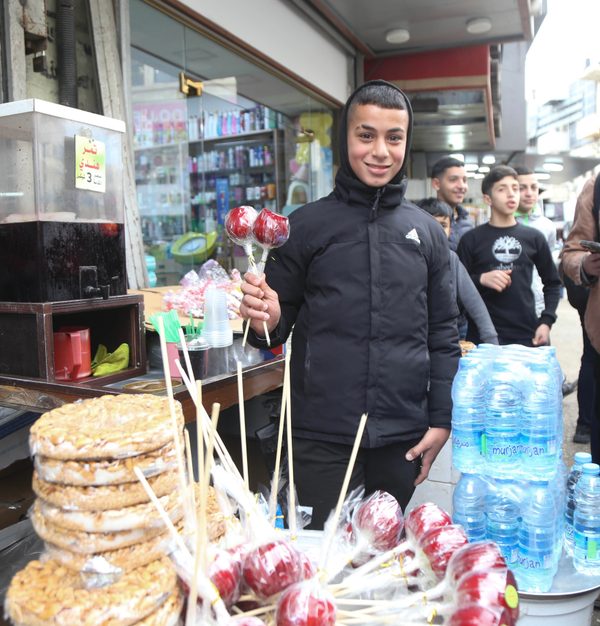
15-year-old Talal Adabiq, who dropped out of school to support his family, now sells sweets on the streets of Nablus, February 2026
The reduced schedule has, unsurprisingly, had a significant impact on educational quality. “The three days solution is a bad solution. It doesn’t cover the minimum education students need,” Tamara Shtayeh, an elementary school teacher in Nablus, told Jewish Currents. While she used to teach all subjects, most of her classes have been cut, leaving only a core curriculum of English, Arabic, and math. Even instruction time for these subjects has been reduced: While the Ministry of Education’s Arabic curriculum used to include 15 units a semester, it has dropped to just six. Shtayeh says these cuts have had drastic implications on educational outcomes. Her students, she explained, have “big gaps,” particularly in reading, and even though schools have tried experimenting with online and at-home learning, many students lack computer access and regular internet connection, making such programs largely ineffective.
There are few alternatives to PA-funded public schools in the West Bank. UNRWA schools have either been closed by military operations in refugee camps, like in Tulkaram and Jenin, putting tens of thousands of students out of school, or are also on reduced schedules. Private schools are rare, and tuition costs put them out of reach for most families. “I cannot send my son to a private school,” Eman Hassaneh, who works at a halvah factory as her household’s only breadwinner, explained. “My salary is 2,000 NIS [$700]; 1,000 [$350] goes to rent, 500 [$175] goes to electricity and internet, and we have very little left to live, for food,” she said. The lack of a consistent academic routine has left her son Zaid, a top student at Zenabia, bored and depressed, she said.
Moreover, other realities of occupation make it hard for schools to pull off even three days of instruction. “All the villages around Nablus are under constant attack from settlers,” Ghassan Daglas, the governor of Nablus, explained. Settler violence in the West Bank has surged in recent years, and regularly targets schools: In January, settlers set fire to a classroom outside Nablus; in late April, a 14-year-old student was killed when settlers opened fire on a school in al-Mughayyir, a village northeast of Ramallah; and in recent months, settlers have closed the road connecting the children of Umm al-Kheir in the southern West Bank to the village’s school. Schools are often closed for long periods of time after events like these. And even when they reopen, parents may be afraid to send their children, knowing that attacks are always around the corner. This kind of intimidation makes daily life impossible—the exact goal of settler violence. “Parents carry a heavy burden,” Tariq Hathaleen, an English teacher at the Umm al-Kheir school, said. “In many cases, families choose to keep their children home because they fear for their safety.” In addition, even settler violence that doesn’t specifically target schools often still affects education. In villages such as al-Mughayyir and Hammamat al-Maleh in the northern Jordan Valley, multiple days of school were canceled after settlers attacked in April. And in the over 70 villages that have been ethnically cleansed as a result of mounting harassment since October 7th, children are also pulled from school. “When communities disappear, their schools disappear with them,” Hathaleen said.
Beyond settler attacks, the Israeli military also plays a direct role in preventing access to education. In the West Bank’s cities, school days are stolen by constant Israeli military raids, a phenomenon that has become both more frequent and more violent since 2023. Between July and September 2025, the military conducted at least 35 raids on schools. According to Hassaneh, Zaid’s mother, schooling is disrupted at least once a month because of Israeli military raids, which shut down whole sections of the city for days on end. Other times, the military’s home invasions target school children. “This is daily,” Mahmoud al-Aloul, the vice-chairman of the Fatah Party and a member of the party’s steering committee, said. Moreover, 86 West Bank schools currently face demolition orders, and at least six were destroyed by the Israeli military during the 2024–2025 school year. “What kind of mentality will students have after that?” al-Aloul asked.
The material impact of the growing crisis are clear: In the short term, schools are sanctuaries for children to eat, rest, and receive aid, and when they are shut down, children are denied access to these services; in the long term, a less educated Palestinian work force will inevitably limit social mobility. The social and political consequences are all the more acute given the centrality of education to Palestinian life. Historically, Palestinians have had high rates of literacy, far exceeding global averages. “Education is a central part of Palestinian society’s sense of itself—it’s a crucial crucible for belonging, identity, collective politics,” Mezna Qato, a scholar of the history of Palestinian education at Cambridge University, said. “Schooling is the place where social cohesion and national cohesion are drawn, exercised, articulated, re-invigorated . . . It’s where you practice politics, you practice democracy.” Al-Khatib, the Nablus principal, agreed, and said she worries about the implications of the new status-quo for Palestine’s future: “It’s destroying the nation.”

I’m Arielle Angel, editor-at-large of Jewish Currents. Before you go, there’s something I need to ask.
We’ve seen over and over how the mainstream media falters in telling stories on our beats—whether it’s antisemitism, Israel/Palestine in American politics, Jewish identity, or the American left. At Jewish Currents we’re committed to uncompromising analysis and longform reporting on these issues and more—stories you won’t find anywhere else. In a media landscape that obscures injustice and flattens discussion, we’re changing the conversation. But we need you.
If you believe in this work, please consider making a donation—or even better, a recurring one—to ensure that we are able to keep publishing stories like this one. We can’t do it without you.

Charlotte Ritz-Jack is an editorial fellow at +972 Magazine living and writing in Jerusalem.