The Ecology of Dispossession
Israel’s nature reserves in the West Bank use the language of conservation to restrict Palestinian life while facilitating settlement expansion.
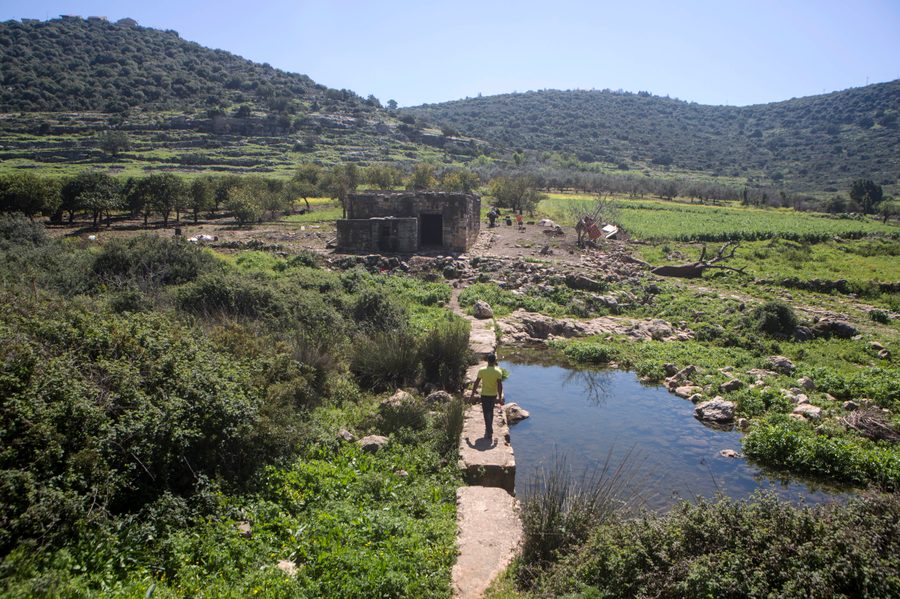
A Palestinian farm house in Wadi Qana, a community in the northern West Bank facing ongoing displacement due to its designation as an Israeli nature reserve, March 2019
In late April of last year, Israeli officials left three notices informing Bassem Mansour, a farmer from the Palestinian community of Deir Istiya in the northern West Bank, that three of his citrus tree plots were violating the boundaries of Wadi Qana, a protected nature reserve. The notices ordered Mansour to remove the saplings immediately, or he would be subject to “arrest, prosecution, and penalties.” Mansour, like many other Palestinian farmers in the area, was forced to dig up his saplings. Six months later and just a few kilometers away from Mansour’s citrus plots, the Israeli outpost El Matan celebrated its official incorporation as a neighborhood of the larger settlement of Karnei Shomron. When El Matan was founded in 2000, the settler outpost fell within the boundaries of the reserve, in violation of Israeli law, but in 2014, the Israeli government quietly redrew Wadi Qana’s boundaries to exclude the 25-acre parcel of land containing the outpost. And although El Matan regularly releases untreated sewage into the protected valley below, Israel’s environmental protection minister attended the incorporation ceremony, where she emphasized its importance for Jewish expansion in the area. “Our presence in the field will . . . determine the security of the entire State of Israel,” she said at the event.
Israel’s use of land reserves is one element of what is often termed “green” or “eco” Zionism, which posits that caring for the environment is central to maintaining the territory as Jewish. On paper, the purpose of Israel’s nature reserves is to protect native plants and wildlife, both within the country’s 1948 boundaries and in the occupied West Bank. Following a 1970 military order granting the army the authority to set aside land in the West Bank for parks or conservation, the army appointed the Israel Nature and Parks Authority (INPA), a governmental organization under the Ministry of Environmental Protection, to administer the parks in Area C, which makes up most of the West Bank, on its behalf. The INPA’s stated mission is to “preserve and manage the special look of typical landscapes throughout the country for the benefit of all inhabitants,” and Israel has expanded the boundaries of more than a dozen reserves in the West Bank in the last five years, including Wadi Qana, in service of this ostensible goal.
Green Zionism thus allows the State of Israel to cloak its occupation of territory and ethnic cleansing of Palestinians in the liberal language of environmentalism, pointing to tree-planting initiatives and nature reserves as proof of Israel’s necessary role stewarding the land. Experts and Palestinian rights groups have long claimed that these environmental “protections” are a cover used to justify the eviction of Palestinians from their homes, while illegal Israeli settlements are allowed to proliferate. Wadi Qana, for example, is surrounded by seven such settlements. As Alon Cohen-Lifshitz, of the Israeli planning rights organization Bimkom, put it to me, Israeli authorities’ main goal in creating nature reserves is “to delimit the development of Palestinians and to prevent access for shepherds and their herds . . . They’re using [environmental] planning as a tool to support taking over more land.”
Israel’s weaponization of ecology goes back to its founding. For example, Keren Kayemeth LeIsrael-Jewish National Fund (JNF), a nonprofit founded in 1901 by Theodor Herzl, the father of modern political Zionism, advanced a policy of “greening the desert,” planting pine trees across the Naqab (or Negev) Desert and driving out Bedouin herders in the process. Today, the JNF owns more than 13% of the land in Israel, which it bars non-Jews from leasing, and has planted hundreds of millions of trees, which have historically been used to cover up Palestinian villages destroyed in the Nakba and are still used to prevent Palestinian “invasions” and enable “strong capture” of the land, in the words of Israeli government documents. To promote this work, JNF-USA trademarked the phrase “Eco-Zionism,” which it describes as “one of the most successful environmental movements of the 21st century.”
This claim, in which Israeli organizations and governmental bodies present themselves as defenders of nature, follows a familiar pattern that legal scholar Irus Braverman terms “ecological exceptionalism,” whereby the state presents itself as uniquely capable of saving the environment, often from harm allegedly perpetrated by Native people. In this framework, Israeli officials and the INPA “emerge as the civilized forces that save innocent nonhuman animals from the criminal and inhumane acts of Palestinians,” Braverman wrote in her 2023 book Settling Nature: The Conservation Regime in Palestine-Israel. This positioning parallels that of other settler-colonial governments as they displaced Native peoples, Ghada Sasa, a Palestinian political scientist and activist, told me. For example, in Tanzania, Indigenous Maasai people have been forced off of their ancestral lands to make way for expanded safari parks, and the US’s Yellowstone National Park was created amid a push for westward expansion that entailed the displacement of Crow, Blackfeet, Bannock, Nez Perce, and Shoshone peoples. In Israel/Palestine, some 25% of the land has been placed under the jurisdiction of the INPA, an even greater percentage than in countries heavily reliant on wildlife tourism, such as Kenya and South Africa.
Israel’s claims of environmental stewardship contradict its well-documented destruction of the environment, such as its siphoning of the Jordan River’s water; its clearing of land for the construction of the Separation Wall, which has since proved catastrophic for wildlife; its protection of settlers as they rip up olive trees in the West Bank; and its poisoning of farmland in Gaza and Lebanon with white phosphorous. Since October 2023, the toxic health and environmental effects of the genocide in Gaza, including the bombing of sewage infrastructure and near-total annihilation of farmland, have given rise to renewed calls to make ecocide a war crime. The claims of Israel’s ecological stewardship are also belied by the fact that many of the environmental harms attributed to Palestinians, such as burning trash (which a far-right Member of Knesset has advocated should be an executable offense) or cutting down trees, are the result of living under occupation and lacking access to proper waste disposal and fuel supplies. At the same time, Palestinians have a lower carbon footprint than Israelis, use far less water, and are more vulnerable to the effects of climate change.
Moreover, Israel often acts on political, rather than environmental, motivations when making decisions about ecology. A 2023 paper in the journal Parks found that the majority of nature reserves in the West Bank were established “without sufficient biological justification”; about a third were simultaneously designated as military training grounds, while another third were used for expanding nearby Israeli settlements. In the military training zones, the army “literally goes in with tanks and helicopters . . . to prepare for going to invade Gaza or other places,” Mazin Qumsiyeh, one of the article’s co-authors and the director of the Palestine Institute for Biodiversity and Sustainability, told Jewish Currents. “So clearly this is not about nature protection. This is about utility for the Israeli military and the ethnic cleansing of Palestinians.”
Wadi Qana offers a particularly stark example of how these dynamics play out on the ground. For most of the last 100 years, 50 Palestinian families lived in the valley, maintaining olive groves, citrus trees, and vegetable patches. The first Israeli settlement in the area, Karnei Shomron, was founded on the hills overlooking the valley in 1977. Six years later, the Israeli military declared the area a nature reserve, which meant that the Palestinian farmers living in it were banned from building any new structures or planting any new trees. At the same time, settlers continued to build. Sewage runoff from the seven settlements established in the years that followed pushed out most of the valley’s residents in the 1990s.
In 2006, several of the largest settlements received sewage treatment facilities and Palestinian farming families who had left the valley were able to return. But their return was marked by further devastation. Throughout the 2010s, the INPA destroyed Palestinian irrigation channels and uprooted thousands of trees; meanwhile, settlers built roads cutting through the protected area to connect the settlements with new outposts. Though some were eventually charged with harming the environment in the reserve, in 2015 Israeli authorities, seeking to connect the settlements of El Matan and Ma’ale Shomron, began constructing a new road that would bisect the reserve, separating many Palestinian farmers from their land. The impact of settler construction in Wadi Qana demonstrates how nature reserves are being used to further Israeli settlement policy in the West Bank, Qumsiyeh explained. Although the area is indeed rich in biodiversity, Israeli settlements are destroying habitats for endangered species, such as the Syrian spade-foot toad, which, in the West Bank, is found only in a single pond in the Wadi Qana area. “Thanks to the settlements and their infrastructure, what we’re witnessing is environmental slow destruction,” Qumsiyeh said.
This pattern has repeated across the West Bank. While some areas—such as al-Arqoub near Bethlehem and Wadi al-Quff near Hebron—are designated as nature reserves because they offer valuable repositories of biodiversity and natural beauty, the INPA tends to prioritize the settlements over the Palestinian communities living on the land and even over nature itself. This means that the same laws that are used to justify the expulsion of Palestinians from these areas are often ignored when settlements harm the environment, Qumsiyeh explained. In Wadi Qana, the INPA has worked with the municipal administration of the Karnei Shomron settlement to develop a recreational park for settlers to enjoy. As Braverman’s book recounts, the goal, in the words of the former head of Karnei Shomron Council, is to turn the reserve “into the front yard of Karnei Shomron.”
Nature reserves are just one tool that the State of Israel uses to solidify its control over Palestinian land, experts I spoke to emphasized. But as Braverman explained, it’s especially important to recognize ecology as a distinct strategy of colonial control because of its invisibility. “Nature is powerful precisely for presenting itself as apolitical,” she told me. Such a portrayal, she argued, obscures the political work that environmental narratives perform. This process, often known as greenwashing, can make it harder for international bodies and casual observers to name and challenge dispossession.
In the meantime, in Wadi Qana, and across the West Bank more broadly, the processes of land dispossession are showing no signs of slowing down. In January, Israel seized 170 acres near Wadi Qana and declared them state land, which is very often a precursor to establishing new settlements. And rising settler violence has increased pressure on the remaining Palestinian families. Othman Odeh, a leader from the Palestinian community of Ayun Khirbet Qara, which consists of roughly a dozen families living in Wadi Qana, told me that since October 7th, settlers have felt emboldened to expand their herding activity into Wadi Qana, knowing the INPA would not intervene, despite the legal prohibition on grazing livestock in protected nature reserves. Since August of last year, three Palestinian families have left the valley after repeated harassment by settlers, who graze their cows in the valley and destroy the community’s crops. “The situation is catastrophic,” Odeh explained. “The daily, organized attacks on farmers, the destruction of their crops and olive trees, and the theft of their flocks are all unbearable. We face either displacement or death.”

I’m Arielle Angel, editor-at-large of Jewish Currents. Before you go, there’s something I need to ask.
We’ve seen over and over how the mainstream media falters in telling stories on our beats—whether it’s antisemitism, Israel/Palestine in American politics, Jewish identity, or the American left. At Jewish Currents we’re committed to uncompromising analysis and longform reporting on these issues and more—stories you won’t find anywhere else. In a media landscape that obscures injustice and flattens discussion, we’re changing the conversation. But we need you.
If you believe in this work, please consider making a donation—or even better, a recurring one—to ensure that we are able to keep publishing stories like this one. We can’t do it without you.

Diana Kruzman is a freelance journalist covering environmental and human rights issues around the world. Her writing has appeared in New Lines Magazine, The Intercept, Inside Climate News, and other publications. She lives in New York City.