Abe Foxman Made Jewish Politics Worse
The former ADL leader outlived the relevance of his politics—but helped cement the crisis that followed.
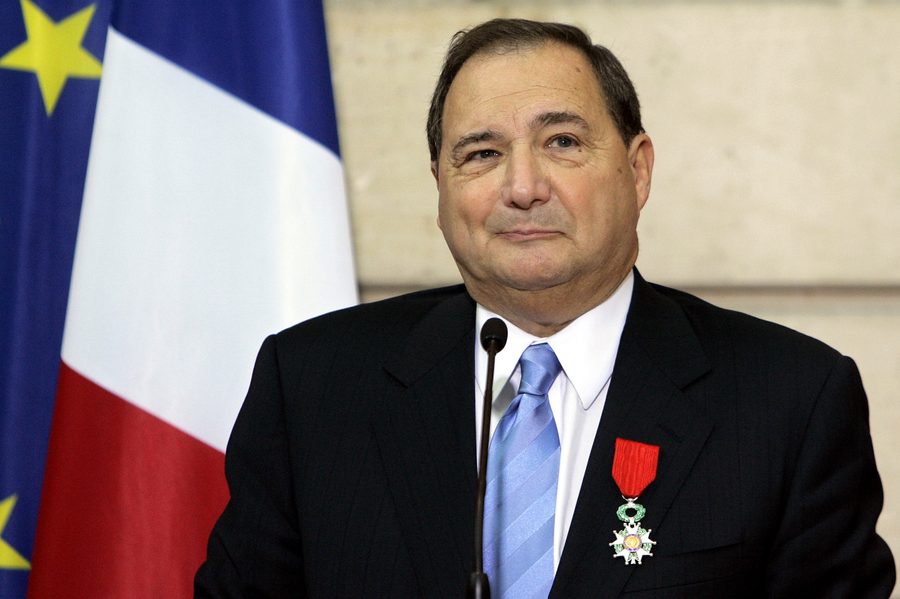
Abe Foxman receiving the Knight of the Legion of Honor medal in France in 2006.
This article first appeared in the Jewish Currents news desk newsletter. Subscribe here.
In May 2025, former Anti-Defamation League director Abe Foxman appeared on a podcast with Yehuda Kurtzer of the Shalom Hartman Institute think tank, sounding every bit like a man who had been left behind by his times. In his scratchy New York accent, Foxman—who died this past Sunday at age 86—lamented how the world had “changed” in the decade since he left his 28-year post helming the major Jewish organization. He was referring in part to Donald Trump’s bold disregard for political norms—“He destroyed the truth. He destroyed the media”—but also to the state of US–Israel relations. At the time of the interview, Trump was giving Prime Minister Benjamin Netanyahu the cold shoulder on a Middle East trip, while US liberal leaders, including several in the Jewish community, were becoming increasingly willing to criticize Israel’s starvation of Palestinians in Gaza. “What we saw this week, all the efforts at lobbying, all the efforts at advocacy, all the relationships that we built—within 24 hours are down the drain,” said Foxman.
For Foxman, this rapidly changing status quo appeared to offer less an opportunity for new analysis than for nostalgia. On the Hartman podcast, he mourned the old days of bipartisan trips to Israel, when support for the Jewish state was depoliticized, and reiterated the old Jewish establishment maxim that American Jews don’t have the standing to criticize the Israeli government’s geopolitical decisions: It would be “chutzpah,” he said, to assume his own “view of what is in the best interest of the lives and safety of Israeli citizens” would be better than Netanyahu’s. (Perhaps even he realized how unequal this was to the scale of contemporary Israeli hubris: By August, his posts were acknowledging Israel’s “many unnecessary mistakes” in its assault on Gaza, including in “stopping food delivery.”)
In the year before his death, on his X account, he often expressed a sense of betrayal and incredulity at the present political reality, in which both poll-conscious Democrats and isolationist Republicans have lost their appetite for exorbitant Israeli military expenses. “It is outrageous that so many prominent democrats are distancing themselves from and demonizing AIPAC. AIPAC is part of an established and respected American tradition of lobbying,” he exclaimed in March 2026 with his trademark bombast. Even as Foxman took subtle (and not-so-subtle) digs at his ADL successor, Jonathan Greenblatt, for slow-walking criticisms of Trump and Elon Musk, his issue was never with the current CEO’s steadfast alignment of the ADL with Israel’s interests. He just didn’t understand why this alignment could no longer be combined with an equally robust defense of American liberal principles. “Jews have to learn to walk and chew gum at the same time,” he told Kurtzer on the podcast. Why, he asked, couldn’t present-day establishment Jewish leaders say “Thank you, Mr. President, for Jerusalem. No thank you for banning Arabs. Thank you for what you’re doing here [on antisemitism], but no thank you for immigration”?
But the days when the political environment countenanced such zig-zagging are over—in a sense, they were on their way out as soon as Foxman retired from the ADL in 2015. No one symbolized the heyday of American Jewish consensus politics, and their attendant twinning of liberalism and Zionism, more than the so-called “Jewish pope” himself. Foxman drew much of his public authority from his experience as a child survivor of the Holocaust; his parents kept him out of the Vilna ghetto by leaving him in the care of a Polish Catholic nanny. They survived and returned to reclaim him in a tense custody battle with the nanny, and immigrated to Brooklyn when Foxman was 10. There, he merged into an upwardly mobile New York Jewish milieu, earning an undergrad degree at City College and a law degree at NYU. As American Jewry writ large accumulated whiteness, wealth, and upper-middle-class manners, Foxman’s Brooklyn accent and Yiddish-and-Hebrew-inflected speech helped his organization make Jews legible as a distinct minority alongside its Black or Asian American coalition partners. Meanwhile, when it came to Israel, Foxman exuded the enthusiasm of post-1967 American Jewish Zionist culture, in which the young state became a sacred symbol of Jewish resurgence.
Indeed, for Foxman, the fate of Israel was the fate of the Jews, and any challenge to the former could be considered an existential attack on the latter. His position, which he articulated in his various public writings, including in his 2003 book, Never Again? The Threat of the New Anti-Semitism, was that anti-Zionism constituted antisemitism “always, everywhere, and for all time.” While he claimed that criticism of Israeli policies could be permissible, he had little patience for most such critiques, always finding a way to defend the state. Israel’s East Jerusalem Har Homa settlement, built on land partially expropriated from Palestinians and widely seen as undermining the Oslo accords, was “simply a neighborhood in Jerusalem where Israel decided to build housing,” he wrote in Never Again; the increasing extremism of 21st century Israeli leadership could be blamed entirely on “a divided Palestinian leadership . . . a passive if not destructive Arab world” he complained in the New York Review of Books. Critiques could not be traced to legitimate grievances but to irrational expressions of Jew hatred, and their messengers often found the full weight of the ADL’s power arrayed against them. Jim Zogby, for example, founder of the Arab American Institute, recounted to Jewish Currents in 2021 that Foxman’s ADL frequently sent memos smearing him as an antisemite to outlets and organizations set to host him. The ADL’s attempts to box pro-Palestine voices out of US politics predated Foxman’s leadership by decades, but he intensified them with his doggedness and clout. The enormity of the ADL’s anti-left operation became particularly clear in 1993, when a police and FBI raid revealed that a contracted ADL investigator had been keeping files on groups including the Arab Anti-Discrimination Committee, ACT UP, the United Farmworkers, and the ACLU.
Throughout his tenure, Foxman’s hardline stance continually translated into ADL efforts to make US law hostile to pro-Palestinian politics—and, by extension, for Muslim and Arab communities in general. Many of the recommendations from a 1994 ADL “Counterterrorism Action Agenda” found their way into the 1995 Antiterrorism and Effective Death Penalty Act, which allowed the US government to designate certain foreign groups as terrorist organizations—and allowed criminal prosecution of any Americans alleged to “materially support” such groups, even through nonviolent charitable activities. (The legislation served as a template for later invasive laws like the Patriot Act.) In its most public embrace of post-9/11 Islamophobia, the ADL infamously announced in 2010 that, out of special sensitivity to victims of 9/11, it would oppose plans to build a mosque and community center near Ground Zero.
Even as it pursued these policies with one hand, Foxman’s ADL publicly disavowed Islamophobia with the other. The group took out a full page ad in The New York Times after the September 11th attacks with the message “Let’s not fight hatred with hatred.” Unlike Greenblatt, who has made little secret of his increasing disinterest in the civil rights dimension of the ADL’s mission, Foxman, at least rhetorically, never wavered from his insistence that the ADL intended to both “stop the defamation of the Jewish people” and “secure justice and fair treatment for all.” Thanks to his stubbornness and independence, Foxman was difficult for even the ADL’s richest donors to sway. He was a consistent critic of far-right governments around the world, and his commitment to free speech extended far enough that he declined to support a new wave of state legislation penalizing support for the Boycott, Divestment, and Sanctions movement—a position that the ADL would reverse after his departure.
Once Americans stopped seeing liberalism and Zionism as natural bedfellows, Greenblatt made his choice: The current ADL is riding with Zionism all the way, and scrubbing the references to its civil liberties legal strategy and anti-bias education work from its website. Foxman could never join his successor—a man whose buzzword is not kishkes but social entrepreneurship—in neatly setting liberalism aside. But he also never reckoned with his own role in setting the stage for the ADL’s mask-off moment. He built an organization—and a broader Jewish political culture—so committed to the defense of the Jewish state that it’s no surprise that all its other priorities would eventually become subordinate. Foxman watched the center-left sour on the organization that was his lifelong political home from his diminished figurehead position. In recent months, he could be found tweeting into the wind, with complaints about the “arrogance” of the “socialist/Muslim ideologue” mayor. But that mayor’s moment has just begun. Foxman’s era of centrist consensus is over.

I’m Arielle Angel, editor-at-large of Jewish Currents. Before you go, there’s something I need to ask.
We’ve seen over and over how the mainstream media falters in telling stories on our beats—whether it’s antisemitism, Israel/Palestine in American politics, Jewish identity, or the American left. At Jewish Currents we’re committed to uncompromising analysis and longform reporting on these issues and more—stories you won’t find anywhere else. In a media landscape that obscures injustice and flattens discussion, we’re changing the conversation. But we need you.
If you believe in this work, please consider making a donation—or even better, a recurring one—to ensure that we are able to keep publishing stories like this one. We can’t do it without you.

Mari Cohen is a senior politics editor at Jewish Currents.