A pro-Israel supporter cries during the “United for Israel”
march outside Columbia University in Manhattan, April 25th, 2024.
Does the Jewish Body Keep the Score?
Parts of the Jewish left believe trauma explains attachment to Zionism. But what they call “trauma” is more likely a collective story than a biological fact.

In her 2019 book Wounds into Wisdom: Healing Intergenerational Jewish Trauma, Rabbi Tirzah Firestone recalls a moment during the 2006 war between Israel and Lebanon when a prayer vigil at a synagogue in an unnamed American town took a dramatic turn. A “young government official” who spoke at the vigil expressed support for Israel throughout his speech, but closed with the hope that both sides would exercise restraint in the conflict. In response, the crowd “began hissing and booing loudly,” Firestone writes. “A few individuals rose to their feet, indignantly striking their fists in the air. Curiously, there were no words used, only primal sounds and gestures.”
Why would a group of “dignified Jews” at a somber gathering act in such an undignified way? For that matter, why did many of Firestone’s own congregants at a Jewish Renewal synagogue in Boulder, Colorado, exhibit similar qualities of “reactivity, agitation, and often a sense of profound urgency and unsafety in the world”? In Wounds into Wisdom, Firestone explains that she came to see these pervasive traits as expressions of “Jewish cultural trauma,” a state of stress transmitted from generation to generation of Jews as a “biological memory” of painful events in Jewish history. Her on-edge congregants typically did not know they were suffering in this way, which was part of the problem: The ghostly memories passed down from their ancestors, inaccessible and unprocessed, had become physical in nature, a “muscle memory of shock, bracing, and helplessness” that, when triggered, could explode. At the prayer vigil, Firestone argues, the official’s call for restraint served as such a trigger, activating a collective response located in a primitive part of the human body: “the limbic response of an entire group, that segment of the human nervous system that is responsible for survival at all costs.” When this happens, she writes, “we shoot from the hip, fire off missiles that offend, or missiles that destroy, and the cycle of damage continues.”
Firestone’s book, republished in 2022 with a foreword from the popular self-help author Gabor Maté, is part of a growing shelf of progressive titles that see trauma as the skeleton key to understanding the mainstream American Jewish community’s ongoing support for a genocidal Jewish state. In Taking the State Out of the Body: A Guide to Embodied Resistance to Zionism (2024), Eliana Rubin, who leads an organizer training center called Sanctuary Embodied, argues that “echoes of trauma in [Jews’] bodies are drawn out as we are told that the only way we can be safe from antisemitism or even genocide is to align with the state of Israel.” An Anti-Zionist Path to Embodied Jewish Healing, published last year by Wendy Elisheva Somerson, a somatic healer and longtime organizer with Jewish Voice for Peace (JVP), claims that ancestral trauma “lives on in our muscles, connective tissue, and bones,” leading to irrational political behavior. Similar ideas have made their way through progressive Jewish spiritual and political spaces since the revitalization of the Jewish left in the 2010s. As the anti-Israeli-apartheid group IfNotNow writes in its “core story,” which narrates the group’s approach to Jewish safety, “Of course we are afraid. We carry thousands of years of historical trauma in our bones.”
We are living in an age of what literary critic Parul Sehgal has called “trauma’s creep”: The concept of trauma has become omnipresent and often totalizing, offering a unified account of phenomena from the cellular to the cosmic. Trauma has crept into the discourse of the Jewish left as an attempt to diagnose and challenge ubiquitous Zionist rhetoric that marshals Jewish historical memory to affirm the need for an ethnonationalist state. In the progressive account, Jews were under constant existential threat, and remain unable to process what Firestone identifies as “the new reality . . . that Jews are now living in an age of unprecedented freedom and agency”; as a result, they are now easily deceived into thinking they need a Jewish state to stay safe. Firestone, Rubin, and Somerson share an interest in somatics, a therapeutic approach that helps attune the patient to their nervous system in moments of distress and is often deployed as a treatment for trauma; both Rubin and Somerson are trained somatic healers who studied at a now-defunct institute called Generative Somatics, which sought to bring somatic techniques into organizing spaces. For these writers, just as hurt people hurt people, the traumatized Jewish people inflict harm on other peoples; to stop the “cycle of damage,” they will need to be healed.
For these writers, just as hurt people hurt people, the traumatized Jewish people inflict harm on other peoples; to stop the “cycle of damage,” they will need to be healed.
In his 1928 essay “Ghetto and Emancipation,” the historian Salo Baron, often considered the originator of modern Jewish historiography, identified a popular mythology that he later called the “lachrymose conception of Jewish history,” which understood antisemitism as a historical constant and suffering as the primary mode of Jewish being. In reality, Baron argued, contemporary antisemitism emerged only in the 19th century, as Europe’s nascent nation-states granted emancipation to the Jewish communities of the region; during the wave of reaction that followed, antisemites began to portray Jews as fundamentally unassimilable. According to Baron, the lachrymose conception of Jewish history took hold in response to these charges, as liberal Jewish community leaders sought to portray “Jewish ‘peculiarities’”—including real hesitations about the fraught bargain of assimilation—as a symptom of historical oppression that would naturally wane over time. In this framework, Jews who chose to resist or ignore the new order were not expressing their political agency, but their maladaptive psychology as a result of their sustained experience of suffering.
Strikingly, the 19th-century lachrymose conception of Jewish history prefigured a lachrymose conception of Jewish biology. “The Jews, who for centuries had been maltreated or at least harassed, have had their nervous system shattered,” the anthropologist Maurice Fishberg, an American Jewish immigrant from what is now Ukraine, wrote in his 1911 work The Jews: A Study of Race and Environment, which relied heavily on the techniques of phrenology to ground its claims about Jewish character. Having inherited malformed temperaments “from their maltreated grandparents,” Fishberg argued, Jews have a tendency to “‘cry before they are hit,’ not only individually, but also as a class.” Like the Jewish leaders who used a mythologized account of Jewish history to deflect antisemitic charges, Fishberg and his allies were liberals attempting to counter ideas of innate Jewish biological difference with claims about the powerful but remediable effects of trauma across generations. But his project ultimately mimicked the notions it meant to unseat, reinforcing the logic of race science with its own questionable attempt to tell a story about group difference through biological inheritance. (Later, as Nazi racial science came to the fore, Fishberg disavowed his own methods.)
When we look back at present-day claims that embodied trauma determines what Somerson calls Jews’ “collective shape” and circumscribes their capacity for thought and action, it will likely be clear that these claims, too, constitute myth-making rather than history, race science rather than serious political analysis. The discourse of Jewish cultural trauma makes sweeping and often misleading generalizations both about the experiences of Jews in the past and about our relationship to those experiences today. “Jews still carry the collective memory of their genocide at a visceral level,” Firestone writes, leading to a collective state of “hyperarousal” in the nervous system that “can show up in any group that carries a history of near annihilation.” Yet most American Jews—who are typically at the center of progressive Jewish trauma discourse—do not come from survivor families; the US took in only around 135,000 Jewish refugees after World War II, and their descendants make up only a small minority of American Jews today. The 21st-century American Jewish community includes converts, Soviet refugees, Persian Jews, mixed-race Jews, Mizrahim, Sephardim (including the historic communities that predate the founding of the United States), Ashkenazim who’ve been in the US going on five generations, and many, many more. Do we really all share a common experience of intergenerational trauma that lives in our muscles and bones?
The homogenization of vastly different histories into a grand narrative of Jewish trauma points to a desire to tell a palatable story about how Zionism became hegemonic in American Jewish life. Like the original deployment of the lachrymose conception of Jewish history, it relieves Jews of political agency while making historic trauma the focal point of Jewish identity. This time, what gets lost in the mythologized Jewish past is an understanding of the political, economic, and social forces that shaped what scholar Shaul Magid calls the “Zionization of American Jewish life,” like the centralization of financial and communal resources by Jewish communal leadership toward support for the State of Israel. Zionism was not simply adopted by a terrified rank-and-file American Jewry, nor is it a trauma response today; it was, and is, a political project, with specific and evolving strategies aimed at particular, and—it should be emphasized—violent aims.
“History is what hurts,” wrote the Marxist critic Fredric Jameson. It is undeniable that Jewish history hurts, that it leaves lasting wounds on its victims that reverberate through the generations, turning the family into a site of remembrance for a tragic history that is deeply felt, yet can never be truly known. But history is ultimately a narrative form, and its utility lies in how that narrative is constructed. In other words, what we are calling trauma is more likely a collective story with a discrete political function. To place our faith for defeating Zionism in the demand to heal is to treat politics as a pathology, and obscure politics as the method we must use to fight.
Zionism was not simply adopted by a terrified rank-and-file American Jewry, nor is it a trauma response today; it was, and is, a political project—with particularly violent aims.
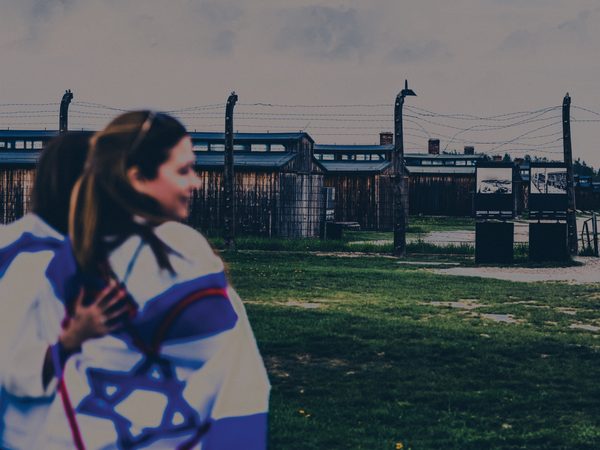
Participants in the March of the Living wrapped in Israeli flags at Auschwitz-Birkenau Memorial and Museum, April 25th, 2025.
For the past century, trauma has often been positioned at the hazy juncture between historical atrocity and personal experience. Modern conceptions of trauma originate in Sigmund Freud’s 1920 work Beyond the Pleasure Principle, which used the term to describe the psychic phenomenon of undergoing an event too overwhelming to take in. Freud observed that this “flooding” of mental excitement could lead to an unraveling of a person’s sense of self. The treatment of traumatized patients was thus a process of helping them make meaning out of what they had experienced, and eventually integrating that meaning into a newly understood selfhood.
Freud wrote Beyond the Pleasure Principle in the wake of World War I as psychologists attempted to understand the “shell shock” or “war neuroses” widely observed among combatants. Variations on his notion of trauma passed into broad circulation 50 years later thanks largely to a different group of soldiers: Americans who fought in the Vietnam War and returned home with symptoms like hypervigilance, flashbacks, and outbursts of rage. An advocacy campaign by mental health workers on their behalf led the American Psychiatric Association to include post-traumatic stress disorder, or PTSD, in the 1980 edition of its Diagnostic and Statistical Manual of Mental Disorders, granting authority to the diagnosis as a serious condition that demanded recognition and care. As trauma acquired medical, legal, and social legitimacy, it also became politicized. Who counted as traumatized? If trauma was the natural outcome of unassimilable experiences of violence, then what about whole communities punished by structural violence; were signs of PTSD ubiquitous in these communities, as some Black and Indigenous scholars argued? Could trauma be transmitted through families or communities or even just through the power of testimony—and if so, could anyone and everyone understand themselves as traumatized by the force of the past?
On the left, the idea of collective historical trauma offered a potent framework for addressing the psychic dimensions of oppression and the possibility of transformation. Many organizers who came of age in the post-New Left milieu of the 1970s and ’80s were trained in the techniques of Re-evaluation Counseling (RC), or co-counseling, a peer counseling network rooted in the idea—borrowed from Dianetics, the forerunner of Scientology—that repressed childhood traumas form “distress patterns” that are stored in the body and can be expunged, or “discharged,” when surfaced in the presence of a partner. In an RC framework, racism, sexism, and other forms of social injustice function like large-scale distress patterns, traumas that take root inside their victims and lead them to turn against themselves and oppress others in turn. As the RC website puts it today, “The person who functions as an oppressor does so always and only because he or she has first been oppressed.”
Re-evaluation Counseling had a large Jewish following, and Jewish co-counselors developed their own theory of “internalized antisemitism,” arguing—as Cherie Brown, an RC leader and the group’s longstanding “International Liberation Reference Person for Jews,” wrote in a 1995 article in the progressive Jewish magazine Tikkun—that “the hostility and brutality leveled at Jews, when left unhealed, can be internalized and then Jews may become hostile, hypercritical, or even brutal to one another.” This framework, and Re-evaluation Counseling more broadly, became deeply influential (and sometimes hotly controversial) within progressive Jewish organizing circles over the course of several decades, leaving its mark on organizations from the multi-issue progressive group New Jewish Agenda in the ’80s, to the New York-based Jews for Racial and Economic Justice, to IfNotNow, which in its early years consulted with Brown as an adviser and used the concept of internalized antisemitism to explain Jews’ commitment to Israel.
Meanwhile, over the past decade, an energetic discourse around mental health and self-care became permeated by the idea of trauma as a biological phenomenon, thanks in large part to psychiatrist Bessel van der Kolk’s enormously popular 2014 self-help book The Body Keeps the Score. In van der Kolk’s account, human brains are divided between rational cognitive processes and an older “reptilian brain” focused on safety and the regulation of the nervous system. Van der Kolk claimed that the experience of trauma leaves a lasting imprint on this older part of the brain in the form of a “traumatic memory”—a vivid representation of the traumatic event’s sights and sounds—that remains lodged in the nervous system, resurfacing in moments that recall these sensations and triggering “automatic” responses like emotional outbursts, episodes of irrationality, and reenactments of the traumatic event. Plagued by the traumatic memory, the body still believes itself to be in danger of the traumatic event, and thus remains stuck in the past. One pitfall of this now-ubiquitous paradigm is that, as anthropologist Danielle Carr suggested in a 2023 interview with Jacobin, it has encouraged a misapprehension that trauma is “literally a state of the body”—a disease like diabetes or breast cancer—and, further, that it is possible to “straightforwardly deduce political behavior” from such a state.
Recent Jewish trauma discourse like the work of Firestone, Rubin, and Somerson draws on both RC-style accounts of collective trauma and van der Kolk-style accounts of embodied trauma, concluding that internalized antisemitism is literally “embedded at a cellular level,” as Rubin puts it, in Jewish bodies. “When someone in our current or historic collective body experiences a trauma, we shape our bodies around that trauma,” Rubin writes. Posture, gestures, and movements can all be read as expressions of trauma moving through the body; for example, “someone who walks with their head hanging down, not taking up space, or apologizing with their bodies [sic] could be coping with trauma-induced shame in the form of appeasing.” Like the early 20th-century Jews of Maurice Fishberg’s imagination who “cry before they are hit,” the 21st-century Jews conjured by Rubin are easily triggered—particularly by conflict over Zionism, which sends them “into a state of reactivity—unable to listen, empathize, or find a way forward together toward justice.” Somerson similarly argues that because Jews hold “traumatic histories . . . in our bodies,” they are vulnerable to getting “stuck in a trauma response” that blurs the lines between past and present, and makes it difficult “to distinguish between a history of powerlessness and current access to power.”
In order to explain how Jewish trauma gets transmitted to Jews who have not experienced antisemitic violence themselves, these writers often turn to epigenetics, a scientific field that studies the effect of environmental factors on genetic expression—and has sometimes been used, controversially, to make claims about biological differences between social groups. Both Firestone and Rubin cite the work of neuroscientist Rachel Yehuda, whose studies have shown that the offspring of Holocaust survivors exhibit epigenetic alterations in genes relating to stress management. Yehuda herself clarified in a 2018 article in the journal Environmental Epigenetics that these findings are inconclusive and that epigenetic research is inherently limited in its ability to model the transmission of trauma in humans, as “cultural and social mediators, or even individual differences among trauma survivors and their offspring,” must also be taken into account. Yehuda further elaborated over email when reached for comment that epigenetics research “does not support the idea that complex political beliefs or behaviors can be reduced to biology.”
Yet Firestone and Rubin insist that epigenetics can account for the fact that, as Rubin puts it, “things we may not have personally experienced in our lifetime can still live in our bodies,” shaping “our perceptions, behaviors, relationships, and choices.” Rubin even goes so far as to argue that Jews constitute a “collective body”—a “whole and unified organism” or “soma” that can act in concert in the way that redwood trees “shape their bodies to support and heal together” when one tree experiences an injury. Crucially, it was this essentialist understanding of trauma and identity that IfNotNow moved away from around 2020. “As we invested more in a multiracial organizing strategy, it became increasingly clear that sweeping generalizations about Jewish trauma didn’t hold up, given the true diversity of Jewish history and experience,” the group’s executive director, Morriah Kaplan, told me in an email. The idea that Jews could isolate a “specific experience or familial history” as a source of trauma “wasn’t resonating.”
“As we invested more in a multiracial organizing strategy, it became clear that generalizations about Jewish trauma didn’t hold up, given the diversity of Jewish history and experience,” IfNotNow’s executive director told me.
The reality is that humans are not redwood trees, and—as the historian Saul Friedländer observed in a 2013 lecture about the enduring prominence of the Holocaust in Israeli national consciousness—trauma changes form when it moves from the individual to the collective. While individual trauma typically takes root in the family or a similarly “closed emotional field,” Friedländer noted, collective trauma comes about through the communal process of giving meaning to such an event, turning an “incomprehensible occurrence” into a coherent narrative. This resulting story serves a “social function,” providing an “empowering mandate for the community.” Jewish collective trauma, of course, has been transformed into a mandate for Zionism’s crimes, and progressive Jewish trauma discourse is at its most cogent when it acknowledges this as a social and political process. Firestone offers case studies of diverse personal histories of trauma, including those of elderly Holocaust survivors and their grandchildren, arguing, reasonably enough, that “Jewish culture itself [has] been changed by the sum of these individual trials.” What has changed, both Somerson and Rubin suggest, has to do with the cultivation of fear, which has been key to the project of engendering support for the State of Israel. As Somerson puts it, Jews are often “encouraged to feel as though we directly experienced what happened to our ancestors.” Rubin writes that “capitalism, militarism, and patriotism” derive their appeal from false promises of safety and security.
Unfortunately, though, these authors stop short of analyzing how trauma has become collectivized in contemporary Jewish politics, and therefore fail to delve beneath the surface of their diagnosis. If they had been more willing to consider this question, they might have brought some crucial machinations of the Zionist institutional landscape into view. They might have explored the push by American Jewish leaders in the 1970s to unify a broadly disaffiliated Jewish community by placing Holocaust memory at the center of Jewish life, or the way that, in the 1990s, Holocaust education became the paradigm for what the historian Alison Landsberg called “prosthetic memory”: a pedagogical strategy through which individuals in the present are encouraged not just to study history from a distance, but to take on “a more personal, deeply felt memory of a past event through which he or she did not live.” (Think, for instance, of Holocaust museums that distribute ID cards of victims to visitors before they make their way through exhibits.) They might have been able to speak to what scholar Ben Ratskoff recently described in the Journal of Genocide Research as the “compulsive and paranoid victimology” of hasbara strategies like the Nova Exhibition, an immersive simulation of the October 7th massacre at Israel’s Nova Music Festival that has traveled the world like a carnival of Jewish suffering. Without an understanding of such strategies, we are left to infer that trauma has an infectious quality, spreading seamlessly from the traumatized to the people who surround them.
Ultimately, these writers mistake an effect for a cause, contending that heightened emotional reactions are evidence of an embodied historical trauma that allows for the efficacy of the appeal to fear; they affirm even the most unmoored paranoia as a form of truth, rather than acknowledging that these feelings might be prosthetic or constructed—or simply not felt at all. Within this circular logic, there is no limit to trauma’s explanatory power—a trap van der Kolk himself fell into last year when he made a comment at a healing retreat in upstate New York comparing Israelis to Nazis, prompting some participants to walk out. “At what was meant to be a trauma workshop, the person leading it inflicted fresh trauma on me and on several other Jewish attendees,” one attendee told The Times of Israel. If the body keeps the score, who can argue with the body?
What prevents progressive Jewish trauma discourse from fully collapsing into conservative notions of peoplehood and a lachrymose approach to Jewish biology is the fact that its promoters want Jews to change. Firestone, Rubin, and Somerson alike see the process of healing from trauma as a transformative one that can engender a newfound sense of safety in both body and mind. All three are experienced at working with individuals and groups who seek transformation—Firestone as a rabbi and psychotherapist, and Rubin and Somerson as healers and organizers—and their books are filled with healing exercises and stories of successful treatments. Firestone proposes Eye Movement Desensitization and Reprocessing (EMDR) therapy, a widely practiced treatment for PTSD, alongside Jewish rituals like sitting shiva—a practice, she writes, that allows for grief while “putting boundaries around our need to remember and mourn.” Rubin offers “embodied practices” at the end of each chapter: One exercise, meant to increase awareness of stress responses, asks partners to agitate each other with short phrases like “You are a self-hating Jew,” while another advises setting a bowl of rose petals in water next to your bed to facilitate connection with ancestors through dreams. (To go deeper, they recommend working with a skilled practitioner.) Somerson presents case studies of their work as a healer with people like Leo, a Mizrahi man who is finally able to release his shame over not being “Jewish enough” after Somerson encourages him to fight for his ancestors by striking Muay Thai boxing pads.
The people with whom these authors are most concerned—militant, reactionary Zionists—are unlikely to be compelled by the idea that their politics constitute a trauma response; they do not believe they are sick and have not asked to be healed.
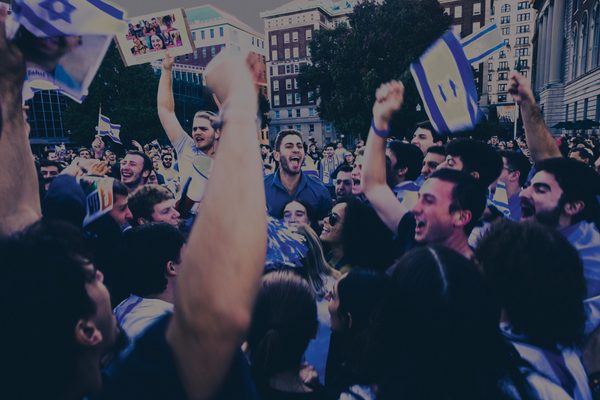
Pro-Israel demonstrators dance and sing during a protest at Columbia University in Manhattan, October 12th, 2023.
All of these accounts describe this work not just as therapeutic, but as political: As both Somerson and Rubin write, healing from Jewish trauma helps us to “align with our values.” The trouble, though, is that “our values” are not a default set of righteous beliefs overshadowed by accumulated trauma—to the contrary, we can’t even agree on what “our values” are. By the same token, the people with whom these authors are most concerned—militant, reactionary Zionists—are unlikely to be compelled by the idea that their politics constitute a trauma response; they do not believe they are sick and have not asked to be healed. Progressive Jewish trauma discourse assumes that Zionism primarily serves its adherents as a salve for negative feelings like fear, neglecting the other emotional benefits it confers: a comforting belief in the righteousness of a Jewish state, a stable and concrete national identity, a sense of pride. The prospect of healing from intergenerational trauma addresses none of these feelings. In fact, it threatens to take them away.
Perhaps most tellingly, despite the authors’ emphasis on collective trauma, nearly all the practices and examples described in these books involve individual healing, and the group practices that do occasionally come up have little to do with intergenerational transmission. Rubin, for instance, describes an exercise they performed to help activists self-regulate and recover from an experience of police violence—a useful intervention, perhaps, but one not particularly relevant to the book’s central task. What these books seem unable to provide, ironically, are concrete examples or even visions of their own central conceit: that Jewish healing from intergenerational trauma is possible at a communal level, and that this healing, in turn, will be liberatory.
If the intended audience for these books is fantastical, it is also revealing. Implicit in the authors’ demand for collective healing is an understandable aspiration to rescue friends, family, congregants, and even the Jewish people as a whole from their own destructiveness, and to forgive them for the harm they have caused. This desire comes through most vividly in Firestone’s deeply personal account of her relationship with her father, a “heavy handed” patriarch and Orthodox Jew whose “bluster, rage, and incontrovertible opinions” served as a powder keg in a fractious family riven by tragedy (two of Firestone’s siblings ultimately died under tragic circumstances related to mental illness, including her sister, the feminist theorist Shulamith Firestone). When her father died in 1981, Firestone discovered a disturbing set of photographs he took as an American soldier after the liberation of Bergen-Belsen, and came to understand “the high voltage he carried inside of himself all those years,” she writes. “He had to supply meaning to the sheer barbarity that had shifted his axis. One way he did this was to understand that Jews were special and distinct from all other people.” Understanding her father as ruled by his trauma allowed Firestone to forgive him.
This desire for exoneration and reconciliation takes on a disturbing valence when Firestone—who, unlike Rubin and Somerson, does not position herself as an anti-Zionist—frames the experiences of Israeli soldiers who have committed war crimes as iterations of “Jewish trauma.” It is trauma, she argues, that “often complicates Israel’s military policies in the West Bank,” leading to disproportionate responses among soldiers facing down children with rocks. By this logic, Israeli violence toward Palestinians is not the outcome of brutal state policies, but an organic expression of collective Jewish suffering that disrupts an otherwise “healthy” instinct for self-defense. Politics, here, is fully subsumed by the psychological. Healing opens a path to redemption for the perpetrators, while relegating the victims’ claims back to the margins.
Within this dream to heal Jews is the wish to return to a pristine and unified Jewish body, back before Zionism made us into genocidaires. But there is no unsullied Judaism to which we can return, and no authentic Jewish peoplehood that would manifest itself if healed. Zionism is not simply “an accidental perversion or derailment of Judaism, which could be overcome by reclaiming a more authentic interpretation of the tradition,” as the sociologist Atalia Omer writes, critiquing a trend in activist thinking in her 2019 book Days of Awe: Reimagining Jewishness in Solidarity with Palestinians. From a different perspective, however, there is a profound power in accepting Jewishness not as a transhistorical fact anchored by a shared history of suffering, but as an unfolding process of discovery and rediscovery. We are living in a moment when the meaning of Jewishness is being contested in fundamental ways; this is where the possibility of real change becomes more than a fantasy. It’s time to turn away from the idea that trauma can explain the horrors committed by and in the name of Jews, and toward the possibilities on offer when we accept that the Jew is not born but made.

I’m Arielle Angel, editor-at-large of Jewish Currents. Before you go, there’s something I need to ask.
We’ve seen over and over how the mainstream media falters in telling stories on our beats—whether it’s antisemitism, Israel/Palestine in American politics, Jewish identity, or the American left. At Jewish Currents we’re committed to uncompromising analysis and longform reporting on these issues and more—stories you won’t find anywhere else. In a media landscape that obscures injustice and flattens discussion, we’re changing the conversation. But we need you.
If you believe in this work, please consider making a donation—or even better, a recurring one—to ensure that we are able to keep publishing stories like this one. We can’t do it without you.
Jon Danforth-Appell is a filmmaker, writer, and organizer living in Los Angeles. He is a former board member of the Silverlake Independent Jewish Community Center and a founding member of Hollywood Labor, a labor project of the Democratic Socialists of America – Los Angeles.