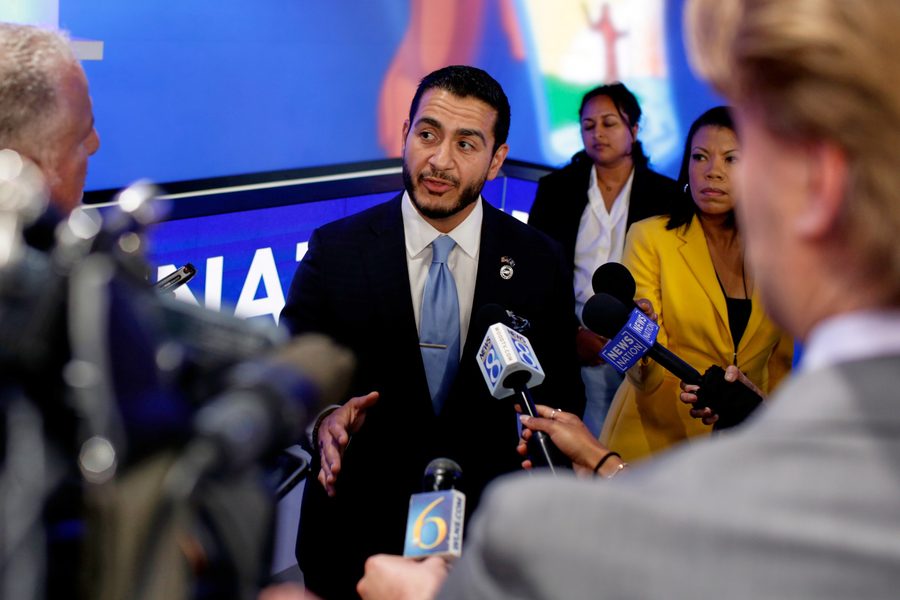
US Senate candidate Abdul El-Sayed faces Rep. Haley Stevens in next month’s Democratic primary in Michigan.
This article first appeared in the Jewish Currents news desk newsletter. Subscribe here.
The Democratic Party’s insurgent left is looking to extend its recent winning streak to Michigan, where the Bernie Sanders-backed public health official Abdul El-Sayed is facing off against one of AIPAC’s top allies in Congress, Rep. Haley Stevens, in a Democratic primary for an open Senate seat.
It may be a bumpy ride.
Progressives hope that the platform of Medicare for All and opposition to Israeli impunity that worked this summer in safe Democratic House districts in New York City, New Jersey, and Colorado can win in a purple state. The primary, which will take place early next month, will shape the general election contest this fall that may determine control of the Senate. But Michigan, a swing state where resentments still simmer over the Democrats’ split in the 2024 primary over the Gaza genocide, poses a serious challenge to progressives’ efforts to remake the Democratic party.
El-Sayed’s coalition of young voters will face off against Stevens’s base of older voters and Black voters, who are generally friendlier to establishment-backed candidates. As the Stevens campaign leans heavily into the argument that she’ll fare the best against a Republican opponent in the general election this fall, AIPAC’s super PAC is courting Black voters with ads featuring clips of former President Obama praising Stevens’s work on the 2009 auto bailout. Meanwhile, some local Black Democrats have attacked El-Sayed over his support for the Uncommitted movement, which clashed first with Joe Biden and then with Kamala Harris during the 2024 presidential campaign over the Biden administration’s response to the genocide in Gaza.
Progressives, however, remain bullish. They say Michigan, which has above-average union density, could be the rare purple state where a left-wing populist has a shot at a Senate seat. “People see a swing state and they think, ‘We must all rush to the mushy middle.’ But that’s wrong,” said Andy Levin, the former congressman and union organizer whom Stevens defeated in 2022 with the help of $8 million in AIPAC spending. “Michigan often swings between the populist left and right. Strong, clear messages work here. It’s the place where George Wallace, Jesse Jackson and Bernie Sanders won Democratic primaries, and then Trump beat Hillary in the general.”
In the Democratic primaries set for early August, El-Sayed has cross-endorsed two progressive House candidates, State Senator Donavan McKinney and William Lawrence, an organizer running in a swing district now held by a Republican. McKinney, who is running against Detroit-area Rep. Shri Thanedar in one of the poorest Congressional districts in the country, says this political moment is particularly ripe for insurgent Democrats. “People are fed up and tired of the status quo Democrat, and they want real results. They want people that are going to deliver resources to them,” he said.
El-Sayed is leaning into the exact message that powered his mentor Bernie Sanders’s shock 2016 primary victory in Michigan over Clinton. He also has the backing of the United Auto Workers, the biggest union in the state, which has shifted left since its new president, Shawn Fain, took the helm.
But to that traditional left-wing populist profile, El-Sayed has mixed in what has emerged as a winning platform this primary cycle: opposing all US weapons sales to Israel while calling out AIPAC as the poster child for how money corrupts in politics.
Stevens, who has consistently voted for US aid to Israel, has so far benefited from $14 million in spending by AIPAC’s super PAC, with another $7 million on the way, making her the candidate with the most AIPAC support so far this cycle. “They’ve made themselves an issue in this race, and we understand what that is about: continuing to secure a vote in the US Senate to put the needs of the Israeli government first,” El-Sayed told Jewish Currents. Responding to criticism of AIPAC spending in a July 8th debate with El-Sayed, Stevens said: “No one owns my vote and no one owns my policies.” The Stevens campaign did not make her available for an interview.
El-Sayed’s opposition to AIPAC and Israel’s genocide is powering his support among Arab Americans, who account for around four percent of the state’s population, the highest concentration in the country.
“He’s a candidate that people have been dying for, and his boldness on policy issues related to Israel and Palestine is exactly what people love,” said Lexi Zeidan, a Michigan activist who was a leader in 2024’s Listen to Michigan campaign, the precursor to the national Uncommitted movement.
It’s a message that has also brought him a surge of youth support, the exact demographic that powered Zohran Mamdani’s 2025 victory in New York City’s mayoral race as well as the success of his congressional allies in the New York primaries in June and t of Melat Kiros in the Democratic primary this month in Denver.
“He has to hope that there’s a larger-than-usual turnout of younger voters, because that’s the constituency with which he is doing really well,” said Michigan pollster Steve Mitchell, whose recent surveys have shown El-Sayed leading Stevens by overwhelming margins.
Pro-Palestine sentiment dominated Michigan’s Democratic convention in April. It has also shown up in unexpected places around the state, said Lawrence, the populist congressional candidate running in a swing district currently held by a Republican. Early in his campaign, Lawrence attended a local Democratic party meeting in rural Clinton County, where the party committee passed a resolution condemning Israel’s starvation of Gaza.
“That was like a real wake-up moment for me,” he said in an interview. “It was almost an entirely white group, almost entirely over the age of 60, and that’s where their hearts were.”
The pro-Palestine message, however, has complicated El-Sayed’s outreach to Black communities in Michigan. “The narrative lingers that Arabs and Muslims in Metro Detroit were largely responsible for Harris’s loss,” said Bilal Baydoun, a Michigan-based progressive strategist. “There’s been trust broken between those communities.”
Black and Arab progressives have since worked to rebuild ties, and El-Sayed has reminded voters that he was the first Muslim-American leader in Michigan to endorse Harris following Biden’s withdrawal from the race. He is hoping that endorsements from some Black pastors and elected officials in the Detroit area—where El-Sayed is known because of his time directing Wayne County’s Department of Health, Human, and Veterans Services—will help him cut into Stevens’s expected advantage.
In the downballot races, El-Sayed’s ally Lawrence is also facing opposition from Black political leaders. The Congressional Black Caucus PAC over the weekend denounced Lawrence for comments he made on his podcast two years ago that were critical of “the older generation of Black political leadership,” whom he called a “pillar” of the “imperialist” American establishment; he also claimed that their backing of Democratic leaders “defangs the white left.” Lawrence has since said he respects Black leaders’ historic fight for freedom and regrets the way he expressed himself on the podcast.
El-Sayed says that if he pulls off a victory—and goes on to win in November against Republican Mike Rogers—it will have huge implications for the future of the progressive movement.
“Everybody and their mom who’s thinking about running for president is going to be watching this race, and they’re going to be watching to see whether or not we can pull off a politics of integrity against the massive outside spending that’s coming in to beat us,” he said. “And if we can, well, then we prove out that it’s doable.”

I’m Arielle Angel, editor-at-large of Jewish Currents. Before you go, there’s something I need to ask.
We’ve seen over and over how the mainstream media falters in telling stories on our beats—whether it’s antisemitism, Israel/Palestine in American politics, Jewish identity, or the American left. At Jewish Currents we’re committed to uncompromising analysis and longform reporting on these issues and more—stories you won’t find anywhere else. In a media landscape that obscures injustice and flattens discussion, we’re changing the conversation. But we need you.
If you believe in this work, please consider making a donation—or even better, a recurring one—to ensure that we are able to keep publishing stories like this one. We can’t do it without you.