An Earthquake Just Hit New York Politics
Our political reporter explains the left’s near-sweep in the city’s Democratic primaries.
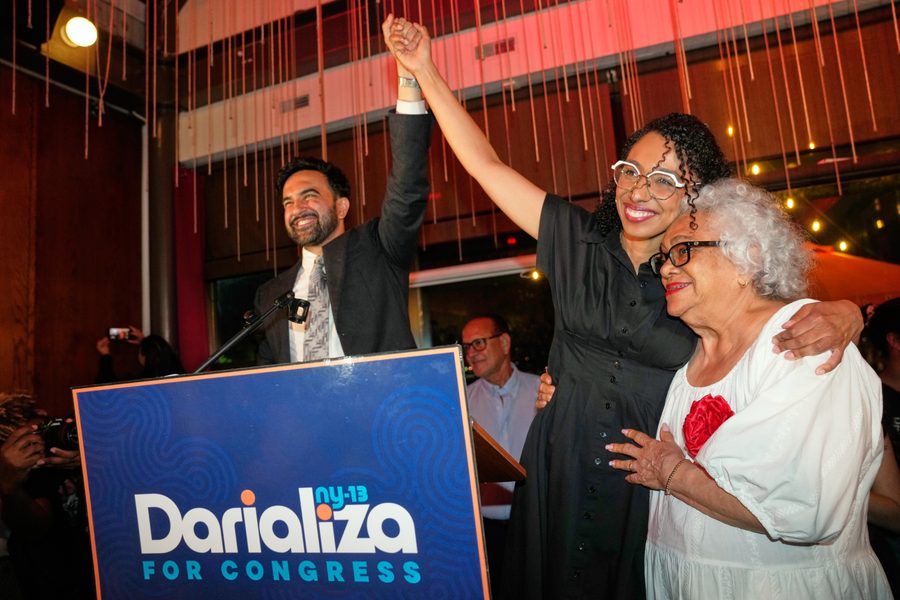
Zohran Mamdani and Darializa Avila Chevalier celebrate Chevalier’s victory on Tuesday night.
This article first appeared in the Jewish Currents news desk newsletter. Subscribe here.
Alex Kane spent Tuesday in uptown Manhattan reporting on the tight Democratic congressional primary between Rep. Adriano Espaillat, the incumbent, and Darializa Avila Chevalier, his leftist challenger. We spoke early Wednesday about the left’s stunning victory in uptown Manhattan, and across nearly all of the city’s contested Democratic primaries.
Josh Nathan-Kazis: Alex, it’s 7:30 on Wednesday morning. Today feels as momentous as the day after Mamdani’s mayoral victory last fall, if not more so. What just happened?
Alex Kane: The grand narrative is Mamdani and the New York City-DSA have built a machine strong enough to dislodge the political establishment in races across the city. Mamdani is the kingmaker. He successfully transferred his popularity to the candidates he endorsed, and the democratic establishment and the Jewish establishment are reeling. They don’t know what hit them, once again, for the second time in two years.
JNK: You were in uptown Manhattan reporting on the race between Espaillat and Darializa until 1 am last night, and I want to hear about what you saw. I was stunned by Espaillat’s loss. Tell me how the day unfolded for you, and what you were thinking as the polls closed.
AK: It’s always a potential hazard to just trust your gut and your anecdotal reporting, because anecdotes are just anecdotes. But there were signs throughout the day that Darializa was doing well.
The first place I went was in central Harlem, at a voting site at 127th Street and Adam Clayton Powell Jr. Boulevard. I went there because, as I reported the other week, the Black vote was the swing vote in this district. Ethnic politics are very polarized between Latino, Black, and white people in the 13th District. Espaillat’s base is in the Dominican community, and he has a reputation of not paying attention to Black voters. So central Harlem was an area of the city Darializa needed to win.
I hung around for about an hour, and I spoke to voters as they left the poll site, and all of them said they had voted for Darializa. This was a racially mixed group. One voter there, a young woman of color, independently brought up Gaza as an issue for her. I had expected to encounter some Espaillat voters, but all of the people I spoke with were for Darializa.
After that I went up to Washington Heights, east of Broadway, which is Espaillat country, to a poll site on 182nd Street and Audubon Avenue. Espaillat campaigners had a heavy presence, with tents and signs. There was nothing like that for Darializa, at least on the east side of Broadway. The first few people I talked to up there were Espaillat voters. I asked one older Latino woman what she thought of Darializa. She said she talks too much.
But then I talked to a couple of Latino voters who said they voted for Darializa. One of them told me he voted for her because she’s new. So there was anti-incumbent sentiment penetrating even Espaillat’s stronghold. In my head I was like, This is getting interesting.
JNK: Then you went to Darializa’s campaign election night party?
AK: Yeah, it was at a Puerto Rican restaurant, Sofrito, in Riverbank State Park in Harlem. I was talking with a DSA insider before the party, and I told him what I was seeing, and that it felt like Darializa was looking strong. He was like, “Oh, that’s interesting, because I heard the same thing from the campaign, that they were feeling pretty good.”
The doors at the party opened around 9 pm. People cheered Brad Lander’s victory when it was announced immediately after the polls closed, and then probably 25 minutes later, Claire Valdez was announced the winner in her race, and people got more excited and started chanting, “DSA, DSA.” The energy was really revving up and it was getting more and more crowded and everybody was talking to each other like, What is this? Is this really happening?
JNK: Who was there?
AK: The most prominent players in left-wing New York City politics started to show up. Palestinian American activist Linda Sarsour was there, and Jamaal Bowman, the former Congressman who was unseated by Rep. George Latimer two years ago in a race where AIPAC spent what was at the time a record-breaking $14.5 million.
Word started to spread around 10 pm that NBC had called it for Darializa. NY1, which was playing on the television screens, had not yet called it. So there was still some trepidation, but then news spread through the crowd that Espaillat had conceded, and there was this massive cheer. The mayor and Darializa arrived together around midnight to speak. At one point during Darializa’s speech someone shouted “free Palestine,” and people started chanting.
JNK: You asked Mamdani a question as he left.
AK: He had stopped to talk to the TV cameras, and I shouted, “What does this mean for AIPAC?” He said, “It’s a new day.”
All of the candidates Mamdani endorsed—the three Congressional candidates and five potential state legislators—won yesterday. The only DSA-endorsed candidate who lost was Conrad Blackburn, a state assembly candidate in Harlem, whom Mamdani did not endorse, likely to preserve his relationship with Democratic leadership in Albany. He did not endorse any challengers to Albany incumbents. That was the toughest race. He was taking on the Black political establishment in Harlem, and lost by eight points.
JNK: One question this morning is whether Mamdani was aggressive enough. He’s obviously the kingmaker. Could he have endorsed in more House primaries? Could he have gone after Rep. Ritchie Torres in the Bronx, or Rep. Hakeem Jefferies, the House Minority leader, in Brooklyn?
AK: Last night Gustavo Gordillo, one of the co-chairs of New York City DSA, tweeted, “Chi would have won,” a reference to Chi Ossé, a democratic socialist in Bed-Stuy who launched a campaign to challenge Jeffries and tried to convince NYC-DSA to back him in doing so. This was immediately after Mamdani won, and there was a very heated debate within NYC-DSA about what to do. They ended up not endorsing Ossé, and he dropped out. One of the reasons why they didn’t challenge Jeffries was because they were worried that they would be overextending themselves. Could they have beat Jeffries? I don’t know the answer to that question. He’s extremely influential and powerful and pretty popular in his district.
JNK: So what did we learn last night?
AK: It definitively shows that continuing to support Israel as the horrors of Gaza became apparent to everybody was a very bad bet in liberal districts in New York City. The other thing that it shows is that New York City-DSA has built a machine, and we haven’t seen the end of it. I think many Democratic political leaders, depending on their district, are looking at this moment and are really worried. It’s an earthquake.
JNK: You’ve been writing about the politics of Israel and Palestine in the US for a long time.
AK: Yeah, it’s a real moment in which we see the maturation of the pro-Palestine movement from very scrappy activists who did not have a big electoral presence to one that’s playing in the big leagues. This moment is at least 25 years in the making. The pro-Palestine movement was slowly building and having some success at the public opinion level well before October 7th and Israel’s response. But then the full nature of Israel’s genocide accelerated existing trends and really supercharged them. Combined with a left-wing political machine in DSA, it has changed the map of the New York City Democratic congressional delegation. It’s also showing up at the state level: The Not on Our Dime Act, a bill in the New York State legislature that would stop New York-based nonprofits from funding Israeli settlements, will get at least nine additional sponsors, and potentially more.
JNK: Thanks, Alex. Now get some rest.

I’m Arielle Angel, editor-at-large of Jewish Currents. Before you go, there’s something I need to ask.
We’ve seen over and over how the mainstream media falters in telling stories on our beats—whether it’s antisemitism, Israel/Palestine in American politics, Jewish identity, or the American left. At Jewish Currents we’re committed to uncompromising analysis and longform reporting on these issues and more—stories you won’t find anywhere else. In a media landscape that obscures injustice and flattens discussion, we’re changing the conversation. But we need you.
If you believe in this work, please consider making a donation—or even better, a recurring one—to ensure that we are able to keep publishing stories like this one. We can’t do it without you.
Josh Nathan-Kazis is the news director at Jewish Currents. Previously, he was a senior writer at Barron’s, where he covered healthcare companies, and a staff writer at The Forward, where he investigated Jewish communal institutions.