Trump Wants a “Depoliticized” Gaza
Middle East expert Robert Malley discusses the Board of Peace, its plan for Gaza, and what it means for Palestinians.
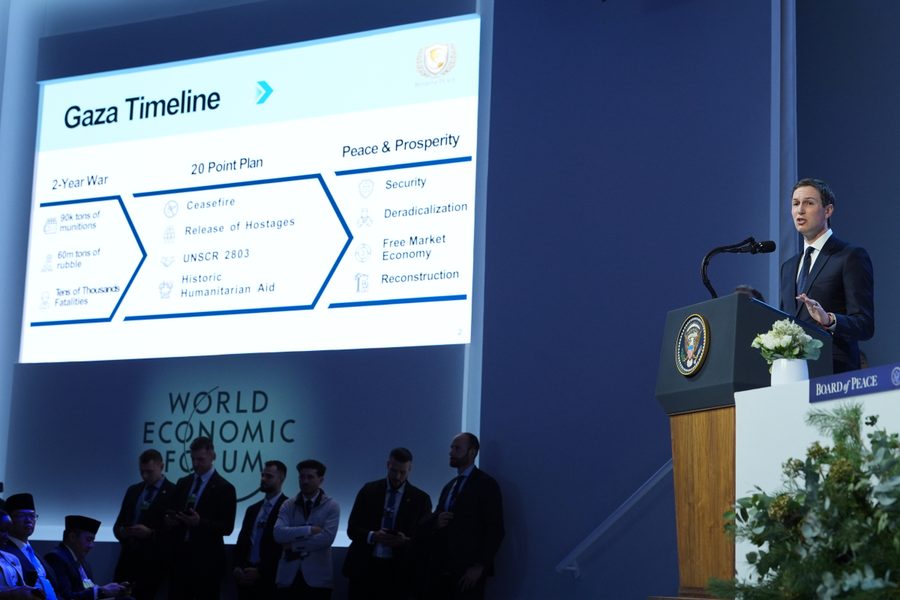
Jared Kushner speaks after the signing of a Board of Peace charter during the annual meeting of the World Economic Forum in Davos, Switzerland last month.
At the World Economic Forum meetings in Davos last month, Jared Kushner laid out what he called a “master plan” to redevelop Gaza. The scheme imagines a fully redrawn map of Gaza, with a coastal strip given over to tourist towers, and inland areas designated for housing and industrial use. Kushner’s plan for Gaza serves as a test case for the so-called Board of Peace, which President Trump established last month as a forum for addressing conflict all around the world. “We can do pretty much whatever we want to do,” Trump announced at the ratification of the board’s charter, saying “This Board has the chance to be one of the most consequential bodies ever created.” On Sunday, Trump said members of the board had committed $5 billion for Gaza’s reconstruction and thousands of officers for a so-called stabilization force. We spoke recently with Robert Malley, who worked on Middle East affairs for the Clinton, Obama, and Biden administrations, and is the co-author (with Hussein Agha) of the book Tomorrow Is Yesterday: Life, Death, and the Pursuit of Peace in Israel/Palestine, about the Board of Peace, the Trump plan for Gaza, and what it means for the people who live there. This interview has been edited for length and clarity.
Alex Kane: How do you understand the Board of Peace, and what does Kushner’s plan mean for Palestinians in Gaza?
Robert Malley: I think it’s important to think of this at three levels. At the broadest, most grandiose level, the Board of Peace is theoretically supposed to deal with much more than Gaza. It’s a substitute United Nations, a gathering of countries that were not able to say no to Trump, or saw some benefit in joining. At this point, it remains a very abstract entity. It’s unclear how it’s going to function when it doesn’t have the legitimacy, the authority, or the membership that President Trump would like. Still, it is illustrative of President Trump’s ambition to be the leader of the world, and, through transactional deals, to benefit either himself personally or what he considers to be the US national interest, and thus to substitute his own rules for international norms and international law.
Next is the vision for Gaza that Jared Kushner [who is a member of the Board of Peace] presented at Davos. It will probably never see the light of day for all sorts of reasons. So much of what’s been announced about Gaza around the Board of Peace to date has been performative—milestones that are claimed in order for the president to be able to say that things are moving. But the vision nonetheless conveys an important political message: a vision of a depoliticized Palestinian community in Gaza without any civic or political life, nor the ability to escape 24/7 Israeli surveillance. Palestinians in this vision would be able to go about their daily business, but would not be allowed to participate in anything that smacks of citizen engagement, politics, or mobilization, let alone struggle or resistance.
These two dimensions give the board and its plans varying degrees of grandiosity but both are disconnected from the reality of day-to-day life in Gaza, which is more normal and more of a ceasefire than it was three months ago, but is neither normal nor a true ceasefire. Food distribution has been improved, but Israel isn’t allowing basic shelter materials to come in. None of the ingredients that would allow a normal life to be restored are being allowed, and at the rate at which Gaza was rebuilt after prior wars, we would be well into the 22nd century before you could speak about anything resembling a normal, decent life. Of course, I should say it’s easy for me, sitting where I’m sitting, to be critical of and dismiss what’s been happening on the ground. I have no doubt that for people in Gaza, this reality is far better than the hell that they were living in.
AK: The Board of Peace is overseeing a body called the National Committee for the Administration of Gaza, which is meant to manage Gaza’s governance. Is that a step towards that vision of a depoliticized community?
RM: There are people in Gaza looking positively, to some extent, on this technocratic government, because this is the one Board of Peace entity that has Palestinian membership, that knows Gaza, and that cares about Gaza. That doesn’t mean that they have that much power. They are fully dependent on every one of those higher levels that we discussed. The committee seems to have the consensus [backing] of the various Palestinian factions and of the PA. But it is by design a technocratic government. Listen to the very careful statements that the head of the committee, Ali Shaath, has been issuing. He tries to be balanced, to not to put the weight of the blame on Israel when there are violations of the ceasefire. This technocratic administration has to be very careful, because it is utterly dependent on Israel and ultimately on the US. Israel has not even allowed it to enter Gaza yet. So yes, this is part of a plan that wants to make sure that no organizational political capacity is revived in Gaza.
AK: Is the involvement of other countries—such as the Gulf Arab states, Turkey, and Qatar—significant? Does this internationalize the issue in a positive way?
RM: The notion that this is a period of unprecedented internationalization is a bit overstated. There are of course a series of UN Security Council resolutions on Israel/Palestine and earlier instances in which the US brought in other sets of countries, such as the Quartet [a body to facilitate Israeli–Palestinian talks that consisted of the UN, the US, the EU, and Russia]. True, more countries are in theory getting involved in what is happening in Gaza, and some of these countries have close relations to the Palestinians. Maybe that creates some level of discomfort on the Israeli side, maybe not. But fundamentally, it’s unclear what it will change. If, as appears to be the case, the situation in Gaza becomes a more negative replica of the West Bank—a technocratic cabinet that is governing Gaza’s day to day affairs, but with Israel enjoying overall security oversight, and the ability to go in and out at will—how different would that be, ultimately, from what we’ve witnessed in the past in Gaza or today in the West Bank? Some features will be different, and I don’t want to underestimate the significance of having countries like Qatar and Turkey playing a role in Gaza. But does that change the fundamental structure of relations between Israelis and Palestinians?
AK: The Trump administration has been heavily involved in implementing the Gaza deal, seemingly to the most minute detail. You have been part of past US-brokered negotiations between the Israeli and Palestinian leadership. Is this administration’s involvement in Gaza comparable to how previous administrations approached Israeli-Palestinian negotiations?
RM: I’m not sure that it’s accurate to say that the US is significantly more involved than in the past. In fact, a major recurring flaw of the US-Israel dynamic is that the US gets bogged down in minute questions. The national security advisor gets on the phone to discuss how many trucks are going to enter Gaza, what’s going to be in the truck at what hour of day, which settlements can and cannot grow, rather than using the immense leverage that the US has to try to produce a more systemic policy change. What senior US officials should be saying is, either you’re going to abide by international and US domestic law [which prohibits foreign armies from using US weapons to abuse human rights], or there are going to be consequences, rather than get nickled and dimed over the minutia of how many trucks are allowed in.
AK: Trump officials engaged in direct talks with Hamas to reach a negotiated end to widespread warfare in Gaza, and will likely have to engage directly again over the question of demilitarizing the group, a central point of Trump’s ceasefire plan, which Hamas has not agreed to. Is this a meaningful break from how past presidential administrations approached Hamas?
RM: This is indeed unprecedented: None of the Trump administration’s predecessors even contemplated establishing political contacts with Hamas. I suspect that deep down, a number of senior US officials would have said, it’s the right thing to do if you want to reach a deal. You’re going to have to talk to the party that’s in conflict if you’re going to end the conflict. But chiefly because of political constraints, it never really crossed their minds, and so at best they engaged Hamas through the Qataris or the Turks. Talking to Hamas is going to be important if you want to move to the next stages of the deal and in particular if you’re ever going to talk about decommissioning Hamas’s weapons. How far the Trump administration is going to take this dialogue remains unclear, but they don’t seem particularly held back by the fear of domestic criticism.
AK: Is there a responsible way for the US to intervene in Gaza’s future and the broader Palestinian issue, or should the US get out of the way?
RM: What Hussein Agha and I asked in our book is, what would have happened since Oslo if the US had not been in the room as it has been, and it was left up to the parties to negotiate their future. It’s hard to imagine how it would have been much worse. We had Hamas’s massacre on October 7th and the Israeli slaughter that followed. More broadly, it is incontrovertible that conditions between Israelis and Palestinians have not improved since 1993. So, it’s hard to look at what the US has done and say we’ve improved the situation.
That’s not to say that there is not a positive role the US could play—it has the power, and it has the leverage, though it would take fundamental changes in the way the US views itself, views its role in the world, and views the Israeli–Palestinian conflict. That will be up to future generations.

I’m Arielle Angel, editor-at-large of Jewish Currents. Before you go, there’s something I need to ask.
We’ve seen over and over how the mainstream media falters in telling stories on our beats—whether it’s antisemitism, Israel/Palestine in American politics, Jewish identity, or the American left. At Jewish Currents we’re committed to uncompromising analysis and longform reporting on these issues and more—stories you won’t find anywhere else. In a media landscape that obscures injustice and flattens discussion, we’re changing the conversation. But we need you.
If you believe in this work, please consider making a donation—or even better, a recurring one—to ensure that we are able to keep publishing stories like this one. We can’t do it without you.