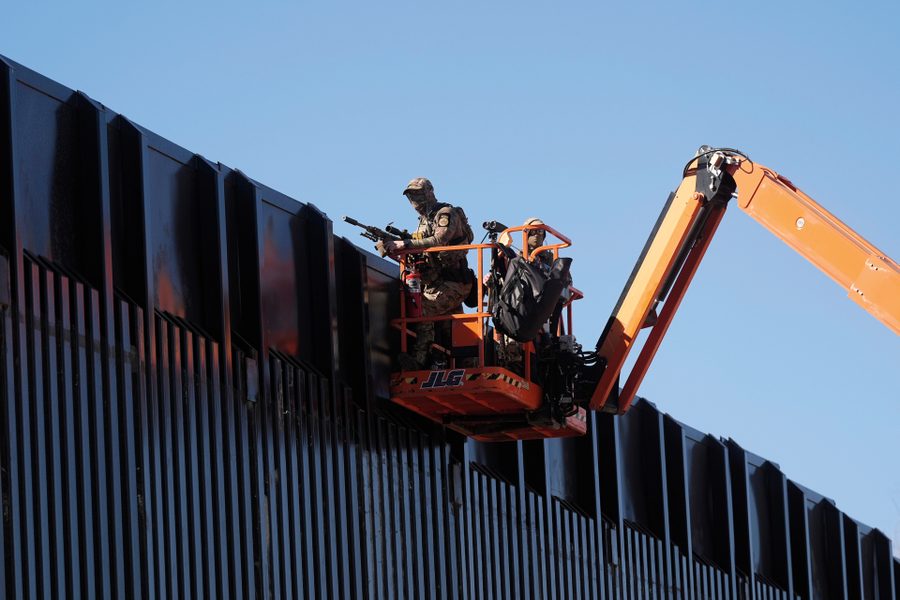
An armed federal agent guards the US–Mexico border, February 4th.
Ross D. Franklin/APThe Death of Asylum
How centuries of efforts to deny refuge to persecuted people paved way for authoritarianism

On June 3rd, 2024, President Joe Biden announced a policy change with catastrophic implications. Following record-high migration across the United States–Mexico border, he issued a presidential proclamation capping the number of people who were allowed to cross the border to seek asylum. Just four years earlier, Biden had promised to transform Donald Trump’s “cruel” border into a “humane and well-managed” one, vowing on World Refugee Day 2020 to “restore [the US’s] asylum laws.” In practice, however, he retained and even expanded Trump’s most notorious border policies—such as Title 42, which used the Covid-19 pandemic as an excuse to sidestep laws requiring border officials to screen migrants at the US–Mexico border for asylum eligibility. Biden also introduced new restrictions, such as making people ineligible for asylum if they crossed the border without first getting an appointment through a glitchy Customs and Border Protection app. The June declaration marked a drastic escalation in this trajectory—heralding what Heidi Altman, vice president of policy at the National Immigration Law Center, later called “a critical juncture in [asylum’s] history.”
Setting a quota on a category of migrants is itself nothing new: Every year, the US president does so for refugees, and Congress does it for visa holders. But in the decades since its codification in international and US law, asylum has, at least on paper, been exempt from such caps. Once they set foot on a host country’s soil, anyone fleeing political, religious, or identity-based persecution can make a case for asylum—regardless of if they entered the country legally. People fleeing for their lives, after all, don’t have time to go through the protracted offshore vetting involved in the refugee resettlement process. In this way, the right to asylum has formed a sort of antidote to a world where the sanctity of national borders is generally placed above that of human life. By delimiting asylum, the Biden administration had reneged on this fundamental promise.
Of course, the US had not always protected people fleeing harm even before Biden. From the pre-Revolutionary War era all the way through the Cold War, the US granted asylum and other humanitarian protections selectively—in ways that served its interests and maintained its racial hierarchies. This was often done by preventing certain categories of migrants from even landing on the country’s shores and requesting asylum in the first place. In recent decades, such self-serving uses of asylum have given way to systematic attacks on the apparatus as a whole—with politicians across partisan lines casting asylum not just as a burden but as a threat, susceptible to fueling out-of-control “illegal” migration. “We won’t tolerate immigration by people whose first act is to break the law as they enter our country,” President Bill Clinton said in a 1995 address. His administration went on to pass a “tough-on-crime” immigration law that created an “expedited removal” process for migrants, including asylum seekers, who crossed the southern border, and made it mandatory for them to be detained while they argued their cases. It also allowed the US to deport anyone to a different “safe” country—an attempt to quickly remove asylees from US territory. Clinton’s successors took the assault further; President Barack Obama, for instance, put asylum proceedings involving Central American families on a “rocket docket” in 2014—fast-tracking the proceedings of all members, including children, before deporting many back to the places they had fled. First-term Trump policies like Title 42 and “Remain in Mexico” greatly intensified this process of pushing asylees out, and Biden capped it off with his numerical limits.
With Trump’s return to office, these attacks have now paved the way for a full-scale war on asylum. “The asylum system has become a huge loophole in our migration laws,” Deputy Secretary of State Christopher Landau said at a UN event last September. A year into his second presidency, Trump has mobilized almost every type of domestic and foreign policy tool, including public health regulations, anti-terrorism laws, and rarely used wartime powers, to close the supposed loophole. His administration has taken dozens of policy actions to eviscerate the right to asylum. This has included canceling the appointments of hundreds of migrants within hours of Trump’s inauguration, directing multiple federal agencies to ramp up immigration enforcement, and expanding the list of countries whose citizens face a travel ban, even if they are asylum seekers. Trump has also pulled bureaucratic levers, using a November 2025 Washington, DC, shooting as a pretext to pause all asylum adjudications, and issuing new rules to further narrow eligibility and raise the standards of proof. Additionally, Trump’s lawyers have been instructing immigration judges to summarily dismiss asylum cases without hearings in a bid to speed up the removal of applicants to countries like Uganda, Ecuador, and Honduras, with which the US has brokered new deportation agreements.
The human impact of this bipartisan offensive has been severe. Already, in Trump’s first term, vulnerable migrants were forced to wait in tent shelters in dangerous parts of Mexico for months, where at least 1,500 of them reportedly suffered kidnappings, rapes, assault, and other forms of violence. Biden’s caps worsened the situation, granting border agents unprecedented discretion to turn away applicants—even if they were likely to face harm elsewhere. “People were saying that they fear return and basically begging for an asylum interview, but they were being ignored,” Yael Schacher of Refugees International told Jewish Currents in an interview, conducted after she visited the Southern border in Arizona in June 2024.Trump 2.0 has built on these violations. Crossing the US’s border, which one has to do to seek asylum, is now not only much more dangerous, it is also seen as an affront to national identity—so much so that Trump has explicitly framed his border crackdown as a way of “protecting the American people against invasion.” This “protection” has entailed endangering asylum seekers not just at the border but also inside the US. Since he took office, Trump has mobilized his immigration agents to seize and—sometimes in violation of US court orders—rush-deport thousands of migrants, many of whom entered the country with humanitarian permission through the Biden-era border app and have cases pending in immigration court.
“The institution of asylum worldwide is under more threat now than it has ever been,” the head of the UN Refugee Agency told reporters in September 2025.
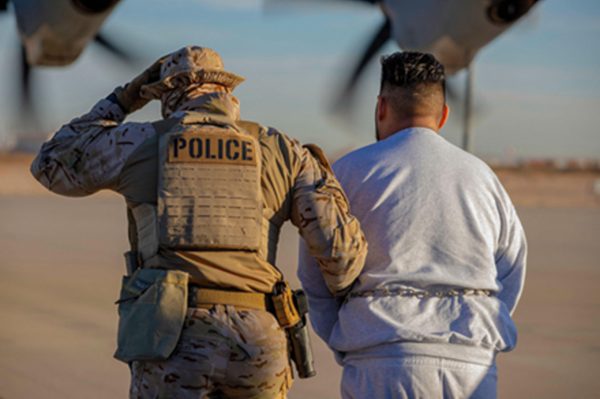
A federal agent deports a person out of Biggs Army Airfield in Fort Bliss, Texas, February 8th, 2025.
From the United Kingdom to the European Union to Australia, similar anti-asylum measures have been implemented across the globe—leading human rights observers to worry that we may be witnessing the death of asylum as we know it. “I am not exaggerating when I say that the institution of asylum worldwide is under more threat now than it has ever been,” Ruvendrini Menikdiwela, Assistant High Commissioner for Protection at the UN High Commission for Refugees in Geneva, told reporters in September 2025. In this, asylum joins the other crumbling pillars of the post-World War II liberal order—including the International Criminal Court, currently facing US sanctions; the climate-focused Paris Agreement, the cultural agency UNESCO, and the World Health Organization, all now subject to the US’s withdrawal; and international law as a whole, increasingly left in rubble in the wake of illegal attacks on Gaza, Iran, Venezuela, and beyond.
Perhaps this liberal rules-based international order was destined to be doomed by its own inherent contradictions: After all, even though it purported to advance universal human rights, it was always administered by nation-states and therefore, limited by borders, literal and figurative. As the scholar Mikkel Flohr points out, the current migrant crisis is certainly “rooted in the inherent exclusivity and limitations of the nation state. And as long as responses are dictated by nationalism and narrow national interests, finding a solution [will remain] impossible.” The death of the asylum system, then, may have been inevitable. But, as we’re starting to see in the US—amid a federal onslaught that began with “illegal” border crossers but has gone on to encompass anyone who finds themselves on the wrong side of the ideological and racial divides—the fallout of this demise is not going to be siloed.
The political philosopher Hannah Arendt, herself a refugee who fled Nazi Germany, wrote in The Origins of Totalitarianism in 1951 that the “long and sacred history” of the right to asylum “dates back to the very beginnings of regulated political life.” Arendt observed that since ancient times, asylum “has protected both the refugee and the land of refuge from situations in which people were forced to become outlaws.” In ancient Greece, “asylos”—meaning “inviolable,” the root of the English word asylum—referred to laws that declared certain spaces off-limits for plunder by pirates, the journalist and author John Washington writes in The Dispossessed. Roman imperial law, he explains, transformed this concept of a sacred location exempt from ordinary threats into a more formalized idea of sanctuary between the walls of the Christian Church; even fugitives were meant to be protected in that hallowed space. Modern asylum law builds on these precedents by delineating asylum as a place-based right. Washington describes this as a sort of “locational citizenship law”: Once you step into the church, the city, or onto the national soil, you are entitled to that body’s protection—or at the very least, to the process by which to request that protection.
In reality, however, modern empires and nation states have rarely granted asylum in such a universal manner. Instead, they have consistently doled out the right on a case-by-case basis, in ways that buttress their interests. In the 18th century, for instance, a group of Palatines—German-speaking Protestants persecuted in France—arrived in Great Britain seeking refuge. But because the English saw the Palatines as “less skilled and therefore less valuable,” the literary historian Stephanie DeGooyer writes, Britain refused them entry. Instead, as a way of appeasing British humanitarians, in 1710 the Crown paid to ship the Palatines away to its colonies in Ireland and America. In the New World, the refugees initially found work as indentured servants. But later, after they “began to regard themselves as American settlers,” DeGooyer notes, the Palatines were absorbed into the body politic.
The newly formed United States carried on this selective use of asylum. An early example came at the turn of the 19th century, when the Haitian Revolution—an armed slave insurrection in Saint-Domingue—led some 25,000 exiles to make for US shores. The historian Nicholas Foreman explains that this group included white slave owners, mixed-race people, and free Black people “who did not support the end of the plantation regime, along with a few thousand slaves forced to join them.” Once in the US, these groups received very different welcomes. Foreman notes that white, Christian, and slaveholding refugees were seen as victims, offered charitable donations for relocation, and lodged with sympathetic locals. But Black Haitians were, in the words of historian Nathalie Dessens, “feared as agents of rebellion” and often prevented from disembarking onto US soil. Indeed, Southern politicians like John Rutledge, a founding father who later became a Supreme Court justice, were so concerned about Black Haitians spreading the anti-slavery revolt that they advocated for a halt on the import of slaves altogether.
In subsequent centuries, US policy built on these early precedents, and by the 20th century, a hierarchy of migrants was codified. The Immigration Act of 1924 established race-based national origin quotas that favored immigrants from the white, Protestant nations of Northern and Western Europe; severely limited those from the more Catholic and Jewish nations of Southern and Eastern Europe; and, in keeping with prevailing ideas of eugenics, reinforced an earlier ban on people from the “Asiatic Barred Zone,” which included most of Asia and the modern Middle East. These exclusionary laws contained no humanitarian carveouts, and as such, served to racially segregate the right to refuge just as 20th-century wars were spurring mass displacement. By the time World War II broke out, the dire costs of this selectivity were on full display. In May 1939, the German ship SS St. Louis made the journey from Hamburg to Havana, and later to Miami, with around 1,000 passengers on board, almost all of whom were Jewish refugees fleeing Nazi persecution. The vessel got close enough that the passengers could see the city lights. But because of widespread antisemitism and the perception of the passengers as German spies, the Roosevelt government did not heed the ship’s request to dock. The St. Louis was forced to return to Europe, where more than 200 of its passengers were eventually killed in the Holocaust.
In May 1939, 1,000 Jewish refugees fleeing Nazi persecution arrived in Miami, but because of widespread antisemitism and the perception of the passengers as German spies, the Roosevelt government did not heed the ship’s request to dock.
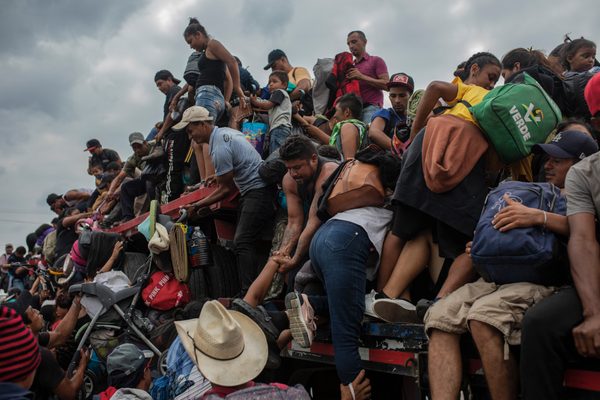
Central American migrants bound for the US climb onto
the bed of a trailer in Mexico, November 17th, 2021.
In the wake of the Shoah, political leaders around the world urgently perceived a need for a new international order premised on human rights—what Arendt called the “right to have rights.” Codifying a right to asylum—which, had it been in place in the prior decades, could have saved millions of lives—was an early priority, and delegates at the 1951 Refugee Convention and the 1961 Convention on the Reduction of Statelessness took up that task. At the heart of these efforts was the principle of “non-refoulement.” Derived from the French verb “refouler,” meaning “to push back,” non-refoulement dictated that people crossing a national border to seek refuge could not be sent back to harm, and specified that it was the host country’s obligation to hear out their claims and offer them asylum if the claims were bona fide. Like many of the other precepts set forth by international bodies, these directives were not backed by any enforcement mechanism; compliance remained at the discretion of nation-states.
Despite being integral in its crafting, the US was a latecomer to international asylum law. For almost two decades after the first Refugee Convention, the race-based quota system continued to dictate entry into the US, and political leaders were content to use ad hoc tools like special visas and parole to resettle certain groups of refugees without offering a universal right to asylum to all. It was only in 1965—after the highly publicized trial of Nazi leader Adolf Eichmann deepened the public’s understanding of the Holocaust, and the civil rights movement brought the struggle for racial parity onto a national stage—that Congress finally overhauled the racial quotas, opening the door to refugees who would have been otherwise barred from the US. Three years later, the US signed on to a UN protocol on asylum. It took a decade more for these shifts to be reflected in US law. In 1979, Senator Edward Kennedy, a Democrat from Massachusetts, introduced legislation that laid out mechanisms for both refugee resettlement and asylum processing. The following year, the bill was signed into law; the Refugee Act established the nation’s first official procedure for hearing asylum claims.
Even after these formal protections were in place, the US continued to use asylum to advance its own interests—and, increasingly, as a geopolitical chip in the Cold War. This was evident as early as April 1980, only a month after the Refugee Act was passed, when over a hundred thousand Cubans set sail to Florida in a mass exodus that came to be known as the Mariel Boatlift. As with so many other 20th-century refugees, most Marielitos were fleeing a crisis that the US had a role in creating—in this case, by way of a decades-long trade embargo on Cuba. President Jimmy Carter was initially reluctant to allow the Marielitos in because he did not want to “reward illegal entry.” But accepting the exiles offered Carter the opportunity to fire a symbolic salvo against Cuban President Fidel Castro, a key Cold War rival. So, after a period of detention, Carter eventually granted them parole into the US, declaring that May that his administration would “continue to provide an open heart and open arms to refugees seeking freedom from Communist domination and from economic deprivation, brought about primarily by Fidel Castro and his government.” The US later gave many of these refugees federal support as well as a pathway to citizenship.
The belatedly warm, if instrumental, welcome the Marielitos received stood in stark contrast to how the US treated Haitians who had been fleeing dictatorial regimes since the 1950s. Successive US presidents saw Haitian President François Duvalier (and later his son and successor, Jean-Claude) as a bulwark against Communism in the Caribbean. This meant that the asylum requests of many of the journalists, activists, and academics critical of the Duvaliers were seldom approved. In 1980, Carter did temporarily allow Haitians parole into the US, but within a few years President Ronald Reagan reversed the policy—jailing recently arrived Haitians and instructing the Coast Guard to intercept and turn back any future boats.
As with the enslaved exiles from Saint-Domingue and the German Jews aboard the SS St. Louis, the US was preventing Haitian refugees from reaching its shores because once they did, they were owed something—something that the US did not see as being in its interests to grant. The sociologist David Scott FitzGerald called this tactic the “North American moat,” which he characterizes as a “radical move to externalize borders” in order to thwart asylum seekers from landing at US shores. It would prove to be an overture that future US administrations would build on, racing to push the moat-and-border regime to its inevitable extreme.
On a map, borders appear static, but in practice they are always porous and shifting. That is why asylum seekers pose such a threat: There is no moment at which a border’s flimsiness is more evident than when a person steps over it without permission. As the French philosopher Jacques Derrida writes in Aporias, “There is a problem as soon as the edge-line is threatened. And it is threatened from its first tracing.”
If the border is “an elastic regime, rather than a fixed line,” it also has the potential to “exist anywhere and everywhere.”
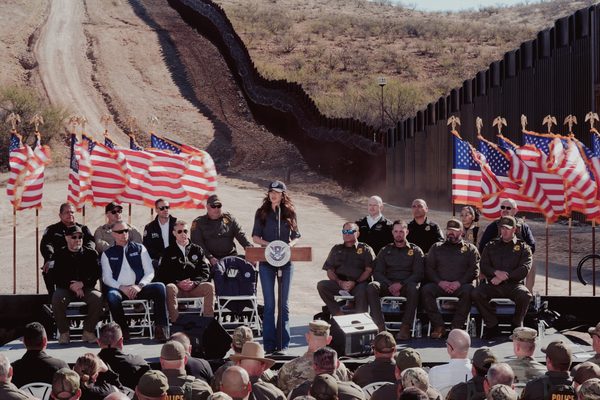
Former Secretary of Homeland Security Kristi Noem addresses immigration agents at the US–Mexico border, February 4th.
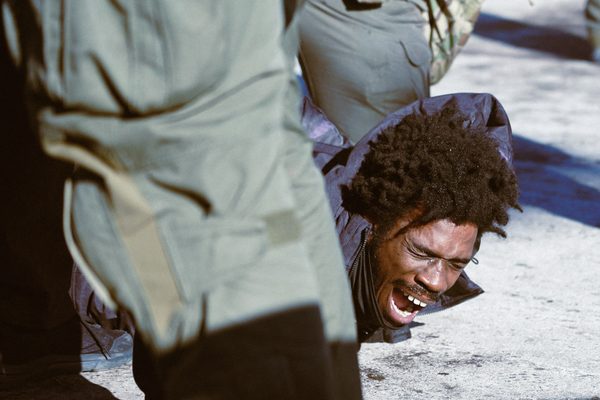
County Sheriff officers arrest a protester in Minneapolis, Minnesota, January 30th.
But if the border is “an elastic regime, rather than a fixed line,” the migration scholar Harsha Walia has argued, then it also has the potential to “exist anywhere and everywhere.” This process of border diffusion, already underway in the late 20th century, was turbocharged after 9/11. Analysts have noted that the creation of the Department of Homeland Security and the exponential growth in the Customs and Border Protection budget made the US border less porous to migrants. But the post-9/11 border didn’t just harden in place: It expanded. The journalist Todd Miller recounts that as early as 2004, US Customs and Border Protection Commissioner Robert Bonner was seeking to “[extend] our zone of security . . . beyond our physical borders—so that American borders are the last line of defense, not the first.” Consequently, US border agents were stationed in Puerto Rico to police the Caribbean, which the US began calling its “third border.” US border agents started training their Dominican counterparts to patrol the border with Haiti in the same way the US polices its border with Mexico, a bid to further constrict migration pathways. The US also entered into agreements to train and boost border control operations on the Mexico–Guatemala border, in Panama, and beyond, all to disrupt migration routes from Latin America. By 2017, when Trump’s Homeland Security Secretary John Kelly began promoting a “layered defense” of the US border—one that “starts 1,500 miles south and that is partnering with great countries as far south as Peru”—the infrastructure he was envisioning was largely already in place.
The border also spilled inward. Already, Walia writes, “when a migrant crosses the border, the border still follows them” through continued surveillance and policing. In fact, since 1953, border agents have been permitted to operate with extended search and seizure powers 100 nautical miles inside the boundary of the US—essentially placing over 60% of residents, mostly people of color living in major metropolitan areas, in a “border zone.” The Supreme Court has also allowed agents to enjoy this exceptional power at international airports, coastal ports, post offices receiving international airmail, and any other “functional equivalent” of the border, which case law says “need bear no time or space relationship to the actual border.” Within such zones, agents can set up checkpoints, conduct stops and ask for papers, and traipse through private property. After 9/11, and especially in recent years, these internal border powers began to be used in unprecedented ways—to the point that we are now seeing Border Patrol rappelling down Black Hawk helicopters to target alleged squatters in a Chicago apartment complex, storming into Los Angeles parks on horseback and bloodying protesters, and killing two people in Minnesota in sweeps more brazen and violent than ever before.
This dynamic, where anti-asylum structures have systematically paved the way for authoritarianism, is an increasingly global one. Around the world, governments have set up border infrastructure to ensure that displaced people never even arrive to make the case for refuge. The European Union, for example, has used northern Africa as what scholars have called a “buffer zone,” training Libya’s coast guard so it can intercept migrants trying to sail through the Mediterranean and reach Europe. In the process, the Associated Press reported, the coast guard regularly worked with militia members and traffickers to exploit migrants in custody, and fired at boats that tried to aid migrants. The result is that migrants are now more likely to die than arrive at their destinations: Just last year, a mass grave of migrants was found in Libya, some of the bodies marked with gunshot wounds. Those who somehow survive these perilous journeys are greeted by border walls, boots on the ground, and surveillance systems—as well as policies designed to push them out. The UK has sought to ship asylum seekers to Rwanda; members of the European Union have brokered deals with Turkey and various North African states to cut off migrants’ routes and keep them detained in remote offshore locations; and Australia has paid to send away its migrant detainees to the island of Nauru in the South Pacific. India recently forced Rohingya refugees into life jackets and aboard a naval vessel: “They bound our hands, covered our faces and brought us like captives [onto the boat],” one refugee told the BBC. “Then they threw us in the sea.”
Such efforts to punish migrants are ostensibly undertaken to secure the nation-state that lies within heavily guarded borders. In the final analysis, though, they may be its biggest undoing. By stripping the right to asylum, nations are creating a growing underclass of placeless, rightless people to police in perpetuity, and an ever-greater policing apparatus with which to crack down on them—and, increasingly, everyone else. The more that states “[refuse] to treat stateless people as legal persons” and “rule by police decree,” Arendt wrote, “the more difficult it is for states to resist the temptation to deprive all citizens of legal status.” As the scholar Nikhil Pal Singh has written, in our time this looks like “legal authority and institutional power . . . being redirected toward an overriding end: governing populations as subjects rather than citizens” everywhere “from Caracas to Minneapolis.” If the border is everywhere, in other words, its violence can have no limits.

I’m Arielle Angel, editor-at-large of Jewish Currents. Before you go, there’s something I need to ask.
We’ve seen over and over how the mainstream media falters in telling stories on our beats—whether it’s antisemitism, Israel/Palestine in American politics, Jewish identity, or the American left. At Jewish Currents we’re committed to uncompromising analysis and longform reporting on these issues and more—stories you won’t find anywhere else. In a media landscape that obscures injustice and flattens discussion, we’re changing the conversation. But we need you.
If you believe in this work, please consider making a donation—or even better, a recurring one—to ensure that we are able to keep publishing stories like this one. We can’t do it without you.
Tanvi Misra is a writer and investigative journalist covering migration and justice issues whose work has appeared in The Nation, The Guardian, Politico Magazine, and The Baffler among other publications.