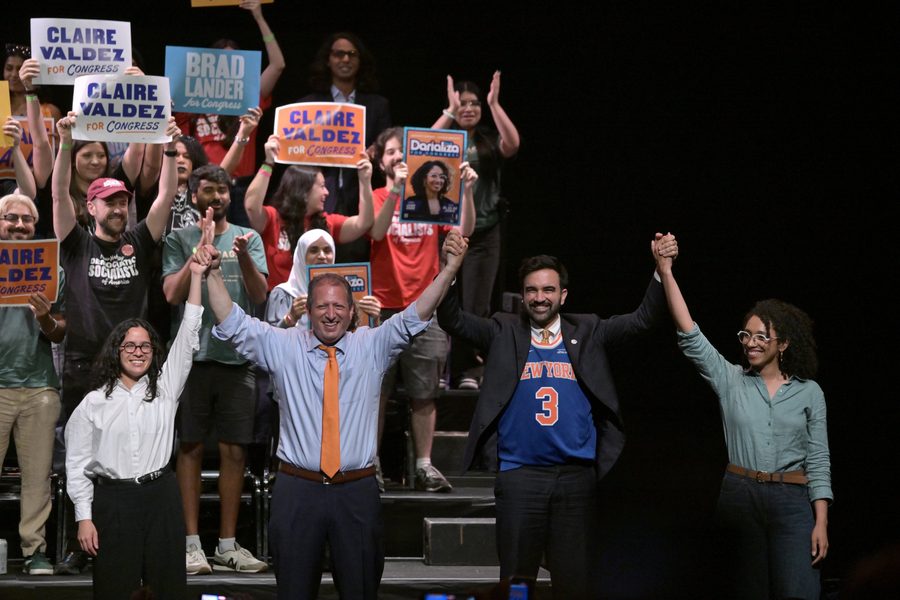
New York City mayor Zohran Mamdani with his endorsees in New York’s Congressional primaries on Tuesday. From left, they are Claire Valdez, Brad Lander, and Darializa Avila Chevalier.
This article first appeared in the Jewish Currents news desk newsletter. Subscribe here.
New Yorkers are heading to the polls today to vote in the Democratic primaries. The end of the night will mark the finale of this wild New York City election season—the first of the Mamdani era, and the second since Israel’s genocide in Gaza turned Palestine into a major electoral issue, dividing establishment Democrats from progressive insurgents.
As we wait for official election results—polls close at 9 pm—here are five storylines I’ll be watching.
1. A Test for Mamdani
Mayor Zohran Mamdani isn’t on the ballot tomorrow. But the results will nonetheless be a test of his political influence one year after he shocked the political establishment with his own victory.
Mamdani has endorsed three Congressional candidates: Assemblymember Claire Valdez in the 7th District in Brooklyn and Queens, former comptroller Brad Lander in the 10th District in Brooklyn and downtown Manhattan, and activist and legal investigator Darializa Avila Chevalier in the 13th District in uptown Manhattan and parts of the Bronx. He’s also backed five state legislative candidates.
His endorsements of Valdez and Avila Chevalier have been particularly contentious within the political class, putting him at odds with past allies and heavyweight Black and Latino progressives. In the NY-13 race, he’s opposing incumbent Adriano Espaillat, chair of the Congressional Hispanic Caucus, who has the backing of Attorney General Letitia James. In NY-7, Valdez’s opponent, the progressive Brooklyn Borough President Antonio Reynoso, is supported by outgoing incumbent Rep. Nydia Velasquez.
Mamdani won every single one of these congressional and state districts by commanding margins, and remains extremely popular in these slices of the city. Now he’s putting significant time and political capital into the campaigns of his endorsed candidates. “Politically it’s a big boost. The mayor is very popular in this district, and his support was critical to helping coalesce progressives,” Lander told me after a June 14th rally.
Will his popularity transfer to legislative candidates, particularly Valdez and Avila Chevalier, in lower-profile races? It’s the question that everyone’s asking—and the answer will have serious consequences for Mamdani’s political future.
2. Will Young Voters Stay Home?
Progressive victories depend on younger voters. Last year, Mamdani relied on millennial and Gen Z voters, who turned out at unprecedented levels to propel him to victory.
This year, with no Mamdani on the ballot, turnout is not going to be anywhere near what it reached last year. But the question is whether younger voters in those key congressional districts will make up a higher proportion of voters than normal. If it is anywhere near the 43% that it reached last year, that would be an excellent sign for DSA’s chances. But the lower it goes, the better it is for the incumbent representatives, like Espaillat in the 13th District. Data from early voting shows worrying signs for the left: Older voters are turning out at a higher rate than younger voters, though young voter turnout increased in recent days.
3. The Gaza Factor
The race to be the next representative in the 7th Congressional District in Brooklyn and Queens is mainly between Valdez and Reynoso, the Brooklyn borough president. (Queens Councilmember Julie Won is also running, but is not expected to win.) Reynoso and Valdez have virtually indistinguishable platforms. They both back Medicare for All, abolishing ICE, and ending US military aid to Israel.
But Valdez is betting that her early opposition to Israel’s genocide in Gaza will be a winner among voters in the young and educated district she’s running to represent, which includes the gentrifying neighborhoods of Williamsburg, Bushwick, Ridgewood, and Greenpoint, among others. To a greater extent than Reynoso, Valdez has leaned into Gaza in the closing days of her campaign. Her rallies feature “Free Palestine” signs, and one of her last campaign ads touts her early calls for a ceasefire and her participation in civil disobedience actions against Israel’s bombardment. She has used the issue to draw a contrast with Reynoso, who only called Israel’s actions a genocide when he started his congressional campaign. Valdez has also criticized Reynoso for taking money from donors who have also donated to AIPAC, though AIPAC as an organization has not endorsed Reynoso, and a top ally said he returned those contributions.
How much does the timing of a politician’s opposition to Israel’s genocide in Gaza matter? Valdez is making a bet that key demographics in her district will see her early opposition as more authentic than Reynoso’s.
4. The Hasidic Vote
Reynoso and his allies are campaigning hard in Hasidic Williamsburg, where the bloc vote could be the key to his victory.
Williamsburg boasts an adult population of 36,000 Jews, the vast majority of them members of Satmar and other smaller Hasidic groups. Though last year’s endorsement of Mamdani by one Satmar political leader didn’t net the mayor a ton of votes, Hasidic voters generally follow the endorsements of the political leaders of their sect, and the Satmar vote is a potent one in the district. Earlier this month, Hasidic political leaders in Williamsburg, including the political leaders of both sides of the split Satmar sect, issued an endorsement of Reynoso, pointing to their long relationship with him. (Reynoso has been in some form of local office since 2013.)
The only independent public poll in the district has Reynoso and Valdez separated by two points. In a close race like that, the Hasidic vote could be decisive, and Hasidic voters have come out to vote early at high rates.
5. A Swipe at Tom DiNapoli
State Comptroller Tom DiNapoli has been in office since 2007. But a May poll found that two-thirds of New Yorkers say they’ve never heard of him, or don’t know enough to have an opinion of him.
His low profile has given progressives an opening to take him on. The two progressive candidates—former Kansas legislator Raj Goyle and affordable housing advocate Drew Warshaw—have argued that DiNapoli has mismanaged the state retirement system and has put pension fund money into ICE contractor Palantir. Israel Bonds has also become a big issue in the campaign: DiNapoli has purchased $340 million in Israeli debt securities over his tenure. Both of his opponents say they would divest that money.
DiNapoli is the favorite to win re-election. His opposition is split, and the heavy hitters in New York progressive politics—the Working Families Party and the DSA—are not involved. Still, this is his first primary challenge, and it is a test of whether two unknown candidates can put a dent in his armor. If he does poorly, this race may be the harbinger of a more serious challenger in four years.

I’m Arielle Angel, editor-at-large of Jewish Currents. Before you go, there’s something I need to ask.
We’ve seen over and over how the mainstream media falters in telling stories on our beats—whether it’s antisemitism, Israel/Palestine in American politics, Jewish identity, or the American left. At Jewish Currents we’re committed to uncompromising analysis and longform reporting on these issues and more—stories you won’t find anywhere else. In a media landscape that obscures injustice and flattens discussion, we’re changing the conversation. But we need you.
If you believe in this work, please consider making a donation—or even better, a recurring one—to ensure that we are able to keep publishing stories like this one. We can’t do it without you.