Criminal Governance
Political scientist As’ad Ghanem argues that the rise of crime in Palestinian communities inside Israel is not a policy failure, but the result of decades of state efforts to weaken Palestinian collective life.
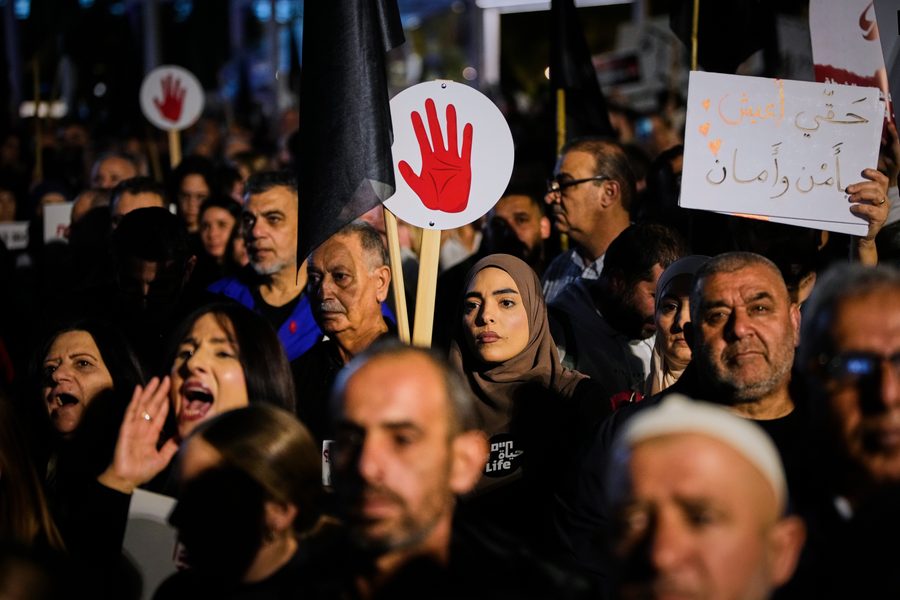
Palestinian citizens of Israel rally, calling for greater security amid rising crime in their communities, Tel Aviv, January 31st, 2026.
Palestinian citizens of Israel make up about a fifth of the country’s population, yet accounted for over 80% of all homicide victims last year. More than 100 Palestinian citizens have been killed since January alone, significantly outpacing the rate of previous years. “Entire families have left the country or changed their place of residence, others are hiding in their homes, not to mention the daily explosions, the burning of cars, and all those injured in the attacks,” Rawyah Handaqlu, a lawyer who heads the Emergency Headquarters to Combat Crime in Arab Society, told +972 Magazine in 2024. The response from Israeli authorities has ranged from hand-wringing to studied indifference to hostile victim-blaming.
To understand the conditions that have given rise to this spike in violence, I spoke to As’ad Ghanem, a political scientist at the University of Haifa, who, together with sociologist Nohad ‘Ali, published Violence and Crime among the Palestinian Minority in Israel: The Shattering of the Indigenous earlier this year. Building on Ghanem’s previous work on the structural exclusion of Palestinian citizens, this new book traces the history of Israel’s systematic weakening of the institutional, civic, and social infrastructure of Palestinian communities inside Israel. This process began in 1948, when the newly established state imposed military rule on Palestinians who remained within the armistice line; for nearly two decades, Palestinian citizens of Israel were subject to curfews, censorship, broad limitations on civil liberties, and severe movement restrictions, including the requirement that they secure permits to leave their villages for work, medical care, and education. Even after military rule was lifted in 1966, the state’s differential treatment of Palestinian citizens has continued through unequal planning laws, chronic underfunding of Arab municipalities, and an accumulating body of discriminatory legislation—most notably the 2018 Nation-State Law, which enshrined Israel as “the nation-state of the Jewish people” and downgraded the official status of Arabic.
Ghanem and ‘Ali also bring a structural analysis to their historical account of the state’s erosion of Palestinian civic life. Drawing on the settler-colonial theory of Patrick Wolfe, they argue that the explosion of violence in Palestinian communities in Israel since 2000 is not the incidental byproduct of governmental neglect but rather a decades-long strategic effort to undermine Palestinian collective organization and future self-determination. In light of this, an ostensible Israeli “policy failure” to protect its Arab citizens is actually the successful implementation of settler-colonial governance.
In the book’s final chapters, Ghanem and ‘Ali survey international models for combating violence, and draw lessons for Palestinian communities in Israel, such as the need to pair enforcement with sustained social investment in youth, employment, and community infrastructure. But they refuse to let community responsibility substitute for state accountability, instead insisting that collective survival cannot be outsourced to an authority invested in a community’s fragmentation. Whether Palestinian civil society can organize faster than the state can break it apart remains, for Ghanem, an open question. This interview has been edited for length and clarity.
Eliyahu Freedman: It may seem at first glance that regional war with Iran and rising violence inside Palestinian communities in Israel are separate issues. But you have recently argued that they stem from the same political logic. How so?
As’ad Ghanem: The war on Iran is not just about Iran. Its central objective is to eliminate any possibility of resistance to Israel. When Netanyahu speaks about fighting on multiple fronts—Gaza, Lebanon, the West Bank, Iran—he presents Israel as a state besieged.
Notably, he does not name Palestinian citizens inside Israel as a front. And yet the government’s domestic policies make the battle against Palestinian citizens unmistakable. You do not have to declare a population an enemy to govern them as one. In other words, we are not a front Israel needs to name, because Palestinian citizens are not a security threat in the traditional sense. We do not present a military danger. Instead, we are a democratic threat—a threat to Israel as a project of racial supremacy. That is why the Israeli government responds to our presence not militarily but structurally: fragmentation, disorder, the erosion of our collective capacity to act. We are a problem that Israel has chosen to manage through means other than military force, but the state’s underlying goal is the same both externally and internally: to break any possibility of collective resistance to Israeli dominance.
EF: You date the significant rise in violence in Palestinian communities in Israel to the year 2000. What happened then?
AG: Before 1999, the number of Palestinian citizens involved in serious crime was low. Between 1980 and 2000, fewer than 100 Palestinian citizens were killed in criminal incidents, while since 2000, there have been over 1,000 people murdered. There are of course certain social factors that give rise to crime—family disputes, economic pressures. But these realities were also present before 2000. Because of this, it is clear that the rupture in question stems from a political change.
In October 2000, as the collapse of the Oslo Accords gave way to the Second Intifada, Palestinian citizens protested in solidarity with Palestinians in the West Bank and Gaza. In response, Israeli police killed 13 protesters, 12 of whom were citizens, that month alone. This led to a consolidation of collective identity among Palestinian citizens. Israel has since wanted to dismantle that consolidation. The violence that has risen steadily since then points to Israel’s deliberate weakening of the Palestinian collective over the last 25 years.
EF: The book’s subtitle uses the phrase “the shattering of the indigenous.” What is the shattering in the case of Palestinian citizens, and what are its causes?
AG: Societies have mechanisms to maintain order and coherence. In the book, I focus on three such mechanisms that help explain our context. The first is civic status: A modern state either governs its population through military rule, without granting civil rights, or extends full and protected citizenship. But Palestinian citizens exist in an intermediate realm that provides citizenship in name only. Structural inequality, including dozens of laws that discriminate against Palestinian citizens, means that their status is always vulnerable, and they are not truly full citizens.
The second mechanism is national cohesion. When people share a strong collective identity, including being subject to shared external threats, they unite. In parts of the fragmented West Bank, cohesion exists because of a collective national consciousness under occupation. But within Israel, Palestinian national identity is viewed with suspicion in the national sphere, which prevents it from functioning as a source of collective cohesion. On the one hand, Palestinians living in Israel are suppressed by the Israeli state, and on the other hand, they are excluded by the Palestinian national movement, meaning they are left without a meaningful point of national reference.
Lastly, social structures—extended families, religious institutions, communal frameworks—regulate behavior and mediate conflict. But for Palestinian communities, particularly among Bedouin communities, these social structures have eroded under economic and policy pressures. When all three of these pillars collapse at once, violence spreads more easily and society shatters.
EF: Your book argues that what looks like negligence toward Palestinians in Israel is actually deliberate policy. How do you make that case?
AG: In the West Bank, Israel exerts control through military power and settlement expansion, and in Gaza, through siege and war. Inside Israel, the tactic is different but the goal of preventing organized resistance is the same, and so the state operates through fragmentation and internal disintegration.
If the state were to decide to fight organized crime seriously, it could do so. We see this in Jewish cities: When a Palestinian citizen shoots a Jew, the suspect is generally arrested within 24 or 48 hours. But in Arab towns, most crimes are not seriously investigated. In 2022, the clearance rate—or the percentage of crimes solved by the police—for serious crimes in Arab communities was around 15%, compared to 65% for Jewish Israelis. In Area A of the West Bank, where the Palestinian Authority handles crime, the clearance rate is 84%, despite the PA lacking Israel’s surveillance technology and other law-enforcement resources. This clearly shows that the issue is not the police’s ability but the government’s political will—or, in this case, the lack thereof.
There is also evidence that the issue goes beyond neglect. A 2021 report by Channel 12 News revealed that a senior police official stated in a meeting with the Minister of Internal Security that “most of the criminals—Arabs—who carry out serious crimes in Arab society work as agents of the Shin Bet [Israel’s internal security agency, parallel to the FBI in the US]. Therefore, the police cannot pursue them because they have immunity from the security services.”
In short, the security services are, in some cases, actively protecting the networks the police claimed to be fighting. The Shin Bet’s involvement in the rising number of murders of Palestinians suggests the state’s security apparatus actually supports the targeting and fragmentation of this community.
EF: Israel’s Minister of National Security, Itamar Ben-Gvir, and members of his party are advancing legislation that seeks to classify crime networks in Palestinian towns and cities as terrorist organizations. What is the motivation behind this move?
AG: Labeling an organization as a terrorist entity allows Israeli officials to use an expanded set of powers: prolonged detention without charge, surveillance without warrant, restrictions on political activity. These are the same instruments used against Palestinians in the West Bank under military law. The goal is to import that apparatus into Israel proper—to treat Palestinian citizens the way Palestinians under occupation are treated. In this way, the existence of crime in Palestinian communities serves the state’s goal of suppressing national resistance by providing it with new tools of repression.
EF: Your book examines international models for combating violence, including El Salvador’s hardline Mano Dura policies. What do these other cases teach us, and what are their limitations?
AG: The Salvadoran case is instructive precisely because it shows what pure control achieves—and what it cannot. The 2003 Mano Dura plan was a zero-tolerance crackdown on organized crime: mass arrests, military policing, harsh sentencing for suspected gang members based on appearance alone. In the first year, nearly 20,000 people were detained. The murder rate fell temporarily. But then it rose again. Eventually the Supreme Court declared parts of the plan unconstitutional.
The lesson is that while the iron first can reduce violence in the short term, it cannot address the conditions that produce violence. El Salvador’s more durable successes came from the combination of enforcement with social investment, such as programs for youth, community organizations, and rehabilitation infrastructure.
But in the Palestinian case, we face an additional constraint that El Salvador did not. El Salvador’s government, however dysfunctional, was not trying to weaken its own population. Here, the state’s neglect is intentional. Demanding better policing from a government that benefits from your disorder is necessary—but it cannot be sufficient. You cannot outsource your collective survival to an authority that is invested in your fragmentation.
EF: Your final chapter calls for mobilization within Arab society. Some readers will hear that as a familiar liberal argument: Civil society must fill the gap where the state has failed. Is there a risk that framing community responsibility too strongly lets the state off the hook?
AG: This is not about liberal NGOs replacing politics, and it is not about accepting the terms of state abdication. When I speak of civil society I mean something broad and combative: neighborhood committees, parents’ associations, religious leaders, local councils, business associations acting in coordination. Palestinian citizens of Israel are not weak. We have a broad middle class, and education levels are high. The problem is a lack of coordination and a lack of collective mobilization.
But crucially, the goal of organizing is not only to fight crime. It is also for the national cause. We must not abandon larger political questions because violence is rising. On the contrary—organizing around violence can strengthen our collective capacity more broadly. We saw this in January in the Palestinian city of Sakhnin in the north of the country. Shopkeepers began refusing to pay protection money to local gangs and the town rose up against the crime network. In one meeting with local political leadership that I attended, a young man stood on a table to loudly proclaim his message to the assembled politicians: “You don’t understand what we’ve built here,” he shouted. “You went to hold a demonstration—we built a revolution.” He was right. Lawyers published a collective statement. Doctors signed on. Parents’ committees, imams, business owners—everyone sat at the same table and said: We will not pay the gangs, and we will stand together. Violence dropped. Not because the state intervened, but because the community organized itself as a community. That is the model. Not a demonstration that delivers a message to the state and goes home. An organized local society that builds the capacity to protect itself—and from that foundation, fights for everything else.
The mistake would be to treat community mobilization as an alternative to demanding state accountability. They must happen simultaneously. We must protest. We must engage internationally. We must build alliances with Jewish citizens who believe in equality. Under this government, I do not expect change from above. But that is not a reason to stop demanding it; it is a reason to build power in parallel so that when political conditions shift, we are organized enough to make use of them.

I’m Arielle Angel, editor-at-large of Jewish Currents. Before you go, there’s something I need to ask.
We’ve seen over and over how the mainstream media falters in telling stories on our beats—whether it’s antisemitism, Israel/Palestine in American politics, Jewish identity, or the American left. At Jewish Currents we’re committed to uncompromising analysis and longform reporting on these issues and more—stories you won’t find anywhere else. In a media landscape that obscures injustice and flattens discussion, we’re changing the conversation. But we need you.
If you believe in this work, please consider making a donation—or even better, a recurring one—to ensure that we are able to keep publishing stories like this one. We can’t do it without you.

Eliyahu Freedman is an Iraqi Jewish journalist and independent scholar. He completed a master’s degree in Talmud at Tel Aviv University and is currently working on doctoral studies in medieval Judeo-Arabic.