The Consequences of New US Sanctions on Palestinian Human Rights Groups
Attorney Shayana Kadidal discusses how Trump’s sanctions could curtail American support for ICC prosecutions of Israel.
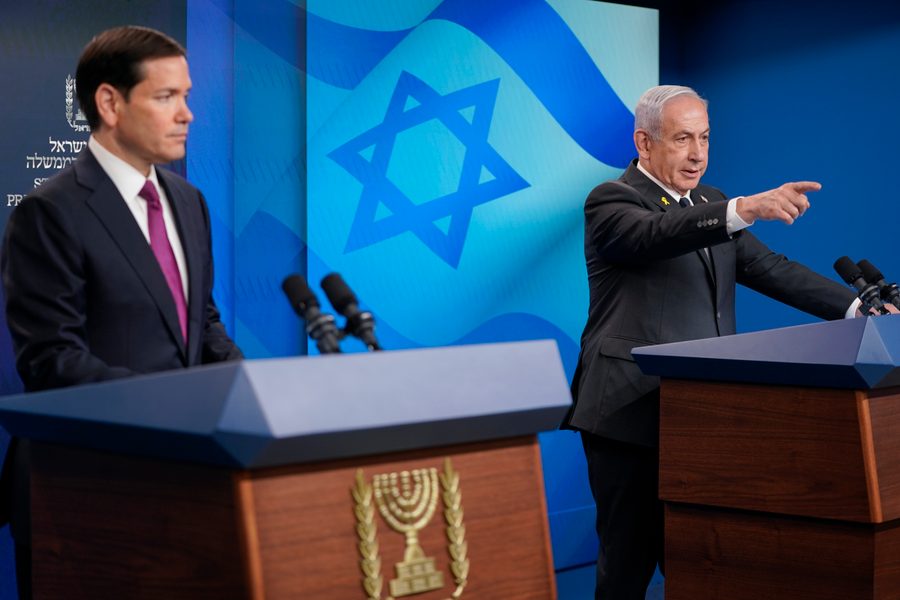
US Secretary of State Marco Rubio and Israeli Prime Minister Benjamin Netanyahu hold a joint press conference in Jerusalem on September 15th.
Earlier this month, Secretary of State Marco Rubio announced that he was imposing sanctions on three prominent Palestinian human rights groups over their involvement in efforts to hold Israel accountable at the International Criminal Court (ICC). The targeted groups are Al-Haq, Al Mezan Center for Human Rights (Al Mezan), and the Palestinian Centre for Human Rights (PCHR), all of which document human rights violations against Palestinians, disseminate such information in reports, and work in legal forums to hold Israeli officials accountable. All three of the groups have filed evidence of Israeli war crimes with the ICC as part of their campaign to have the international court prosecute Israeli officials for abuses committed during Israel’s bombardment of Gaza, as well as during Israeli military operations and settler activity in the occupied West Bank and East Jerusalem. The unprecedented sanctions bar Americans from donating to the groups, or even coordinating with them to hold Israeli officials accountable for war crimes.
The sanctions mark the latest Trump administration attack on both Palestinian human rights organizations and the ICC. In November 2024, the ICC issued arrest warrants for Israeli leaders for the crimes of starvation and “murder, persecution, and other inhumane acts” committed during Israel’s bombing and invasion of Gaza, which is widely viewed as a genocide. In February, President Donald Trump unveiled a sweeping executive order targeting the court, saying that the US would “impose tangible and significant consequences” on people working on war crimes investigations that implicate the United States and its allies—specifically, Israel. That executive order paved the way for sanctions on ICC judges and Francesca Albanese, the UN Special Rapporteur for the Palestinian territories, who has encouraged the ICC to prosecute Israeli leaders and has issued numerous statements and reports criticizing Israel’s destruction of Gaza. Those sanctions include a freeze on assets held in the US, a ban on traveling to the US, and a prohibition on Americans doing business with sanctioned individuals.
While parts of Trump’s sanctions on the ICC are being challenged in US court—two federal judges have separately blocked the administration from punishing professors and advocates who assisted the ICC—the announcement concerning Al-Haq, Al Mezan, and PCHR indicates that the administration continues to use executive power to target human rights defenders. To discuss the implications these sanctions have for free speech and political organizing, and what they mean for the effort to use the ICC to hold Israel accountable, I interviewed Shayana Kadidal, a senior managing attorney for the Center for Constitutional Rights. This interview has been edited for length and clarity.
Alex Kane: Why is the Trump administration enacting these sanctions now?
Shayana Kadidal: The goal is pretty straightforward: to stifle and censor any criticism of the Israeli government whatsoever. Israel has wanted six Palestinian human rights groups [Addameer, the Bissan Center for Research and Development, Defense for Children International-Palestine, the Union of Palestinian Women’s Committees, the Union of Agricultural Work Committees, and Al-Haq] to be designated as terrorist organizations for a long time. They brought a dossier to the US government in 2022, during the Biden administration; the CIA reviewed it and apparently found that there wasn’t enough substance to designate any of these Palestinian civil society organizations as such. The European Union countries also found the same.
In June 2025, during the Trump administration, the US Treasury Department—which is usually responsible for making terrorism designations—finally found that one of the previously targeted organizations could be designated: Addameer, which represents prisoners facing trial in Israeli military courts. A lot of those prisoners are members of Palestinian political parties, all of which are designated as terrorist organizations by the US or Israel. It seems that that’s why the Treasury Department was willing to designate Addameer.
But my read of the situation is that the Treasury Department was unwilling to designate other groups like Al-Haq as terrorist groups. The administration then went to the State Department, which is allowed to separately designate groups as part of Trump’s sanctions against the International Criminal Court. The State Department’s process for designations is typically a lot more political, a lot more driven by the secretary of state than at Treasury, where a lot of it is in the hands of the Office of Foreign Assets Control. That office has a lot of continuity between Republican and Democratic administrations and is much more careful about guarding its institutional credibility between administrations. Trump’s White House went to the State Department, knowing that they were more liable to designate groups for political reasons, and got these three groups to be designated for their assistance to prosecutions at the ICC.
AK: What is the practical impact of these sanctions? Can Americans still fundraise for these groups? Can they get information from them?
SK: The consequence of designations under either these International Criminal Court sanctions or the general terrorism sanctions [through the Treasury] are the same. They make the groups radioactive. They make almost any form of interaction by an American with these organizations a crime. You can’t send them money. But you also can’t give them your own services. The government has said that providing services to these groups is just as impermissible as providing guns and money.
It always shocks Americans to hear how broadly this reaches. As lawyers, we’re used to thinking that we have a First Amendment right to represent anybody and to bring litigation into the courts as a form of free speech. But under these sanctions, lawyers are technically not allowed to provide their services to these groups or their officials, though there are a narrow set of regulatory exemptions that lawyers can utilize just to be able to give legal advice to these groups and to their staffers. Imagine that you’re an American citizen working for Al-Haq or Al Mezan. Just to get legal advice from us about what you have to do to comply with the sanction schemes, the lawyers have to fit into one of these little boxes that the administration allows in order for legal services to be provided. For example, if one of the staffers were criminally charged, they would have a Sixth Amendment right to counsel in those narrow circumstances.
You also can’t serve, for instance, as a public relations firm for one of these groups. But that’s probably not the most shocking part of what you can’t do as an American. The government’s position has always been that doing coordinated political advocacy with one of these groups is also impermissible. Let’s say one of the human rights groups interviewed a bunch of Palestinian victims of Israeli military atrocities in Gaza, and they say, “We call on civil society groups throughout the world to amplify this message, to put it up on their own websites, to retweet it, and to bring it to the International Criminal Court.” Once they’ve asked for it, it becomes really problematic for us to go and try to do it, because the government would view it as coordinated political advocacy.
AK: What would happen to an American who reads such a call and amplifies it?
SK: They could prosecute that American for providing coordinated political advocacy services to that group—with potential sentences of up to 20 years imprisonment per count and fines of more than a million dollars. We challenged this in the Supreme Court in 2010, in a case called Holder v. Humanitarian Law Project. We had a bunch of plaintiffs who were human rights advocates and who wanted to go and teach designated terrorist organizations—namely the Kurdistan Workers Party and the Tamil Tigers—skills in nonviolent conflict resolution and in how to bring claims to the United Nations against the governments of Turkey or Sri Lanka. The Supreme Court said, basically, “We are not going to say that you have permission to do this.” They didn’t flat out say that coordinated political advocacy is a crime, but everything in their rationale would support the idea that coordinated political advocacy can be criminalized. In his dissent, Justice Stephen Breyer points out how problematic this is—that it really doesn’t have a logical stopping point. You’re really prohibiting Americans from having any association with these organizations.That’s the great problem that we face. I was so shocked by losing that case; we had won six times in the lower courts on the grounds that the prohibitions were just too vague. We thought the Supreme Court was going to say, “This is political speech that your clients want to engage in.” The court did, in fact, say that this was speech, but what was surprising to me was that they decided on the merits that the government could restrict speech in this case despite the First Amendment, rather than just sending that issue back down to the lower courts, which we presumed would give us a win on the issue. Previously, when the government had tried to restrict political speech based on its content, it had never won. This case was the first content-based restriction on political speech that was upheld by a [Supreme Court] majority outside of the campaign-finance restriction context.
AK: Does this restriction apply to an American journalist writing a sympathetic profile of any of these groups? Could they face prosecution for doing so?
SK: Yes, if they did the story at the behest of the organization. You might tell yourself, “I’m not doing that. I’m doing this for my own independent reasons, and my editor approved it.” But the fundamental problem is that in the US, questions of knowledge and intent—which are so critical in this coordination scenario—are decided by a jury, and the jury can decide on whether you have the requisite knowledge and intent by circumstantial evidence. So they don’t need a smoking gun where you write to your editor and say, “I really want to do a sympathetic story, and I want it to have the most impact in favor of them.” They can just infer it. It becomes like a criminal prosecution, in which they have 40 defendants, and some of them are these low-level guys who don’t know very much about the big operation, but the prosecutor puts the big table with the cocaine and machine guns in front of the jury and says, “Everybody here is culpable.” These questions get decided based on circumstantial evidence by a jury.
AK: What do you make of the fact that these are human rights groups facing these US terrorism designations and sanctions?
SK: It’s astonishing, and it shows how fundamentally political these schemes are. They’re not really about stopping finances to armed groups. They’re about stopping Americans from speaking out by cutting off their ability to associate with human rights groups on the ground, and particularly by cutting off the flow of factual information from these groups. When we are outside Gaza, we count on these human rights organizations on the ground to gather information about what’s happening to civilians and to pass it on to us to use in forums like the ICC or elsewhere. These sanctions are directly aimed at cutting off that flow of information—cutting off the ability of Americans to do advocacy with information that comes from these groups before Congress. But this is going to be a major topic for litigation in the next couple of months. If Al-Haq, or Al Mezan, or PCHR collect victim statements, can we take them and use them at the ICC, or would that constitute impermissible coordinated political advocacy? That question is going to be a really significant one for the courts to face down.
AK: How exactly will these sanctions impact those efforts to use the ICC to hold Israeli officials accountable?
SK: These sanctions reach American citizens and residents and people located in the US. They don’t reach the panoply of European entities that do the same kind of work that we do, though there is some concern for American staffers of European groups. There are also immigration concerns for their staffers who may want to enter the United States, including for UN meetings. The administration has essentially complete discretion over who can enter the United States, even if they’re from a country where you don’t typically need a visa, or even if they’re people who’ve been issued long term visas. And then, in theory, foreign organizations can be themselves designated under these sanction schemes for the offense of working with already-designated organizations. So these are all problems that European organizations might face if they wanted to continue to do the work. But I think the ball is firmly in the court of European organizations, who are perfectly free to keep doing coordinated political advocacy, as long as they are willing to tolerate some of those other consequences I mentioned.
AK: These sanctions were levied following Trump’s repeal of the Biden administration’s sanctions on Israeli settlers. What message do you think Trump is sending here?
SK: The message is one of unqualified support for this extreme right-wing government that’s currently running Israel—that no matter what is done, the administration is going to support it uncritically, and that it’s going to be more interested in censoring criticism of this extreme government than it is in preventing human rights abuses.
It’s also important to step back and appreciate the horrible irony of sanctions being directed against an international criminal tribunal. Under President Clinton, the US signed the treaty establishing the ICC. It’s just that Congress never ratified it. We have been supportive of the ICC when it comes to prosecutions in South Sudan or the former Yugoslavia, or any number of other situations. There’s just this particular Israel exemption from justice—and more particularly, the idea that the Palestinians are the only group of people out there that aren’t allowed to seek justice, if our administration has anything to say about it.

I’m Arielle Angel, editor-at-large of Jewish Currents. Before you go, there’s something I need to ask.
We’ve seen over and over how the mainstream media falters in telling stories on our beats—whether it’s antisemitism, Israel/Palestine in American politics, Jewish identity, or the American left. At Jewish Currents we’re committed to uncompromising analysis and longform reporting on these issues and more—stories you won’t find anywhere else. In a media landscape that obscures injustice and flattens discussion, we’re changing the conversation. But we need you.
If you believe in this work, please consider making a donation—or even better, a recurring one—to ensure that we are able to keep publishing stories like this one. We can’t do it without you.