Staying in Motion
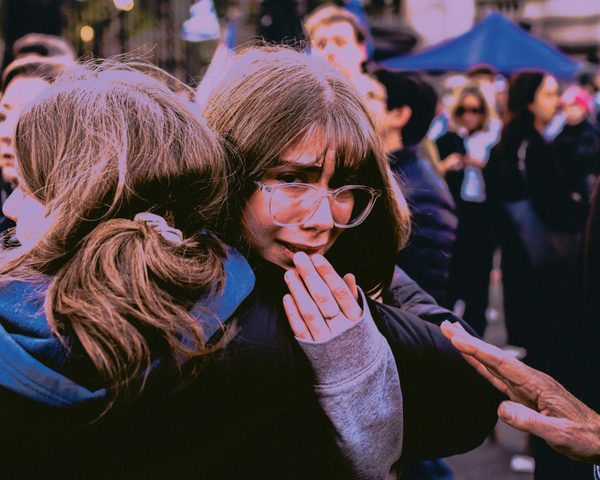
The JVP national members meeting was a show of force at a moment of alarming vulnerability to repression.
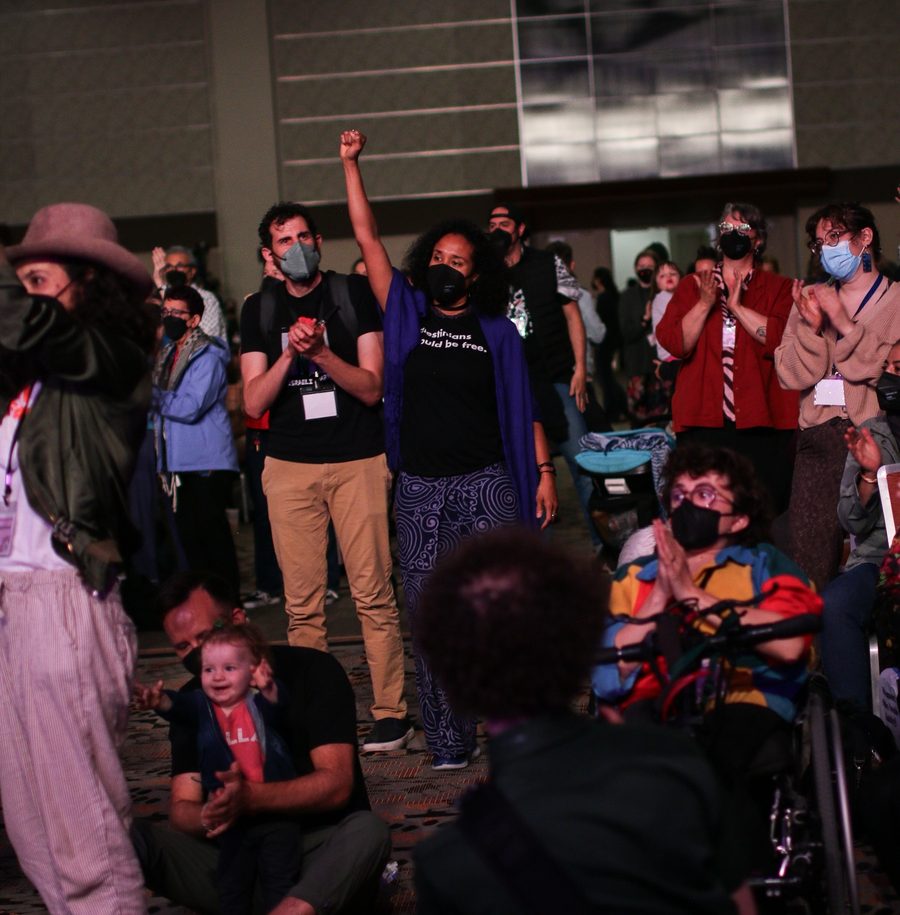
A scene from the JVP National Members Meeting in Baltimore, May 3rd, 2025.
On the first Sunday afternoon in May, the final day of the Jewish Voice for Peace (JVP) National Members Meeting in Baltimore, executive director Stefanie Fox took the stage to fortify the crowd for the work ahead. She laid out a lengthy list of threats to the movement for Palestine, many of them already on the tracks—from the potential revocation of nonprofit status and freezing of bank accounts to the criminal prosecution of activists—before switching into a personal register. Her voice softened as she spoke of a recent walk with her young son through an old growth forest near their home in Seattle. When they came upon a fallen tree, her kid began to tell her about “nurse logs,” relating how these felled giants became incubators for new growth, releasing nutrients and holding moisture in the soil so life could take root. “Look around,” Fox entreated the attendees, some of whom, after four days of nonstop workshops, lectures, performances, and organizing meetings, were spread out on the floor at the periphery of the audience, where they stretched, tended to children, or lay with heads resting on friends’ bellies. “This movement is an old growth forest. You can’t stop a forest from growing.” “What can we do,” she asked, “to ensure that no matter what they take from us, we are nurturing this movement forward?”
This ominous image, implicitly likening the organization to a fallen tree, was a striking note on which to close—a reminder of JVP’s alarming vulnerability to repression even at a moment of unprecedented influence. It cut a sharp contrast to the mood of the rest of the convening, which was by all accounts a show of force. The meeting drew over 2,000 attendees from 45 states, and featured distinguished speakers including politicians like Rashida Tlaib and Cori Bush and activist intellectuals like Naomi Klein, Angela Davis, and Noura Erakat. After decades spent countering a charge of marginality from the Jewish establishment (and sometimes, subtly, from other corners of the Jewish left), JVP now appears to be the beating heart of an anti-Zionist Jewish movement that polling suggests claims anywhere from a fifth to a third of American Jews. Since October 7th, those disgusted by the Israeli genocide in Gaza have flocked to the organization, which has doubled in size over the past 19 months, claiming 32,000 dues-paying members from over 100 chapters across the country. High-profile arrestable actions from an October 2023 takeover of Grand Central Station to a March 2025 sit-in at Trump Tower have made their black or red t-shirts, with the block-letter slogans “Not In Our Name” and “Stop Arming Israel,” a potent symbol of American Jewish refusal.
If the widely circulated photos of masses in JVP t-shirts show the organization’s power as a unified anti-war voice, the conference also showcased its particularities, embodying a robust cross-section of Jewish life. There were nightly meet-ups for Jews of color, workshops on Arab Jewish political storytelling and “disability justice and direct action” that quickly filled to capacity, and panels on navigating intergenerational organizing—the latter a particular necessity in a crowd that evenly spanned generations, from college students to those older than the State of Israel. Every morning, there was a well-attended traditional-egalitarian service, complete with a Torah scroll; a pomegranate symbol in the program indicated if a workshop was compatible with Sabbath observance. At a time when so many anti-Zionist Jews don’t have home communities or congregations, it was a rare glimpse of abundance in left Jewish life.
It would be easy to take this degree of diversity for granted, but none of it was inevitable. In the past decade, JVP has weathered a number of broad, internal conflicts about their ability to provide a political home for many of these groups. Last year’s book by former JVP executive directors Rebecca Vilkommerson and Alissa Wise, Solidarity Is the Political Version of Love, identifies a 2015 racial justice reckoning in particular as “undoubtedly the biggest test of our leadership.” When a caucus of Jews of Color, Sephardi, and Mizrahi members challenged JVP to better align its white- and Ashkenazi-dominated culture with its stated commitment to anti-racism, the organization eventually undertook a process that encompassed “almost every aspect of our work, from our internal communications to work with chapters and member leaders, campaign selection, HR policies and beyond.”
JVP has also long navigated challenges in its relationship to other movement organizations—a terrain that has only become more delicate since October 7th, as affective and strategic divides have sometimes opened up between Jewish and Palestinian-led formations that are otherwise aligned. And still, there were enough Palestinian organizers at the conference from a variety of groups—including the Arab Resource and Organizing Center, US Campaign for Palestinian Rights, Palestinian Youth Movement, and Adalah Justice Project—that they were able to hold their own internal meeting there. In particular, representatives from Palestinian groups helped to shift the focus of the conference when it seemed like the emphasis on building for the long haul drew attention from the stakes of the present: the continued Israeli starvation and bombardment of Gaza. “Many of them have families in Gaza who, at that very moment of the convening, could not survive another day without food and medical treatment,” Elena Stein, JVP’s director of organizing strategy, told me shortly after the conference. “They brought us that dire urgency.” In response, Stein said, JVP called in chapter leaders to stay longer after the convening for an emergency strategy meeting, planning campaigns aimed at pressuring Israel to let aid trucks into Gaza. “Whatever actions emerge in this next period will come out of that moment and the direct calls from our partners,” she said.
In some ways, that circumstance reflected the difficulty of assessing strategy at a time when nothing has worked. JVP has balanced boycott and divestment campaigns, direct action and narrative work, and—through their advocacy arm JVP Action—congressional lobbying. But nothing has stopped the slaughter in Gaza. Fox told me that while they were confident that they had the ingredients for the “next right step to keep emerging,” she admitted that “the short-term is really hard. We don’t know how to end the genocide.” In this environment, almost everything about JVP’s strategy can be called into question: Is it enough for civil disobedience to keep Gaza in the headlines, or should the group’s direct actions aim for greater material disruption? What good does it do to lobby Congress when they’re clearly not listening? As JVP Action political director Beth Miller put it, “the US Congress is one of the most anti-Palestinian institutions in the world,” which means that, for example, 19 senators voting to block certain weapons sales to Israel is both profoundly insufficient and an unprecedented win. But Miller stressed the importance of staying the course: “Our opposition is already in those spaces. If we are not, we are ceding that terrain entirely.” She predicted that Congress would be “the last to move,” but insisted that this is why JVP must keep fighting on multiple fronts: “They will move only once our movement has changed the cultural narrative in this country, and has shifted the political calculus for members of Congress.”
To speed the sea change it seeks, a mature JVP appears to be priming its base to stretch into a Jewish mass movement, with all the discomfort that entails. Over the course of the long weekend, I heard from all corners a militant commitment to Palestinian liberation complemented by a softer approach to relationships, oriented toward bringing people along. In her welcome speech, Fox asked attendees to commit to building “the biggest we,” to reach for connection over condemnation. She reminded members that, in engaging with comrades over the course of the weekend, “the point you’re making is not as important as the person you’re talking to.” In the workshops I attended, vital conversations that have been largely taboo amid the intensity of the past 19 months were tackled head on. (“If it’s mentionable, it’s manageable,” organizer and performer Morgan Bassichis told me, paraphrasing Mister Rogers.) A session on bridging divides between anti-Zionist Israelis and American Jews—in my experience, a frequent third rail in movement spaces—provided a space for Israelis to reflect frankly on the experience of feeling unwelcome in American activist spaces over the past year and a half, and to offer their analysis of how such ostracism functions as a bid to innocence by Americans displacing a reckoning with their own settler identities. Elsewhere, I heard students active in campus chapters brainstorming how they might begin to connect with—and thus, demobilize—liberal Zionists on campus repelled by Israel’s campaign of starvation. Other workshops aimed to use grief as a vehicle for “turning toward each other rather than on each other,” or to strengthen skills for dealing with interpersonal conflict against a backdrop of repression and despair. In the latter workshop, the writer and activist Dean Spade challenged the audience to reflect on their own behavior in movement spaces, providing exercises for staying focused on what we can control in relationships with others, and for identifying and managing the aggrieved states where we do the most damage. I could feel myself beginning to release the defensive crouch of these past months, as individual difficulties were reframed in collective terms. “It’s very hard to stay soft when you’re embattled. That’s how repression functions. It hardens you,” Fox told me. “The organizing space is a place where we can take the risk of staying soft with each other even when we feel attacked.”
But the attacks are coming: In a broad effort to criminalize pro-Palestine activism as “material support for terrorism,” there is no doubt that JVP is high on the list of targets. The group is mentioned prominently as a “Hamas Support Organization” alongside groups like Students for Justice in Palestine (SJP) in the Heritage Foundation’s Project Esther, a plan created last fall to quickly dismantle the Palestine movement in the first year or two of a favorable administration. Since Donald Trump has come into office, several of the plan’s planks have been put into action, including the investigation and attempted deportation of student activists and the revocation of grants to universities on the grounds of antisemitism. Meanwhile, more than two dozen nonprofits or funders have been threatened with congressional investigations into their tax and legal statuses. JVP has come up by name again and again in calls for such investigations, with congressional players referring to them as a “Pro-Hamas,” “anti-American,” “dark money” group.
Even more immediately, the group is facing a volley of attacks by a network of Trump-affiliated lawfare firms. At Columbia, for instance, a lawsuit brought by 15 Israeli and American plaintiffs, some of whom are family members of people killed or taken hostage in the October 7th attacks, accuses individuals in groups like JVP, SJP, and Within Our Lifetime of “aiding and abetting Hamas’ continuing acts of international terrorism,” even absurdly suggesting that students in campus groups had foreknowledge of the Hamas attacks. Other lawsuits, brought by the Hamilton Lincoln Law Institute, are suing JVP, among other parties, for damages on behalf of people who missed flights or work while being “falsely imprisoned” in their cars during highway blockade actions in Chicago or Washington, DC. “They’re just shopping for plaintiffs, throwing spaghetti at the wall,” Fox told me. Even if many of these cases are dismissed, they will have served their purpose, draining the organization of time and money. Already, the group has settled a suit with the Department of Justice brought by David Abrams of the Zionist Advocacy Center—a registered foreign agent with ties to the Israeli government—alleging fraud around JVP’s application for Covid relief funds. In a statement on their website, JVP announced their decision not to fight the “politically motivated” legal battle, saying the $700,000 settlement would cost less than a protracted lawsuit, which would constitute a distraction from their mobilization against the genocide in Gaza. (They also cited concerns that litigating the suit would require the federal government to access discovery documents “far beyond the remit of the investigation”—a serious concern for a group already facing surveillance.)
The knowledge of these threats hung in the background of the conference, somewhat tucked away until the closing plenary on the very last day. The effect was like being in a strange, protective bubble, as attendees focused squarely on the nitty gritty of continuing the work: attending workshops on running a good meeting, the art of the one-on-one, and documenting actions. (A skybridge from a hotel across the street to the convention center even insulated attendees from the single, small Zionist protest, penned within barricades outside the entrance to the convention center.)
I spoke with Fox about this dissonance a few days after the convening, while she waited to board a flight back to the West Coast, fresh off a day of congressional lobbying in Washington with students active in campus organizing. She told me about a series of leadership meetings in early 2025, as the litigation piled up and an emboldened right announced their ambitious intentions. The organization’s lawyers had already delivered a sobering assessment of its viability during an aggressive Trump regime, and leaders had to ask themselves: Do we stay the course or do we disassemble the organization, reconstituting ourselves differently while we still have agency? In one such meeting, Dorothy Zellner, an 87-year-old movement elder who lived through government repression of her Communist milieu during McCarthyism, shared her experience: “People talked about going underground to continue the fight. A lot of people went underground. Not everyone kept fighting.” The group debated the implications of this warning: As a Jewish organization with a membership largely composed of US citizens, it still maintains a measure of privilege even amid its targeting by Project Esther, members of Congress, and lawfare organizations. Now, it was being called to serve not just as a defense organization, but a kind of test case in its own right. “If we stop, then we’re showing that it can’t be done, that we can’t fight,” Fox said. That meeting was the precise moment when they decided to move ahead with planning the conference. “The only way to prepare is to be in motion.”

I’m Arielle Angel, editor-at-large of Jewish Currents. Before you go, there’s something I need to ask.
We’ve seen over and over how the mainstream media falters in telling stories on our beats—whether it’s antisemitism, Israel/Palestine in American politics, Jewish identity, or the American left. At Jewish Currents we’re committed to uncompromising analysis and longform reporting on these issues and more—stories you won’t find anywhere else. In a media landscape that obscures injustice and flattens discussion, we’re changing the conversation. But we need you.
If you believe in this work, please consider making a donation—or even better, a recurring one—to ensure that we are able to keep publishing stories like this one. We can’t do it without you.

Arielle Angel is the editor-in-chief of Jewish Currents.