Sand in the Gears
As the Trump administration draws down its invasion of Minneapolis, the citywide mobilization against ICE offers lessons in fighting the deportation machine.
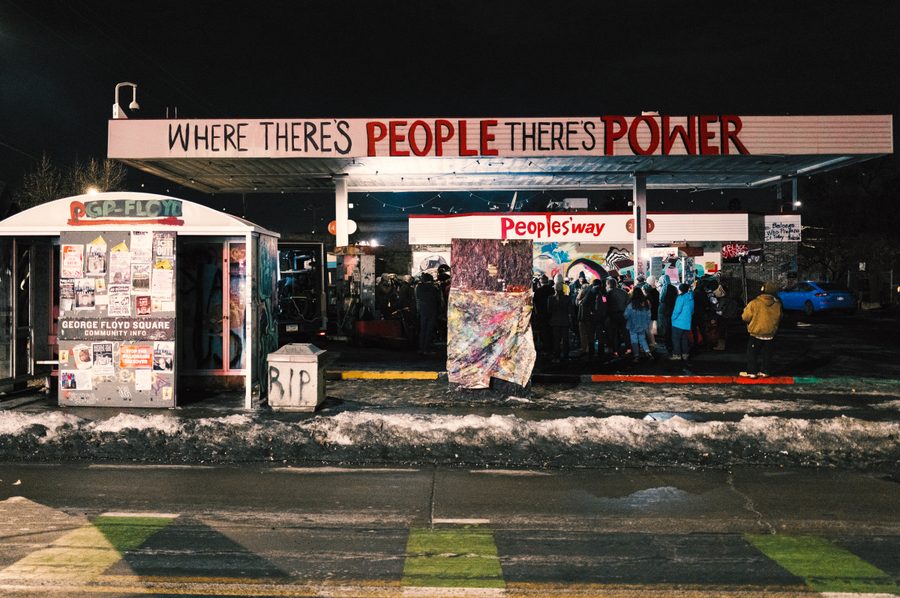
At George Floyd Square, the band Brass Solidarity plays as Minneapolis residents continue to pay tribute to Renee Good and Alex Pretti, February 9, 2026.
While I’ve lived in Brooklyn almost 20 years now, I still refer to Minneapolis as home. Over the last month, as I’ve incessantly scrolled through social media posts showing masked agents in military gear beat and abduct neighbors on street corners familiar from adolescent bike rides, I have felt a need to be back that surprised me with its physicality. My life and family are in New York now, and my responsibilities here aren’t easy to leave abruptly. I’m no longer connected enough to the organizing in Minnesota to be of any real use. But I couldn’t shake the feeling that I needed to be there. After Alex Pretti’s murder, I booked a last-minute flight home.
When I arrived, I drove to the corner where Pretti was murdered. A sprawling memorial had taken shape, a small sea of flowers and cards and posters and candles alongside a giant banner that read “Rest in Power Alex” and under that, “Any righteous person would have done the same.” Roughly 50 folks were standing in the cold as a young woman led the group in song, the fog of her breath drifting upward with each line: “We are justice, justice-loving people/singing, singing for our lives/We are neighbor, neighbor-loving people/singing, singing for our lives.” I was surprised by the beauty and serenity of the scene and found myself lingering to read the dozens of thank-you cards and poems and notes placed between the frozen flowers. From the memorial I drove through the North Side, passing small groups of observers in green vests who were watching for ICE vehicles outside schools, daycares, businesses, and community centers. I met a colleague at a coffee shop whose shelves were stocked with whistles, hand warmers, and eye wash—the standard supplies for ICE observers—and that in lieu of payment was accepting donations for mutual aid efforts in the neighborhood.
The next morning, after getting on a few Signal threads monitoring ICE activity, I drove to a corner not far from my parents’ house and joined a half dozen folks watching a black SUV with tinted windows circle the neighborhood. Everyone in the group lived within a block, and I can’t say they were enthusiastic about my arrival; infiltration of Signal threads and observation teams has become common. But after trading stories of Twin Cities teenage escapades, we split up into pairs for short walks in search of the SUV, blowing whistles as loud as we could each time we spotted it. Barely visible behind the darkened glass, the ICE agents would mockingly wave. After concluding the SUV had left the neighborhood, I joined my best friend since seventh grade at an action led by the Minnesota Federation of Educators in which over 300 teachers flooded one of the city’s many Target stores to demand that the company, which is headquartered in Minneapolis, no longer allow ICE agents to enter its stores without a warrant; similar actions unfolded at Target stores throughout the metropolitan area, each one led by a different union or community group. As we marched back out into the parking lot, cars of shoppers honked in appreciation and drivers rolled down their windows to shout “Fuck ICE!” On the way to my friend’s house, we had to wait for several turns of the traffic signal as a river of cyclists rode by in heavy winter gear, a roving squad scanning the neighborhood for ICE activity. Back in his family’s living room, friends stopped by, each conversation revolving around the action they had recently participated in or the mutual aid project they had helped organize at work. The dining room table was stacked high with homemade coloring books and markers, which would be delivered to kids around the city that weren’t able to leave their homes.
On my last day home, I visited a church in downtown Minneapolis for a gathering hosted by the Singing Resistance, a collective that had been meeting weekly to sing songs of solidarity. I tend to dismiss this sort of thing as performative and hokey, but taking in the scene—a crowd of 2,000 mostly middle-aged folks squeezed into a sanctuary that could hardly contain us—I was overwhelmed with emotion. After learning a few songs and listening to a short teaching on the need for anti-authoritarian movements to facilitate defections from the state’s apparatus, we all bundled up in thick coats and padded gloves, the only sound the rustling of all that fabric until we spilled out into the street, a singing procession stretching over several blocks of downtown. Staff from the many restaurants that lined these blocks stepped out to watch us pass, several of them weeping. When we arrived at the Marriott where ICE agents were staying, we sang in a round: “Put down your weapons/and sing your heart/we walk the same road/but we’ve been torn apart.” None of us believed that the sound of the song would lead to anyone quitting, but the act itself suggested a promise and possibility of redemption, and repair.
Several times throughout the weekend my mom would say, in fury and exasperation, “I can’t believe this is happening here!” It’s a common refrain, and it is undeniably shocking to see a paramilitary force occupy your city. But if you had asked me a year ago if I could imagine Trump sending ICE into American cities to round up immigrants at the point of a gun, I would have said I expected it. If you had also told me that something like 100,000 people in that city of half a million would organize to observe and harass ICE agents on their streets, to deliver groceries to thousands of families and give rides to thousands of children—if you had said that trade unions would hold sit-ins at Target to demand it cease its cooperation with ICE, that small businesses across the city, from the diners to the gyms to the clothing stores, would place signs on their doors saying “no ICE agents allowed entry without a warrant” and put bowls of whistles on their counters, and that all this would be unfolding and growing after federal agents had murdered two citizens in the street for observing ICE operations—I would have told you that no, I don’t see that happening, not in a country as shaped as ours is by segregation and anonymity and isolation.
I would have been wrong.
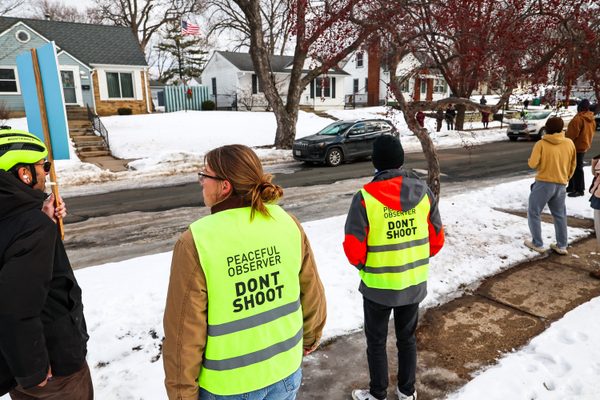
Observers gather while federal agents sit in a vehicle in Saint Louis Park, Minnesota, on February 10, 2026.
There are things about Minneapolis that make it distinctive—the neighborliness born from weathering winters bearable only when others stop to help push your car when it’s stuck; the fact that it has become a home for refugee communities, first from Laos and then Ethiopia and more recently from Somalia; its legacy of working-class politics (after all, the state’s Democratic party is still called the Democratic-Farmer-Labor Party); a Scandinavian Lutheran sensibility that prizes contribution to community; and a flourishing organizing culture in which people have forged strong networks and trained thousands over the last decade, particularly since Minneapolis police killed George Floyd. But as George Floyd’s murder itself attests, Minneapolis is also an American city. What was arguably the most thriving Black neighborhood in all of the Midwest was demolished to build the I-94 highway that connects St. Paul and Minneapolis. And while the city boasts some of the highest rates of life expectancy, home ownership, and income in the country, the rates of racial disparity are also among the nation’s highest. For those of us that can get cynical about such places and what is possible within them, the organizing unfolding in Minneapolis is inspiring enough to demand a reconsideration of some basic assumptions.
Most obviously, it turns out that under present conditions many, many thousands can not only be activated to take action for the first time, but can be activated to take time-consuming, risky, and militant action: hours spent delivering food, walking blocks in subzero weather, and of course confronting armed and masked men that have already assassinated others that have done the same. Much is made of the need for a “left-liberal” coalition to challenge American fascism, but in practice it turns out that what that looks like is huge numbers of liberals taking action familiar to the left. This is not to simplify the ideological context of what is unfolding, which defies easy categorization. From one vantage, it could be described as conservative; after all, this is a defensive effort whose aim is to restore a preexisting condition. But the movement also implicitly (and often explicitly) rejects the authority of the state. There is a lot of appropriate and necessary talk around constitutional integrity and the violation of due process, but nobody delivering food to a family that is too afraid to leave their home is asking about the status of their immigration case. The fault line is not between legal and not, but between inhumane and decent.
Much of the reporting on Minneapolis describes what is unfolding as a surge of “widespread protest.” But that’s not quite right. There have been protests, but few that follow the familiar pattern of large numbers of folks waving signs and chanting demands. That kind of activism attempts to make visible a collective, a mass in which each individual is subsumed into a larger display of political unity. The more militant versions, like the shutdowns of highways, ask that participants “put their bodies on the line,” but those bodies are generic—they could be anyone’s, so long as they are used to disrupt.
Against that backdrop, the most striking feature of the organizing in Minneapolis is how personal it is, how inextricable the actions are from the lives of those participating in them. Parents are picking up kids on the way to their school; neighbors are blowing whistles and filming on their blocks; bartenders are organizing fundraisers at their bars; folks are dropping off groceries collected by their church. People good with data maintain spreadsheets to help identify ICE vehicles, cross-referencing the constant stream of license plate numbers that fill Signal chats against registration databases. Gifted musicians bring their friends together to sing, and a few weeks later one of the city’s largest sanctuaries is filled to capacity. In this country, politics is generally understood as a realm separate and distinct from one’s private and professional life, necessary in order to protect the “non-political” spaces of community and friendship and family. The eruption of organizing in Minneapolis offers a glimpse of something different. Politics has become part of the fabric of life, embedded within community, work, school, and family, reflecting particular capacities and personal talents and individual passions. It is hard to hold the sense of possibility this organizing inspires together with the horror of what provoked it — thousands ripped out of their communities and put in cages, families devastated by separation, and children evicted from their homes because their parents know that simply by driving to work, they could end up facing the barrel of a gun. But what has emerged in response is among the most powerful organizing I’ve witnessed: courageous and ordinary, massive and intimate, varied and coordinated, strategic and beautiful.
As the Trump administration draws down its invasion of Minneapolis and funding for Homeland Security is held up in Washington, it’s clear the extent to which the administration has suffered a significant defeat, and the resistance a victory. But it’s not clear how much of the organizing we’ve seen in Minneapolis is replicable. ICE will soon be deployed in other cities and neighborhoods, and when they are it will undoubtedly look different. Nonetheless, the organizing in Minneapolis offers a basic lesson. The fight against fascism is not going to be won through mass marches along Broadway. It is going to be won by getting enough sand in the gears of the regime’s machine. Unsurprisingly but still remarkably, throwing sand in the gears of a machine hell-bent on crushing people means, it turns out, caring for people. In that simple fact lies some possibility, and some power.

I’m Peter Beinart, editor-at-large of Jewish Currents. Before you go, I need to ask something of you.
In recent years, I’ve watched as mainstream Jewish institutions and media have chosen ethnonationalism over liberal democracy and mass slaughter over the pursuit of a just peace. Jewish Currents offers something different. It’s a magazine built on intellectual curiosity and respect for the dignity of all people.
But a project like this doesn’t sustain itself, and we can’t do it without your help. If you share my belief in the importance of this mission, please consider making a donation—or even better, a recurring one. We need you with us.
Daniel May is the publisher at Jewish Currents.