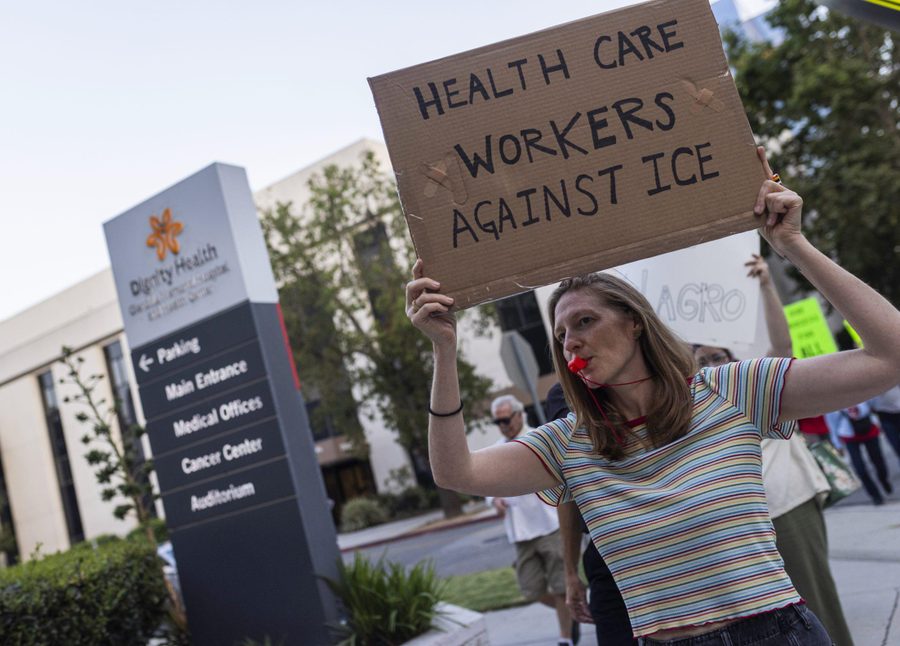
Protesters gather outside Glendale Memorial Hospital in Glendale, CA, on July 17th, 2025.
For months, the federal government has sustained a relentless assault on the people of Minnesota. Every day, masked agents disguised in civilian clothes or casually sporting military gear have snatched up loved ones without even the pretense of due process. They’ve kidnapped children and used them as bait; they shot a mother of three in the face and blocked her from receiving medical aid while she still had a pulse; they unloaded a magazine of bullets into an ICU nurse trying to help a woman who’d been pepper sprayed. Alongside this spectacular violence, we’ve also witnessed a quieter erosion of well-being. From my position as an urgent care provider in the Twin Cities, I’ve seen how the occupation has restricted access to critical medical treatment. Pregnant mothers are forgoing desperately needed prenatal care, while patients with kidney failure are missing dialysis, all from fear of being taken on the way to their appointments.
They’re right to worry. The federal government has turned what should be safe havens into places of peril: ICE agents have violated HIPAA policies by forcing themselves into patient rooms, and have even shackled patients to their beds. Where there has been institutional resistance, the regime has been brutally effective at crushing it. After Hennepin County Medical Center, a major Minneapolis safety net hospital, adopted strong policies to protect their patients from ICE, the Department of Homeland Security punished them by issuing a subpoena demanding employee information, including home addresses and social security numbers, to determine whom they could deport. Now, healthcare organizations here and across the country are weakening patient protections to comply with the administration’s demands, in the hope that acquiescence will protect them from scrutiny—and ultimately the loss of crucial funding. For instance, some Minnesota health systems, including my own, have begun requiring providers to treat patients in ICE custody as “prisoners,” as if they’ve been tried and convicted of a crime. As institutions submit, the question facing those of us within them is: How can we continue to resist?
One recent evening, ICE arrived at my workplace with a young woman who’d been detained at the Bishop Henry Whipple Federal Building; they wheeled her into a private patient room with shackled ankles. My colleagues and I had no idea what to do. We called our supervisors, who called risk management, who called the legal team, all of us trying to figure out what degree of compliance was expected—and how we could help her. At first the ICE agents insisted on staying with her, but the medical assistants convinced them to sit in the room across from hers, on the condition that all the doors remained open. I signed up for the patient, reviewed her chart, and—feigning ignorance of the negotiation—closed the door as I entered her room.
The patient recounted what had brought her here, as a Spanish interpreter on an iPad screen translated her words. She had been taken into ICE custody that morning on the way to work. As she spent the day lying on a cold and crowded cement floor with countless others, she kept losing consciousness. No one in her family knew where she was because she’d been denied access to a phone—but even if she could call her loved ones, she told me, she wouldn’t want to risk endangering them. I lowered the volume on the iPad so the agents couldn’t hear. I asked her if she had any children; my question triggered a panic attack, and she began to shake and sob. My chest tightened, and a lump formed in my throat as I desperately tried to control my facial expression; on the screen, the interpreter pursed her lips to steady her quivering chin. I considered leaving the room to collect myself—that’s what I’d normally do. But I knew ICE was right across the hall, watching the door, and I worried that if I stepped out, they’d use it as an opportunity to intervene. So I stayed, and the three of us all cried together.
When the patient gathered herself, she told me she did have children. She wanted her husband to know where she was, but knew if they were both deported, her kids would have no one left. As I examined her and prescribed medication, I considered my options. The protocol at my workplace does not allow “prisoners” to make or receive phone calls unless authorized by the custodial agency—but she was not actually a “prisoner.” So I asked her if I could update her family about where she was and contact a lawyer on her behalf. She said yes. I took my time with the encounter; because Minnesota is so progressive, ICE has been shipping people down to Texas within 12 hours of their abduction, to appear in court in front of a less favorable judge and increase their likelihood of deportation. The longer she stayed with me, the more likely she’d miss that evening’s transport to Texas, which would give me more time to find a lawyer. When I told her I needed to give her back to the agents, my stomach twisted into a knot; I felt indescribably helpless. But she seemed more at peace, knowing that family would at least know where she was.
After I left the clinic, I went to the home of a fellow activist, who translated for me as I called the patient’s husband and told him where she was, and who connected me with a lawyer. This activist is part of a vast network of people working with lawyers to submit habeas corpus petitions—legal court orders that allow a person to challenge their detention by having a judge determine whether it has a lawful basis. Anyone can submit such a petition, but by doing so, I was violating a hospital prohibition on working with legislators and advocacy groups, due to concerns about releasing patient information. I filled out an affidavit saying that the patient was at high medical risk of morbidity and mortality while in ICE custody, citing the fact that more than 30 people had died in their care in 2025. We submitted the petition early the next morning. And then we waited.
I spent the next few days anxious and despondent. Did ICE give her the medications I’d prescribed? Was she still at Whipple, or already in Texas, hundreds of miles from her family? Did I do enough? Should I have done more? Did I do too much? Would I lose my job? Could I have lived with myself if I’d followed my employer’s policies and simply diagnosed and treated her symptoms, without acknowledging or addressing the context that was making her sick? And as terrible as the circumstances were, I was haunted by all the ways they could have been even worse. What would have happened if she hadn’t been sick enough to be brought to a medical provider? Besides the ICE agents, I was the only person in the world who’d known where she was, as her family nervously waited for her to come home. If she hadn’t shown up at my clinic, she would have disappeared without a trace. A few days later, desperate for an update, I checked in with the activist and was told that the habeas corpus petition worked; she would be able to return home to her family, at least for now.
As ICE terrorizes our city, my colleagues and I have struggled to understand how to best help our patients. The siege has muddied what should be perfectly clear: As healthcare providers, we are mandated reporters for vulnerable patients, meaning that we have the legal authority and obligation to report suspected incidents of abuse, neglect, or exploitation to the relevant authorities, including sharing patient information. But if providers are tasked with reporting abuse to the state, what happens when it occurs at the hands of the federal government? And how can we, as individual providers within larger healthcare systems, protect our patients when our institutional policies do not? Providers have been building covert care networks: working to intercept patients when they enter the healthcare system under ICE detention and directing them to legal resources to negotiate their release, while establishing encrypted communication systems and strategies to meet the medical needs of patients sheltering in place at no cost. But working outside of the healthcare system has many challenges. How do we document, prescribe, and follow up with folks, especially those without insurance, while protecting our medical licensure? How do we maintain secrecy to ensure that ICE agents do not infiltrate our networks? How do we navigate the security risks to which we are subjecting our patients and ourselves?
While Operation Metro Surge allegedly winds down, these questions will remain pressing, and the care will remain urgently needed, whether or not the abductions stop. Many people are still afraid to leave their homes; countless children are traumatized after witnessing federal agents kidnap their teachers, their classmates, their parents. As ICE invades other cities, we will all need to ask what we can do—and what we are willing to risk—to stand in the way of our country’s descent into unadulterated fascism.

I’m Peter Beinart, editor-at-large of Jewish Currents. Before you go, I need to ask something of you.
In recent years, I’ve watched as mainstream Jewish institutions and media have chosen ethnonationalism over liberal democracy and mass slaughter over the pursuit of a just peace. Jewish Currents offers something different. It’s a magazine built on intellectual curiosity and respect for the dignity of all people.
But a project like this doesn’t sustain itself, and we can’t do it without your help. If you share my belief in the importance of this mission, please consider making a donation—or even better, a recurring one. We need you with us.
Muna Hada is the pseudonym of an urgent care provider in the Twin Cities.