Process of Punishment
During my bid for clemency last year, it was clear state officials didn’t care about my rehabilitation—or about helping the victim’s family heal.
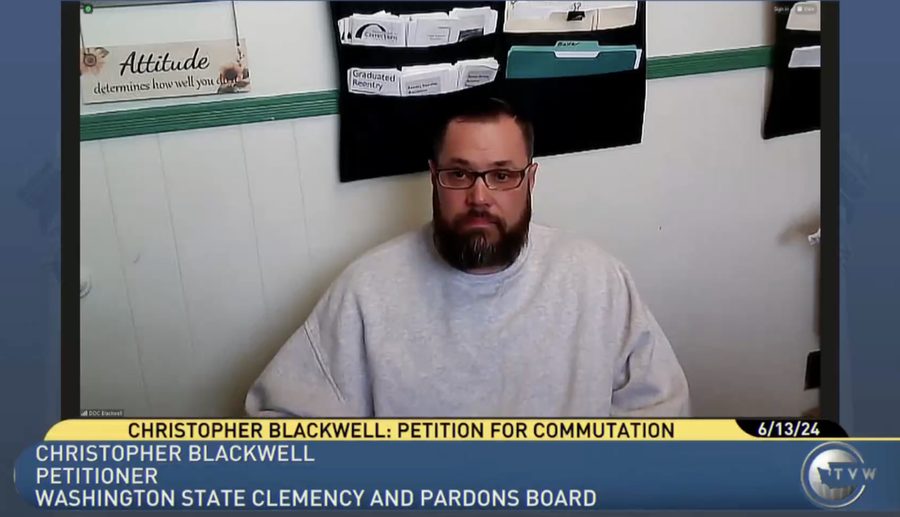
Christopher Blackwell at his clemency hearing, June 13th, 2024.
Nothing I learned in the nearly 23 years I’ve spent incarcerated had prepared me for the three-hour hearing—not the thousands of hours of schooling and self-help programs, nor my work in restorative and transformative justice. When I logged onto Zoom last year on June 13th to appear before the Washington State Clemency & Pardons Board, I didn’t yet know that I was entering one of the toughest encounters of my life.
For those of us incarcerated in Washington, clemency hearings are the main avenue of possible early release. There is only the haziest outline of a standard procedure: The incarcerated person appears in a virtual, publicly accessible hearing before the five-person clemency board. There is no rubric for evaluation; the decision is made purely at the whim of the governor-appointed board members, who, after several hours of asking questions, vote on whether they think the individual deserves clemency. If the majority votes affirmatively, the recommendation proceeds to the governor for his sign-off.
Even before the hearing, the Pierce County Prosecuting Attorney’s Office in Tacoma had been at work ensuring the process would not run smoothly. Over the course of a year, the clemency board had proposed dates for my hearing. Again and again, the prosecutors had ensured the hearing was delayed. They needed more time, they said. Or, I didn’t actually deserve a hearing at all because I hadn’t yet completed the mandatory minimum sentence. They spent months stalling, trying to figure out a way to achieve their singular goal: to keep me in prison for two more decades, the remainder of the 45-year sentence I am serving for taking the life of a young man named Joshua in a drug robbery gone terribly wrong.
On June 13th, 2024, my hearing finally took place. Over the course of three grueling hours, the prosecutor assigned to my case and the clemency board members interrogated me and my loved ones. When my wife Chelsea—with whom I co-founded Look2Justice, an education and advocacy organization which aims to transform the criminal legal system—spoke about how my profound regret for the harm I caused has turned me toward a life of careful consideration for the impacts my actions have on others, a board member seemed skeptical, responding by asking her if I get angry. When a mentor testified to my transformation, underscoring how I had left my old destructive social circles and nurtured a community of people committed to mutual accountability, that same board member asked how much time we’d spent together, as if to say: How well do you really know Chris? It did not feel like she was trying to better understand my relationships; it felt like she was trying to discredit them.
Even though my appeal for clemency is supposed to be evaluated based solely on the person I have become, the prosecutor insisted that, regardless of my rehabilitation, it would not be fair for me, a white-passing person, to be released while my Black and brown co-defendants remain in prison. This was hard to hear coming from a white woman who advocates for the incarceration of Black and brown people every day—and whose office was responsible for the extraordinarily harsh sentencing my co-defendants received in the first place.
It was painful to watch my loved ones be treated with such distrust and to hear my co-defendants used as pawns in the prosecutor’s agenda, but by far the most difficult part of the hearing was when my victim’s father spoke. He was hurting deeply. In the more than 20 years since his son’s death, he told us, “Nobody’s helped us. We have been handling this on our own.” The only time anyone from the state system had reached out to the family was to notify them when I was being moved from one facility to the next. The prosecutors, who made such a show of concern for his well-being, had extended nothing but the promise that I might sit in prison for decades. He was frustrated I’d never tried to reach out and explain myself.
But I had reached out. Years earlier, I had written a letter to my victim’s father and his family. I wanted them to know I understood that I’d caused them irreparable grief—and that I would spend the rest of my life in service to others in Joshua’s name. I submitted the letter to the Department of Corrections (DOC) Victim Services Letter Bank, which provides incarcerated people the opportunity to address those they’ve harmed. The DOC never informed the family of the letter.
Now, during the hearing, board members put my victim’s father directly in conversion with me. It wasn’t easy to face a person I had taken so much from—and I know it had to be a thousand times harder for him. After all, this was the first time he had seen me since the day I was sentenced, and without his consent, we were thrust into an unmediated conversation. One of the board members instructed me to tell the father why, after taking his son’s life, I deserved to go home early. My mind was racing. It felt cruel to try to convince him of anything. From my own training as a facilitator in restorative practices, I knew this wasn’t how it was meant to happen. We each should have been offered months of support to prepare us for this encounter. He should have been engaged in extended conversation to be sure he wanted to face me at all. But I had no choice: If I didn’t respond to the board’s request, they were unlikely to recommend that my parole be granted.
Through tears I tried to help my victim’s father understand how sorry I was for taking his son’s life. I pledged that I would never use violence again. I reiterated my dedication to service. That was all I could offer. That’s the thing about taking a human life: You can never give it back. The best you can do is to commit to helping others not to make the mistakes you did.
My victim’s father did not feel that I should be released before serving my full sentence, but he gave me something far more meaningful: his forgiveness. The values he derives from his Christian faith led him to this act of mercy, he explained. I was in awe of his bravery, of the way his faith guided him toward what he believed to be right. Still, I could tell this process had done nothing to support his healing. I yearned to do something about that. I struggled to stay present as the board members continued with their questions until, finally, it came time for them to vote.
One woman said there wasn’t much to think about. In her eyes, I hadn’t done enough time inside. She motioned for a “no” vote. Another board member seconded that motion. I was doing great work from prison, she said. I should just keep doing it there. My heart sank. Just one more “no” and the board would recommend that Governor Inslee deny my petition for release. I had spent the past decade engaged in transforming my life and working to better my communities, but none of that mattered to their decision.
As I waited for the final blow, one of the board members, a former public defender, made a bold statement. Raymond Delos Reyes argued the idea that an arbitrary number in the form of a mandatory minimum sentence—a practice originally instituted by lawmakers in the 1980s to quell public panic about rising crime rates, and which is now widely recognized as harmful—should not prevent me from receiving the board’s endorsement. “We don’t get to put numbers on grief,” Mr. Delos Reyes said. Joshua’s life was infinitely valuable; so, too, he believed, is the human capacity for transformation. He motioned for a “yes” vote! The remaining two board members concurred. The tide had turned. I was going to receive a 3-2 vote. Suddenly, I felt the possibility of returning to my family and all the work I could do in my community. Tears filled my eyes. As I listened to the board members tell me how important it was not to lose sight of this blessing, I couldn’t help but watch the father’s face. Was this whole production making his life even more difficult? Was I causing more trauma? Was there something I could do to help? It was impossible to tell over Zoom.
As soon as the hearing was over, I raced back to my living unit and called my wife. When she picked up the phone, we were both crying. We had fought so hard to get here. We just kept asking each other if this had really happened. After a few minutes we decided to call my lawyer, Jeff Ellis, who had been fighting for me for almost ten years. “We have to do something for the dad,” I told Jeff. “I want to help him heal.” “Let’s get you home, my friend, and we will,” he responded. We all thought my release was imminent. After all, the liberal governor had been consistently following the board’s clemency recommendations, and he was now at the end of his final term, when governors are usually most open to granting clemency without worrying about backlash from voters.
However, in the weeks that followed, the prosecutor reached out to the governor’s office opposing my release. During the hearing, even the prosecutor had admitted that I was accountable, rehabilitated, and remorseful. But she insisted that only one thing mattered in the end: The punishment hadn’t been served. We later learned that she had key connections to get this argument across to Inslee’s team—she and the lawyer in the governor’s office in charge of making the final clemency recommendations had previously been coworkers. I had never had a fair shot. Months after the hearing and on the heels of hundreds of hours of work from my support team fighting the prosecutor’s continued attacks, Jeff received a letter: The governor would not be granting my clemency.
I struggled to grasp who the denial was serving. My co-defendants were not freed by it. My victim’s father was not offered any additional support. In the end, it seems that my denial only served the bureaucratic system that has held me captive since my first encounter with it as a 12-year-old child from an impoverished and over-policed community who was forced, like many, to live in survival mode. Today, as I wait for another chance to go home, I, along with my legal team and others in my support network, are working toward addressing the state failures that shaped my case—advocating not only for myself, but also for my codefendants, who should be at home with their families; for the victim’s loved ones, who deserve robust support in their healing; and for all of those impacted by a system that devalues relationships and thrives on punishment.

I’m Arielle Angel, editor-at-large of Jewish Currents. Before you go, there’s something I need to ask.
We’ve seen over and over how the mainstream media falters in telling stories on our beats—whether it’s antisemitism, Israel/Palestine in American politics, Jewish identity, or the American left. At Jewish Currents we’re committed to uncompromising analysis and longform reporting on these issues and more—stories you won’t find anywhere else. In a media landscape that obscures injustice and flattens discussion, we’re changing the conversation. But we need you.
If you believe in this work, please consider making a donation—or even better, a recurring one—to ensure that we are able to keep publishing stories like this one. We can’t do it without you.

Christopher Blackwell is an award-winning journalist currently serving a 45-year prison sentence in Washington State. He is a contributing writer at Jewish Currents and the co-founder and current executive director of Look2Justice.