A Body That Outlived Its Heart
The grief that at first flowed with my tears now has calcified in my chest with no release.
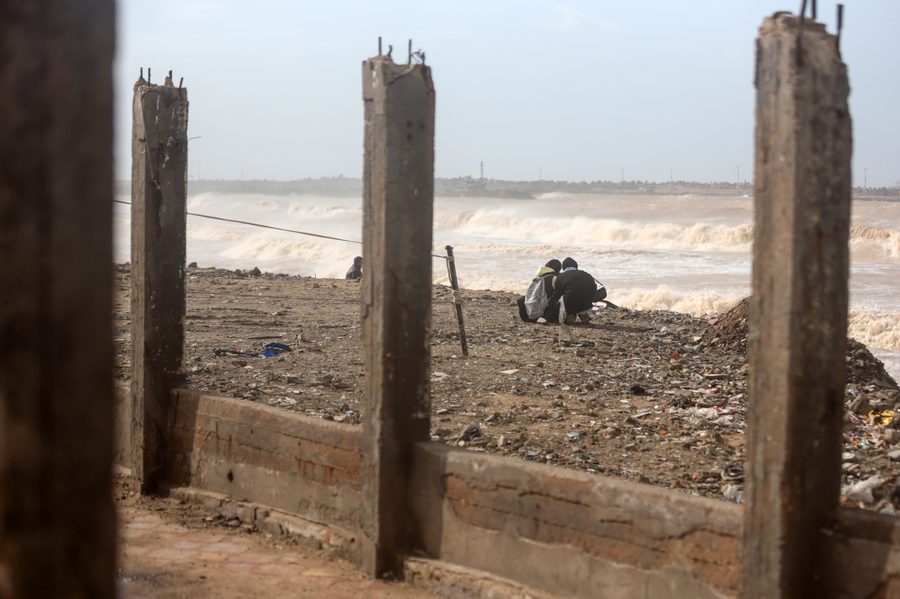
By the sea in the central Gaza Strip following heavy rains, December 29th, 2025.
I lost my cousin Sari on the third day of the war. My father’s phone rang. It was my uncle Rafiq: “Sari is gone . . . I was beside him.” For a moment I waited for my father to say it was a mistake, but he didn’t. I cried as I had never cried before.
It was the first death that ripped something out of me. His face stayed etched in my mind, his voice echoed inside me however I tried to escape its memory. I could not imagine that life could go on after him. And yet, life went on in a strange way, as if dragging me forward against my will.
After Sari, many others were lost. Members of my family, people I saw every day. Each of them was killed at a different time and in a different place, as if death kept returning to me in new forms to finish what it had begun with Sari. With each loss, I felt something else break inside me. And yet I did not cry as I had the first time. It was as if my tears had run out, or as if my heart had learned to protect itself with silence. I heard the news and felt I should collapse, but something inside me was rigid. No sound came out, no tears fell. Sometimes I sat alone and blamed myself: “Have I lost my humanity? How can you not cry for your relatives? How has death become ordinary?”
Another question also haunted me: Why am I alive when they are not? I had no answer. I tried to console myself by saying I remained to write, to be a witness. But this justification collapsed quickly. Inside me, a voice screamed: “You are a traitor because you survived while they did not.” Guilt hovered over me like a shadow.
Over time, I have realized I am no longer the same person. The grief that at first flowed with my tears now has calcified in my chest with no release. And the fear that once dominated my body has begun to fade. In the beginning, when the bombs fell, the trembling of my jaw would not stop. My body shook on its own, my breath breaking even as I sat motionless. But now I no longer have the strength to fear, as if everything I have endured has drained the last drop of my ability to feel. I don’t flinch at the news of an entire family being killed. I don’t shake at the sound of nearby bombing. I am not searching for my tears anymore. It is as if I have become another wall of Gaza, shattered, but still there.
The pain has not ended, but its shape has changed. The question “Why am I alive and they are not?” no longer torments me. A harsher question has replaced it: “Am I truly alive, or just a body moving with a dead heart?” A heart that no longer trembles, no longer rages, no longer breaks, but instead stands in a terrifying silence.
I write because writing is the last trace of feeling. And perhaps in writing I discover that a dead heart is not complete death, but a stage the survivors pass through to keep going. Yet I know that I am no longer the person I once was. I am alive, yes, but alive with an empty heart. Perhaps that is the cruelest form of survival.

I’m Arielle Angel, editor-at-large of Jewish Currents. Before you go, there’s something I need to ask.
We’ve seen over and over how the mainstream media falters in telling stories on our beats—whether it’s antisemitism, Israel/Palestine in American politics, Jewish identity, or the American left. At Jewish Currents we’re committed to uncompromising analysis and longform reporting on these issues and more—stories you won’t find anywhere else. In a media landscape that obscures injustice and flattens discussion, we’re changing the conversation. But we need you.
If you believe in this work, please consider making a donation—or even better, a recurring one—to ensure that we are able to keep publishing stories like this one. We can’t do it without you.
Abdullah Hany Daher is a Palestinian writer and journalist from Gaza. He documents the human stories of war, aiming to preserve voices that the rubble cannot silence.