Beirut Fragments

An account of Israel’s 1982 bombing campaign echoes through the decades.
It was Friday, June 4, 1982. There was to be an athletics awards ceremony at the International College, near the American University of Beirut. My youngest son, age eleven, was to receive an award for soccer. We had arranged that his brothers and I would meet him at the playing field after school and proceed to the ceremony. As I stood at the edge of the field beckoning to him, the war began. It was a little after three o’clock in the afternoon.
It took a few minutes for it to register in my mind that something serious was happening. The clear blue sky was being embroidered with the white lines left by the darting jets, their silver shapes gleaming as they dived, turned, dived again, and flew off, screaming, spewing their glistening missiles and heat balloons. In a few seconds the sky was dotted as well with the explosion of hundreds of anti-aircraft shells.
At first, the children on the soccer field, the teachers who had emerged from the school buildings, the bus drivers leaning against their green and white vehicles, other passersby, and I stood, mesmerized, looking up at the planes.
For years the Israelis had been bombing Lebanon. Most often they bombed the south and then passed screaming over our heads here in Beirut. Sometimes they flew so low that their sonic booms shattered our windows, as they did our nerves. Usually they were fired at by anti-aircraft guns situated on the coast and near the Palestinian refugee camps. There was no possibility whatsoever that the Lebanese air force, such as it was, could offer the slightest challenge to the Israelis. Indeed, the air force and its antique planes were often the subject of cynical jokes among the population. Long ago, air raid sirens had stopped wailing at the Israelis’ approach, and long ago the government had stopped issuing civil defense warnings of any kind, thus acquiescing to the inevitability of their passage. Civilians, especially outside the refugee camps, were on their own to make a decision about what precautions, if any, to take during the passage of the planes. Generally, people rushed out to their balconies or craned their necks on the streets to get a better look, pointing with strange fascination at the direction they had taken.
There was a peculiar relationship between Beirutis and the Israeli planes: If one dared, one might almost call it romantic. In this attitude was a strange commingling of repugnance and desire, alienation and belonging, intimacy and coldness. It was partly admiration for the breathtaking technology; for the sheer physical beauty of the gleaming, silver streaks in the clear blue skies; for their seductive elegance. Partly also it was the soaring sensation one felt as, fixed to the earth, one watched as they flew and turned, dived and soared again, extraordinarily free and graceful, unchallenged masters of the sky. There was a shared experience with them, the crucified and the crucifier united in those moments, in the possibility of godhead in us all, the taking of life and the suffering of sacrificial death, because always the death they delivered was perceived as sacrifice. In a sense there was in that foolhardy, neck-craning, finger-pointing refusal to take cover a kind of symbolic appropriation of the technology and mastery of those silver screams in the sky.
There was a peculiar relationship between Beirutis and the Israeli planes: If one dared, one might almost call it romantic.
The attitude toward the planes betokened as well a kind of grudging admiration for the Israelis. They at least had succeeded where everyone else had failed. There we were, foundering in the violence that had plagued us all these years, and there were they, masters of the game, watching and recording our misery as they flew overhead year after year, mocking the threat of the anti-aircraft guns.
Always the Israelis announced that they had bombed “Palestinian targets” or “terrorist bases.” Always there would be terrible anger and bitterness, not only at the raids themselves but at the hypocrisy of the announcements. If the targets were often Palestinian refugee camps, they were as often Lebanese villages; and if some fighters were killed, the majority of the victims in either case were civilians. The pictures in the papers were always the same: babies and old men, Palestinian and Lebanese, lying dead or dying; bits of bodies, shops, and cars; houses reduced to unrecognizable rubble; an old woman, wiping away her tears, picking her way through the ruins of her home, holding up a picture, perhaps, a saucepan, a bent and twisted vase—items that had once been part of her life and now had lost all meaning.
There was a certainty that day that the planes were not coming at us here in our haven of Ras Beirut. We all knew that their targets must be the Palestinian refugee camps on the outskirts of the city, so we could stand and watch with impunity. In fact, the danger that afternoon came, ironically, not from the planes themselves but from the shells fired at them; and several children were injured by the shrapnel falling out of the sky. By the time school officials had peremptorily shepherded everyone indoors, it was abundantly plain that this was not just another Israeli hit-and-run attack. In fact, the air raid lasted about two hours.
I stood inside the school building, surrounded by the sweaty bodies of dozens of boys, thankful that at least I was with my sons and didn’t have to worry, as so many mothers did that day, whether they were safe, whether they were on the road, whether they were sensible enough to take cover.
Some of the younger boys in the crowded school corridor were visibly frightened and on the brink of tears. Some of the older boys, blasé and seemingly immune to fear after years of war, just carried on punching one another and making crude jokes about each other’s awkward shapes. A pimply fifteen-year-old standing behind me chattered with his friend, his voice alternating between soprano and bass registers. “This must be,” he croaked cheerfully, “their response to the shooting of the Israeli ambassador in London yesterday.” Then he added acidly, “If they did all this for one ambassador, think what they would have done for two!”
In fact, for the next few days we were to hear a great deal about that ambassador. Although the PLO had denied responsibility for the shooting and, indeed, had roundly condemned it, Israel held the PLO responsible and, as usual, claimed the right of retaliation. After a while nobody mentioned the ambassador anymore, until—several tens of thousands dead later; several hundred thousand refugees later; after large parts of Tyre, Sidon, Damour, and Beirut, not to mention dozens of other towns and villages had been destroyed—there was a small item in the newspaper that he had survived and been discharged from the hospital.
A proverb had grown popular over the years: Whenever the clouds gather in the Arab world, it rains in Beirut.
By June 6, we knew that an invasion had begun in earnest. The Israeli army had crossed the border. At first, the number of troops mentioned was so staggering that we thought there must be some exaggeration in the reports. Since the Israeli evacuation from Sinai began to be discussed, and long before it actually took place, it was clear to everyone in Lebanon that the price for Egyptian peace would be paid here. A proverb had grown popular over the years: Whenever the clouds gather in the Arab world, it rains in Beirut. So at last, and to no one’s surprise, it had come, just a few weeks after the withdrawal from Sinai, but the scale and scope of the invasion and the toll it would take had not been imagined.
That evening, we watched the television news, maps in hand. It had been announced from Israel that “the operation” was called “Peace for Galilee” and that the Israeli aim was to create a forty-kilometer “security zone” to protect the citizens of Galilee from “the terrorists” who had, just a few days before, shot the ambassador in London. Once more we were faced with Israeli claims of the need to secure its borders, of moral justification for the attack. In our own perception, Israel was an unshackled aggressor, being granted a moral cloak by the world’s—at least the Western world’s—unquestioning acceptance of its claim to morality. In the West, its regularly recurring acts of violence seemed always to be regarded as aberrations.
After lingering on the immense damage caused by the air raids of the last three days, the news program showed an episode that demonstrated the irrelevance of all else to the actual experience of horror. The body of an Israeli pilot, killed in the crash of his plane, was in the hands of the people of a village in the south. They were beating it, kicking it, cursing, their faces distorted in rage. Sitting, horrified, in my still comfortable living room watching this frightful episode, I tried to switch off the set to prevent my children’s seeing it. They showed a morbid curiosity—natural, I suppose to children of their ages—and insisted on watching. Finally, I gave in, feeling that they had been through so much war, had been at risk of losing their lives so often, that I had no right to censor even war’s ugliest realities from their knowledge. We argued about the villagers’ response. “What would you do if we had been killed?” they asked. “What if you had lost everything in an air raid?” “I hope,” I said, “I hope I wouldn’t do that.”
No doubt the villagers had been restrained eventually, and the body rescued from their hands; but who was I, sitting comfortably in Beirut, to disapprove their reaction, their impotence in the face of the continuous Israeli air raids, destroying year after year their people, their homes, their crops, their lands, translated into this one mad gesture of revenge and hate? In the months that followed I was to think often of this episode.
On Monday, June 7, we awoke to the news that there was to be no school for the boys, although the universities muddled on. At first final exams for schools and universities were postponed; later they were canceled altogether. Almost every school in West Beirut was eventually converted into a refugee center or a clinic; and the question arose, as the summer wore on, whether there would be a school year at all after the invasion. Still, teachers did manage to produce final grades for every student, and the academic year was, though abbreviated, completed.
On Tuesday afternoon, as a result of the Israeli air raids on Jiyyeh, south of Beirut, where a major power station lay, the electricity went off. The power was to be restored a day later but rationed; later, of course, during the siege, we learned to live without electricity at all. At this point, however, there was a flurry of emptying freezers that had been stocked just the day before in anticipation of possible food shortages. In the next few days, if one dropped by to see a friend and exchange news, one was inevitably offered hastily defrosted fatayir, sambousik, and kibbe with some desperation, so that there was an inappropriately festive feeling to such visits. Once more, people could be seen carrying plastic containers full of water from wherever they could get it: The first problem with the loss of electricity was always the consequent loss of water.
By the middle of the week, the Israelis had reached Sidon, and stories began to emerge of the horrors experienced in the south. For most Beirutis they were still just stories, and Beirut itself remained relatively unaffected but for the never-ending procession of planes overhead and a number of air raids on the outskirts of the city. The south was totally cut off from the rest of the world. No telephone lines functioned, and normally intrepid reporters could not make their way to or from the region. All we knew for sure was that first Tyre and then Sidon were being subjected to immense bombardments from land, sea, and air. Day after day the battles continued, and day after day people with relatives in the south became more and more desperate for news.
The battles came to the outskirts of Beirut. From now on, the threat of the “Battle of Beirut” hovered over us, until suddenly we realized that it was no threat, that we had been in it all along.
And how to describe those battles? How to capture in words the horror of those weeks? The sky orange with the unnatural light of exploding phosphorus bombs; the whizzing screams of jets darting for the kill; the graceful beauty of the flares falling gently in the night sky, iridescent golden balls on black velvet, lighting the whole world, it seemed, their charm belying their murderous intent. And the sound of the battles—one eschews thunder and rumble as too easy, too weak, to express it. It was a sound seemingly made by all the devils in hell beating gigantic drums under the earth and over it; a sound like that of the sea breaking its bounds or of a frightful, rebellious monster hatched out of the shell of the earth.
I would have to tell also of the fear seeping in like slow poison, panic spreading noiselessly; of gunboats sailing by gracefully, insolently, on the calm blue waters; of the sudden whistle and crash of the shells they fired; of the mad scramble downstairs to dubious shelter; of poor jokes told to quiet the nerves; of the growing sense of finality and no escape. The experience of war is unique, and all else, civilization and custom, law, truth, lies—all else pales and becomes irrelevant.
For once I found myself in agreement with rhetoric that had previously irritated me, and the accusatory word genocide no longer seemed exaggerated.
The intensity of the attacks, the frequency of the air raids, the nature of the weapons, the sheer numbers and weights involved, were staggering in comparison with what we had experienced before. We listened angrily to news reports of debates in the United States about whether or not the wide use by Israel of cluster bombs was defensive and therefore legal. For once I found myself in agreement with rhetoric that had previously irritated me, and the accusatory word genocide no longer seemed exaggerated. There was no doubt in my mind that the Israelis wished to destroy not just an organization or just an army but to stamp something out entirely: principally, the idea of Palestine in the minds of Palestinians and their supporters.
Suddenly, on the evening of June 25, there was silence and a ceasefire was announced. We heard that Alexander Haig had resigned as the U.S. Secretary of State, and we rejoiced, thinking that his departure meant a change in American policy and that we would be spared.
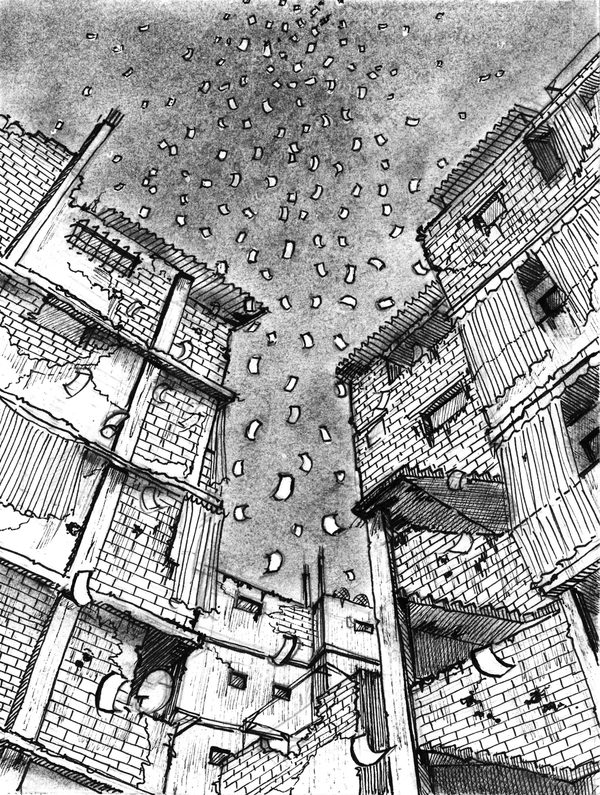
But on Sunday, June 27, there was a sudden scream of a plane and then an explosion, and confetti rained out of the sky. The pernicious leaflets of the Israel Defense Forces, printed on pink, green, and yellow sheets, fell gaily all around, while people snatched at them, chasing them in the wind like children playing with soap bubbles. The message read:
To the citizens of Beirut: The Israel Defense Forces have not used all the means at their disposal to defeat the terrorists. Save your lives and the lives of your loved ones. Leave Beirut. The following roads are open—Save your lives.
This tactic had already been practiced in Sidon. The humiliation of finding oneself in the position of wanting safety, but knowing one could have it only by the ignominious flight offered by the Israelis was a bitterness increased by the memory of the flight from Palestine a generation ago. The empty house, the abandoned field, the refugee carrying his life in a suitcase—these were the symbols not only of the Israeli presence but of our own impotence as well.
When I read the leaflet, a momentary fear was immediately overwhelmed by a tremendous anger. I would not go; no matter what, I would not go.
But I did. My husband insisted. Like so many Lebanese, he had learned the lesson of Palestine, and so he would stay; but for the safety of our children, I must take them and go. I argued; I pleaded; I fought; but he prevailed. Would I, he had shouted, would I take the responsibility if our children were burned like those we had seen on television the night before? The sight of those little burned bodies had made him vomit. I had not had the courage even to look at them.
I could not find a counterargument. “You take them; I’ll stay,” I had tried feebly. I had no right to condemn the children. I felt shame, humiliation, rage, as I packed in the dark—there was no electricity that night—not knowing or caring what I threw into the accursed suitcase. My anger was a wheel with a hundred spokes: anger at my husband for forcing me to abandon my short-lived resolution, for breaking the pact that we had made earlier and which tonight he had waved aside as a piece of nonsense; anger at my children for the tyranny of their existence, to which mine was always secondary; at my friends for not supporting me in my stand, for themselves deciding to go; at my sister, who, triumphantly staying, had repelled my appeals with, “I haven’t got children to think about”; at myself for not having the strength of my convictions; at the PLO and the Lebanese government for not ever, not even now, offering me a way out of this dilemma that they had helped create—for not making a suggestion, not denying, not denouncing, not asking for my support or help, not offering me a leg to stand on, for ignoring me, for not saying a word, for their silence in this most symbolic and awful moment; at the society in which I lived for leaving me out, so that just at this of all times I should have felt myself to be only a useless, discarded, redundant object, only another mouth to feed, another consumer of rapidly dwindling resources, another potentially wounded or dead body to heal or to bury—a nothing at all.
And so, on June 28, feeling betrayed and betraying, I left West Beirut to stay with friends on the other side. Our friends had a house in the hills just above the city. Every house in the area was crammed with guests from West Beirut. For three weeks I sat there, ceaselessly listening to radio reports and playing “patience” with an old deck of cards, one of those things I had hastily thrown into the suitcase.
Once in a while, I would take the children for a walk in those lovely hills. The roads were jammed with cars full of people from West Beirut, who, having no friends in the East and unable to afford the hotels, which were all full anyway, were camping in their cars. Some people had hitched up television sets to their car batteries and then, settling down comfortably, watched the World Cup soccer games. My children, soccer fanatics, would often join them, sitting on the rocks that lined the roads. On the evening of the finals, the war seemed to come to a complete stop: It was said that even the Israeli soldiers were watching the match, cheering the Italians on against the Germans.
Other people came in their cars and parked in the area for a different reason: This particular spot offered a panoramic view of Beirut, so they could watch the battles; a grotesque form of entertainment. Some evenings we would go up to the roof of our host’s house and from there watch what was happening below: flares falling, rockets streaming red in the night sky, crisscrossing it in dozens of patterns, phosphorescent explosions rising silently, the sound following seconds later.
My husband “came across” one day, just to see us for a few hours. He bombarded me with stories of the hardship and danger in West Beirut in order to convince me that I was better off where I was. The children, hostages in this struggle between their parents over their good—for I wished to throw off from them as well as myself the baggage of privilege—were themselves eager to return.
While we pursued the argument, we heard that the Israelis had closed the crossing point between East and West Beirut. For a few days, my husband shared our exile and became more sympathetic to my position. A day or two later all the crossings were open again.
At last I had come home to Ras Beirut, then in its darkest hours. The siege of Beirut had begun. There was to be no water, no electricity, no food, or fuel for weeks. In those days of the siege, Beirut was an extraordinary place. Mahmoud Darwish, the Palestinian poet, has called it “a holy city,” and so I think it was, the suffering and the spirit of the place sanctifying its struggle for survival.
The streets were strewn with rubbish; collection had stopped long ago. There were smoldering piles of garbage, and the air was thick with stench and smoke and the unpleasant humidity of summer. Unwashed people smelled of perspiration. The men were mostly unshaven. The previously dyed white showed through the uncared-for hair of women who had always been impeccably groomed. Children pitifully played their war games in the open streets. Refugee women humorously and courageously coped with their impossible situation, walking down the streets with plastic jugs of precious water from the wells balanced on one hip, infants on the other. Yet I felt, amazingly, a kind of euphoria inexplicable but for the parallel sense of apocalyptic doom hanging over the city.
Everything receded in those days except the feeling that we were the defending us versus a violating them. Anyone in West Beirut was us: fighters, refugees, foreign correspondents, rich, poor, Christians, Muslims, Lebanese, Palestinians, men, women, old, young, policemen—and, for all I know, murderers and thieves—we were all in it together and we felt a kind of closeness, a kind of unity that in normal times would have been unthinkable. We exchanged greetings and odd morsels of news with people we had never seen before and never would see again.
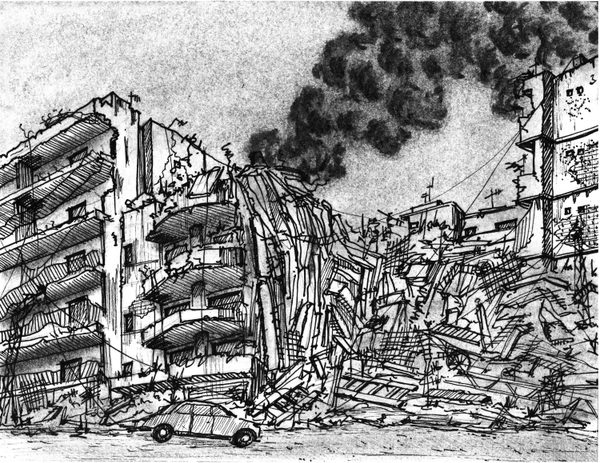
I had a sense of timelessness, as though the siege had always been and would always be; as though I had known no other reality. There was no work and no play, no proper time for doing this or that, for sleep or waking. We slept when we could; we woke when we had to. The structure of time collapsed, and hours fell about us like stones off a broken building. Sundays, Mondays—all the days of the week were alike and lost their character, and all the dates of the month as well.
Until this point, perhaps, the war that began in 1975 had never been clear, had never been pure; now, in the confrontation I felt something akin to a sublimely clear revelation of our role. Our familiar human selves were pitted against them, and they had become totally inhuman. Out of the muddy waters of the last seven years had emerged the true evil: Israel had presented itself thus at last, in open, undisguised, unpardonable ferocity. All of my previous hesitancy evaporated: Here was no doubt at all. This was the one battle in which I felt I could unquestioningly take sides. All the criticisms that I had of the PLO’s conduct in Lebanon—and there were many—receded, for it fought directly and gallantly, against the overwhelming force of the Israelis. Such courage as I possessed, such imagination, such idealism, such historical sense were all mobilized, focused on the necessity of resistance, which became to me the most meaningful political act of my life.
But how could I offer resistance to that overwhelming force? Not for a minute did I contemplate joining any army. It was too late to volunteer assistance to the hospitals: I had tried and been told that no one had the time to train me. My resistance was simply being there, looking after my family, and saying no to the leaflets. Perhaps what I did was foolish, a mere empty gesture that did no one any good. Yet to me it was not empty and, clearly, to many thousands of other people who had chosen the same course of action, it was not either.
There is an Arabic word that has been used a great deal in Lebanon in recent years but never so much as in those days: assoumoud. There is no single English sound-and-sense equivalent that I know of; rather, it would have to be rendered by tapping the thesaurus’s rich repository—tenacity, steadfastness, resolution, endurance, indomitability—all these words together, with their overlapping shades of meaning, give a sense of that noble word, assoumoud.
That it should have been used so often and so self-consciously by so many people points, I think, not only to what they thought of themselves but to the reality of the situation. No one, I think, in those weeks of the siege had the least illusion that there was even the remotest possibility of defeating the Israelis. This was the extraordinary thing: that the resistance was utterly hopeless, and that yet it took place.
From Beirut Fragments: A War Memoir, published by Outsider Editions on July 14th, 2026. Copyright (c) 1990 by Jean Said Makdisi.

I’m Arielle Angel, editor-at-large of Jewish Currents. Before you go, there’s something I need to ask.
We’ve seen over and over how the mainstream media falters in telling stories on our beats—whether it’s antisemitism, Israel/Palestine in American politics, Jewish identity, or the American left. At Jewish Currents we’re committed to uncompromising analysis and longform reporting on these issues and more—stories you won’t find anywhere else. In a media landscape that obscures injustice and flattens discussion, we’re changing the conversation. But we need you.
If you believe in this work, please consider making a donation—or even better, a recurring one—to ensure that we are able to keep publishing stories like this one. We can’t do it without you.
Jean Said Makdisi is a Palestinian writer and scholar. She taught English and humanities at Beirut University College in Lebanon, where she remained with her family throughout the civil war and the 1982 Israeli invasion, and lives today. She is the author of Beirut Fragments and Teta, Mother, and Me.