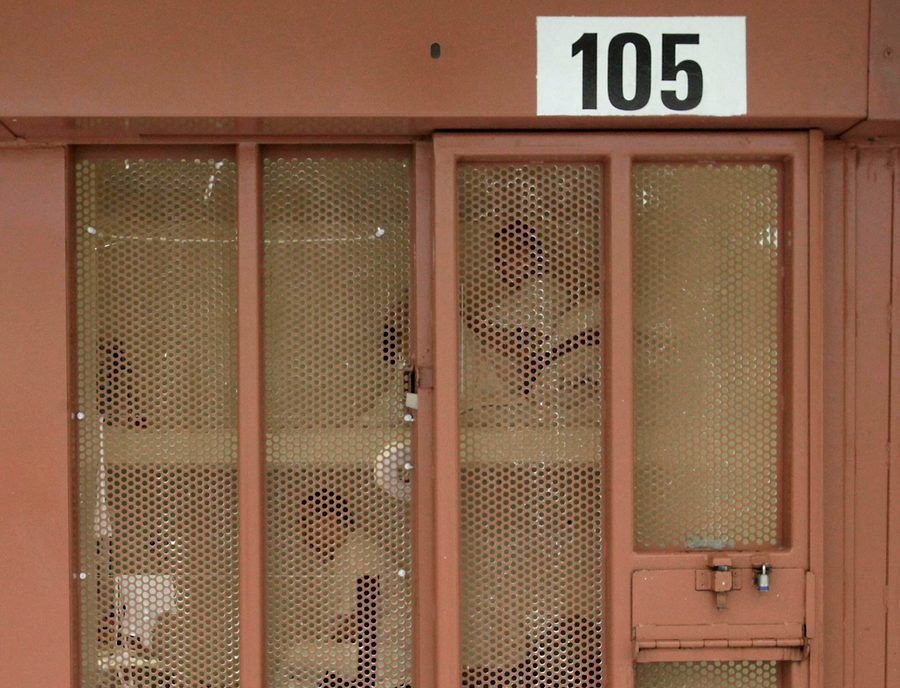
A Security Housing Unit solitary confinement cell at Pelican Bay Prison in 2011.
Rich Pedroncelli / AP PhotoA Brief History of Solitary Confinement in America
The use of the punitive tactic exploded a century after US officials had deemed it too torturous.
Solitary Confinement goes by many names—the box, lockup, seg, SHU, Special Management—but the most common term used in penitentiaries across the United States is “the hole.“
When I came into the prison system in 1996, inmates went to the hole for just about anything and everything that security staff didn’t like. The first time I took a trip there I was 19 years old. The jail commander had caught me with a long cord of tightly wound toilet paper. The Owyhee County Jail allowed inmates to smoke cigarettes in the outdoor recreation area. The contraband I was caught with is called a Wick. I’d palm a lit cigarette while returning from a smoke break then hold the hot ember to one end of the toilet paper until it smoldered. The Wick would slowly burn, allowing all of the inmates living in the dorm with me to sneak into the bathroom for a quick puff between smoke breaks.
Since then, I’ve been to the hole for disobedience, battery, positive urine analysis, menacing staff, staff manipulation, group disruption, and investigations more times than I care to count.
As I’ve aged, my trips have become less frequent. I was in my 30s when I finally found myself staying clear of lockup for a year or two at a time. I am currently 46 years old. Two weeks ago, I went to the hole for fighting. Not a wise choice and yes, I am a little too old for such immaturity, however, I was fighting with my celly so off to the hole I went.
When I was younger, I’d have conversations through the ventilation system with neighbors. I’d make toilet paper dice and play solitaire, Yahtzee, or 10,000. Now, all I did was shuffle back and forth while I inched my way through one of the two books I got my hands on the second day I was in there. I unfortunately had neighbors who, for hours a day, chose to talk or yell through the vent. If it isn’t the many voices in the vent, it’s slamming doors, jingling keys, handcuffs, radio traffic, and yelling. Inmates get easily agitated and kick doors. The only break is the two hours in a recreation cage.
–Jason Burdett, Idaho
Solitary confinement was introduced to the United States in the late 1790s, by way of the Maple Street Jail in Philadelphia. A few decades later, in 1826, the practice made its way to the Eastern State Penitentiary in Philadelphia, also known as “Cherry Hill.” In what came to be known as the Cherry Hill or Pennsylvania model, incarcerated persons were confined to their cells and unable to speak or communicate, other than to the warden, who would visit each prisoner daily to talk about his progress. It was a paradigm heavily influenced by the philosophy of local Quakers, who believed that isolating men in cold concrete cells would give them time to reflect, study, and pray, and thus leave their criminal ways behind.
The model was adopted by many prisons in other states, but it was quickly abandoned after just a few years. As jails (short-term facilities typically run by local counties and cities) and prisons (long-term facilities typically run by state or federal governments) became more crowded, incarcerated people were forced to share their cells and the warden could no longer visit daily. More importantly, prison administrators found that the practice did not reform men but instead made them lose their minds. As French magistrate Gustave de Beaumont and diplomat and historian Alexis de Tocqueville observed during an 1833 visit to the United States, “This experiment, of which such favourable results had been anticipated, proved fatal for the majority of the prisoners. It devours the victim incessantly and unmercifully; it does not reform, it kills.” The combination of financial burden and adverse health effects led to a consensus among all states that tried the Cherry Hill model between 1830 and 1880 that the practice was a failed experiment that should not be repeated.
Soon after, the US Supreme Court issued its first criticism of solitary confinement. In the 1890 case In re Medley, the Supreme Court declared the punishment to be a form of torture. In that case, between when James Medley allegedly committed a murder and when he was convicted and sentenced to death, Colorado enacted a new law requiring people on death row to spend time in solitary confinement before being executed. The Supreme Court found the new requirement to be “an additional punishment of the most important and painful character,” in violation of ex post facto laws that prevent new punishments from being applied retroactively. Tthe Supreme Court called the practice “too severe,” in part due to the psychological deterioration people suffered:
A considerable number of the prisoners fell, after even a short confinement, into a semi-fatuous condition, from which it was next to impossible to arouse them, and others became violently insane; others still, committed suicide; while those who stood the ordeal better were not generally reformed, and in most cases did not recover sufficient mental activity to be of any subsequent service to the community.
Well into the 20th century, the use of solitary confinement continued to diminish. It was not until the 1980s, on the heels of an explosion of the prison population that began the previous decade, that the practice was once again widely implemented. As a 2024 report by the Sentencing Project explains, “The prison expansion that began in 1973 reached its peak in 2009, achieving a seven-fold increase over the intervening years.” The rapid expansion of the prison population since the 1970s can be explained by a confluence of several social conditions. The 1970s were the era of the “war on drugs,” a project of mass criminalization that included mandatory and longer sentencing, particularly impacting lower-income and Black people. Around the same time, as a result of the movement to de-institutionalize people with mental illness, mental health facilities started closing in large numbers—but community mental health clinics never received the resources those reformers had advocated for as an alternative, and adequate psychiatric care became widely unavailable. And with the concurrent emergence of the neoliberal policy paradigm, budgets for social welfare safety net programs were slashed and disadvantaged people found themselves lacking resources to stay afloat.
All of these factors, which reflected and fueled a general “tough on crime” mentality, led to the spike in the prison population, including an unprecedented number of people with serious mental illness. Even as new prisons were rapidly built to accommodate higher incarceration rates and longer sentences, most prisons were plagued by extreme overcrowding. Unlike in the early 19th century, when the need to fit a growing population into small spaces limited the use of enforced isolation, now the uptick in violence and psychiatric breakdowns that resulted from the unsanitary and dangerous conditions turned policymakers back toward the increased use of solitary confinement. To make matters worse, the 1970s and the 1980s saw a shift from a focus on rehabilitation to a focus on managerial control and punishment in prisons. The reduced emphasis on rehabilitation increased the violence—having a large number of idle men on a prison yard creates risky conditions, thereby further driving the trend toward the use of solitary.
As solitary confinement reemerged as a dominant practice, it also became more extreme in both duration and intensity. Beginning in 1972, prolonged solitary began to proliferate as a disciplinary measure with the construction of the “control unit” at the federal penitentiary at Marion in Illinois. A decade later, in 1983, after two prison guards were murdered, prison officials locked down the entirety of Marion indefinitely, instituting a rule requiring incarcerated people to isolate in their cells for 23 hours a day, with no communal yard time; it was the first instance of a supermax prison, an architectural structure—either a cell block or an entire prison—dedicated to solitary confinement, for supposedly the “worst of the worst.”
In 1989, California built Pelican Bay State Prison, one of the first prison units constructed solely to keep individuals in solitary confinement, with no congregate recreation, cafeteria, classrooms, or shops. The prison’s notoriously brutal Security Housing Unit (SHU) is made up of windowless cells that are 7.6 feet × 11.6 feet. (Pelican Bay is the site of legendary 2015 prisoners’ hunger strikes to combat the conditions of solitary.) The 1990s saw the construction of many additional supermax facilities. By 2004, 44 states had super-maximum-security prisons, and in the years that followed, solitary confinement continued to become even more prevalent across the US.
Notably, this expanded use of solitary confinement was largely driven not by legislators, but by corrections officials, who advocated for the practice as a useful tool for combatting overcrowding and violence. However, as Jules Lobel, a human rights activist, law professor, and lead attorney in Ashker v. Governor of California (the successful class-action lawsuit against the prolonged use of solitary in California) has explained, the rise of mass solitary confinement in prisons across the United States was actually tied closely to the need for social control over “turmoil” caused by mass civil rights protests, litigation, and changing societal attitudes toward inequities and racism. According to Lobel, both mass incarceration and mass solitary were fueled by the search for a preventive solution to the possibility of riots or disorder. Lobel noted that the change of Marion’s character to a solitary confinement supermax had been planned before the 1983 violence and was in fact a “response to political non-violent disturbances,” like protests against guard abuses and mistreatment.
As the use of solitary expanded, the legal landscape also shifted. In Hutto v. Finney (1978), the Supreme Court upheld remedial orders placing a maximum limit of 30 days on confinement in solitary, and affirmed the lower court’s findings that conditions in solitary amounted to cruel and unusual punishment in violation of the Eighth Amendment. However, in the decades that followed, the Supreme Court began upholding extreme use of solitary. In Rhodes v. Chapman (1981), the Supreme Court notably did not find that a state prison had violated the Eighth Amendment by housing two prisoners in a 63-square-foot cell designed for one person, noting that “the Constitution does not mandate comfortable prisons.” While the case was not about solitary confinement, the precedent was clear: “Restrictive, and even harsh” conditions are “part of the penalty that criminal offenders pay for their offenses against society.” In cases like Hewitt v. Helms in 1983, and later Sandin v. Conner in 1995, individuals challenged the procedures by which they were placed in solitary confinement, but the Court consistently found that the individual liberty of incarcerated people was outweighed by institutional interests of prison administrators. In Hewitt, the Court articulated the preventative rationale particularly insidiously, explaining that incarcerated individuals were not owed “the trial-type procedural safeguards suggested by the respondent,” because they would basically hinder the ability of prison administrators to manage their institution.
Tom (who requested we not use his real name for fear of retaliation) has been incarcerated in Washington State since 1981. Having lived through four decades of policy shifts, Tom has seen how those legal decisions play out behind prison walls:
In 1981, solitary was a building notoriously known as “Big Red” (the building was made with red bricks). It was two stories with two tiers on each. The tiers were 24 cells long and cells were open bars, except for ‘A’ tier.
‘A’ tier was different—the first ten cells were isolation cells. They had a wooden facade built over the front. They could only put you there for ten days at a time back then. Those cells were typically kept dark around the clock, completely disorienting the occupants.
They had a more nefarious purpose as well. Since they had this facade, even the person in the next cell was completely isolated from anything outside of their own cell. Twice while I was there, prisoners who had a high-profile relationship with the guards committed suicide in isolation cells. The belief of many was that the guards drugged their food and came in and hanged them while they were unconscious
This belief was confirmed by a friend of mine who had stabbed a guard. They presumably drugged his food one evening but he gave his cake to another guy that night (he wasn’t on ‘A’ tier). Anyway, when they came by to hang him, he was still awake so they aborted. The guy he gave his cake to didn’t wake up until the next evening.
They let guys out for an hour a day, six at a time. Sometimes, seemingly for entertainment, they’d let out guys who were known not to get along at the same time. This resulted in murders, rapes, stabbings, and other incidents of violence.
The thing that was better back then was that guys didn’t have to do ridiculous amounts of time there. Most guys got out in 30–60 days even for such things as fighting guards. Bed space was limited, so the violation had to be real serious.
Today, there is much greater capacity to send people to solitary and no one would claim that they don’t use it. Back in the 1980s, the penitentiary held only 1,400 prisoners and they had fewer than 100 seg beds. Now, they’ve built these control units at every prison in the state.
This article is an excerpt from Ending Isolation: The Case Against Solitary Confinement by Christopher Blackwell and Deborah Zalesne, Copyright © 2025. This text was originally published by Pluto Press and has been reprinted here with permission.

I’m Arielle Angel, editor-at-large of Jewish Currents. Before you go, there’s something I need to ask.
We’ve seen over and over how the mainstream media falters in telling stories on our beats—whether it’s antisemitism, Israel/Palestine in American politics, Jewish identity, or the American left. At Jewish Currents we’re committed to uncompromising analysis and longform reporting on these issues and more—stories you won’t find anywhere else. In a media landscape that obscures injustice and flattens discussion, we’re changing the conversation. But we need you.
If you believe in this work, please consider making a donation—or even better, a recurring one—to ensure that we are able to keep publishing stories like this one. We can’t do it without you.

Christopher Blackwell is an award-winning journalist currently serving a 45-year prison sentence in Washington State. He is a contributing writer at Jewish Currents and the co-founder and current executive director of Look2Justice.

Deborah Zalesne is a professor of law at CUNY School of Law and co-director of the Writers Development Program for aspiring incarcerated writers.

Terry A. Kupers is a psychiatrist with a background in psychoanalytic psychotherapy, forensics, and social and community psychiatry.

Kwaneta Harris is a former nurse and an incarcerated journalist in Texas who spent over eight years in solitary confinement.