Prisoners and Activists Push Back on HALT Act Suspension in New York
The pause of a landmark state reform to solitary confinement exemplifies today’s backlash to the fight against mass incarceration.
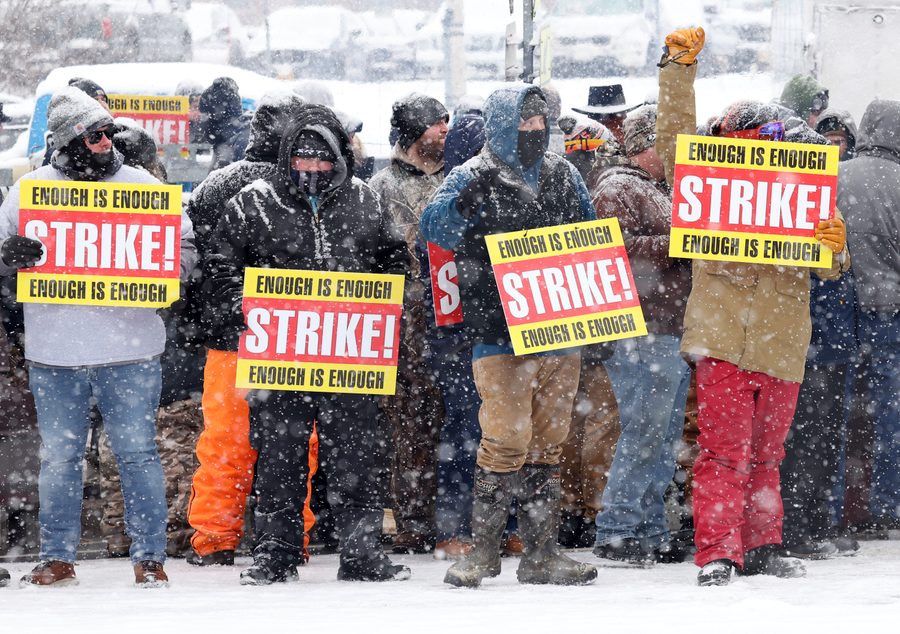
Striking officers at Auburn Correctional Center protest outside on February 19th.
On February 17th, as hundreds of prison guards across New York State abandoned their posts in a wildcat strike, Robert Williams, a 41-year-old incarcerated man in Eastern New York Correctional Facility in Ulster County, was stuck in his cell, trying to make sense of what was happening. Usually, guards would come by for count at 6:00 am, letting prisoners out for breakfast around 7.30. But now it was 12:00 pm, and they were still locked up. Like thousands of others held in the state’s sprawling carceral system, he pieced together the situation through whispers in corridors, calls from worried family members, and eventually, delayed memos from prison administrators. “There was a lot of anxiety,” he told Jewish Currents. The thought crossed his mind that maybe he would just be left abandoned in his cell, with no way out. “This was unprecedented—nothing like this has ever happened in my 15 years of being in prison.”
The following day, New York Governor Kathy Hochul was forced to deploy thousands of National Guard personnel to provide basic services in prison, like delivering food and assisting with commissary services. The strike, which ultimately lasted for three weeks and which at its height saw 90% of correction officers at almost 40 prisons walk out, was not authorized by the guards’ union, and it violated a state law that forbids public employees from striking. The striking guards flouted a state supreme court order declaring their action illegal, and in some cases actively sabotaged efforts to maintain basic services. At Attica—a prison whose name remains synonymous with the 1971 prisoners’ uprising that left 43 people dead, most of whom were killed by state police and corrections officers during the retaking of the prison—some officers reportedly prevented National Guard members from providing showers to incarcerated people. Elsewhere, prison buses were vandalized and set on fire. “Everyone in facilities was effectively put in solitary confinement,” said Anisah Sabur, national campaign coordinator at Unlock the Box, a coalition to end solitary confinement in the US, including people in the process of attending college or receiving treatment for medical or mental health issues. Overall, she said, “everything came to a halt. People lost time and education. People lost their lives.” Indeed, altogether, seven people died as a result of suicide, overdose, or assault during the strike, including 22-year-old Messiah Nantwi, who was beaten to death by six officers who had remained on the job.
Despite the fact that the strike was not authorized, union leadership negotiated with the state on behalf of the guards, presenting a list of 17 demands on the first day of the strike. Top of the list was an insistence that the state overturn the Humane Alternatives to Long-Term (HALT) Solitary Confinement Act, a law passed by New York’s legislature in 2021 and implemented in March 2022. The law limits solitary confinement to 15 consecutive days and prohibits isolating people for more than 20 days total during any 60-day period. It also requires hearings and written justification for keeping someone in segregated confinement. Guards blamed the HALT Act for increasing violence against prison staff by limiting their ability to discipline prisoners. Eventually, on February 28th, the governor temporarily suspended parts of the bill as part of the first of four agreements to bring officers back to work.
Previously, passing the legislation had represented a rare success in a decades-long struggle by formerly incarcerated people and advocates to end a practice that the UN has condemned as torture and that research links to profound psychological damage. For decades, solitary confinement has remained one of the most powerful and least visible instruments of control within American prisons. In New York, before HALT’s implementation, people could be placed in isolation for months, years, or even decades with minimal oversight or recourse, according to Sabur. “People were losing their minds and harming themselves. People were spending decades or just dying in solitary,” she said. New York’s heavy use of solitary is not exceptional. Across the United States, some 120,000 people are held in solitary confinement on any given day, according to recent estimates. Now, the suspension of HALT stands as a reminder that even a successful state anti-solitary campaign can face major obstacles to implementation, as major constituencies, like guards, retain a vested interest in being able to isolate prisoners. “Solitary is a tool of oppression and they want it back,” said Williams. “Without it, they feel like there is no control.”
The practice of solitary confinement gained particular prominence in the US in the 1980s and ’90s, as the war on drugs and “tough on crime” politics drove mass incarceration to unprecedented levels. During this period, new “supermax” facilities were built specifically to hold people in long-term isolation, often justified as necessary for controlling those the public considered high-risk and violent.
Yet inside prisons around the country, the reality of how solitary is deployed has often borne little resemblance to its purported purpose. Solitary confinement is routinely imposed for infractions as minor as having an “altered hot pot” for making food in a cell or testing positive for marijuana. Williams, who works as a journalist while serving his sentence, explained that solitary allows guards to get away with mistreating prisoners, by keeping violent measures hidden from view. “Without it, officers have to be more respectful, because they can’t just jump someone and beat them up and put them in the box with broken ribs,” he said.
The psychological consequences of such frequent usage can be devastating. “I’ve witnessed guys come out of the box and I am flabbergasted. It’s like something snaps in them while they are in there,” Williams said. According to Terry Kupers, a psychiatrist and one of the leading experts on solitary in the country, “solitary creates huge human damage—massive psych disorders, disability.” Even short periods in isolation can be devastating: “You lose sense of time, get anxious, pace a lot, have trouble reading—and that is the people who are relatively stable.” Those with pre-existing mental illness can see their symptoms exacerbated, often leading to psychosis, self-harm, or suicide. Studies show that people who experience solitary for any amount of time are 127% more likely to die by overdose within two weeks of release and 78% more likely to die by suicide one year after release. Even those with young, vulnerable brains are often subject to such conditions: More than a third of children in carceral facilities experience solitary at some point.
In New York, solitary usage has historically been widespread: In 2018, for example, the New York Civil Liberties Union found that guards had given up to 40,000 solitary sanctions over the course of the year for a prison population of 45,000. The push to pass HALT in the state began in 2012, on the back of a UN report that classified solitary as torture. Various activist coalitions, including the New York Campaign for Alternatives to Isolated Confinement, began working together to challenge the practice. The campaign gained momentum following the UN General Assembly’s 2015 adoption of the “Mandela Rules”—named in honor of the South African activist’s writings about his ordeal in solitary—that lay out guidelines for the humane treatment of prisoners, including restricting the use of solitary confinement to a last resort and prohibiting solitary confinement that exceeds 15 days. In the state, several high-profile cases demonstrating solitary’s harms helped build support to push the bill over the finish line, like that of Kalief Browder, a young man who died by suicide two years after being held more than 800 days in solitary at Rikers Island before his trial for allegedly stealing a backpack. Concurrently, the mounting evidence of solitary’s harms also led other states to explore its restriction; since 2009, 42 states have established laws to curb the practice, often limiting its use for children or the mentally ill or establishing additional oversight.
In theory, New York’s law sets some of the most comprehensive solitary reforms in the country, making it one of only three states putting time-bound limits on solitary. Its passage served as a national model, pushing eight other states to introduce similar legislation. However, in New York as across the country, implementation of these anti-solitary measures has consistently fallen short, with advocates and researchers finding evidence that corrections departments either openly flout or quietly circumvent these laws. “In many states, they don’t say they are not going to abide by the law—they just don’t abide. Or they keep doing [solitary], just under a different name,” explains Kupers. Since HALT went into effect in 2022, state prisons have routinely ignored many of the law’s provisions, as early investigations by Gothamist and New York Focus revealed. Advocates report that prison officials continued to hold people in isolation beyond the allowed limits. Where the law called for meaningful out-of-cell programming and therapeutic interventions for incarcerated people with behavioral problems, many facilities responded by simply placing people in “Residential Rehabilitation Units” that differed little from traditional solitary, sometimes handcuffing prisoners to tables during the so-called programming. Michael Shane Hale, who is incarcerated at Sing Sing in Ossining, New York, reported to Jewish Currents that when prisoners handcuffed to tables in such units had to go to the bathroom, they were sent back to their cells and then locked in. The result was compliance on paper while maintaining the essence of isolation in practice. Several lawsuits have been filed against the Department of Corrections and Community Supervision (DOCCS) for failing to comply with the law—a fact that makes the guards’ aggressive pushback all the more striking. “HALT was never really implemented from the beginning,” said Sabur. “So what are you even pausing?” (DOCSS and the state correctional officers’ union did not respond to requests for comment by press time.)
Indeed, prisoners and their advocates say they believe that the guards’ strike was not actually a response to problems with the HALT Act, but instead was purposely timed just a few days before the start of criminal proceedings against several New York guards for the December 9th murder of Robert Brooks, a 43-year-old incarcerated Black man who was beaten to death by ten correctional officers while being transferred between facilities. The footage of Brooks’s killing prompted a national outcry. Hale went on a seven-day hunger strike after viewing footage of the incident, and said Brooks’s death exemplified the culture of impunity that has long characterized discipline in many American prisons. “Being on the inside, what was clearly happening was that we were being scapegoated,” said Hale. The strike framed correctional officers as victims, rather than perpetrators, which Hale viewed as “incredibly convenient right around when they were doing the indictment [in the case] of Robert Brooks.” Joe Sanchez, who is also incarcerated in Sing Sing, said he also believes the guards went on strike in part because they feared retaliation from prisoners over the Brooks incident.
When Governor Kathy Hochul ultimately agreed to a 90-day “pause” on the required out-of-cell programming elements of the HALT Act, many incarcerated people felt betrayed. “When we heard that they wanted to repeal the HALT Act that’s when the anxiety really started,” says Williams. “They want to bring back the box. We were rooting for the governor, but she was basically held hostage.” The pause created immediate legal questions about whether Hochul was even authorized to suspend a law passed by the legislature. The Legal Aid Society of New York filed a legal challenge, demanding clarity on exactly which portions of the law were being suspended. (By press time, Hochul’s office had not responded to a request for comment for this article.) For advocates, the stakes could not be higher: “It can’t happen. If they continue to isolate people indefinitely, it would be total chaos,” said Sabur. “The death rate would increase.”
For HALT’s supporters, the strikes and the larger debate around the bill have reaffirmed the argument that such reforms are desperately needed, now more than ever. “The [correctional officers’] criticism affirms our position that prisons are intrinsically violent—and emphasizes the urgent need for greater oversight, transparency, accountability, programming, alternatives to incarceration, and, finally, decarceration, including parole reform,” Andrew Block, the chief of staff for New York State Senator Julia Salazar, who sponsored the bill, told Jewish Currents. Still, Block is confident that the governor can’t override the will of the legislature. “The probability of rolling back HALT is essentially zero,” Block added. But, he said, it remains pressing to ensure that the HALT Act will be fully implemented and to explore how it might be enhanced.
The question of how to ensure HALT’s implementation may have major consequences for the future of prisoners’ rights efforts in an era dominated by backlash to criminal justice reform. The temporary suspension of HALT signals state officials’ troubling willingness to retreat from reform when faced with resistance from those invested in maintaining control. But for Sabur, who herself spent 16 years in the prison system before dedicating her life to advocacy, the fight against solitary confinement must be understood as part of a broader struggle for transformation of a system that was “not built to help people rehabilitate.” She argues that the answer to guards’ complaints that there aren’t enough of them to adequately handle the number of people incarcerated is a comprehensive decarceration, including the release of aging prisoners and the implementation of alternatives to incarceration. For prisoners, the battle over the HALT Act is a bellwether for the country’s approach to incarceration. “In my opinion, this is a battle for the soul of corrections—if corrections can be said to have a soul,” Williams said.
Meanwhile, as the National Guard begins to withdraw—a smaller crew of voluntary officers remain, whose deployment Hochul recently extended until early May—and prison operations in New York slowly return to normal, tensions remain high. “I fear that once these national guards leave, things may get very dicey in here between prisoners and officers,” said Williams.

I’m Arielle Angel, editor-at-large of Jewish Currents. Before you go, there’s something I need to ask.
We’ve seen over and over how the mainstream media falters in telling stories on our beats—whether it’s antisemitism, Israel/Palestine in American politics, Jewish identity, or the American left. At Jewish Currents we’re committed to uncompromising analysis and longform reporting on these issues and more—stories you won’t find anywhere else. In a media landscape that obscures injustice and flattens discussion, we’re changing the conversation. But we need you.
If you believe in this work, please consider making a donation—or even better, a recurring one—to ensure that we are able to keep publishing stories like this one. We can’t do it without you.

Christopher Blackwell is an award-winning journalist currently serving a 45-year prison sentence in Washington State. He is a contributing writer at Jewish Currents and the co-founder and current executive director of Look2Justice.
Sarah Sax is a Brooklyn-based reporter who examines systems of power, from criminal justice to climate change.