The End of Aid to Israel Isn’t a Win For the Pro-Palestine Left
As the US and Israel trade military aid for military integration, the pro-Palestine left loses one of its most potent political weapons.
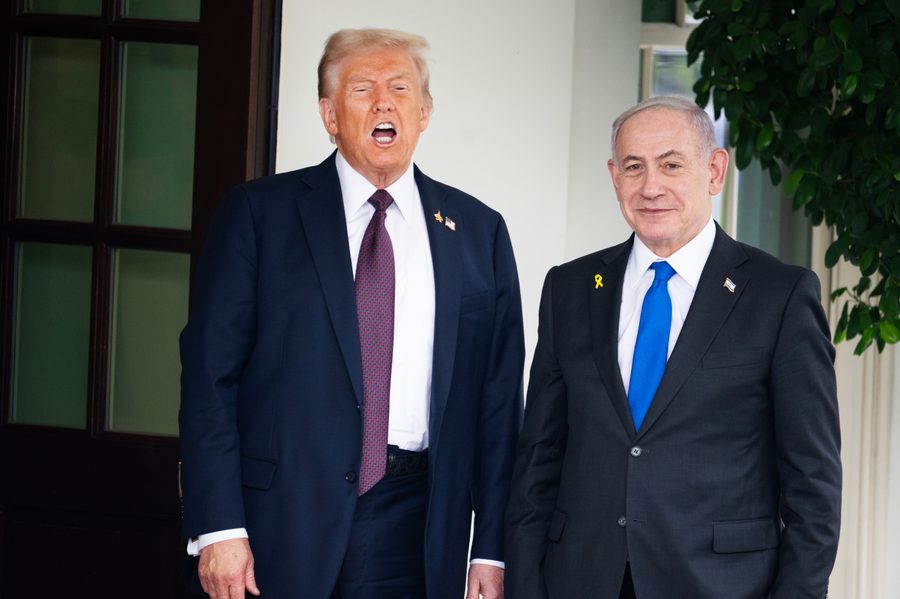
President Donald Trump and Israeli Prime Minister Benjamin Netanyahu at the White House in September.
This article first appeared in the Jewish Currents news desk newsletter. Subscribe here.
Pro-Palestine groups in the United States have spent decades pushing to halt American military aid to Israel. Over the past three weeks, they’ve found they may suddenly be pushing against an open door.
After months of hints and teases, the Israeli government and its allies in Congress rolled out a new strategy—consisting of a package of related measures in the House and the Senate—to slowly swap out the nearly $4 billion the US has been spending on direct military aid to Israel each year for a new paradigm of deep technological and supply-chain integration. The legislation currently under consideration, which Israeli prime minister Benjamin Netanyahu referred to in a June 1 letter as “my plan,” would empower senior Pentagon officials to spend billions of dollars developing weapons systems in tandem with Israel, “synchronizing” research efforts and intertwining an extraordinary range of technologies. The resultant interdependencies, Foundation for Middle East Peace president Lara Friedman wrote last week, would effectively give Netanyahu “a seat in the US situation room.”
Opposition to military aid to Israel is a winning issue for progressive Democrats, embraced by candidates in House primaries across the country this spring. The new strategy of defense integration is hard to grasp and so novel that the politics and messaging around it have yet to develop. It’s a politically astute switcheroo from the Israelis and their allies, snatching away from pro-Palestine groups what has become their most potent political device while replacing it with a far more slippery target. For the pro-Palestine left, it creates a serious strategic challenge.
“There’s going to need to be—and there are—a lot of conversations that are happening around this,” said Beth Miller, political director of Jewish Voice for Peace Action.
Even as groups on the pro-Palestine left push for a total arms embargo on Israel, it’s their campaign for an end to military aid that’s been the big political winner this year. In early April, Rep. Alexandria Ocasio-Cortez realigned the progressive consensus on military aid overnight when she announced she wouldn’t support any US aid to Israel, pulling an impressive list of other left-leaning Democrats along with her. A month later, a New York Times poll found that a majority of Americans now oppose more military aid. The shift in the politics of the issue has been so extreme that even the liberal Zionist group J Street dropped its support for military aid, long a key position of the organization.
Now, instead of continuing to fight on a losing issue, the Israelis are reshaping their approach. Their shift is a “shell game,” as A New Policy’s Josh Paul told Jewish Currents earlier this month.
For the groups working to oppose the new Israeli strategy, the immediate challenge is that the legislation moving to formalize US and Israeli military integration appeared in just the past few weeks, far too recently to mobilize real popular opposition. The ten-year agreement governing US military aid to Israel signed during the Obama administration, which pledged $3.8 billion in annual aid, expires this year, and policy experts have long expected it to be renegotiated under different terms. This effort to phase out aid in favor of close integration of the two militaries, however, came as a surprise. Hadar Susskind, president and CEO of the progressive group New Jewish Narrative, said that when his colleagues began to see signs of the new strategy starting to coalesce around a month ago, it remained poorly understood by Congressional staffers.
The new measures, if passed into law, would put pro-Palestine groups into even murkier political terrain. The new spending on co-development and integration would happen deep in the Pentagon, far more shielded from public view than traditional foreign aid. “The co-production and co-development model is much harder for people to intuitively understand what it is,” said Josh Ruebner, policy director at the IMEU Policy Project.
The question now is what the activists are to do. In the short term, Susskind said that efforts to talk to members of Congress and raise public awareness of the new strategy are ongoing. “There’s still a step where Congress has oversight and accountability and a role here, before that’s given away and dumped into the depths of the Pentagon,” he said.
For left groups like JVP Action and the IMEU Policy Project, whose goals go well beyond stopping military aid to Israel, the shift may pose fewer immediate challenges. The groups are already largely focused on the Block the Bombs Act, which would block the sale of certain munitions to Israel, regardless of who pays for them. “It’s not just about ending US military funding; it’s about pulling back all forms of US partnership and complicity and enabling of crimes against humanity,” Miller said.
For liberal groups like J Street, which have come around to the position of opposing military aid to Israel but are squishier on the question of arms sales, the implications are less clear. Asked about how it’s rethinking its strategy amid the Israeli government’s move away from the military aid paradigm, J Street president Jeremy Ben-Ami said in a statement that J Street “believes any new approach must not become a backdoor mechanism for recreating unconditional financial subsidies under another name.” He added that “the goal should be a modernized US-Israel relationship grounded in genuine partnership, shared interests and responsible stewardship of American taxpayer dollars.”
The political messaging necessary to distinguish J Street’s “modernized US-Israel relationship” from the version being realized by the Israelis and their allies in Washington seems difficult and nuanced, and perhaps a harder sell than the left groups’ doubling down on Block the Bombs and their call for an arms embargo. As the politics of military aid to Israel fade into the rearview, the left case for arms embargo may be the next battlefield.

I’m Arielle Angel, editor-at-large of Jewish Currents. Before you go, there’s something I need to ask.
We’ve seen over and over how the mainstream media falters in telling stories on our beats—whether it’s antisemitism, Israel/Palestine in American politics, Jewish identity, or the American left. At Jewish Currents we’re committed to uncompromising analysis and longform reporting on these issues and more—stories you won’t find anywhere else. In a media landscape that obscures injustice and flattens discussion, we’re changing the conversation. But we need you.
If you believe in this work, please consider making a donation—or even better, a recurring one—to ensure that we are able to keep publishing stories like this one. We can’t do it without you.
Josh Nathan-Kazis is the news director at Jewish Currents. Previously, he was a senior writer at Barron’s, where he covered healthcare companies, and a staff writer at The Forward, where he investigated Jewish communal institutions.