The Phantom Boycott
The Anti-Defamation League says BDS would cost New Yorkers billions. It’s overstating the demands of divestment campaigners.
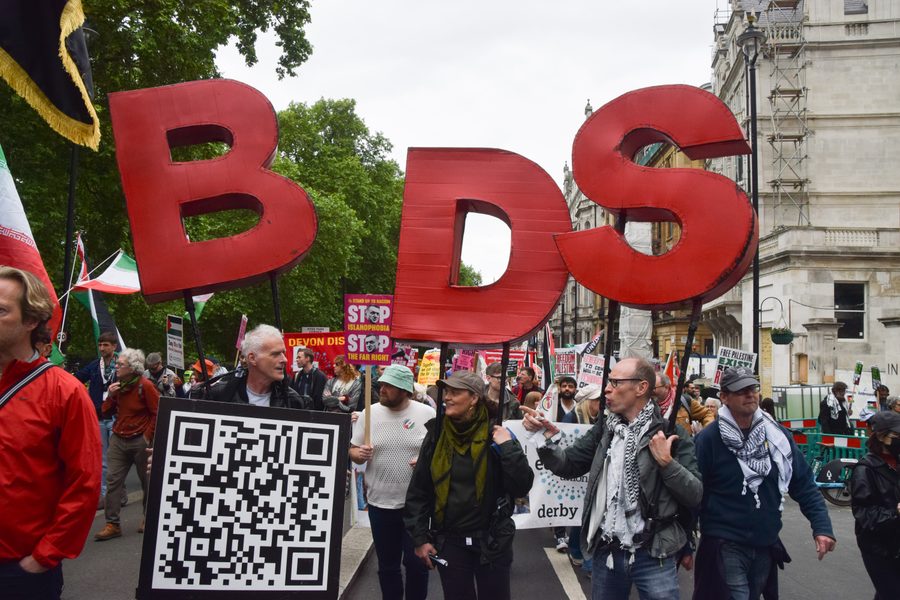
Protesters in London in May carry signs supporting the Boycott, Divestment and Sanctions movement.
This article first appeared in the Jewish Currents news desk newsletter. Subscribe here.
An Anti-Defamation League subsidiary called JLens put out a report Wednesday that purported to demonstrate that if New York City’s public employee pension funds acceded to the demands of Palestinians to divest from companies that sustain Israeli apartheid, it “could reduce total pension assets by approximately $37.55 billion between 2025 and 2035.” Taxpayers, JLens said, would have to make up for any resultant shortfalls.
It’s a sophisticated effort, and part of the pro-Israel Jewish establishment’s broad campaign to undermine the Palestinian-led nonviolent boycott movement. But JLens appears to have arrived at that $37.6 billion figure by significantly overstating the number of companies targeted for divestment by the BDS movement.
JLens’s report says it based its calculations on a list of 47 large US-listed public companies “targeted” by the BDS movement. To create its list, the report says JLens reviewed online lists of divestment targets from a handful of pro-BDS groups. But Dov Baum, director of corporate accountability at the American Friends Service Committee (AFSC), says the list JLens built vastly overstates the demands the BDS movement has made on institutional investors.
Baum says JLens’s list includes many companies that are not actually on the BDS divestment shortlist, which is maintained by AFSC and endorsed by the leadership of the BDS movement. “They are vacuuming up any name of any company that Palestine solidarity activists have ever targeted for any issue and calling that a divestment list,” Baum said. The companies that the movement actually targets for divestment campaigns, Baum says, are only those that are “considered unmovable at this time, companies that have direct complicity in severe violations and at the same time are not responsive to public concerns on the matter.”
Asked about the decision to include companies not on the BDS divestment shortlist, a JLens spokesperson said that no such shortlist exists. “There is no single, unified ‘BDS divestment short list,’” the spokesperson said via email. “As the report documents, generally the organizations that drive these campaigns operate without a shared methodology or central coordination, which can produce significant variation in which companies they target and how.” Despite the ADL’s claims, the BDS movement generally does coordinate its major divestment campaigns through the BDS National Committee, a Palestinian civil society coalition.
Some of the companies on JLens’s list are on AFSC’S BDS divestment short list, like the construction equipment manufacturer Caterpillar. But others are not, including many of the large tech companies that are responsible for much of the US stock market’s growth over the past decade. The JLens list includes Alphabet, Amazon.com, Oracle, Intel, Meta, Microsoft, and NVIDIA, none of which are on the divestment shortlist. JLens arrived at its $37.6 billion projection by testing how a portfolio that excluded its list of notionally boycotted stocks would have performed over the past decade, relative to portfolio that didn’t. By slipping the tech stocks onto its list, JLens was putting a big thumb on the scale. The BDS movement wasn’t asking institutional investors to omit these stocks, but JLens’s anti-BDS fearmongering only works if they were.

I’m Peter Beinart, editor-at-large of Jewish Currents. Before you go, I need to ask something of you.
In recent years, I’ve watched as mainstream Jewish institutions and media have chosen ethnonationalism over liberal democracy and mass slaughter over the pursuit of a just peace. Jewish Currents offers something different. It’s a magazine built on intellectual curiosity and respect for the dignity of all people.
But a project like this doesn’t sustain itself, and we can’t do it without your help. If you share my belief in the importance of this mission, please consider making a donation—or even better, a recurring one. We need you with us.
Josh Nathan-Kazis is the news director at Jewish Currents. Previously, he was a senior writer at Barron’s, where he covered healthcare companies, and a staff writer at The Forward, where he investigated Jewish communal institutions.