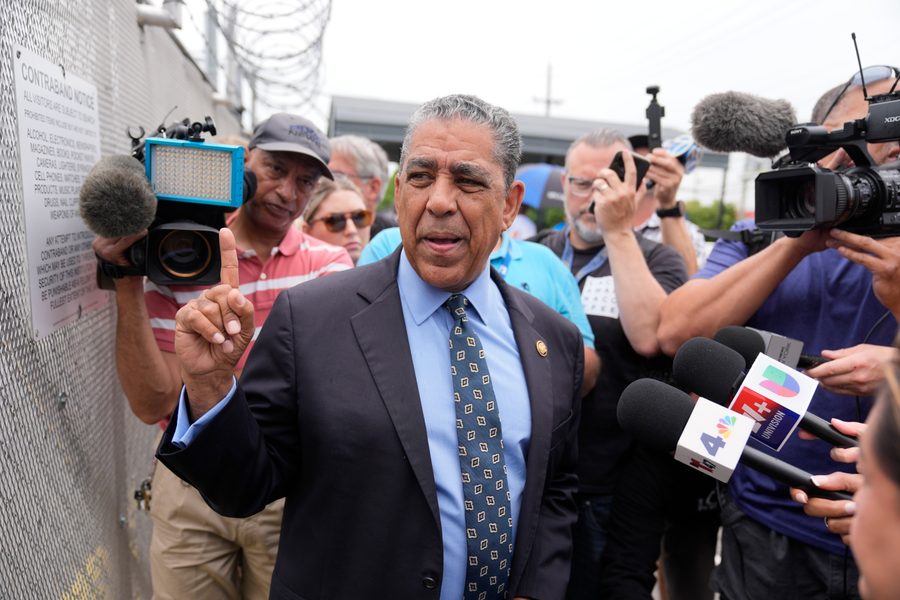
Rep. Adriano Espaillat late last month outside Delaney Hall, an ICE detention center in New Jersey.
This article first appeared in the Jewish Currents news desk newsletter. Subscribe here.
In uptown Manhattan this month, Darializa Avila Chevalier, a Democratic Socialists of America-backed insurgent, is testing whether the anti-AIPAC politics that have driven Democratic primary victories in progressive bastions around the country in recent months can play in a working class, largely Black and Latino district.
Avila Chevalier’s message to voters in New York’s 13th Congressional district is that Rep. Adriano Espaillat, the incumbent congressman, is beholden to AIPAC, and supports sending money to Israel that should be spent at home. That’s similar to the case made by recent Democratic primary winner Adam Hamawy in New Jersey, who ran on a pro-Palestine platform in an affluent district where nearly half of residents are college educated.
In an uphill battle to expand the electoral playing field for the pro-Palestine left, Avila Chevalier is testing whether the strategy can win in a district where, despite recent waves of gentrification, the proportion of residents living under the poverty line is double the rate of the city overall. The race is tight, according to a poll commissioned by Justice Democrats, a progressive PAC that backs Avila Chevalier. The survey showed Espaillat down four points, with 22% of voters undecided.
Avila Chevalier’s political identity is entwined with the pro-Palestine cause. She joined Columbia University’s Students for Justice in Palestine chapter in 2014 after a trip to the occupied West Bank, and in 2024 returned to Columbia’s campus to help organize the student encampment there. One day after the October 7th attacks, she attended a pro-Palestinian rally in Times Square that was condemned by many Democratic politicians because of some protesters’ praise of armed resistance.
Some political experts say that foreign policy issues alone won’t be decisive in this race. While Democratic voters of all races have soured on Israel, it’s an open question as to how much that will matter in NY-13 later this month. “Parts of this district have a pro-Palestine voting base, but it’s not a traditional stronghold of the left in New York City,” said Beth Miller, the political director of the anti-Zionist group Jewish Voice for Peace Action.
As Zohran Mamdani did in his mayoral campaign last fall, Avila Chevalier has connected her pro-Palestine political commitments to populist affordability politics. “Every dollar that we send to Israel is a dollar that is stolen from the mouths of our children,” she told Jewish Currents.
Avila Chevalier has also pushed the idea that Espaillat is a Democratic party insider—a potentially potent message at a time when many Democratic voters disapprove of party leadership. “She wants to tie him to the establishment by using [the Palestine] issue,” said Eli Valentin, a scholar who writes on Latino politics in New York City.
But Espaillat’s backers say that the district isn’t interested in Avila Chevalier’s anti-AIPAC politics. “You can support our allies abroad while doing constituent services and bringing hundreds of millions of dollars to his district, which he has done masterfully,” said Councilman Eric Dinowitz, whose Bronx City Council district overlaps with the 13th congressional district.
Unlike other incumbents who have pivoted left on Israel as the Democratic base has become decidedly pro-Palestine, Espaillat has stuck to a conventional pro-Israel line. “I am a strong supporter of the existence of Israel as a sovereign and democratic state in the region,” he told Jewish Currents in an interview. Donors affiliated with AIPAC are his top campaign contributors, but Espaillat insists that has no bearing on his record. “I am not influenced by anybody that contributes to my campaign,” he said.
When asked why he is not a supporter of the Block the Bombs Act—which would ban the sales of some munitions to Israel—Espaillat responded by saying, “I’m not on that bill, but I tell you, what’s important is that we have a path to peace.” The bill has been endorsed by the Congressional Progressive Caucus, which is nonetheless supporting Espaillat’s re-election bid.
Espaillat’s pro-Israel stance may not harm him with his core base of older, working-class Latinos, said Adam Carlson, a Democratic pollster. But Carlson said the winner would be determined by Black voters in the district—some of whom are still smarting from Espaillat’s defeat of Assemblyman Keith Wright in the 2016 Democratic congressional primary, who had been the designated successor to Charlie Rangel, the Harlem power broker who had represented the area since the early 1970s. In this race, Espaillat is making a play for Black voters. Recent TV ads from his campaign and its allies highlight a past tweet from Avila Chevalier reading, “fuck Kamala Harris,” which will likely turn off some Black voters. Espaillat also has the backing of the Congressional Black Caucus.
But Avila Chevalier has made some inroads with Black political leaders. Last month, she was endorsed by State Senator Robert Jackson, a Black Muslim who represents northern Manhattan and a longtime rival of Espaillat’s. Former Congressman Jamaal Bowman, as well as fellow DSA members, City Councilman Chi Ossé and State Senator Jabari Brisport, are behind her. And she is campaigning alongside Conrad Blackburn, another DSA-endorsed candidate who is competing against incumbent Jordan Wright, Keith Wright’s son, for a New York State Assembly seat in the neighborhood.
Carlson said that Avila Chevalier’s Palestine politics will especially appeal to younger Black people. “Espaillat is making a strategic mistake by continuing to openly embrace AIPAC,” said Carlson. According to the new Justice Democrats poll, 56% of voters in the district have an unfavorable view of the pro-Israel lobby, while 34% said they didn’t know enough to have an opinion.
Avila Chevalier is also counting on the support of progressive voters of all races in the district. Mayor Zohran Mamdani—who jolted the race with his endorsement of Avila Chevalier two weeks ago—decisively won the 13th Congressional district in both the primary and general elections during last year’s mayoral race.
Espaillat has touted the support of progressive groups to boost his standing. But his ability to claim progressive bona fides took a hit earlier this month, when the New York Progressive Action Network rescinded its endorsement of Espaillat over his decisions to continue taking AIPAC money and not to sign on to Block the Bombs. The Working Families Party also declined to endorse Espaillat over his refusal to back Block the Bombs.
If Avila Chevalier’s strategy works, leftist activists say, it would be a sign that anti-AIPAC politics can win outside of wealthier, more highly-educated progressive districts where it’s had success so far. It would show, says JVP’s Miller, that support for “ending US complicity in apartheid and genocide is a winning popular message among the multiracial working class voter base that Democrats need to take back power in this country.”

I’m Arielle Angel, editor-at-large of Jewish Currents. Before you go, there’s something I need to ask.
We’ve seen over and over how the mainstream media falters in telling stories on our beats—whether it’s antisemitism, Israel/Palestine in American politics, Jewish identity, or the American left. At Jewish Currents we’re committed to uncompromising analysis and longform reporting on these issues and more—stories you won’t find anywhere else. In a media landscape that obscures injustice and flattens discussion, we’re changing the conversation. But we need you.
If you believe in this work, please consider making a donation—or even better, a recurring one—to ensure that we are able to keep publishing stories like this one. We can’t do it without you.