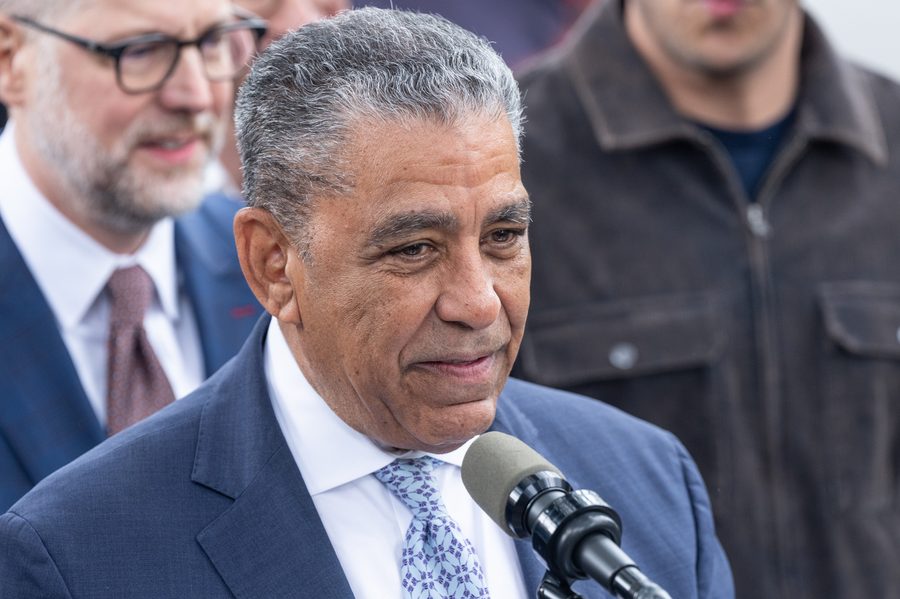
Progressive Democrats in Congress are backing Rep. Adriano Espaillat over a left-wing challenger in next month’s primary.
This article first appeared in the Jewish Currents news desk newsletter. Subscribe here.
The Congressional Progressive Caucus’s decision last week to endorse New York Rep. Adriano Espaillat against a left-wing challenger in the upcoming Democratic primary was a classic case of a caucus protecting its own—at the expense of a chance to undermine AIPAC’s influence in Congress.
The caucus, the central organizing body for progressive policymakers in Congress, has made opposition to AIPAC a focus of its broader attack on big money in politics. As AIPAC dropped $20 million against progressive Democrats in Illinois earlier this year, caucus chair Rep. Greg Casar denounced the lobby group. “If you care about the future of the Democratic Party, you should be outraged about what AIPAC is doing in Chicago right now,” he said.
But the Espaillat endorsement by Progressive Caucus PAC—the electoral arm of the caucus—shows that opposition to AIPAC apparently does not extend to opposition to caucus members who take AIPAC money. “We have great progressive leaders who are taking on AIPAC,” said one progressive political consultant who requested anonymity to protect their job. “But in the search for trying to have a bigger caucus than some corporate Democratic caucuses, we are sacrificing the substance of the progressive caucus.”
Espaillat is no centrist: He says ICE should be dismantled (though he has voted for broad spending packages that include money for ICE) and backs Medicare for All. But he has taken around $150,000 total in donations from both AIPAC itself and from donors who send money through AIPAC this election cycle, and about $335,000 over his nine-year career. In April 2024, he voted to send Israel an additional $14.5 billion in military in the midst of what experts say is a genocide. And he is not a sponsor of the Block the Bombs Act, which would prohibit the sale of certain munitions to Israel, and which the Progressive Caucus endorsed last year.
Espaillat is facing a primary challenge from Darializa Avila Chevalier, a Democratic Socialists of America endorsee who has made Espaillat’s alliance with AIPAC a central theme of her upstart campaign. “Actions speaker louder than caucus memberships, and Adriano Espaillat has used his time in Congress to give ICE billions, fund the Israeli military, and vote for Trump’s crypto corruption—while being bankrolled by AIPAC and the real estate lobby,” Avila Chevalier told Jewish Currents.
The leaders of the Congressional Progressive Caucus left no opening for members to back Chevalier. An April memo from the affiliated Progressive Caucus PAC, circulated to caucus members and obtained by Jewish Currents, said that the PAC board recommended endorsing Espaillat and asked members to vote on whether to do so. Avila Chevalier’s name was not mentioned.
Congressional insiders say this is typical of how caucuses operate. “There is an unwritten rule in Congress that you do not endorse against your colleagues, and that holds for pretty much any caucus,” said one former senior Democratic staffer who requested anonymity to protect relationships with members of the caucus. “If you’re seen publicly supporting a primary challenge against one of your colleagues, you have to sit next to them at the next caucus meeting, and it just makes it uncomfortable. You could also face other members organizing against you. It really comes down to those interpersonal dynamics.”
The PAC has endorsed left-wing candidates in primary races around the country, but only in open-seat races with no incumbent or in districts represented by a Republican. It has, however, declined so far to back the reelection bid of Rep. Dan Goldman, a caucus member who is facing a serious primary challenge. That may be because Goldman voted to censure his fellow caucus member, Rep. Rashida Tlaib, over her pro-Palestine positions, and because Goldman’s opponent, former New York City Comptroller Brad Lander, has a close relationship with Casar. The PAC, however, has not endorsed Lander.
The Progressive Caucus PAC did not respond to requests for comment on this story. The Espaillat campaign sent Jewish Currents a statement touting the caucus’s endorsement—in which PAC co-chairs said that he “has been a strong progressive fighter in Congress for working people, immigrants and democratic values”—but did not respond to specific questions. “My voting record has put me in the top 5% of most progressive members of Congress,” Espaillat wrote in an Instagram post on the endorsement.
Espaillat is not the only Progressive Caucus member who gets money from AIPAC. In May 2024, the lobby group boasted that they are “the top fundraiser for Progressive Caucus members.” Other members bolstered by AIPAC funds include Ohio Rep. Shontel Brown and California Reps. Brad Sherman, and California Rep. Ted Lieu, all of whom have taken hundreds of thousands of dollars from AIPAC or from donors who sent money to them through AIPAC. The progressive body has some requirements for members—including that they are expected to vote in line with the caucus’s positions on bills two-thirds of the time—but there is no position on Israel or AIPAC that members must take.
Some progressives say that should change, and that allying with AIPAC should be a dealbreaker for the caucus. “The ties between AIPAC and Netanyahu and the genocide are very clear, so it’s disappointing to see the Progressive Caucus back someone who is willing to support AIPAC,” said Marie Newman, a former caucus member who used to represent Illinois’s 3rd congressional district. “You do have to draw the line.”

I’m Peter Beinart, editor-at-large of Jewish Currents. Before you go, I need to ask something of you.
In recent years, I’ve watched as mainstream Jewish institutions and media have chosen ethnonationalism over liberal democracy and mass slaughter over the pursuit of a just peace. Jewish Currents offers something different. It’s a magazine built on intellectual curiosity and respect for the dignity of all people.
But a project like this doesn’t sustain itself, and we can’t do it without your help. If you share my belief in the importance of this mission, please consider making a donation—or even better, a recurring one. We need you with us.