Newsletter
Jun
16
2026
Good afternoon from the Jewish Currents news desk. In today’s newsletter, Israel’s decision to give up on US aid in favor of deep integration with the US military is stripping the pro-Palestine left of one of its most potent political weapons. We look at what it means—and how activists intend to respond.
I’m Josh Nathan-Kazis, and here’s what we’re talking about today at the Jewish Currents news desk.

In Nabatiyeh in southern Lebanon on Tuesday, residents returned home after the US and Iran announced a preliminary deal to end the war. Israel is not a party to the agreement.
Hussein Malla/AP
END OF THE AFFAIR: In February, in the White House Situation Room, Israeli Prime Minister Benjamin Netanyahu talked President Trump into starting a war with Iran. As the adventure they launched that winter morning draws to a close this week, one casualty is the friendship between the two comrades. In France this morning, shortly after announcing his secret deal with Iran, Trump took a break from posing for pictures at the G7 summit to savage Israel’s conduct in Lebanon. “You don’t have to knock down an apartment house every time you’re looking for somebody,” he said. Meanwhile, in Israel, Netanyahu has been busy pretending as though he hadn’t spent the past decade cuddling up to the American president, declaring in a speech Monday that Israel would keep fighting and would hold onto the land it had seized in Lebanon. “The struggle is not over and done,” he said.
All signs are pointing towards a sharp split between Netanyahu and Trump. Netanyahu’s petulance towards his American patrons comes with just months to go before Israeli elections, as his centrist opponents look to undercut him from the right on national security, and even his allies condemn him as a patsy for Trump. Although the terms of the secret US-Iranian deal were not known as of midday Tuesday, the widespread assumption was that Trump had caved, leaving Israel with nothing to show for months of war. The Israeli political establishment has now pounced on Netanyahu.
“Israel cannot allow its security to be dictated from Washington, and the prime minister who allows that to happen will not be prime minister for long,” the right-wing Israeli political commentator Amit Segal posted Monday. Gadi Eisenkot, the former chief of staff of the Israeli military whose Yashar party has been soaring in the polls, posted that the “security and regional opportunity that Israel needed to take was missed.” Yair Lapid of the centrist Yesh Atid wrote that “Netanyahu lost the war… He collapsed at the moment of truth.”
Netanyahu, anxious to salvage his political career, will likely try to prove them wrong by showing he can keep bombing Beirut and occupying southern Lebanon if he wants to. That’s bound to spoil the US-Iranian deal—Iranian officials said Tuesday that Israeli withdrawal from Lebanon is a predicate for the agreement—which would annoy Trump, who wants this failed war over and forgotten. Netanyahu’s chumminess with the Republicans has shaped American politics for more than a decade. A break seems to be coming, one that will weaken Israel’s friends within the GOP and strengthen its increasingly sharp critics.
CIVIL WAR: Daniel Gordis, the American-born Israeli rabbi and columnist, has for decades been among the most widely-read and influential writers on Israel in the US Jewish mainstream. This month, he’s written two essays that walk right up to the line of calling for civil war in Israel. Gordis’s subject is the Haredi draft protests, which have grown increasingly disruptive and violent in recent weeks.
On June 5th, Gordis posted an essay to his Substack under the headline: “‘We’re going to have to start shooting them,’ people now say. And they may well be right.” The essay relies throughout on the Trumpian rhetorical trick of attributing violent urges to unnamed “people.” But despite the ventriloquism, Gordis leaves little doubt that he’s calling for violence. “Some people — more and more people, in fact — are saying, ‘Shoot them. Just shoot them.’ Not to kill, at least at the start. And not many. But shoot them.” Later, he says that the situation is already a de facto civil war. “We’ve shown over the past few years that we know very well how to fight back. It’s time.”
In a follow-up post on Sunday, Gordis reframed his case as a prediction, rather than an exhortation. “What are the chances we get to elections without violence from or at the Haredim?” he wrote. “I’m betting it’s pretty low. That might just be what it’s going to take.”
In the Israeli political context Gordis is no radical, and the fact that he seems to be welcoming civil war seems like a grim sign. Israel has grown addicted to exporting violence to its neighbors and occupied territories. Now that violence is increasingly turning inward on its Jewish citizens.
PARK SLOPE TIGHTROPE: At a rally for Brad Lander in a sweltering park in Brownstone Brooklyn on Sunday, Jewish Currents’s Alex Kane clocked at least one J Street T-shirt and one pro-Palestine watermelon shirt amid all the Knicks hats and Anunoby jerseys. The sartorial range was a visual representation of the tricky political divide that Lander, running to replace Rep. Dan Goldman in a heated Democratic primary in Brooklyn and Manhattan, is seeking to bridge with his campaign. “He’s a liberal Zionist at a time when Zionism has become a dirty word in a district that voted for an anti-Zionist in Zohran Mamdani,” Alex says.
Mamdani joined Lander at the rally, which was billed as a Jewish and Muslim voters solidarity event. The two stood arm and arm on a picnic table. “These are a set of people and organizations that haven’t always been able to be together in coalition,” Lander told Alex. “I think it really does say something that we were able to put this together in this way, and I feel like it’s a winning electoral strategy in this district.”
Lander has shifted to the left as he looks to draw a contrast with Goldman, who is also generally a progressive Democrat. But in a reflection of the zigzag line he’s trying to walk between his liberal Zionist and anti-Zionist constituencies, Lander has held back from fully endorsing Mamdani’s Congressional slate, which includes Darializa Avila Chevalier, a pro-Palestine activist running to unseat Rep. Adriano Espaillat in uptown Manhattan and parts of the Bronx. “Lander doesn’t want to have to answer for Avila Chevalier, and he also doesn’t want to alienate the pro-Palestine activists coming out to vote for him,” Alex says. “He’s trying to stay out of it.”
WATCH WITH US: Next week should bring answers to the biggest political questions in New York Jewish politics: Can Lander beat Goldman? Can Avila Chevalier beat Espaillat? Who will seize the most Jewish House district in the US in the messy, multi-way primary to replace Rep. Jerry Nadler? Come watch the election results with us on Tuesday night at the launch party for our new issue at TJ Byrnes in Manhattan. Tickets and details here.
The Jewish Currents news desk is directed by Josh Nathan-Kazis, with reporting from Alex Kane, Maya Rosen, and Mari Cohen, and editing by Lizzy Ratner and Arielle Angel. Want to get in touch? Email me at jnk@jewishcurrents.org, or message me on Signal @jnk.56. If you were forwarded this email, subscribe here so you don’t miss the next one.
As Israel Gives Up on Military Aid from the US, the Pro-Palestine Left Scrambles for a New Political Strategy
Josh Nathan-Kazis
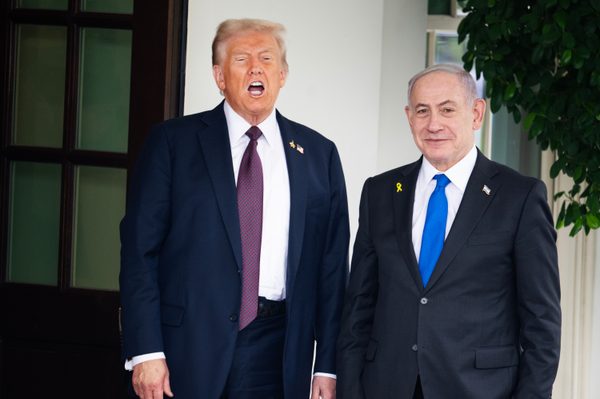
President Donald Trump and Israeli Prime Minister Benjamin Netanyahu at the White House in September.
Tom Williams/CQ Roll Call via AP
Pro-Palestine groups in the United States have spent decades pushing to halt American military aid to Israel. Over the past three weeks, they’ve found they may suddenly be pushing against an open door.
After months of hints and teases, the Israeli government and its allies in Congress rolled out a new strategy—consisting of a package of related measures in the House and the Senate—to slowly swap out the nearly $4 billion the US has been spending on direct military aid to Israel each year for a new paradigm of deep technological and supply-chain integration. The legislation currently under consideration, which Israeli prime minister Benjamin Netanyahu referred to in a June 1 letter as “my plan,” would empower senior Pentagon officials to spend billions of dollars developing weapons systems in tandem with Israel, “synchronizing” research efforts and intertwining an extraordinary range of technologies. The resultant interdependencies, Foundation for Middle East Peace president Lara Friedman wrote last week, would effectively give Netanyahu “a seat in the US situation room.”
Opposition to military aid to Israel is a winning issue for progressive Democrats, embraced by candidates in House primaries across the country this spring. The new strategy of defense integration is hard to grasp and so novel that the politics and messaging around it have yet to develop. It’s a politically astute switcheroo from the Israelis and their allies, snatching away from pro-Palestine groups what has become their most potent political device while replacing it with a far more slippery target. For the pro-Palestine left, it creates a serious strategic challenge.
“There’s going to need to be—and there are—a lot of conversations that are happening around this,” said Beth Miller, political director of Jewish Voice for Peace Action.
