With “Fighting Factions,” IfNotNow Zeroes in on Mainstream Synagogues
As the left gives up on conventional Jewish institutions, IfNotNow still sees members to mobilize.
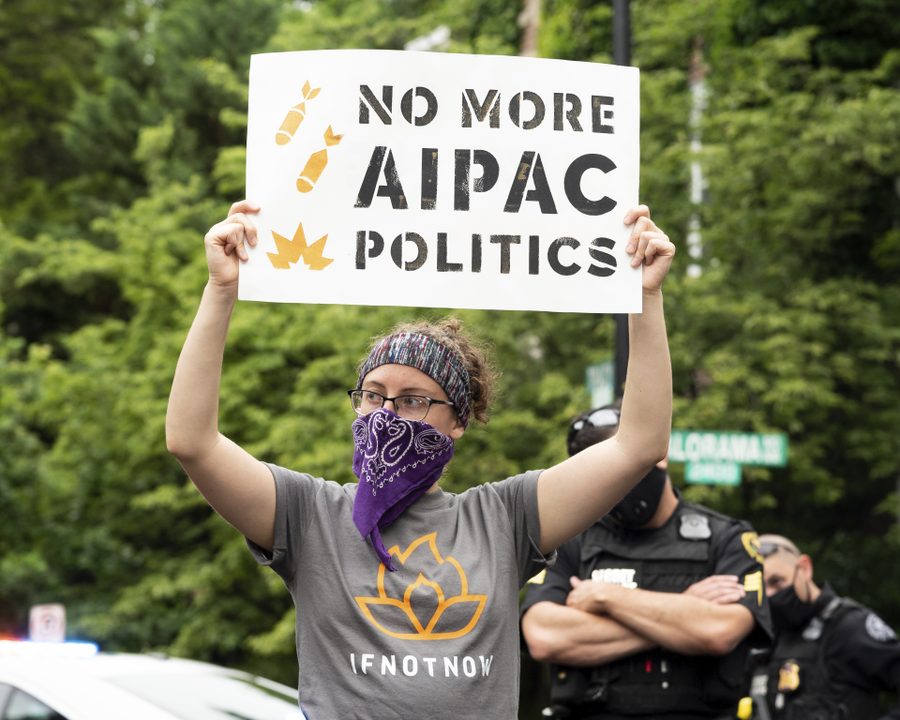
An IfNotNow activist at a rally in July 2020.
This article first appeared in the Jewish Currents news desk newsletter. Subscribe here.
In the summer of 2014, as US Jewish leaders across the political spectrum backed an Israeli invasion of Gaza, a group of young Jewish activists calling themselves “#ifnotnow” delivered a letter to the executive vice chairman of the Conference of Presidents of Major American Jewish Organizations, Malcolm Hoenlein, asking him to “join with us” to “stop the war on Gaza” and “end the occupation.”
He ignored them.
In the months and years that followed, the IfNotNow activists built a movement that drew significant communal attention, with noisy rallies outside the office doors of local Jewish federations, Birthright Israel, and AIPAC. Their wager was that the central institutions of the Jewish establishment would listen to the young people who had grown up in their Hebrew schools and summer camps. They were wrong, and many on the Jewish left—including early IfNotNow activists and leaders themselves—now see those early efforts to reform the establishment as a dead end.
“The last decade of organizing from IfNotNow has revealed that some of the [institutions] that we may have thought were movable are not,” said Yonah Lieberman, who was director of communications and a campaign strategist at the organization from 2015 to 2022.
Even so, IfNotNow isn’t giving up on mainstream Jewish institutions. This month, the group announced plans to spend the next two-and-a-half years on a campaign aimed at strengthening support among US Jews for ending US arms sales to Israel. A central part of the campaign, the group’s leaders say, is an effort to organize what it’s calling “fighting factions” willing to go to bat for blocking bombs to Israel inside of liberal synagogues.
These “fighting factions,” said Morriah Kaplan, IfNotNow Movement’s executive director, are a “group of congregants that the clergy knows is going to make a huge stink if they sign on to a letter that says Zohran Mamdani is a danger to the Jewish people,” referring to a letter opposing the progressive mayor that circulated widely among liberal rabbis during his campaign last fall. A “fighting faction,” Kaplan said, “complicates the calculus for what may have previously been an easy decision for the board or for the senior rabbis about where to throw their weight around politically.”
Kaplan said that the group is involved with members at around 20 different congregations across the US thus far. Much of that activity seems to be taking place in Philadelphia, where local IfNotNow activists are working with cohorts of members in eight mainstream synagogues within the city limits.
The policy goal of IfNotNow’s broader campaign, opposing US arms sales to Israel, is a consensus position among leftist Jewish organizations. But the focus on organizing inside of mainstream synagogues has IfNotNow departing from the powerful current on the Jewish left that pushes for a clean break from the Jewish establishment and a focus on building new leftist Jewish institutions. IfNotNow is part of those efforts—it’s one of dozens of leftist Jewish organizations, including Jewish Currents, that has joined the newly launched Jewish Diaspora Movement—and yet at the same time, it is setting off on a new round of organizing aimed squarely within the mainstream Jewish community.
Leaders and activists with IfNotNow say they are under no illusion that they can change the minds of the executives at the national establishment organizations that IfNotNow targeted a decade ago. But they say they still see value in organizing among Jewish people attached to Jewish institutions, particularly mainstream non-Orthodox synagogues.
“We are not expecting that the JCRCs and the ADLs of the world are going to transform,” said Alyssa Rubin, IfNotNow Movement’s field organizing director, referring to the local Jewish Community Relations Councils that do government relations and interfaith work on behalf of Jewish establishment groups in many cities. “But I think that there’s potential for some synagogues to be able to catch up with their membership.” Prominent liberal pulpit rabbis have often intervened against critics of Israel, with hundreds signing the anti-Mamdani letter last October and dozens of Atlanta-area congregations signing onto a letter in 2024 condemning Sen. Jon Ossoff for a vote against weapons sales to the Israeli military. There are signs, however, that their congregants may be shifting on the issue: 58% of Reform Jews oppose Israel’s conduct of the war in Gaza, according to a recent poll by the Jewish Voters Resource Center.
For IfNotNow, the campaign comes after a period of uncertainty over the group’s purpose and direction. IfNotNow’s membership has exploded since October 7th. The group, which adopted a dues-paying model in 2022, had roughly 1,000 members in the fall of 2023, before the Hamas attacks on Israel and Israel’s ensuing incursion in Gaza, and now has 7,000. But that growth in membership hasn’t brought many political wins. Kaplan said that in 2024, ahead of that year’s presidential election, the organization put significant energy into political campaign work, including supporting the Uncommitted Movement, which threatened opposition to President Biden’s re-election bid over his support for the Gaza war, but ultimately failed to shift the Kamala Harris campaign’s position on the issue. President Donald Trump’s victory that fall was a “clarifying moment,” Kaplan said. “We had lost, not just in terms of not a failing to stop the genocide. We also lost the election—the Uncommitted Movement lost.” The group’s analysis of the losses, she said, was that they hadn’t done enough work to build their base. “Where there was power left on the table was in affiliated Jewish communities.”
At that point, IfNotNow had been organizing for a decade. But in its reappraisal after the election, the group appears to have reconsidered the hallmarks of their strategy. IfNotNow was launched by activists influenced by the Occupy Wall Street movement of 2010 who hoped to create moments of mass political mobilization, hence the noisy protest campaigns outside of federation offices. Now, the group wants to do something different. “It’s a very different type of organizing than we have done in the past,” Rubin said. “It’s not big, flashy, direct actions. We’re not doing sit-ins at the synagogue with our banners demanding that they change. We’re really engaging people in these communities in real conversation.”
The path that IfNotNow has chosen appears difficult. There are thousands of synagogues in the US, and hundreds of large Conservative and Reform congregations. Building “fighting factions” in enough of them to discernably shift the politics of mainstream liberal Judaism seems a tall order. One challenge for IfNotNow is that the organization has long defined itself by the youth of its members, while liberal synagogues are generally oriented towards older cohorts. Kaplan said that the average IfNotNow member is still in their 20s or 30s, but that there’s a wider age range among members than in the past.
When we spoke earlier this month, I told Rubin I was skeptical. It’s clear, after a dozen years, that the establishment doesn’t much care what IfNotNow thinks. But Rubin told me that this isn’t a repeat of previous attempts. “I would say only in the last couple of years have we really started meaningfully engaging people in institutions. Part of the theory is that we really haven’t tried,” Rubin said. “That work is very hard, and it’s very slow, but even in the last year I’ve seen organizations who I never thought would join us come to our side.” The goal, Rubin said, is not to have activists “infiltrate” synagogues, or have people “join a synagogue just for the purpose of organizing,” but to mobilize existing members hoping to influence their institutions.
Elliot Beck, one of the leaders in the Philadelphia IfNotNow chapter who has been leading the group’s efforts to organize synagogues in the city, said that they are working with members who are unhappy with the way their synagogues talk about Israel and Palestine, some of whom have sought out IfNotNow for help. Beck and his colleagues say they are meeting with these members, connecting them with others at the same synagogues, and facilitating conversations with synagogue rabbis. They have organized two gatherings to bring together cohorts from all eight of the synagogues, which include Conservative, Reform, Reconstructionist, and unaffiliated congregations.
“When I’m organizing synagogue members, they’re my people,” said Josh Bloom, who leads the Philadelphia organizing with Beck and works professionally at a synagogue. “I do love and believe in institutional Judaism. I want there to be day schools, and I want there to be summer camps, and I want there to be shuls.”
Some from prior generations of IfNotNow remain skeptical of the synagogue organizing campaign. “You have to be able to stomach navigating a space where horrific things are being said and supported, and have enough compassion for these people that you can still tolerate working with them,” said Simone Zimmerman, an IfNotNow founder. “And then you also have to have enough of a moral center that you will not bend when you’re being asked to compromise certain lines. That’s a really hard thing to navigate. I think it’s a worthwhile thing to test out. I just don’t know if it’s possible.”

I’m Peter Beinart, editor-at-large of Jewish Currents. Before you go, I need to ask something of you.
In recent years, I’ve watched as mainstream Jewish institutions and media have chosen ethnonationalism over liberal democracy and mass slaughter over the pursuit of a just peace. Jewish Currents offers something different. It’s a magazine built on intellectual curiosity and respect for the dignity of all people.
But a project like this doesn’t sustain itself, and we can’t do it without your help. If you share my belief in the importance of this mission, please consider making a donation—or even better, a recurring one. We need you with us.
Josh Nathan-Kazis is the news director at Jewish Currents. Previously, he was a senior writer at Barron’s, where he covered healthcare companies, and a staff writer at The Forward, where he investigated Jewish communal institutions.