Newsletter
May
21
2026
Good afternoon from the Jewish Currents news desk. In today’s newsletter, Alex Kane writes on the Congressional Progressive Caucus’s endorsement of an AIPAC-backed incumbent, despite the caucus’s anti-AIPAC rhetoric. And, we speak with Rabbi Jessica Rosenberg about the Jewish Diaspora Movement, a new network for leftist Jewish groups.
I’m Josh Nathan-Kazis, and here’s what we’re talking about today at the Jewish Currents news desk.

Activists from the Gaza-bound flotilla intercepted by Israeli forces in international waters early this week arrived in Istanbul on Thursday. Yesterday, Israel’s national security minister, Itamar Ben Gvir, posted a video online of the activists being mistreated while in Israeli detention.
Emrah Gurel/AP
IHRA, AGAIN: Jewish establishment groups on Wednesday crowed over the introduction in the Senate of a bipartisan bill called the Jewish American Security Act, timed to coincide with the Jewish Federation of North America’s annual lobby day. The bill appears to be a wrapper for the Jewish establishment’s current push for a massive increase in funding for the federal nonprofit security grant program, which historically has mostly funded security for Jewish institutions. It was nearly something else. An earlier draft, according to someone who saw it circulated, would have codified into federal law the International Holocaust Remembrance Alliance (IHRA) definition of antisemitism, which considers much criticism of Israel to be antisemitic. That’s long been a top aim of Jewish establishment groups, and something they attempted in 2024, with their failed Antisemitism Awareness Act. The earlier version of the Jewish American Security Act attempted to enshrine into law parts of President Trump’s 2019 executive order on antisemitism, which hinged on the IHRA definition. That provision was removed from the version of the bill rolled out this week. “The fight continues to be, ‘Can they get the IHRA definition codified?’” the person who saw the draft said. “This bill was trying to sneak it in.” A representative for the progressive anti-antisemitism organization The Nexus Project told Jewish Currents that the group supports the Jewish American Security Act, and that as introduced it “doesn’t push forward an unhelpful, contested definition of antisemitism that would risk criminalizing political speech.”
SWING AND A MISS: In New York City, Jewish left groups and the mainstream Jewish establishment have been testing their relative influence this spring in the fight over City Council speaker Julie Menin’s buffer zone proposals, which critics fear would limit protests outside of synagogues and schools. A watered-down version of Menin’s synagogue buffer zone bill passed and is now law, but Mayor Zohran Mamdani vetoed the school bill, drawing bitter complaints from the UJA-Federation of New York and its allies. Menin wanted to overturn Mamdani’s veto, and worked on shifting votes until late Tuesday night, according to a report from local New York politics site City & State. City & State says they heard Tuesday night that Menin had enough votes, but by Wednesday her office acknowledged that the effort to overturn the veto was over. Menin and her allies will try again with a new bill, which has been narrowed in an apparent effort to appease local unions, who were concerned the original bill would inhibit organizing at universities and hospitals. Jewish establishment groups wanted this veto overturned to demonstrate their power, and they didn’t get it. The fight’s not over, but their swing and a miss leaves them looking weaker.
RAZOR WIRE: Last month, Jewish Currents assistant editor Maya Rosen reported for the news desk from the West Bank village of Umm al-Khair, where Israelis from the adjacent settlement of Carmel had blocked the path village children used to get to school with razor wire. The path is still closed. The blocked-off area is near an illegal outpost Carmel’s settlers have been building in the center of Umm al-Khair, and on Wednesday morning Umm al-Khair residents watched as settlers added four new caravans to extend the outpost even closer to the area where the path to the school had been. “It very clearly shows the ultimate goal of the barbed wire is the outpost expansion and land takeover of that whole area,” Maya says.
LOOKS LIKE A LANDER LANDSLIDE: A poll out this morning has former NYC comptroller Brad Lander up 34 points over Rep. Dan Goldman, the incumbent, in next month’s Democratic primary in their Brooklyn and Manhattan district. There’s little that distinguishes Goldman and Lander on policy—except that Lander has seized the left lane on Israel, supporting the Block the Bombs act, which would stop the sale of certain weapons to Israel, and opposing all US military aid to the country. Goldman, who is backed by AIPAC, doesn’t share either position, and he strongly pushed for crackdowns on campus Gaza protests in 2024. “Goldman is completely out of step with most voters in the district on Israel,” says Jewish Currents senior reporter Alex Kane. “This might become the first New York City race where an incumbent was ousted because he supports Israel too much.”
TRIGGER WARNING: As we wrote in this space last week, the progressive Park Slope rabbi Rachel Timoner is whipping members of her large Reform synagogue, Congregation Beth Elohim, to vote against yet another proposal to boycott Israeli products at the Park Slope Food Coop. We’re talking about a vote over the purchasing policy of one members-only supermarket in a fancy Brooklyn neighborhood, but CBE, in a histrionic voting guide for its members, says that the synagogue must fight the boycott “because we care about freedom, safety, and equality immediately and forever for both Palestinians and Israelis.” Okay! Jewish members “feel unsafe . . . even walking by” the coop now, the synagogue says, and it wants members to know that they might hear some upsetting things at the coop meeting later this month. In its message, CBE offers an actual “trigger warning,” saying that boycott supporters “use the term ‘Zionism’ to mean ‘settler-colonial political ideology’ that ‘seeks dominance and territorial expansion in Palestine through apartheid rule, ethnic cleansing, and genocide of the indigenous Palestinian people.’” That sounds about right! “These and other antisemitic statements may receive support in the meeting,” CBE warns. “If you are in need of moral support, please get in touch with us.” Time to grow up.
“WELCOME TO ISRAEL”: Israeli officials spent Wednesday trying to convince the world that Itamar Ben Gvir is just some random freak, after European governments got upset over the video the government minister posted of his tour of the camp where Israeli forces are holding foreigners snatched Tuesday from the flotilla headed for Gaza. The video shows Ben Gvir gloating as his officers manhandle and abuse the activists. “You are not the face of Israel,” posted the foreign affairs minister, Gideon Sa’ar, in response. The Israeli ambassador to the US wrote on X that Ben Gvir “is not representative of government policy,” and the editor of the Jerusalem Post, Zvika Klein, wrote, “This is not Israel.” That’s not Israel? Then how did Ben Gvir get into that detention camp, surrounded by bodyguards? Ben Gvir is the minister of national security. The detention camp is his detention camp. He’s responsible for Israel’s police, its border guards, its prisons. There’s no doubt he’s a freak. But he’s a freak who’s a member of the governing coalition, who runs a ministry responsible for core state security functions, and whose party is set to win nine Knesset seats in the next election, according to a recent poll. Itamar Ben Gvir is Israel.
NORMAL COUNTRY: Four years ago, the Irish writer Sally Rooney was tarred as an antisemite for barring her Israeli publisher from publishing a Hebrew translation of her third novel, Beautiful World, Where Are You. Now, her fourth novel, Intermezzo is set to be published in Hebrew next month by the Israeli press November Books and the leftist Israeli publications +972 Magazine and Local Call. The novel is being published in compliance with the cultural boycott guidelines laid out by the Boycott, Divestment, and Sanctions movement, which require that, among other things, publishers not accept funding from Israeli state entities and that they endorse Palestinian refugees’ right to return. +972’s executive director, Haggai Matar, wrote this week that November Books is the only Israeli publisher to meet the BDS criteria. “The choice by authors like Rooney to seek genuine partners on the Israeli side, and to find ways to foster cultural activity in Israel within the framework of the boycott, undermines the widespread perception in Israel that BDS is driven by ignorance, terrorism, or antisemitism,” Matar wrote. The press has previously published translations of works by Ta-Nehisi Coates, Naomi Klein, and Ilan Pappé, among others. There’s been some online pushback to the announcement, including claims that Rooney is exploiting a “loophole” in BDS. But in an exchange published in the The Guardian between Rooney and the Palestinian Irish activist Samir Eskanda, Rooney said that she had been in touch with the Palestinian Campaign for the Academic and Cultural Boycott of Israel, a founding member of the Palestinian BDS National Committee, throughout the process of signing the deal. “I was, of course, never boycotting the Hebrew language or any language,” she said.
The Jewish Currents news desk is directed by Josh Nathan-Kazis, with reporting from Alex Kane and Maya Rosen and editing by Mari Cohen. Want to get in touch? Email me at jnk@jewishcurrents.org, or message me on Signal @jnk.56. If you were forwarded this email, subscribe here so you don’t miss the next one.
Despite their Anti-AIPAC Rhetoric, Congressional Progressives are Backing an AIPAC-Funded Incumbent in New York
Alex Kane
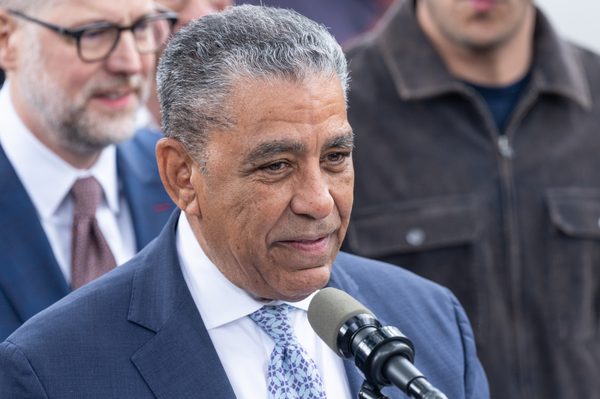
Progressive Democrats in Congress are backing Rep. Adriano Espaillat over a left-wing challenger in next month’s primary.
Lev Radin/Sipa USA via AP
The Congressional Progressive Caucus’s decision last week to endorse New York Rep. Adriano Espaillat against a left-wing challenger in the upcoming Democratic primary was a classic case of a caucus protecting its own—at the expense of a chance to undermine AIPAC’s influence in Congress.
The caucus, the central organizing body for progressive policymakers in Congress, has made opposition to AIPAC a focus of its broader attack on big money in politics. As AIPAC dropped $20 million against progressive Democrats in Illinois earlier this year, caucus chair Rep. Greg Casar denounced the lobby group. “If you care about the future of the Democratic Party, you should be outraged about what AIPAC is doing in Chicago right now,” he said.
But the Espaillat endorsement by Progressive Caucus PAC—the electoral arm of the caucus—shows that opposition to AIPAC apparently does not extend to opposition to caucus members who take AIPAC money. “We have great progressive leaders who are taking on AIPAC,” said one progressive political consultant who requested anonymity to protect their job. “But in the search for trying to have a bigger caucus than some corporate Democratic caucuses, we are sacrificing the substance of the progressive caucus.”
Espaillat is no centrist: He says ICE should be dismantled (though he has voted for broad spending packages that include money for ICE) and backs Medicare for All. But he has taken around $150,000 total in donations from both AIPAC itself and from donors who send money through AIPAC this election cycle, and about $335,000 over his nine-year career. In April 2024, he voted to send Israel an additional $14.5 billion in military in the midst of what experts say is a genocide. And he is not a sponsor of the Block the Bombs Act, which would prohibit the sale of certain munitions to Israel, and which the Progressive Caucus endorsed last year.
Espaillat is facing a primary challenge from Darializa Avila Chevalier, a Democratic Socialists of America endorsee who has made Espaillat’s alliance with AIPAC a central theme of her upstart campaign. “Actions speaker louder than caucus memberships, and Adriano Espaillat has used his time in Congress to give ICE billions, fund the Israeli military, and vote for Trump’s crypto corruption—while being bankrolled by AIPAC and the real estate lobby,” Avila Chevalier told Jewish Currents.
The leaders of the Congressional Progressive Caucus left no opening for members to back Chevalier. An April memo from the affiliated Progressive Caucus PAC, circulated to caucus members and obtained by Jewish Currents, said that the PAC board recommended endorsing Espaillat and asked members to vote on whether to do so. Avila Chevalier’s name was not mentioned.
A Few Quick Questions for Rabbi Jessica Rosenberg on the Jewish Diaspora Movement

A Jewish Voice for Peace (JVP) banner at a May day rally earlier this month.
Robyn Stevens Brody/Sipa USA via AP
Since October 7th and the genocide that followed, as many on the Jewish left have given up on reforming the US Jewish establishment, there’s been a push—in the pages of this magazine and elsewhere—for the creation of new Jewish institutions that can build power and meaning for leftist Jews. One of those new institutions, the Jewish Diaspora Movement (JDM), made its public debut on Monday.
The JDM is a new network of left groups, including Jewish Voice for Peace, Jews for Racial and Economic Justice, Rabbis for Ceasefire, and IfNotNow, as well as several synagogues and dozens of smaller organizations. (Jewish Currents is also a member.) Many of the organizations that have joined JDM are anti-Zionist, though the group says that anti-Zionism is not a requirement for entry. Rather, it says it connects “the growing constellation of Jewish cultural and spiritual organizations that reject ethnonationalism and proudly value universal freedom and the sanctity of all life.”
On Wednesday, I spoke with Jessica Rosenberg, a rabbi of World to Come-Twin Cities and a co-founder of the JDM, about the plan for the organization, and whether it’s a Conference of Presidents of Major American Jewish Organizations for the left.
Josh Nathan-Kazis: Why create an umbrella group for the Jewish left now?
Jessica Rosenberg: Especially in the last years since the genocide in Gaza, seeing the infrastructure of Jewish life double down on Jewish supremacy, it is urgent that we articulate to the world and to each other a fundamentally different understanding of what it means to be Jewish.
The Jewish life that we are centering this movement around has coexisted with Zionism, and now we are at this tipping point where enough of us have organizations that can then come together to be stronger than the sum of our parts. [The anti-Zionist synagogue] Tzedek Chicago is only ten years old—that’s the oldest specifically anti-Zionist synagogue. Most of the rabbis who are connected to this movement were ordained in the last 15 years. Now, we actually have enough infrastructure to do it, which we didn’t have ten years ago.
JNK: What’s the vision for how the JDM supports the Jewish left?
JR: Some people are really excited about this project for the kind of outward-facing power that it shows. Some of us are really excited about this project for the internal [aspects]—we get to be more connected, we get to know what each other are doing.
JNK: So is this kind of a Conference of Presidents—the Jewish establishment umbrella group—for the Jewish left?
JR: We talk about it as a movement. There’s a long history of Jewish movements, stretching back to rabbinic Judaism.
JNK: In the American Jewish context, “movement” generally refers to a Jewish religious denomination.
JR: We’re trying to bring [the idea of a] movement back from before denominations, which are really only the last 150 years of Jewish life. There have been many times in Jewish life when people have articulated a new way of understanding being Jewish and how we orient to the world together. We’re using movement in a broader sense. There are people from all different denominations, and also secular and cultural and non-denominational folks, who are part of JDM.
We are creating a democratic governance structure. We’ve worked pretty hard on what it takes for an organization to become a member, and then how decision-making works. The infrastructure of Jewish life in the US is controlled by wealthy donors, and the very small professional class of people in the Jewish federations, rabbinical schools, or denominational leadership, who by and large do not turn to their members to make decisions. That’s something that is going to be different in the Jewish Diaspora Movement. We’re trying to foster democratic decision making across the movement.
