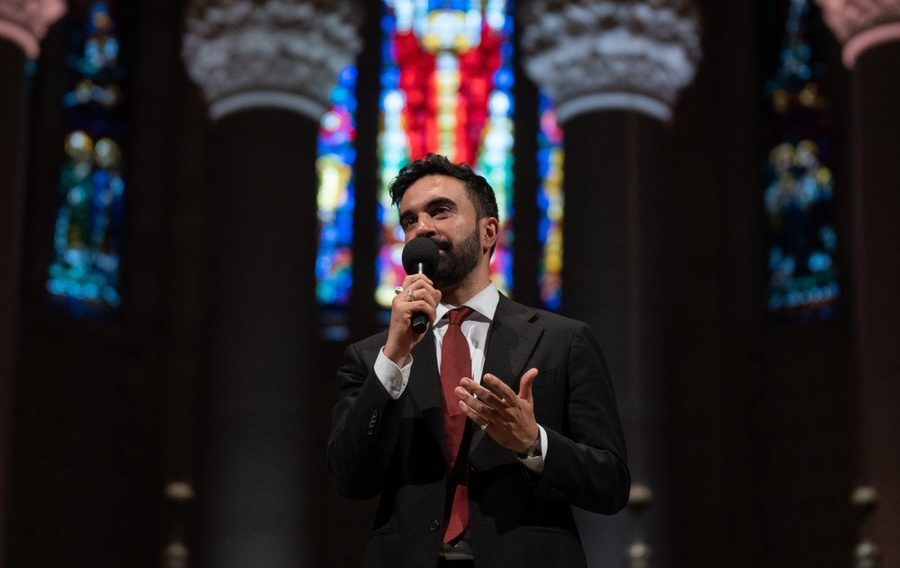
Zohran Mamdani speaks during the “Mayoral Candidate Forum All Faiths, All Candidates” event at Cathedral of St. John the Divine in New York City, June 5th, 2025.
On October 22nd, a group calling themselves The Jewish Majority published an open letter signed by hundreds of rabbis decrying Zohran Mamdani, the Democratic candidate for mayor of New York City, as well as the broader “political normalization” of anti-Zionist politics in American life. The letter, entitled “A Rabbinic Call to Action: Defending the Jewish Future,” argued that when figures like Mamdani “refuse to condemn violent slogans, deny Israel’s legitimacy, and accuse the Jewish state of genocide,” they “delegitimize the Jewish community and encourage and exacerbate hostility toward Judaism and Jews.” It also argued that “Zionism, Israel, [and] Jewish self-determination” are inseparable parts of Jewish identity. The night it was published, Andrew Cuomo, the former New York governor and one of Mamdani’s opponents in the mayoral election next week, referenced the letter on the debate stage to bolster his argument that Mamdani would make Jewish New Yorkers unsafe.
The letter—which, by the following week, had garnered the signatures of over 1,100 rabbis and cantors from around the country—amounted to a last-minute effort to highlight Jewish communal concern about Mamdani, who is leading in the polls. The effort appears designed to present a united Jewish voice against candidates like Mamdani, and to counter the sizable minority of Jews who share his politics. Some polls of Jewish views on the mayoral race have found that Mamdani has substantial Jewish support: A Fox News poll published this month found that 38% of Jews will vote for Mamdani, while a July poll put the number of Jewish Mamdani voters at 43%. The Jewish Majority website also targets Jewish Voice for Peace (JVP) and Jews for Racial and Economic Justice (JFREJ), the left-wing Jewish activist organizations that have been most active in the Mamdani campaign, labeling both groups as “fringe.”
The Jewish Majority is led by Jonathan Schulman, an AIPAC alum whose job was to increase synagogues’ involvement in pro-Israel activism. But the letter includes not only AIPAC-affiliated rabbis but also liberal ones, revealing how some liberal rabbis are leaning when confronted with a choice between their progressivism and their Zionism. Signatories to The Jewish Majority letter included at least 65 members of the rabbinic and cantorial cabinet of J Street, the premier liberal Zionist group in the country, which opposes Israel’s occupation and advocates for a two-state solution. Others on the list have expressed opposition to Israel’s use of food as a weapon during its bombardment of Gaza, or Israeli settler evictions of Palestinian families. “Long before this letter, I had been surprised at the number of my colleagues that I saw expressing fear and distrust of [Mamdani] who are otherwise working for justice of a sort that he would completely agree with,” said Ellen Lippmann, the founder and rabbi emerita of the progressive Brooklyn synagogue Kolot Chayeinu, and a Mamdani supporter.
Still, some liberal New York rabbis—such as Angela Buchdahl of Manhattan’s Central Synagogue and Rachel Timoner of Brooklyn’s Congregation Beth Elohim—did not sign. In a letter to her congregation, Buchdahl said that “political endorsements of candidates are not in the best interest of our congregation, community, or country,” and that “it is up to each of us to vote our conscience.” Meanwhile, Sharon Kleinbaum, the former leader of Congregation Beit Simchat Torah in Manhattan, is openly backing Mamdani, telling a crowd of 13,000 Mamdani supporters last weekend that while she doesn’t agree with the candidate on everything, she was “grateful to Zohran for his commitment to fight antisemitism, for his commitment to protect all houses of worship, and to take seriously the fear that many Jewish communities live with.” According to Alissa Wise, founder and lead organizer of Rabbis for Ceasefire, this moment of left ascendancy in city politics set against a backdrop of an increasingly authoritarian executive branch “naturally, makes liberals subject to competing pressures.” She speculated that, in light of fractured Jewish opinion, the liberal Zionist rabbis who didn’t sign the letter “have congregants that they understand they would be excising from their community, and they don’t want to do that.”
The signatories to the anti-Mamdani letter that Jewish Currents interviewed for this article, all members of the J Street rabbinic cabinet or signatories to letters opposing Israeli annexation of the West Bank or settler plans to evict Palestinians, said their opposition to Mamdani came down to his rejection of a Jewish state. “I am opposed to so much of Israel’s ultra-right-wing zealot makeup. But that does not diminish for one minute my support for Israel as an independent Jewish state,” said Bradd Boxman, a Reform rabbi from Parkland, Florida and a member of J Street’s rabbinical council. “Mamdani has made numerous comments that undermine the right of the Jewish people to have a homeland of their own. That crosses a red line.” (Mamdani has repeatedly said that he believes in Israel’s “right to exist” as a state that grants equality to all its citizens and that he does not believe in “any state’s right to exist with a system of hierarchy on the basis of race or religion.” Israel maintains dozens of laws that discriminate against non-Jewish citizens of the state, and it does not grant voting or civil rights to the Palestinians living under its military occupation.) In a statement, J Street told Jewish Currents that its rabbinic council is “made up of clergy from across the Jewish spectrum, reflecting a wide range of perspectives.” While members are free to advocate on the issues important to them, J Street wrote, “these individual actions do not represent an official position of J Street, which remains neutral in local elections.”
The rabbis also repeatedly brought up what they saw as Mamdani’s endorsement of the phrase “globalize the intifada.” Mamdani has never publicly used the phrase, but when asked during a podcast interview in June about whether it made him uncomfortable, he said he saw the slogan as “a desperate desire for equality and equal rights,” and explained that ”intifada” is the Arabic term for “uprising”—the same word used by the US Holocaust Museum on its Arabic materials about the Warsaw Ghetto Uprising. Jewish leaders and politicians from both parties expressed outrage that Mamdani didn’t condemn the call outright, which they saw as a celebration of the kinds of militant violence against Israeli civilians that characterized the Second Intifada. (The First Intifada was largely associated with acts of nonviolent civil disobedience.) Since the firestorm of criticism, Mamdani has said that he would “discourage” use of the phrase and that he understands that, for some Jews, it is “a reference to bus bombings in Haifa, [and] restaurant attacks in Jerusalem.” Mamdani has also pledged that Zionists would serve in his administration: He has already announced that he plans to retain stalwart Israel supporter Jessica Tisch as NYPD police commissioner, and he has forged a close partnership with City Comptroller Brad Lander, a liberal Zionist. “I cannot imagine that there’s a Jewish leader in New York or elsewhere that has spent as much time in mosques as Zohran has spent with Jews to try to understand who we are in our variety,” said Lippmann.
Still, for Gerald Weider, the rabbi emeritus of the Brooklyn Reform synagogue Congregation Beth Elohim—who signed a letter in 2020 against plans for Israeli settlers to evict a Palestinian family from their East Jerusalem home—Mamdani’s distancing from “globalize the intifada” and his condemnations of antisemitism are not enough. “He discourages the use of that term. The way I read that, that is a wink and a nod to those who use it,” Weider said. “How does that get played out in New York? It is open season on Jews by people who believe in that.” He further added that someone “who has been winked at and nodded at” could “kill” New York Jews. (Weider emphasized that he was only speaking for himself. None of the current rabbis at Congregation Beth Elohim signed the letter, and the synagogue drew protesters earlier this month when Mamdani made a campaign appearance there.)
Weider is one of over 100 signatories who live in New York City, reflecting under 10% of the total, far below the city’s share of the American Jewish population. Palm Springs, California, rabbi Heidi Cohen, a signatory to The Jewish Majority letter who is also in the J Street rabbinical cabinet, said that “it surprises me that there’s such a huge Jewish contingency within New York that supports [Mamdani].” While she and other rabbis Jewish Currents interviewed conceded that some Jews do agree with his positions, they attributed that support, in part, to a lack of education. “Unfortunately, young people are misinformed or completely taken by algorithms that take them to anti-Zionist places without a full story,” said Boxman. They also said some Jews were likely supporting Mamdani not because of agreement with his Israel positions, but because of agreement with his economic policies.
Mamdani’s positions on Israel are not majority views in the American Jewish community, but they are shared by a significant minority—especially among younger Jews. Indeed, 39% of all American Jews—and 50% of Jews between 18 and 34—believe Israel “committed genocide” against Palestinians during its two-year campaign in Gaza, according to a Washington Post poll published earlier this month. Long before images of mass starvation in Gaza hit social media platforms, a 2021 poll conducted by the Jewish Electorate Institute found that 25% of respondents—and 38% of Jews under 40—said that “Israel is an apartheid state.” “I read in the letter fear and desperation. They see the polls that show that particularly those in the rising generation are unwilling to stand by Israel as they enact genocide,” said Wise. “We’re in this tug-of-war about what the Jewish future is going to look like.” This tug-of-war is evident in the two left-wing letters that have appeared to counter The Jewish Majority letter since it came out. The letter organized by Rabbis for Ceasefire, alongside JVP, JFREJ, IfNotNow, and the American Council for Judaism decried “attempts by some legacy Jewish institutions to flatten our diverse Jewish communities and silence the mass numbers of progressive and anti-Zionist voices among us who believe that Palestinian and Jewish liberation are interconnected.”
The Jewish Majority’s attack on JVP and JFREJ comes at a moment when particularly the former are in the crosshairs of an emboldened Trump administration; earlier this month, Reuters reported that the White House included JVP on a list of groups it accused of planning demonstrations where alleged incidents of vandalism or violence occurred. The Jewish Majority website also makes the claim that JVP demonstrations are “violent,” and takes aim at both groups’ participation in nonviolent civil disobedience, which they say disrupts civic life and harms “public safety.” Some of the rabbis who signed the letter told Jewish Currents they were not familiar with The Jewish Majority before signing, though Boxman did not fundamentally disagree with the characterization of JVP, saying that “they claim to be a Jewish organization that speaks for Jews, but almost everything they say is very anti-Israel.” Audrey Sasson, the executive director of JFREJ, said that the letter, by “leaning into division, fear, isolation and supremacy,” played into “the MAGA agenda.”
In signing the letter, Mark Hurvitz, a retired pulpit rabbi who lives in Manhattan, said he hoped to share “what some might consider an elders’ perspective,” although he noted the presence of a “good number” of young rabbis on the letter. Wise said that the most relevant divide reflected by the letter is not between generations—she noted the large number of older members of JVP—but between differing values and divisions over what Israel represents. “The liberal Zionist vision of Israel has never, for a moment, been the reality of the Jewish state. There’s a human cost to that political commitment, and it comes on the backs of Palestinians,” she said. She said she saw a parallel with how such rabbis are approaching the New York City mayoral race, in which “they’re willing to sacrifice policies that will fundamentally improve the lives of millions of people in order to protect a vision of a Jewish state that has no basis in reality.”

I’m Peter Beinart, editor-at-large of Jewish Currents. Before you go, I need to ask something of you.
In recent years, I’ve watched as mainstream Jewish institutions and media have chosen ethnonationalism over liberal democracy and mass slaughter over the pursuit of a just peace. Jewish Currents offers something different. It’s a magazine built on intellectual curiosity and respect for the dignity of all people.
But a project like this doesn’t sustain itself, and we can’t do it without your help. If you share my belief in the importance of this mission, please consider making a donation—or even better, a recurring one. We need you with us.