Trump’s New Travel Ban Targets Palestinians
Immigration law expert Samah Sisay says the new restrictions are about politics, not security.
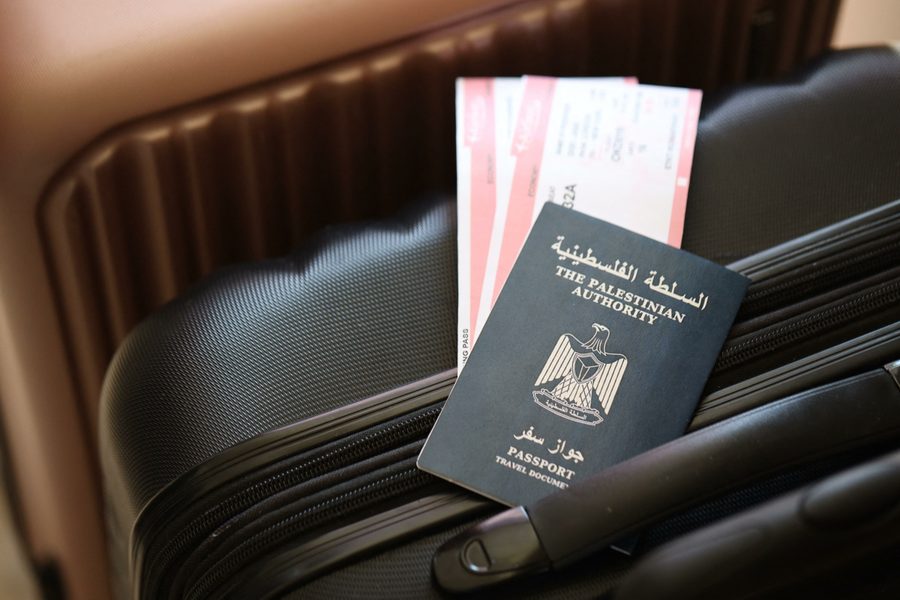
Last week, President Donald Trump issued an executive order that bans people from Syria, South Sudan, Niger, Mali, Burkina Faso, and Palestinians with Palestinian Authority-issued passports, from entering the United States. The order also implemented partial restrictions on the entry of people from 15 other countries, most of them African nations. The administration has framed the new ban as part of its response to the killings of two National Guard troops by an Afghan man who came to the US after fighting in a CIA-backed “death squad” unit, but it is the second time this term that Trump has issued restrictions on who can come to the US. In June, Trump banned travelers from 19 other Middle Eastern and African countries. Immigrant rights groups have criticized the policies as rooted in racism and xenophobia. They also say the initiative will lead to family separation in situations where people outside of the US wish to travel here to reunite with their families.
While Trump issued similar bans during his first administration, the latest travel ban is the first to target Palestinians. Trump justified the ban on Palestinians by pointing to the presence of armed Palestinian groups that “operate actively in the West Bank or Gaza Strip.” He also said that recent “war in these areas” has compromised the ability of the Palestinian Authority to vet and screen applicants for travel. The recent ban builds on a prior decision by the State Department issued in August that paused approvals of visitor visas for people from Gaza, some of which were issued to Gazans injured by Israeli bombardment seeking medical care in the US.
To learn more about this iteration of Trump’s travel ban, the implications for Palestinians, and what the new restrictions say about Trump’s broader immigration agenda, Jewish Currents spoke to Samah Sisay, a staff attorney at the Center for Constitutional Rights (CCR), which filed multiple challenges to travel bans Trump issued during his first term.
Alex Kane: Why do you think Palestinians were included in this travel ban, and what is its practical impact?
Samah Sisay: What we’re seeing now is the expansion of the June travel ban. This ban included 19 countries, and stated that there would be a review done, based on security and other admission issues, to see if other nationals of specific countries would be added. This is the administration testing their Muslim ban and seeing how much they can expand it. The justification for including a lot of the countries is that there are many people overstaying their visas. But the numbers of people who are Palestinian or hold Palestinian Authority passports who are coming to the US is not comparable to a lot of other countries, and yet they are still being targeted.
Before the ban, I’ve worked with a few clients who applied for their family members to try and get them out of Gaza or other parts of Palestine. The application process takes a long time. There are delays. They’re often just denied. So it’s always been really difficult for people to enter through what the administration calls “legal means.” In reality, most people were [already] not receiving visas to come to the United States from Palestine. In the past some Palestinians have gotten temporary status to enter for a conference or a specific educational purpose, but now all of that has been halted.
The addition of individuals who hold passports from the Palestinian Authority highlights the political nature of the ban. It highlights that this administration is utilizing its broad powers around immigration and entry to make political statements. Because immigration is a space where the executive is afforded so much discretion and power, the administration figured out that this is a space that they can utilize to punish Palestinians and exclude them from the fabric of the US system. The exclusion of Palestinians started after the mass student movement in support of Palestine on college campuses. We saw the administration trying to reject student visas for students engaged in Palestinian activism. The majority of the students impacted were Palestinian themselves, such as Mahmoud Khalil, who was targeted for detention.
AK: Does this ban impact Palestinians in the US who are not citizens?
SS: It depends. The most direct impact is on individuals who are outside of the US trying to come in. But technically, if you’re a Palestinian student on a temporary visa, you oftentimes have to leave the country to renew or to extend your stay. Obviously, if there’s currently a ban, leaving means you can’t come back. It puts people in a situation where they have to find other means of stabilizing their status, or they will have to do what the administration calls “self deport”—leaving with the understanding that you will probably not be able to return.
AK: Does this mean a bar on injured Palestinians traveling to the US for medical treatment?
SS: Yes, unfortunately. There is something called “humanitarian parole,” which is a completely different process that, for instance, Afghans and other people utilize in emergency situations, allowing temporary entry for people with urgent humanitarian needs. The executive has discretion here, so it’s possible someone could be paroled, but I doubt that would happen.
AK: How do you understand the ban in the context of the administration’s broader war on immigrants?
SS: The story that’s often told to Americans is that we need to worry about people who are entering the US through “illegal means,” without visas. Yet this administration is actually making it difficult for anyone to come here even with visas. At the end of the day, it just highlights that this has never been about process. It’s always been about exclusion and racism. The office of the executive—which, unfortunately, courts have strengthened a lot in recent years—has the power to exclude certain people based on what they’re claiming are security measures. But all of that is rooted in racism and our relationships with certain countries.
AK: Is the Trump administration also making it difficult for Palestinians to claim asylum?
SS: Because of the closure of these systems that allow people to travel through regular channels, we’re seeing a lot more Palestinians who are fleeing various difficult circumstances entering the US through the Mexico–US border and claiming asylum. The Trump administration is essentially trying to get rid of asylum for everyone, even though asylum is a process that is enshrined in both international law and US law. There is a clear bias against Palestinians within the asylum process, including prolonged detention of Palestinians who have been granted release by immigration courts.
Currently, CCR is representing Mohammed Abushanab, a 27-year-old Palestinian man from the West Bank who fled after facing detention and abuse by Israeli soldiers. He entered the US through California and was immediately detained by immigration officials. He was denied asylum, but only because of the way he entered. Asylum law is very stringent: If you do not enter at a “port of entry” designated as a place where people can claim asylum, you can no longer qualify for asylum status under US law, and that’s what happened with Mohammed. But we have these other protections called “withholding of removal” and protection under the Convention Against Torture, and he was granted both of those protections by an immigration judge. He has been in detention in Texas over almost 18 months, and the administration has refused to release him despite him being granted these forms of relief. They’re saying that they have the right to deport him to a third country—a country that is not Palestine—because the relief he was granted is just against deportation to Palestine. We brought a habeas corpus case, saying that he needs to be released, and that they’re just keeping him detained because he is Palestinian. We’re seeing more and more that ICE is just keeping people in detention who were granted a protection from removal instead of releasing them.
AK: What do you think the stated justification for the travel ban—that there are armed Palestinian groups that operate actively in the West Bank and Gaza—tells us about how the war on terrorism has become linked with the war on immigration?
SS: The creation of agencies like ICE to do this type of enforcement all happened post-9/11. The modern immigration system that we have in the US, where we’re seeing mass detention and these immigration enforcement catchers running around everywhere, is tied to post-9/11 fears and extreme Islamophobia. If you look at the countries that are on this list, many are countries that are majority-Muslim. The few that are not are countries that the US has fraught relationships with.
AK: Is there any hope that a lawsuit could reverse the travel ban?
SS: While the President and the executive branch do have broad discretion over immigration and entry, they’re not allowed to engage in arbitrary decisions or racial animus. Unfortunately, we have a Supreme Court that upheld the first Muslim ban. Still, there are many people who are working to craft arguments to show how this current attempt to exclude people based on race and national origin is truly arbitrary, based in racism and in Islamophobia, etc. The fight continues. I obviously can’t say we will win, but we need to keep pushing and not allow this to become something that’s just accepted.

I’m Arielle Angel, editor-at-large of Jewish Currents. Before you go, there’s something I need to ask.
We’ve seen over and over how the mainstream media falters in telling stories on our beats—whether it’s antisemitism, Israel/Palestine in American politics, Jewish identity, or the American left. At Jewish Currents we’re committed to uncompromising analysis and longform reporting on these issues and more—stories you won’t find anywhere else. In a media landscape that obscures injustice and flattens discussion, we’re changing the conversation. But we need you.
If you believe in this work, please consider making a donation—or even better, a recurring one—to ensure that we are able to keep publishing stories like this one. We can’t do it without you.