The Tangled Knot of Anti-Zionist Violence
Doubling down on the conflation of Zionism and Judaism won’t stop violent attacks.
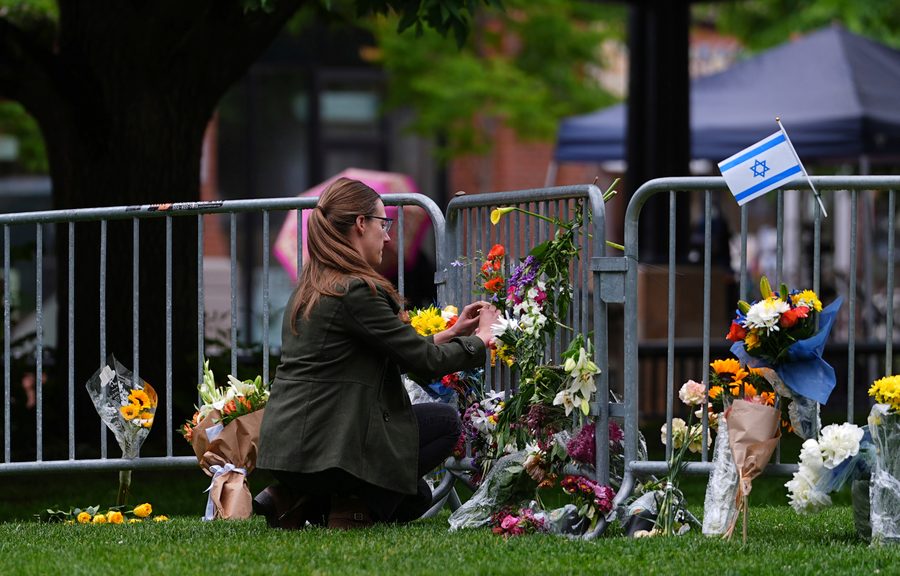
A makeshift memorial for the victims of the attack on demonstrators in Boulder, Colorado.
The day after the June 1st Molotov cocktail attack on demonstrators in Boulder, Colorado, I received an email from my synagogue. Citing the assault, which injured 15 at a walk for Israeli hostages in Gaza, along with the killing of two Israeli embassy workers outside an American Jewish Committee (AJC) event in Washington, DC, a week prior, the note from congregation leadership affirmed that “Attacking Jewish people as a response to a war in Israel and Gaza is unquestionably antisemitic.” The letter reminded readers that “the purpose of antisemitic terror is to make us afraid to live public Jewish lives.”
This interpretation of the violence is ubiquitous among both Jewish communal leadership and American politicians on both sides of the aisle. “Make no mistake,” declared the chief executive of the liberal advocacy group Jewish Council for Public Affairs, “if and when Jews are targeted to protest Israel’s actions, it should clearly and unequivocally be understood and condemned as antisemitism.” Progressive US Representative Alexandria Ocasio-Cortez agreed, writing on X that “Antisemitism is on the rise here at home, and we have a moral responsibility to confront and stop it everywhere it exists.” Speaker Mike Johnson went farther: “It isn’t about Palestine, it isn’t about Gaza, it isn’t about any particular conflict. It’s because these people want a complete and total extermination of the Jewish people.”
The response is both predictable and puzzling. As troubling as these attacks are, neither the shooter in DC nor the assailant in Colorado yelled any obviously antisemitic slogans when they attacked; both chanted “Free Palestine.” Nor is there any evidence that they held classical antisemitic views, like blaming a Jewish cabal for government policies or seeing Jews as especially greedy or mendacious. The DC shooter’s manifesto doesn’t contain the word Jew or Jewish or even Zionist. We know less about the attacker in Boulder, who apparently told police that he wanted “all Zionists to die.” Yet those that have called the violence antisemitic generally insist that the victims were attacked not because they were Zionists but because—and only because—they are Jews. In a representative New York Times editorial, Sheila Katz, chief executive of the National Council of Jewish Women, declared that the victims were targeted because they were at “Jewish events.” Yet Katz’s pronouncement ignores the fact that the AJC is well known as a staunch supporter of the Jewish state, that those killed in the DC attack worked at the Israeli embassy, and that American marches for the release of hostages are recognized by most observers as political demonstrations in support of Israel. It would seem that the victims were targeted not because they were Jews, but because of their support for Israel.
I understand why some find the distinction irrelevant. Jews are being killed and attacked for their views; this is undeniably upsetting. “The very conversation—is this antisemitic or not—trivializes the issue,” Yehuda Kurtzer, president of the Shalom Hartman Institute, said on a recent podcast. “We Jews who support Israel are now being targeted by acts of violence. Does it matter whether somebody calls it antisemitism or not?” In a sense, Kurtzer is correct. The severity of the violence should, on its own, offer sufficient grounds for condemnation. Yet for American Jewish leaders and politicians, it clearly matters a great deal whether or not this violence is called “antisemitism.” There are obvious political reasons why. For many in the Jewish world, antisemitism is an “eternal” hatred; it persists throughout time, a virus always on the verge of outbreak. If that is the cause of the violence—if indeed there is no cause except irrational prejudice—then there is little we can do to stop it. But if one’s interest is the safety of Jews, then it’s imperative to examine the motivation of the violence as stated by those that committed it. Doing so makes plain the uncomfortable but increasingly obvious fact that when associated with Jews as a whole, Israel’s annihilatory campaign of indiscriminate bombing and starvation in Gaza puts Jews around the world in danger. Those committed to preventing such attacks should be working to stop that destruction and to refute that association.
Instead, Jewish leaders are doing the opposite. Katz writes passionately that “our position on this war, or on Israel, does not affect how extremists perceive us. To them, we are all Jews, and that alone makes us targets for hate and violence.” In other words, the violence has everything to do with the victims being Jewish and nothing to do with their support for Israel or their identification with Zionism. Simultaneously, Katz makes clear that to her there is no relevant distinction between the two. “We [Jews] have been asked, unreasonably, to fully disavow our relationship to Israel . . . just to be accepted by supposed allies.” She laments that the word “Zionist” has become a “slur,” when it means nothing more than “the basic belief in Jewish self-determination.” By this logic, anyone opposed to Zionism is an opponent of Jewish freedom; that is, antisemitic. Yet if support for Israel is simply part of what it means to be Jewish, and anti-Zionism is tantamount to antisemitism, then why should anyone—whether a student activist, congressional lobbyist, or murderous loner—be expected to make a distinction between Zionism and Judaism that the leaders of the Jewish community refuse to make themselves?
This knot—in which Zionism and Judaism merge so completely that opposition to Zionism becomes indistinct from opposition to Judaism—was tied at the birth of Zionism as a political program in the late 19th century. The early political Zionists were not only interested in creating a Jewish refuge, but in transforming what it meant to be Jewish. Leon Pinsker, whose 1882 pamphlet Auto-Emancipation is often considered the first text of political Zionism, argued that legal equality in Europe was inherently unable to end discrimination against Jews because it couldn’t make others see Jews as equal. In their prolonged exile, the Jews of Europe were a “ghostlike apparition of a living corpse.” “The proper and only remedy,” he concluded, was “the creation of a Jewish nationality,” achieved “by the acquisition of a home of their own.” The key point for Pinsker, which was also advanced by other early Zionists like Thodeor Herzl, Max Nordau, and Micah Berdyczewski, was that the creation of a Jewish homeland was a means toward the end of establishing a new Jewish identity. Jews were not coreligionists but members of a nation, and only when they recognized themselves as such would they regain a place of pride and honor lost through generations of living in nations that belonged to others. As Berdyczewski wrote at the turn of the century, “we must cease to be Jews by virtue of an abstract Judaism and become Jews in our own right, as a living and developing nationality.” According to this framework, those Jews that rejected their national identity were choosing self-denial over self-respect.
It isn’t hard to see how this position would eventually lead so many to insist that Zionism is not a political ideology, but an integral aspect of Jewish identity—and some to declare that Jews that oppose Zionism are, in fact, not really Jews. When so many synagogues in America feature Israeli flags in their sanctuaries, when campus Hillels are unabashed centers of pro-Israel advocacy, when Jewish communal institutions declare that those calling for divestment from Israel are blatantly antisemitic, it shouldn’t surprise anyone when opponents of Zionism conclude that their political antagonists are, in fact, the Jews. Many Palestinian activists and intellectuals have long recognized that such a conflation would tarnish their cause, and worked to clarify that their enemy was not Jewish people but the state that had stolen Palestinian land. Fayez Sayegh, founder of the Palestine Research Center in Beirut, was among the most persistent and nuanced in making this point. It was Zionism and not opposition to it, he argued, that built directly on antisemitism. Both Zionists and antisemites, he noted, agreed on the basic premise that Jews are a single nation that cannot coexist with others. “The difference between them,” he argued in his 1965 Zionist Colonialism in Palestine, is that antisemitism “disdains those alleged ‘national characteristics’” while “Zionism idealizes” them. In a refrain familiar to any pro-Palestine activist, he insisted: “I am anti-Israel. I am anti-Zionist also. But I am not anti-Jewish.” Astute Jewish commentators recognized how difficult it was to hold the distinction. In 1968, the Israeli writer and historian Nissim Rejwan noted in a letter to a colleague that supporters of Israel wanted it both ways: They demanded that Arabs make a distinction between Jews and Zionists while insisting that “you cannot draw the line between Zionism and Judaism as the former is the ‘national liberation movement’ of the Jews.” Who are we, he would later ask the American critic Irving Howe, “to accuse the Arabs of antisemitism when all they have done is fallen right into the ideological trap which the Zionists have set for them?”
It turns out that this wasn’t just a trap laid for Palestinians struggling against Zionist dispossession. It has also become a trap for Jews. Given that Israel’s founding involved the dispossession of 750,000 people, then decades of military rule over subjects denied basic rights, and now a campaign of bombing and siege that leading human rights organizations have declared a genocide, there are clear reasons for hostility to Zionism. And if support for Israel is essential to being Jewish, then hostility to Israel necessarily entails hostility to Jews. The dynamic feeds on itself like an ouroboros: The hostility proves to Jews that antisemitism is a malignant and eternal force, which reinforces the idea that a militarized ethnostate is essential for Jewish safety, which increases support for that state’s security, which leads to justifications for Israel’s ongoing campaigns of dispossession, which increases the hostility. Rinse, repeat. This is why those that warn of an increasing threat to Jews are right to do so, even if they misattribute the reasons. Studies have long shown that as Israeli violence increases, so too does violence against Jews.
For many Jews, discussing the troubling consequences that follow from the conflation of Judaism with Zionism is too risky or uncomfortable—akin to victim blaming. But describing how the conditions for violence are produced does not exonerate the person directly responsible for that violence; regardless of motivation, we can and should be clear that civilians should not be killed or maimed because of their political positions. More specifically, the idea that these marchers in Boulder might be an apt target for violence from those angry with Israeli policies reflects a warped perspective in which distinctions between identity, complicity, responsibility, and power have dissolved. Even if the boundaries between these categories aren’t always clear, delineating them remains important. Their collapse isn’t, unfortunately, unique to any one assault; it is all too familiar in a political culture in which questions of power are often reduced to matters of identity. We’re not immune to this on the left, where degrees of responsibility are frequently flattened into a catchall “Zionist” identification. But it shouldn’t take a rugged materialist to point out that those manufacturing the bombs killing whole families in Gaza bear more responsibility for that killing than those walking in circles in Boulder. Whether the CEO of Lockheed Martin is or isn’t Jewish is of course irrelevant. It’s also irrelevant whether he is a Zionist. This is not to proffer a list of preferred targets for violence. It is to insist that a politics preoccupied with labels of identity more than with structures of power will not be effective, and can metastasize in dangerous and damaging ways.
Yet those seeking to hold specific individuals and institutions accountable for their support for the ongoing destruction in Gaza will get no help from the Jewish world, whose representatives continually insist that there is no difference between a synagogue service, a march for hostages, or an AJC event for diplomats—or that a municipal ceasefire resolution, a college protest encampment, and a firebombing at a peaceful march are all, equally, signs of pernicious anti-Jewish hatred. The terrible irony is while such declarations are made in the name of Jewish security, they do nothing to make Jews safer. By reinforcing the view that Jews are at risk no matter where they live and no matter what they do or say, such calls distract from addressing the conditions that produce such violence. Rather than demanding generic support for “the fight against antisemitism,” those looking to actually protect Jews will eventually need to turn their eyes from the violence of recent attacks towards the bombing and starvation of millions in Gaza. Doing so will require recognizing recent attacks not as evidence of an eternal hatred but as destructive responses to an unconscionable war.

I’m Arielle Angel, editor-at-large of Jewish Currents. Before you go, there’s something I need to ask.
We’ve seen over and over how the mainstream media falters in telling stories on our beats—whether it’s antisemitism, Israel/Palestine in American politics, Jewish identity, or the American left. At Jewish Currents we’re committed to uncompromising analysis and longform reporting on these issues and more—stories you won’t find anywhere else. In a media landscape that obscures injustice and flattens discussion, we’re changing the conversation. But we need you.
If you believe in this work, please consider making a donation—or even better, a recurring one—to ensure that we are able to keep publishing stories like this one. We can’t do it without you.
Daniel May is the publisher at Jewish Currents.