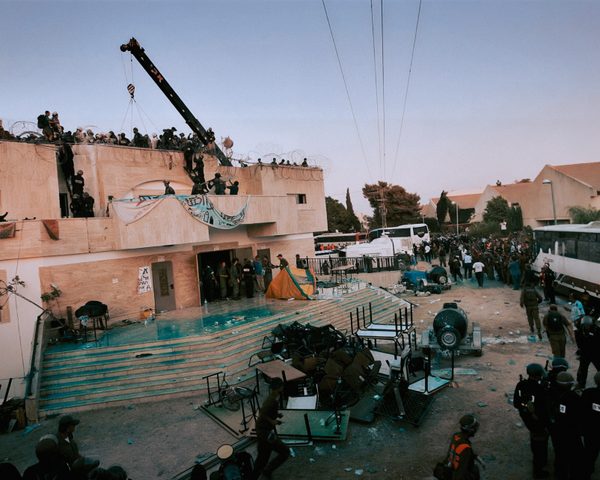
“The War to Bring Democracy to Iran”
The American press has long covered the US’s wars not as criminal invasions but as well-intentioned, if reckless, efforts to spread freedom—a pattern that continues with Iran.
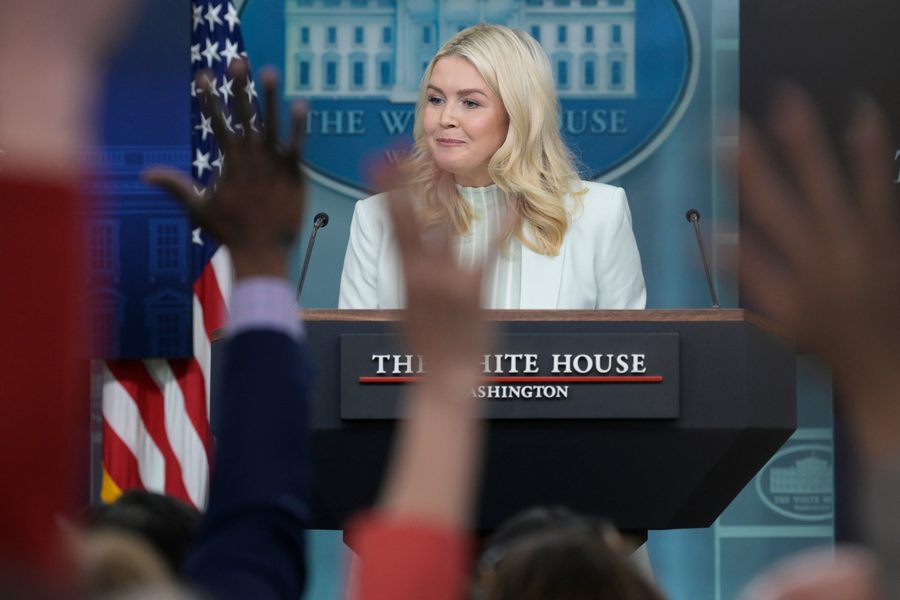
White House Press Secretary Karoline Leavitt speaks about the Iran war during a press briefing, March 25th.
A glance around the major American news media will confirm that the war against Iran, now under a new ceasefire agreement, has not been popular. In the past months, the pages of Foreign Affairs, the foremost journal of the foreign policy establishment, have been filled with laments of “strategic incoherence” and the specter of a new “quagmire.” The New York Times has highlighted President Donald Trump’s “recklessness” and the “military shortcomings” he has wrought. Even the Jeff Bezos-owned Washington Post has, in a February editorial, decried the conflict, noting that Trump’s actions are a “jarring” violation of his promises to end the US’s wars in the Middle East.
Still, mainstream outlets have largely limited themselves to criticizing Trump’s failure to achieve stated American objectives rather than contesting the basic premises and motives behind the war—a posture media scholar Daniel Hallin has referred to as the “technical angle.” “The tendency to frame and analyze events in terms of strategy and tactics, success and failure, is characteristic of modern US journalism,” Hallin wrote in 1994. In keeping with this approach, leading commentators have, even while denouncing Trump, maintained the idea that it is Iran—and not the US and Israel—that is the expansionist threat to regional stability. “Whatever the Trump administration’s flaws in its strategy,” former diplomat James F. Jeffrey wrote in Foreign Affairs, “Iran’s history of direct and indirect aggression meant war was someday inevitable.” Such writers have likewise maintained that even if Trump’s particular war is unwise, Iran still remains “the world’s largest state sponsor of terrorism,” one which might necessitate military force from the US. Indeed, after the initiation of the US–Israeli bombing campaign, The New York Times’s editorial board quickly reminded its readers that “military action, for all its awful costs, can have positive consequences,” while insisting that “a responsible American president could make a plausible argument for further action in Iran.”
Technical criticisms, focused on tactical or messaging failures, have been accompanied by a general disinclination to understand the US bombing of Iran as criminal in itself. News coverage has often depicted only the most flagrant violence and threats as potential crimes, as in the PBS headline: “Experts say Trump’s threats to destroy Iran’s infrastructure could be considered war crime.” This obscures the broader fact that the entire policy of bombing other countries unprovoked and assassinating their officials, however disagreeable they may be, constitutes the same kind of aggression, the “supreme international crime,” for which men were hanged at Tokyo and Nuremberg.
While previous US administrations took pains to insist that their invasions and bombing campaigns were lawful, current American leaders have been openly advertising their criminality. Pete Hegseth’s renaming of the “Department of Defense” to the “Department of War” has, quite literally, removed the veneers of humanitarianism from US violence; Trump has directly threatened to kill “a whole civilization”; his armed forces have torpedoed uninvolved ships, and elsewhere openly murdered civilians in the Caribbean, among other crimes. Despite all this, it is telling that the furthest the Times’s Nicholas Kristof is able to go—following the American bombing of an Iranian school that killed more than 100 children—is to note how, “in some eyes, Trump is taking us a step toward becoming a rogue state” in the process of waging what fellow columnist Thomas Friedman still holds to be “the war to bring democracy and the rule of law to Iran.”
The overall narrowness of media discourse has been the status quo in the last half-century of war news. Throughout the 20th century, the press has directed Americans to understand the US’s invasions, proxy wars, and coups during the Cold War as part of an effort to preserve freedom and democracy, “contain” the expansionist totalitarianism of the Soviet Union, and “deter” aggression around the world.
The Vietnam War serves as one illustrative example. Following the demise of French colonialism in Indochina, the US played an outsized role in establishing an unpopular dictatorship in South Vietnam to represent its interests. When the US-dependent regime appeared too weak to defend itself against the nationalist resistance, the US simply invaded the country and went to war with the popular insurgency. As Pentagon Papers whistleblower Daniel Ellsberg put it, Vietnam was altogether a situation in which Americans “weren’t on the wrong side; we are the wrong side.”
But reading US news media, one would never know of this reality. As Noam Chomsky would often say, the very idea of a US invasion of South Vietnam was effectively expurgated from US discourse. Even as the American military ravaged Indochina—and especially South Vietnam—with carpet bombing and chemical warfare, the US press often referred to the policy as the “defense of South Vietnam.” Endless reports and analyses were devoted to the technical question of whether the “pacification” of Vietnam would be successful. The debates hinged on tactical rather than moral questions: whether the war was “unwinnable,” whether it was incurring too many American casualties, whether it was needless or too costly, and so on. The famed liberal journalist Anthony Lewis epitomized the dominant perspective, writing that the initial policies of war in Southeast Asia “can be regarded as blundering efforts to do good.”
Similar themes were replayed in news coverage of the Reagan administration’s 1986 attack on Libya. That assault, which destroyed Libyan military facilities as well as residential buildings and killed Muammar Qaddafi’s infant daughter, initiated a rhetorical strategy that would come to define decades of US foreign policy dogma: a focus on “terrorism.” The press followed the administration in casting the bombing campaign as a legitimate response to recent attacks in Europe. The Wall Street Journal, for instance, ran articles about the bombing under the title “War Against Terrorism,” while the Washington Post’s editorial board praised the bombing in an article headlined “Acting Against Terorrism.” In an April 16th, 1986, broadcast, CBS’s Dan Rather exemplified the way mainstream media moved in lockstep with the US War on Terror: “Is Muammar Qaddafi the terror master, or just one of many? . . . You could look just as well at Iran and Khomeini, better yet perhaps, Syria and Assad.” (One young Libyan man surveying the rubble of a Tripoli neighborhood could see what most American intellectuals would not: “This is terrorism.”)
The pattern continued with the NATO bombing campaigns in Yugoslavia in 1999 and Libya in 2011. Billed as “humanitarian interventions,” both wars, in truth, greatly increased human suffering. During the bombing of Yugoslavia, NATO forces deliberately targeted Serbian broadcasting studios and killed the civilians inside; the writer Tariq Ali argues that the campaign, “designed, or so we were led to believe, to halt the flow of refugees . . . has increased it a hundredfold.” In Libya, too, scores of people would be killed by NATO itself, not to mention the immiseration of the country following the collapse of its government. Still, the Western press covered the wars not in terms of realpolitik but as humanitarian efforts designed for the protection of civilians. The Times’ editorial board declared in June 1999 that the NATO war in Yugoslavia was “a victory for democracy and human rights.” Kristof gushed in April 2011 that “[Barack] Obama and other world leaders did something truly extraordinary, wonderful and rare [in Libya]: They ordered a humanitarian intervention that saved thousands of lives.” The Libya operation was, according to NPR, about “using bombs to keep the peace” and “holding tyrants accountable.” Even criticism took these purported high-minded principles as its starting point: In 1999, this position was captured well by Times columnist William Safire, who wrote that “in Kosovo, the Western world is doing the right thing in the wrong way.” Friedman echoed this line in 2011, writing: “I respect the president’s desire to prevent a mass killing in Libya. But we need to be more cautious.”
The war in Iran has seen yet another iteration of this false moral hierarchy, wherein the Iranian regime is presented as a uniquely “repressive, terrorist-sponsoring government,” and the US–Israeli war as an endeavor—even if unwise and reckless—is cast as one whose premises would be defensible if competently articulated. If we were to step outside the technical angle and look more closely, however, we may find that Daniel Ellsberg’s reflection on the Vietnam War applies again: We are the wrong side.

I’m Peter Beinart, editor-at-large of Jewish Currents. Before you go, I need to ask something of you.
In recent years, I’ve watched as mainstream Jewish institutions and media have chosen ethnonationalism over liberal democracy and mass slaughter over the pursuit of a just peace. Jewish Currents offers something different. It’s a magazine built on intellectual curiosity and respect for the dignity of all people.
But a project like this doesn’t sustain itself, and we can’t do it without your help. If you share my belief in the importance of this mission, please consider making a donation—or even better, a recurring one. We need you with us.
Zachary Jablow is a PhD candidate in political science at the University of Illinois and a visiting lecturer at Bryn Mawr College.