The Era of Unconditional Support for Israel Is Ending
Trump’s redefinition of America’s imperial role is emboldening US officials to distinguish American interests from Israeli ones—and freeing European governments to challenge the Jewish state.
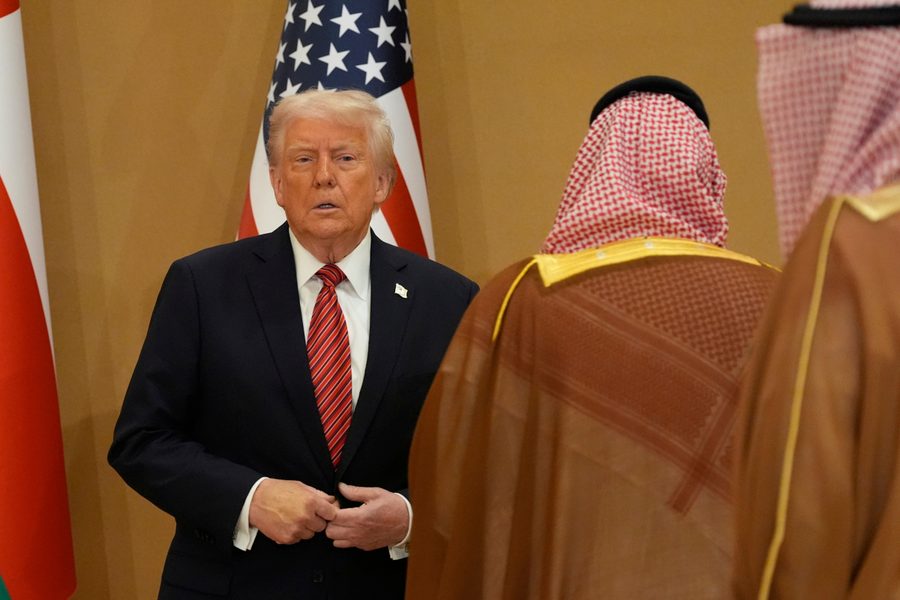
President Donald Trump at the Gulf Cooperation Council Summit in Riyadh, Saudi Arabia, May 14th, 2025.
For more than three decades, American presidents have insisted that what is good for Israel is good for the United States. In Democratic and Republican party platforms since the end of the Cold War, you find the same language again and again: The US and Israel hold “common strategic interests” and maintain “a strategic alliance that benefits both nations.” But in recent months, Trump officials have repeatedly signaled that those interests diverge. On May 9th, the Trump administration cut a deal to ensure that the Houthis would stop attacking US ships—even as the Yemeni militant group continued its strikes against Israel. Asked to justify the agreement, Ambassador to Israel Mike Huckabee made it clear that keeping Americans safe from Houthi attacks is a US priority; keeping Israelis safe is not. The US, he declared, “isn’t required to get permission from Israel to make some type of arrangement that would get the Houthis from firing on our ships.” Two months earlier, when asked about the Trump administration’s direct negotiations with Hamas to secure the release of an American hostage in Gaza, even as Israeli captives languished, US envoy Adam Boehler asserted that, “We’re the United States. We’re not an agent of Israel.” To prove it, Trump has ignored Israeli opposition as he negotiates with Iran on a new nuclear deal.
This willingness to sharply differentiate American interests from those of its longtime partners isn’t restricted to Israel. The Biden administration prided itself on forging a common front with America’s European allies. President Donald Trump prefers going solo. He’s parted ways with Europe’s leaders on Ukraine, climate, and trade—and now he’s allowing EurÏope to go its own way on Israel, too. “Trump isn’t cracking everyone else into line,” observed Daniel Levy, the British-based president of the US/Middle East Project. “The US is not trying to create a common policy.” Without meaningful opposition from the US, European leaders have grown increasingly critical of Israel’s assault on Gaza over the last month. French President Emmanuel Macron has called Israel’s actions there “a disgrace.” Britain’s foreign minister termed Israel’s denial of humanitarian aid to the Strip “abominable.” Slovenia’s president accused Israel of genocide. A joint statement by Britain, France, and Canada labeled the language of some Israeli leaders “abhorrent” and, in a reference to Israeli Prime Minister Benjamin Netanyahu’s embrace of Trump’s plan for the mass relocation of Gaza’s people, the three governments warned that “permanent forced displacement is a breach of international humanitarian law.” Never before in the post-Cold War era have European leaders so seriously discussed punishing the Jewish state.
Trump’s redefinition of America’s imperial role is emboldening US officials to distinguish American interests from Israeli ones—hearkening back to an older era of US–Israel relations—and freeing European governments to challenge the Jewish state without fearing American retribution. The age of virtually unconditional Western government support for Israel is coming to an end.
Peruse foreign policy commentary since Donald Trump’s return to office, and you’ll encounter a persistent lament: He’s abandoned America’s leadership of the “free world”—the group of nations, mostly located in Europe and East Asia, with whom the US partnered to oppose the Soviet Union after World War II. But Trump isn’t interested in this mantle. He doesn’t believe the US shares interests with longtime allies; he suspects they’re ripping America off. And he doesn’t claim that America’s democratic partners are superior to its longtime foes. Trump often prefers autocrats, especially when they pay him.
This inclination is shaping Trump’s policies toward Israel. In the Middle East, he courts super-rich Gulf monarchies, like Saudi Arabia, the United Arab Emirates, and Qatar, which can deposit more money into his family’s bank accounts than Israel can. Before Trump visited the Persian Gulf—and bypassed Jerusalem—on his first foreign trip, his administration reportedly stopped conditioning US support for Saudi Arabia’s nuclear program on its willingness to normalize diplomatic relations with Israel. At the urging of Saudi leader Mohammed bin Salman, he also lifted US sanctions on Syria, over Israel’s objections.
While Trump’s epic corruption is new, his willingness to challenge Israel in pursuit of what he considers American interests is not. It’s a throwback to the Cold War. Between the 1950s and the 1980s—when the Christian right and AIPAC enjoyed less influence in Washington and successive administrations worried that a conflict in the Middle East could spark a war between superpowers—American presidents were less deferential to Israel. President Dwight Eisenhower threatened to end all aid to Israel unless it withdrew its troops from Egypt in 1956. In 1975, when the Jewish state refused a partial withdrawal from the Sinai, Gerald Ford vowed a “reassessment” of “our relations with Israel,” and halted all new assistance. After Saudi Arabia begged Ronald Reagan to force Israel to halt its bombardment of Beirut in 1982, Reagan wrote in his diary that he had told Israeli Prime Minister Menachem Begin that Israel’s assault “had to stop or our entire future relationship was endangered.”
Like Eisenhower, Ford, and Reagan, the Trump administration’s willingness to defy Israel has little to do with Palestinians. It’s about America’s relationships with Middle Eastern regimes. During the Cold War, the existence of a rival superpower gave Arab leaders leverage over the United States. Now that America has superpower rivals again, some of that leverage is back. Trump isn’t only pro-Saudi because its leaders give his family lucrative business deals. His advisors also fear that Riyadh could draw closer to Beijing.
Another reason Trump is more willing to break with Israel is because Republican foreign policy opinion has dramatically changed over the last decade. In his first presidential run, Trump overthrew the GOP establishment in part by harnessing a populist backlash against the Iraq War. In December 2015, in one of the defining moments of the Republican primary, he broke with his hawkish opponents—most notably GOP frontrunner Jeb Bush—by declaring that the war had left the Middle East “totally destabilized, a total and complete mess” and arguing that the US should have instead spent its money “right here in the United States on schools, hospitals, roads, airports, and everything else that are all falling apart!” Trump campaigned this past fall on a renewed promise to avoid military conflict, especially in the Middle East. “If Kamala wins, only death and destruction await because she is the candidate of endless wars,” he told a Michigan crowd days before last November’s election. “I am the candidate of peace.”
Trump’s critique has been taken up by younger conservatives like Vice President J.D. Vance and Missouri Senator Josh Hawley, who want the GOP to fully repudiate the interventionist Bush legacy. For younger people on the right, the CATO Institute’s Justin Logan told me, the “global war on terror was a colossal psychological event”—a catastrophe that has left them deeply skeptical of military adventures, especially in the Middle East. Over the last 18 months, Israel’s assault on Gaza has made many of these conservatives associate the Jewish state even more strongly with wars that threaten to draw in the US. This has contributed to an enormous gap between the way younger and older conservatives view Israel. According to the Pew Research Center, 50% of Republican adults ages 18–49 now hold an unfavorable view of the Jewish state, compared to only 23% ages 50 and above. By comparison, the generation gap among Democrats is only five points. A 2024 Northeastern University poll found that Republicans 18–24 feel more negatively toward Israel than Democrats over the age of 65. These young conservatives are led by a spate of far-right influencers—from Tucker Carlson to Candace Owens to Nick Fuentes—who offer harsh criticism of Israel, much of it suffused with conspiracy theories about Jews.
Though these shifts make the Trump administration more willing to defy Israel in its policies toward Saudi Arabia, Yemen, Syria, and perhaps even Iran, they have not yet made the White House more sympathetic to Palestinians. As a stateless people, the Palestinians have little to offer Trump; they can neither bribe him nor scare him by threatening to ally with China. This means that even as Trump breaks with Netanyahu’s warlike attitudes toward other Middle Eastern regimes, he is providing him weapons and diplomatic support that enable Israel to continue its assault on Gaza. Trump has even proposed expelling the Strip’s entire population.
But Trump’s belligerence on Gaza, coupled with his disinterest in coordinating with allies, has prompted Europe to contemplate its own, very different, break with the Jewish state. As in the US, public support for Israel has been declining in recent years in Germany, France, Britain, and Spain. But until earlier this year, European public discontent had little effect on government policy. That changed this spring, when—with Trump’s blessing—Netanyahu scuttled a ceasefire deal that would have released all the hostages in return for an end to the war, renewing a starvation and bombardment campaign aimed at depopulating Gaza. Israel’s renewed offensive undercut European rationalizations for supporting the war. “For many European governments,” notes Hugh Lovatt, a Senior Policy Fellow at the European Council on Foreign Relations, “Israel’s decision to end the ceasefire removed any Israeli justification for necessary self-defense because there was a realistic [diplomatic] path to releasing all hostages.” According to Martin Konecny, director of European Middle East Project, Israel’s “more obvious and explicit talk of ethnic cleansing cut through the layer of denial in much of Europe.”
Despite the harsher condemnation of Israel from American allies like France and the UK, Europe hasn’t matched its talk with action. But that could change. On May 20th, European Union foreign ministers voted to review whether Israel was complying with the human rights requirements of the EU–Israel Association Agreement, which affords Israel preferential trading access to the continent, along with various forms of scientific and technological cooperation. Revoking the entire agreement is virtually impossible, since it would require unanimity among the EU’s 27 nations, which include Hungary, a staunch Israeli ally. But according to Lovatt, just revoking the trade portion “could cost Israel hundreds of millions of Euros in tariff savings,” since, according to the Financial Times, “Israel sources nearly half of its goods imports from Europe and sends more than a third of its exports to the continent.” Canceling scientific cooperation would also constitute a serious blow to Israeli research institutions.
A partial revocation requires a qualified majority: 15 countries representing 65% of the EU’s population. A key holdout is Germany, which, given its history, has been extremely reluctant to challenge the Jewish state. But even there, attitudes are shifting. A poll last month found that 80% of Germans oppose Israel’s assault on Gaza. Some leaders of the center-left opposition party SPD have publicly called for ending German arms sales to Israel, and Germany’s chancellor recently called Israel’s actions “no longer comprehensible.” Last week, well-known German talk show host, Markus Lanz, lambasted the “hypocrisy” of German politicians who defend IDF conduct in front of the cameras but acknowledge that Israel is committing war crimes behind the scenes. Konecny recalled a conversation with a German-born official who compared the public debate on Gaza to the public debate in East Germany shortly before the fall of the Berlin Wall, when even senior officials said one thing in public and another once the mics were turned off. Given Germany’s economic and political heft, a shift there could change Europe’s relationship with Israel in fundamental ways.
Whether Europe does ultimately act, the growing outrage among its leaders—combined with Trump’s willingness to assert US national interests over Israeli objections—highlights the timidity of Democratic politicians in the US. Congressional Democrats like Chuck Schumer and Hakeem Jeffries have endorsed a ceasefire, but don’t support US pressure to bring one about. Potential 2028 presidential candidates like Josh Shapiro and J.B. Pritzker have condemned Trump’s expulsion plan, but mustered none of the indignation now being heard in London, Paris, and even Berlin.
Democratic elites aren’t just failing morally. They’re failing politically. US public opinion is turning swiftly against Israel. In a survey this March, Gallup recorded Israel’s lowest level of support since the pollster began measuring it in 2001; the Chicago Council on Global Affairs found this May that Israel’s favorability rating was the lowest it has been since the Council began its surveys in 1978. Among Democrats, the numbers are particularly lopsided. In 2013, according to Gallup, Democrats favored Israel over the Palestinians by a margin of 36 points. Now they favor the Palestinians by 38 points.
This chasm between ordinary voters and Democratic leaders, many of whom remain in the Biden mold, offers an opportunity to a Democratic presidential candidate in 2028. Like Howard Dean in 2004, who rose from obscurity because he was the only major Democratic contender who opposed the Iraq War, a Democrat who forthrightly opposed arms sales to Israel could expose establishment opponents as out of touch with the party base. National Democrats could learn from New York mayoral candidate Zohran Mamdani, who cites a conversation with “a 75-year-old woman whose elevator is not working in her building” in which she laments that “the federal government can’t send her a single dollar for public housing” but “somehow has billions of dollars to kill children.” When it comes to Israel and Palestine, Democrats need not choose between the language of justice and the language of national interest.
Obviously, any Democratic presidential candidate who spoke that way would be pilloried by pro-Israel groups and parts of the media. And even if a Democrat did take the White House, they would likely find it harder to defy Israel than Trump has. When the Trump administration negotiated directly with Hamas, congressional Republicans largely stayed silent, as they do when Trump violates all kinds of norms. Had Barack Obama done the same, they would have demanded his impeachment.
Still, among the lessons of Donald Trump’s presidency is that the rules governing what is and isn’t politically possible are often more fragile than they appear. That’s true of unconditional Western support for Israel—a policy consensus that only emerged a few decades ago and is now hemorrhaging public support. Trump’s presidency and Israel’s murderous attack on Gaza are remaking the geopolitical map and creating an opening for Democrats to speak differently about Palestine and Israel. They just have to seize it.

I’m Peter Beinart, editor-at-large of Jewish Currents. Before you go, I need to ask something of you.
In recent years, I’ve watched as mainstream Jewish institutions and media have chosen ethnonationalism over liberal democracy and mass slaughter over the pursuit of a just peace. Jewish Currents offers something different. It’s a magazine built on intellectual curiosity and respect for the dignity of all people.
But a project like this doesn’t sustain itself, and we can’t do it without your help. If you share my belief in the importance of this mission, please consider making a donation—or even better, a recurring one. We need you with us.

Peter Beinart is the editor-at-large of Jewish Currents. He is the author of The Beinart Notebook on Substack.