Supporters of Palestine Are Winning Inside the Democratic Party
Four years ago, unconditional support of Israel was the safest position for Democrats. Not anymore.
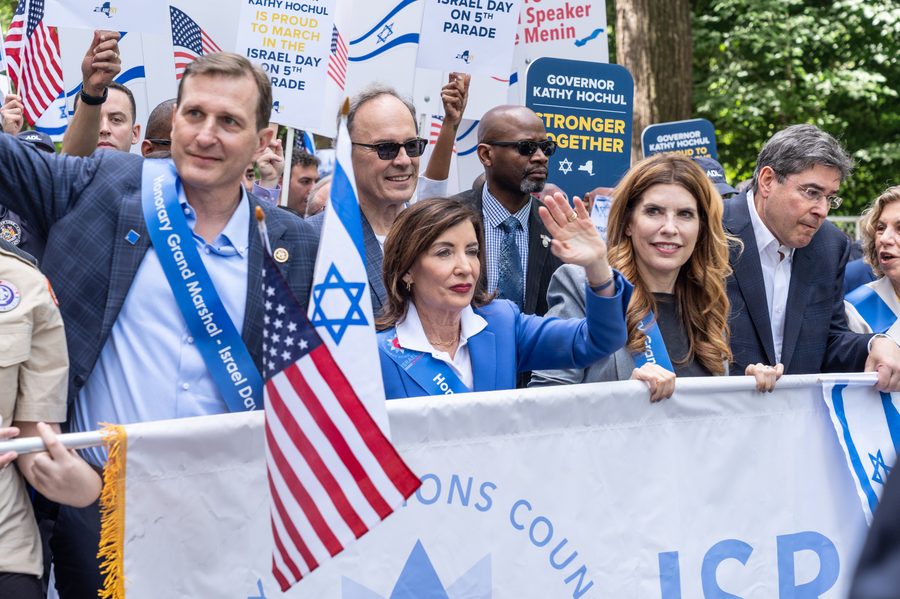
Top New York Democrats march in a pro-Israel parade in Manhattan in late May. Rep. Dan Goldman (left) lost his re-election bid on Tuesday.
This article first appeared in the Jewish Currents news desk newsletter. Subscribe here.
To grasp how profoundly the debate inside the Democratic Party over Israel has changed, it’s worth remembering how Dan Goldman—who lost his congressional seat on Tuesday night by more than 30 percentage points—won it a mere four years ago. A few weeks before the Democratic primary in 2022, Goldman faced off against his top opponent, State Assemblymember Yuh-Line Niou, and other candidates, at a debate at Brooklyn’s Congregation Beth Elohim. When the conversation turned to boycotts of Israel, Niou found herself on the defensive. While insisting that she was not involved in the BDS movement, she said it “needs to be heard.” Goldman pounced. BDS, he said, was “antisemitic.” Instead of boycotting, he added, “we must have unconditional support for Israel.” The room erupted in applause.
This week, by contrast, two New York City congressional candidates who support BDS—Claire Valdez and Darializa Avila Chevalier, the latter of whom participated in the Columbia University Gaza encampment—both won their Democratic primaries. And while Brad Lander, the candidate who defeated Goldman, does not support BDS, he’s called boycotts “legitimate tools” that aren’t necessarily bigoted. He also spent much of the campaign boasting that he does not unconditionally support Israel, and linking Goldman to AIPAC.
What was politic four years ago is now impolitic, and vice versa. Progressive activists have mobilized Americans enraged by US support for Israel’s genocide in Gaza and shown Democratic politicians how electorally potent that rage is. Democratic candidates are either getting the message, or losing their jobs.
In 2022, supporting Israel unconditionally was the safest position a Democrat could take, even in a bright blue district like Goldman’s. Advocating for limits on military aid was risky. Boycotting Israel entirely was career-ending.
Today, the Democratic landscape looks completely different. Restricting US support for Israel is no longer politically perilous; it’s politically expedient. Centrists like Rahm Emmanuel and Gavin Newsom now suggest the US end military aid. Longtime Israel lobby darlings like Cory Booker vote to restrict arms sales.
Going further, and actually supporting BDS, remains a radical position. But it’s no longer unthinkable. Mamdani weakened the taboo last fall, and it has grown even weaker this year as congressional candidates endorsed by the pro-BDS Democratic Socialists of America, like Valdez and Chevalier in New York and Chris Rabb in Philadelphia, along with numerous state and local candidates, have triumphed.
And while these victories generally occur in America’s most progressive precincts, it’s no longer clear that being associated with the DSA’s position on Israel is more dangerous than being associated with AIPAC’s. Last year, formerly AIPAC-allied members of Congress from Kentucky and North Carolina declared they would no longer take money from the organization. In 2025, only one-third of newly elected Democratic House members accepted AIPAC’s offer of a free trip to Israel, down from 70 percent in 2023. And even when candidates do accept AIPAC’s support, they now generally try not talk about it. Asked at a debate last month why she had accepted money from AIPAC donors, Michigan Democratic Senate hopeful Haley Stevens gave an 160-word answer that mentioned “grocery clerk workers,” “freedom,” and the need for campaign finance reform but never mentioned either AIPAC or Israel. By contrast, the Michigan Senate candidate that AIPAC fears most, Abdul El-Sayed boasts that “AIPAC has called me the single most dangerous candidate in this race.” Graham Platner, the Democratic Senate nominee in Maine, similarly touts AIPAC’s opposition to him. When the group called him a “direct threat to the US-Israel relationship,” Platner said he was “proud to appear in this AIPAC fundraising email, and many AIPAC fundraising emails to come.”
The Democratic debate on Israel now features a center comprising candidates who want to restrict arms sales and military aid, a left comprising candidates allied with the DSA and the Palestine solidarity movement, and a right comprising politicians allied with AIPAC. But the left’s influence on the center is growing and the right’s is diminishing.
In 2022, it was hard to imagine a prominent liberal Zionist endorsing a BDS-supporting anti-Zionist. But in last year’s New York mayoral race, Lander did just that, and it has proved not a liability but a boon. This year, running in one of the most Jewish congressional districts in the country, he benefited immensely from Mamdani’s support. Lander’s Israel politics are to the right of the DSA, but he treats it like a partner with whom he sometimes disagrees, and AIPAC as a political foe.
The left is reshaping the political center in swing states, too. In Michigan’s Democratic Senate primary, the third major candidate is State Senator Mallory McMorrow. Three years ago, she was ideologically closer to Stevens than to El-Sayed. In 2023, she went on an AIPAC-funded junket to Israel, and last spring, she attended a private AIPAC event in Michigan. She initially declined to call Israel’s actions in Gaza a genocide. But as the campaign has gone on, she’s moved in El-Sayed’s direction. She now says that she won’t accept AIPAC’s money, pledges to vote against offensive arms sales to Israel, and describes its assault on Gaza as a genocide. If El-Sayed was once the ideological outlier in the race, now Stevens is.
This is how you know supporters of Palestinian freedom are winning. They are changing what DSA founder Michael Harrington called “the left wing of the possible.” A candidate with Mamdani or Chevalier’s views on Israel is unlikely to win the 2028 Democratic presidential nomination. But Bernie Sanders did not need to win the Democratic nomination in 2016 or 2020 to change his party’s position on free trade and economic austerity. He changed it by forcing Democratic politicians to reckon with what ordinary Democrats believe. On the subject of US support for Israel, that reckoning is already well underway.

I’m Peter Beinart, editor-at-large of Jewish Currents. Before you go, I need to ask something of you.
In recent years, I’ve watched as mainstream Jewish institutions and media have chosen ethnonationalism over liberal democracy and mass slaughter over the pursuit of a just peace. Jewish Currents offers something different. It’s a magazine built on intellectual curiosity and respect for the dignity of all people.
But a project like this doesn’t sustain itself, and we can’t do it without your help. If you share my belief in the importance of this mission, please consider making a donation—or even better, a recurring one. We need you with us.

Peter Beinart is the editor-at-large of Jewish Currents. He is the author of The Beinart Notebook on Substack.