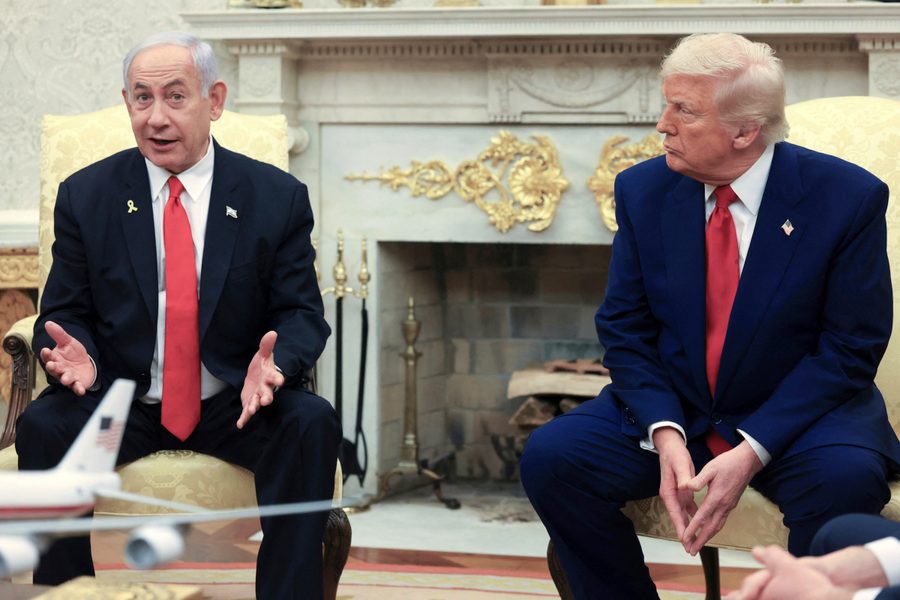
President Donald Trump and Israeli Prime Minister Benjamin Netanyahu during an April 7th White House meeting
In early May, in the days leading up to President Donald Trump’s first trip to the Middle East in his second term, the US embarked on a set of foreign policy shifts that explicitly went against the wishes of Trump’s erstwhile friend, Israeli Prime Minister Benjamin Netanyahu. First, Trump ended the US bombing campaign in Yemen, despite the Houthi rebels vowing to continue their missile attacks against Israel. Next, the administration circumvented Israel and engaged in direct negotiations with Hamas in order to secure the release of Edan Alexander—an Israeli American soldier captured by the militant group on October 7th, 2023. Trump continued this series of policy shifts while in Saudi Arabia last week, on a regional tour that notably excluded Israel. In a speech on May 13th, the president announced the end of sanctions on Syria, in direct contravention of Netanyahu’s recent request that the US continue economic action against the country in order to dissuade cross-border attacks into Israel. In the same speech, Trump also offered Iran, an American and Israeli arch-enemy, “a far better and more hopeful future” if it reaches a nuclear deal with the US. The speech reiterated Trump’s apparent openness to a compromise with the country, a position that Netanyahu has firmly opposed.
Experts say that Trump’s distance from Netanyahu has been visible since before the Middle East tour—in particular since March, when Israel ended the ceasefire with Hamas that Trump and his envoy Steve Witkoff had helped broker. According to Yousef Munayyer, head of the Palestine/Israel Program at the Arab Center Washington, DC, Israel’s renewed bombardment of Gaza dashed Trump’s hopes of using the ceasefire to build on the Abraham Accords—the normalization deals between Israel and Arab states that he facilitated during his first term—and especially his aspiration to bring Saudi Arabia into the agreements. “It became clear the Israelis were not going to help Trump advance the objectives that he wanted within the region, and that Netanyahu was putting his own domestic political interests ahead of his relationship with Trump,” said Munayyer.
Since then, even as the administration has continued the flow of military aid to Israel (and has taken a pro-Israel line in the domestic realm by repressing Palestine activists), Trump officials have publicly asserted US interests as distinct from Israeli interests in a manner unusual for US presidents. One illustrative example, according to Suzanne Schneider, a historian and expert on right-wing thought, was a March CNN interview with Trump hostage envoy Adam Boehler. Boehler had been conducting unprecedented direct negotiations with Hamas in an attempt to release Israeli American hostages and renew the ceasefire, a move that displeased Israeli officials. “I understand the consternation and the concern,” Boehler said in response to the criticism, but “at the same time, we’re the United States. We’re not an agent of Israel.” Other members of the Trump camp have spoken in a similar vein, with Trump’s ambassador to Israel Mike Huckabee explicitly telling an Israeli television station that “the United States isn’t required to get permission from Israel to make some type of arrangement that would get the Houthis from firing on our ships.” Together with the recent policy shifts, Schneider said, these gestures “seem to signal to Israel that they’re going to have to play the game on our terms, rather than the other way around.”
More broadly, observers say, the Trump administration’s assertive position with Israel is part of a new “America First” brand of foreign policy that focuses on making deals with one-time enemies to reduce tensions and advance US economic interests in the Middle East, all while focusing attention on other rivals such as China, which Trump and his allies believe more acutely threaten American hegemony. Multiple conservative commentators told Jewish Currents that the administration’s embrace of this position is responsive to a newly robust conservative “restraint” movement, which sees the War on Terror era of US intervention in the Middle East as an utter failure and instead demands a massive pullback of military assets from the Middle East. “There are dozens of people I would identify as restrainers in this administration,” said Justin Logan, the director of defense and foreign policy studies at the Cato Institute, a libertarian think tank. At times, Trump himself has adopted the language of restraint: In his Saudi Arabia speech, he inveighed against “neocons” and accused Middle East “interventionalists” of “intervening in complex societies that they did not even understand themselves.“ Curt Mills, the executive director of the anti-interventionist conservative magazine The American Conservative, said that the newfound strength of the “restraint” strain has meant that the Israeli government—and in particular Netanyahu—has become more vulnerable to previously muted criticism from the right. “There’s always been this looming question within populist conservative foreign policy: Is it America First, with the exception of Israel?” he said. “This month would seem to indicate the answer to that is no.”
Trump’s recent changes are a turnabout from his first administration, when the president gave Netanyahu nearly everything he wanted. In those years, the US officially recognized Jerusalem as Israel’s capital; legitimized Israeli annexation of the occupied Golan Heights; and engaged in a “maximum pressure” campaign against Iran that involved the US pulling out of the nuclear deal with Iran, initiating punishing economic sanctions, and assassinating a top Iranian military official.
Analysts offer varying theories for Trump’s colder relationship with the Israeli prime minister this time around. John Bolton, one of Trump’s former national security advisers who is now a Trump critic, said the enmity between Netanyahu and Trump goes back to the 2020 election. “Trump has never forgiven Bibi for the speed at which he said he recognized that Biden had won the 2020 election. That’s heresy in the worst form in Trump’s view,” Bolton said. Munayyer, meanwhile, pointed out that Trump is much more comfortable with acting against pro-Israel donors and voters now that he is unburdened from the need to run another election campaign. “He doesn’t need to please this set of interests, and he can pursue his agenda as he sees fit to advance whatever he thinks it advances, whether it’s the American interest, his own personal legacy, his own bank account, or all of the above,” he said. In any case, according to Matt Duss—the executive vice president of the Center for International Policy and the former foreign policy advisor to Senator Bernie Sanders—Trump may recognize that shifts on Israel are unlikely to harm his popularity, given that he has historically managed to persuade his base to back him even when he acts against their long-standing beliefs: “If evangelicals are going to be okay with voting for a philandering, corrupt brute like Donald Trump, they’re going to be okay with him not being super pro-Israel,” he said.
Trump’s Israel policy shifts also respond to the recent prominence of a “restraint” orientation in the conservative voting base. This movement in the base is stark when it comes to Israel policy: A May 5th poll found that 39% of Republican voters believe the US is too one-sided in favor of Israel—a bump of six points from last year’s poll on this question—and nearly half of Republican voters want the US to pressure Israel to end its military occupation of the West Bank, East Jerusalem, and Gaza. “There has also been a huge shift in where the grassroots are, as reflected in someone like Rep. Marjorie Taylor Greene, a leading MAGA voice, inveighing against war with Iran,” Logan of the Cato Institute told Jewish Currents. This shift has also been reflected in the composition of Trump’s advisors: For example, in January, Trump appointed Michael Dimino—a fellow at the restraint-minded think tank Defense Priorities who advocated against US bombing in Yemen, and who has said that the Middle East is minimally important for US interests—as deputy assistant secretary of defense for the Middle East. “Between the number of people that he has brought into his administration that are sympathetic to realism and restraint, and the actual moves he’s making, we’ve seen more hopeful signs than we have seen in years,” said Kelley Vlahos, a senior advisor for the Quincy Institute—a think tank promoting anti-interventionist US foreign policy that includes restrainers on the left and the right—and a former executive editor for The American Conservative. In turn, these moves have worried the pro-war voices who traditionally made up a significant part of the Republican Party coalition. “Be careful of Obama 2.0 [Iran] nuclear deal with a Trump sticker,” Mark Dubowitz, the head of the neoconservative group Foundation for Defense of Democracies (FDD), wrote on X in April amid ongoing US–Iran talks.
Still, for all of the “restraint” camp’s progress, many of the material conditions of US support for Israel haven’t changed; as the historian Schneider put it, “weapons, money, and diplomatic cover are still flowing” to Israel under Trump. In fact, two of Trump’s first acts on Israel policy included the lifting of President Biden’s hold on a shipment of 2,000-pound bombs, and the reversal of a Biden executive order that imposed sanctions on violent Israeli settlers. In February, Trump levied sanctions on the International Criminal Court in part over the body’s issue of arrest warrants against Israeli leaders. And even as Witkoff has reportedly complained about Israel’s intransigence in negotiations to reach another ceasefire—telling Israeli hostage families that “Israel is prolonging the war, even though we do not see where further progress can be made”—he has also apparently said that Washington won’t force Israel to end the war in Gaza. According to Duss, these facts clarify that “Trump isn’t driven by humanitarian concerns but by dealmaking. Ending the war is a politically existential issue for Netanyahu, and Trump currently doesn’t see Gaza as enough of a priority, or enough of a hindrance to dealmaking, to apply the necessary pressure.”
Furthermore, while there appears to be at least some daylight between the US and Israel when it comes to foreign policy, in the domestic sphere Trump has forcefully pursued a pro-Israel agenda. Acceding to the demands of various pro-Israel forces like the Heritage Foundation, the right-wing think tank that helped put together the “Project Esther” strategy to crush the Palestine solidarity movement, the president has launched a fierce crackdown on pro-Palestinian speech—arresting and attempting to deport student activists as well as cutting off government grants to universities where students held pro-Palestinian protests. These attacks on Israel’s critics might appear to be in tension with Trump’s America First foreign policy, but Vlahos suggested that the dual approach may be a strategic move on Trump’s part. “He is indulging one part of his constituency—the [pro-Israel] organizations that create dossiers on college students—because without their support, he loses some energy on his domestic issues,” she said. “But it also holds them at bay while he is doing his thing in the Middle East as he works around Netanyahu.” Munayyer said he, too, doesn’t see a contradiction between the two approaches, and that in both Trump’s domestic and foreign policies, “it’s about him advancing the priorities that he sees fit and using whatever tools and conditions are available to him at the moment to get them done.” In the case of his domestic approach to Israel support, Munayyer said, Trump’s true priorities may include “using Palestine as the low-hanging fruit with which to achieve a couple of different things, including the weaponization of immigration policy and the neutering of the academy.”
However, some portions of Trump’s base—even if otherwise dedicated to mass deportations—have turned against support for pro-Israel positions in the domestic realm. Last month, Charlie Kirk, the head of the campus-focused conservative group Turning Point USA and a close ally of Trump, warned that “jailing, impoverishing, or silencing people based on ‘racism’” might echo the very politics of wokeness that MAGA movement has decried. Kirk’s sentiment was repeated by top MAGA voices in Congress as Republicans debated whether to vote on two bills—the Antisemitism Awareness Act and the Israel Anti-Boycott Act—that would give the federal government new tools to target critics of Israel. As a result of the right-wing backlash, the bills died before coming up for a full vote, with Taylor Greene, a leading voice of Trumpian conservatism in Congress, underscoring her opposition to the anti-boycott bill as a defense of Americans’ “rights to buy or boycott whomever they choose.” “What I don’t understand is why we are voting on a bill on behalf of other countries,” she added. Speaking to the fate of these bills, Mills of the American Conservative said that “AIPAC has cause for concern if they want their maximal goals achieved.” He insisted that there is no “major mainstream desire to expel AIPAC or the neocons from the Republican Party—a lot of people think it should be a big tent. But maximal demands create this decision point where you have to either say yes or no, and I think we’re saying no.”

I’m Peter Beinart, editor-at-large of Jewish Currents. Before you go, I need to ask something of you.
In recent years, I’ve watched as mainstream Jewish institutions and media have chosen ethnonationalism over liberal democracy and mass slaughter over the pursuit of a just peace. Jewish Currents offers something different. It’s a magazine built on intellectual curiosity and respect for the dignity of all people.
But a project like this doesn’t sustain itself, and we can’t do it without your help. If you share my belief in the importance of this mission, please consider making a donation—or even better, a recurring one. We need you with us.