Newsletter
May
26
2026
Good afternoon from the Jewish Currents news desk. In today’s newsletter, we report on IfNotNow’s new effort to organize “fighting factions” inside of mainstream liberal synagogues.
I’m Josh Nathan-Kazis, and here’s what we’re talking about today at the Jewish Currents news desk.
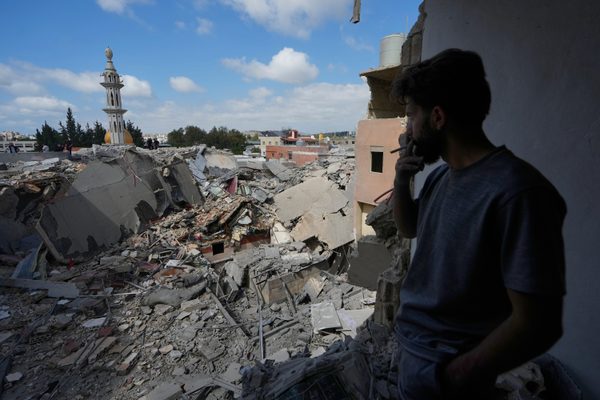
A village near Tyre, Lebanon, hit by an Israeli airstrike on Tuesday. Israel has been ramping up its attacks in Lebanon since late Monday.
Mohammed Zaatari/AP
WAR, AGAIN: As the US and Iran appear to be working haltingly toward a peace deal, Israel is reigniting its war in Lebanon. Israel has bombarded more than a hundred targets in southern Lebanon since late Monday, according to reports, and Israeli leaders are ramping up their rhetoric against Hezbollah. “We are not taking our foot off the gas,” Prime Minister Benjamin Netanyahu said late Monday. “We will smite them hip and thigh.” Benny Gantz, a leader of Israel’s center-right opposition, said that “the best defense against Hezbollah is attack. If [Hezbollah] drones keep exploding in Israel, not a single plane should take off from Beirut.” Israeli media reported Tuesday that Israeli forces were operating north of the “security zone” that Israel seized in southern Lebanon earlier this year. Reports indicate that the draft US–Iran agreement hinges on an end to the fighting between Israel and Hezbollah, which means a deal would seriously limit Israel’s operations in Lebanon. This new wave of Israeli attacks in the country, therefore, looks very much like an effort by Netanyahu to spoil the deal. “Benjamin Netanyahu has repeatedly shown that he will continue to make war everywhere he can in order to keep himself in power and out of prison,” Matt Duss, executive vice president of the Center for International Policy, told Jewish Currents on Tuesday. “He won’t stop until he is stopped, and only the United States has the power to stop him.”
NOT SO FAST: Last week in this space, we reported that a new Senate bill, the Jewish American Security Act, had been amended before introduction to remove language codifying the International Holocaust Remembrance Alliance (IHRA) definition of antisemitism, which considers much criticism of Israel to be antisemitic. We suggested that the bill as it stands would not push forward the longstanding Jewish establishment goal of enshrining IHRA in federal law. Lara Friedman, president of the Foundation for Middle East Peace and an experienced tracker of Hill legislation related to Israel/Palestine and antisemitism, disagrees with our analysis. In her legislative round-up last week, Friedman wrote that the language on IHRA that was removed from the bill was immaterial, given that the bill still cites President Trump’s 2019 executive order endorsing IHRA. “Absent an affirmative repudiation of the IHRA definition and/or the articulation of a clear alternative definition—something the forces behind this bill would never accept—any antisemitism legislation adopted under the Trump administration will, first and foremost, codify into law and expand enforcement of the IHRA definition,” Friedman told Jewish Currents today. “Removal of explicit references to the IHRA definition from the bill is performative—it is about appearances, not impact. Doing so did little more than offer a pretext for some who are ostensibly concerned about that definition to demonstrate they can be part of a big tent solution.”
JOINT LIST: Israel’s Arab parties said this week that they will form a joint slate in the upcoming elections, aiming to win 15 or 16 seats in the next Knesset. That could make them a significant player in the wranglings between the Netanyahu bloc and the Jewish anti-Netanyahu bloc, though a number of Zionist anti-Netanyahu leaders say they won’t join a coalition with the Arab parties. Just as the parties reached their deal, however, Israel’s Channel 13 reported that Netanyahu is looking to ban the conservative Arab party Ra’am, which was a member of Netanyahu’s coalition in 2021, by having its parent group declared a terror organization. “This is part of Netanyahu and the Israeli government’s ongoing campaign against Arab voters, a move that aims to intimidate the community and reduce voter turnout,” says Jewish Currents assistant editor Maya Rosen.
BAD FRIENDS: At Washington’s Museum of the Bible last week, Israel’s ambassador to the US, Yechiel Leiter, called J Street “two-faced” and a “cancer within the Jewish community,” per a Jewish Telegraphic Agency report. J Street and its allies lobbed their response back the next day: A letter, signed by hundreds of rabbis and liberal Jewish leaders, asking Leiter to tell J Street he’s sorry. “A public representative of the State of Israel to the American Jewish community should not sow division but build relationships across difference,” read the letter, first reported by JTA. J Street and its allies think they’re taking the high road, calling for civility in the face of Leiter’s rhetorical brutishness, but they come off looking extremely naive. “It’s a shame, because Israel, right now, needs all the friends it can get,” J Street president Jeremy Ben-Ami told JTA. How long can you keep sticking your neck out for a country that hates you?
REBRAND: For decades, having the name “Wexner” on your CV was a sure ticket to a nice job at a mainstream Jewish institution, as we wrote a couple of months ago. Now that Les Wexner, the lingerie billionaire behind the Wexner Foundation’s prestigious fellowships for Jewish leaders, is most famous as the source of a significant chunk of Jeffrey Epstein’s wealth, the name has turned into a bit of an embarrassment. The Wexner Foundation appears to have hit on a solution: Last week, it said that it would spin off a new nonprofit to operate the fellowships it had previously run. Les Wexner will donate $40 million to the new group. It looks like a flimsy attempt at a rebrand. “My concern is that Les throwing many more millions towards a new organization and then just removing the Wexner name can become very convenient for those who wish to distance themselves from a name that’s now tainted,” said Rabbi Danya Ruttenberg, who last month helped launch a fund to collect donations from Wexner alumni for Epstein victims.
The Jewish Currents news desk is directed by Josh Nathan-Kazis, with reporting from Alex Kane and Maya Rosen and editing by Mari Cohen. Want to get in touch? Email me at jnk@jewishcurrents.org, or message me on Signal @jnk.56. If you were forwarded this email, subscribe here so you don’t miss the next one.
IfNotNow is Building “Fighting Factions” at Mainstream Synagogues
Josh Nathan-Kazis

An IfNotNow activist at a rally in July 2020.
Michael Brochstein/Sipa USA via AP
In the summer of 2014, as US Jewish leaders across the political spectrum backed an Israeli invasion of Gaza, a group of young Jewish activists calling themselves “#ifnotnow” delivered a letter to the executive vice chairman of the Conference of Presidents of Major American Jewish Organizations, Malcolm Hoenlein, asking him to “join with us” to “stop the war on Gaza” and “end the occupation.”
He ignored them.
In the months and years that followed, the IfNotNow activists built a movement that drew significant communal attention, with noisy rallies outside the office doors of local Jewish federations, Birthright Israel, and AIPAC. Their wager was that the central institutions of the Jewish establishment would listen to the young people who had grown up in their Hebrew schools and summer camps. They were wrong, and many on the Jewish left—including early IfNotNow activists and leaders themselves—now see those early efforts to reform the establishment as a dead end.
“The last decade of organizing from IfNotNow has revealed that some of the [institutions] that we may have thought were movable are not,” said Yonah Lieberman, who was director of communications and a campaign strategist at the organization from 2015 to 2022.
Even so, IfNotNow isn’t giving up on mainstream Jewish institutions. This month, the group announced plans to spend the next two-and-a-half years on a campaign aimed at strengthening support among US Jews for ending US arms sales to Israel. A central part of the campaign, the group’s leaders say, is an effort to organize what it’s calling “fighting factions” willing to go to bat for blocking bombs to Israel inside of liberal synagogues.
These “fighting factions,” said Morriah Kaplan, IfNotNow Movement’s executive director, are a “group of congregants that the clergy knows is going to make a huge stink if they sign on to a letter that says Zohran Mamdani is a danger to the Jewish people,” referring to a letter opposing the progressive mayor that circulated widely among liberal rabbis during his campaign last fall. A “fighting faction,” Kaplan said, “complicates the calculus for what may have previously been an easy decision for the board or for the senior rabbis about where to throw their weight around politically.”
Kaplan said that the group is involved with members at around 20 different congregations across the US thus far. Much of that activity seems to be taking place in Philadelphia, where local IfNotNow activists are working with cohorts of members in eight mainstream synagogues within the city limits.
The policy goal of IfNotNow’s broader campaign, opposing US arms sales to Israel, is a consensus position among leftist Jewish organizations. But the focus on organizing inside of mainstream synagogues has IfNotNow departing from the powerful current on the Jewish left that pushes for a clean break from the Jewish establishment and a focus on building new leftist Jewish institutions. IfNotNow is part of those efforts—it’s one of dozens of leftist Jewish organizations, including Jewish Currents, that has joined the newly launched Jewish Diaspora Movement—and yet at the same time, it is setting off on a new round of organizing aimed squarely within the mainstream Jewish community.
Leaders and activists with IfNotNow say they are under no illusion that they can change the minds of the executives at the national establishment organizations that IfNotNow targeted a decade ago. But they say they still see value in organizing among Jewish people attached to Jewish institutions, particularly mainstream non-Orthodox synagogues.
