A New Focus on Leslie Wexner’s Epstein Ties Spreads Unease Among America’s Jewish Leaders
Wexner’s foundation trained generations of rabbis and top Jewish professionals. Now some of them are demanding accountability from its leadership.
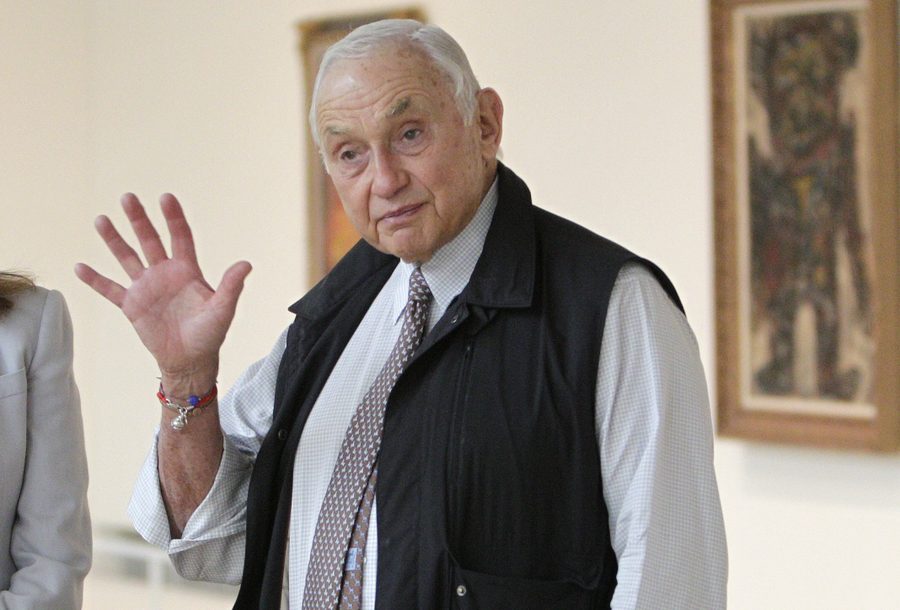
Leslie Wexner, pictured in 2014.
This article first appeared in the Jewish Currents email newsletter. Subscribe here!
Since the late 1980s, the path to power and influence as a leader of the American Jewish community has run through the foundation funded by and named for the lingerie billionaire Leslie Wexner, who had deep financial entanglements with Jeffrey Epstein.
Each year from 1988 to 2021, the Wexner Foundation plucked a handful of promising, pedigreed rabbinical students, along with graduate students in fields like Jewish studies, and lavished them with tens of thousands of dollars each in tuition stipends. Epstein sat on the Wexner Foundation board for 15 of those 33 years.
The foundation swept away its chosen few to twice-yearly, all-expenses-paid retreats; summers in Vermont, winters in Florida. As fellows emerged into the job market, they were invited to annual alumni retreats, where they mingled with members of a network that grew to encompass nearly 600 of the most important Jewish professionals in the country.
For two generations, Wexner’s system has filled many of the most enviable rabbinic pulpits across the country. Alumni lead large Jewish Community Centers and small progressive advocacy organizations; they are executives at major establishment institutions and well-funded upstart nonprofits. For members, Wexner’s name was a seal of approval. It marked its bearers worthy of the trust of the donors who pick and choose the leaders of American Jewish institutions.
This week, after Democratic members of the House Oversight Committee traveled to Ohio to depose Leslie Wexner about his ties to Epstein, there is new discomfort among the Jewish leaders whose careers were founded on Wexner’s largesse.
For some of the Wexner alumni, the elite world exposed by the Epstein revelations has discomfiting resonances. “The Wexner fellowship itself was about trying to create an elite class,” says Lila Corwin Berman, a professor of American Jewish history at NYU and a former Wexner fellow. “This is about the economic model, the philanthropic model, and then the model of the fellowship, that all bore this resemblance around creating this elite, separate group that had access to networks, that had access to power, and could therefore do things that others couldn’t do.”
On Sunday, on a private email listserv for Wexner Foundation alumni, Berman wrote that the foundation should drop Wexner from its name. “The journalist Anand Giridharadas described ‘concentric circles of enablement’ that safeguarded Epstein from consequence,” she wrote in the email, which she shared with Jewish Currents. “The Wexner name appended to a charitable foundation or to a fellowship that includes some of the most prominent leaders in American Jewish life is one of those circles.”
In an open letter to the foundation’s president, Elka Abrahamson, posted on the alumni listserv on Thursday, alumni of the Wexner fellowships asked the foundation to “acknowledge the harm Les enabled through his association with Jeffrey Epstein,” and to “hold Les to account.”
“Les Wexner and the Wexner Foundation have lost the trust of a large portion of the Foundation’s stakeholders, and of the broader leadership of the Jewish community,” the letter said. “The lack of trust is deep and profound, stemming from the Foundation leadership’s failure to adequately address the issues.” The letter’s authors, in their message to the listserv, asked alumni not to share the letter publicly. “This is not meant to be a public performance,” they wrote.
The foundation has brushed off questions about Epstein since 2019, when reporting in The New York Times and other outlets first drew attention to Epstein’s ties to Wexner.
Now, that seems to be changing. On Wednesday, in an email to alumni, Abrahamson wrote that she and foundation staff would hold meetings with alumni starting next week. “It will surprise no one when I say it has not been easy to manage the ongoing Jeffrey Epstein connection to Les,” Abrahamson wrote. “Together with my colleagues, we want to listen, to take in your thinking aspiring to move forward even if along a different path.”
Reached by Jewish Currents via email, Abrahamson declined to clarify the process she was announcing, or to respond to calls to change the foundation’s name. On Wednesday, the foundation declined a request for an interview. “We hold in our hearts the survivors of Epstein’s horrific crimes and pray for their healing and strength,” the Wexner Foundation said in a statement.
That Epstein’s ascent into the global financial elite owed much to Les Wexner has been known since at least 2019. The men met in the mid-1980s, early in Epstein’s career, and Wexner formally gave Epstein power of attorney over his financial affairs in 1991. Epstein became a trustee of the Wexner Foundation in 1992.
A New York Times investigation in 2019 found that Epstein had enriched himself enormously through his work for Wexner, and become deeply enmeshed in Wexner’s personal and financial affairs. The Times also reported that one woman, Maria Farmer, said that she had been sexually assaulted by Epstein at Wexner’s Ohio mansion, and that Wexner’s security staff had not allowed her to leave for 12 hours. A spokesperson for Leslie Wexner told Jewish Currents on Thursday that Wexner had not heard of Farmer before her name appeared in the media, and had been unaware of the incident.
New hints in the recent mammoth document dumps have done little to clarify the lingering questions about the relationship between Epstein and Wexner. What the documents have done is refocus national attention on Wexner, who is identified in a newly released 2019 FBI document as a “co-conspirator” in the Epstein child sex trafficking investigation. Wexner was never charged in the case. In a fiery House committee hearing earlier this month, Rep. Thomas Massie, the iconoclastic Kentucky Republican, badgered Attorney General Pam Bondi to say when the FBI determined that Wexner was not in fact a co-conspirator alongside Epstein. Bondi did not say.
A spokesperson for Leslie Wexner told Jewish Currents that federal prosecutors had informed Wexner’s attorney in 2019 that Wexner was considered a witness in the investigation, and not a target or a co-conspirator. The spokesperson said that Wexner had provided background information on Epstein to prosecutors and was not contacted again.
Virginia Giuffre, a prominent accuser of Epstein who died by suicide in 2025, said in a deposition that she was sexually trafficked to Wexner, among other men, though Wexner has repeatedly denied those allegations. Leslie Wexner’s spokesperson said Thursday that Wexner never met Giuffre, and cited a 2019 interview by a former attorney for Giuffre in which the attorney said Wexner likely did not know of Epstein’s crimes.
Before this week, foundation staff had publicly stood by Wexner. In the summer of 2019, shortly after Epstein’s apparent suicide in a Manhattan federal prison, Abrahamson held a session with fellowship participants who were gathered for the fellowship’s annual summer retreat in Stowe, Vermont to talk about Wexner’s links to Epstein. According to two people who attended, Abrahamson was defensive, criticizing journalists involved in the reporting and defending Wexner.
On Thursday, Abrahamson said she remembered the events differently. “We held many meetings seven years ago and I sat with many alumni and fellows in open conversations,” Abrahamson told Jewish Currents via email. “I honestly do not recall anything that suggests that characterization is correct or a widely held view.”
After the session, the people who were at the 2019 retreat say that fellows pooled $1,800 to donate to RAINN, an anti-sexual violence organization.
In a public statement on Wednesday, Wexner said that he had “completely severed” his relationship with Epstein in 2007. An email released by the DOJ showed that Wexner emailed Epstein in 2008, days before Epstein pleaded guilty to soliciting and procuring a minor for prostitution, writing: “You violated your own number 1 rule . . . always be careful,” according to an Axios report. Leslie Wexner’s spokesperson told Currents that in the email, Wexner was conveying his “strong disappointment” that Epstein had broken the Wexner family’s trust.
There have been a handful of public conversations since 2019 on Wexner’s role among Jewish leaders. The Wexner fellowship for rabbinical and graduate students recruited its final class in 2021, but the foundation continues to run other fellowship programs for mid-career Jewish professionals and lay leaders, among others. It held its annual retreat for alumni of the graduate fellowship earlier this month. In 2022, writer and rabbi Danya Ruttenberg, who participated in a mid-career Wexner Foundation fellowship program, said she would donate the amount she calculated she had received from the foundation to a group for victims of sex trafficking.
“I want to have the real conversations about why there’s been so much silence and so much fear,” Ruttenberg told Jewish Currents this week. “What is your obligation as one of the 600 . . . most elite professionals, as part of one of the most powerful networks, probably the most powerful network in the entire Jewish community? How do you not feel you have the power to do something?”

I’m Arielle Angel, editor-at-large of Jewish Currents. Before you go, there’s something I need to ask.
We’ve seen over and over how the mainstream media falters in telling stories on our beats—whether it’s antisemitism, Israel/Palestine in American politics, Jewish identity, or the American left. At Jewish Currents we’re committed to uncompromising analysis and longform reporting on these issues and more—stories you won’t find anywhere else. In a media landscape that obscures injustice and flattens discussion, we’re changing the conversation. But we need you.
If you believe in this work, please consider making a donation—or even better, a recurring one—to ensure that we are able to keep publishing stories like this one. We can’t do it without you.
Josh Nathan-Kazis is the news director at Jewish Currents. Previously, he was a senior writer at Barron’s, where he covered healthcare companies, and a staff writer at The Forward, where he investigated Jewish communal institutions.