Support for Settlement of Lebanon Goes Mainstream in Israel
What was once a fringe curiosity is now an organized movement with broad governmental and public support.
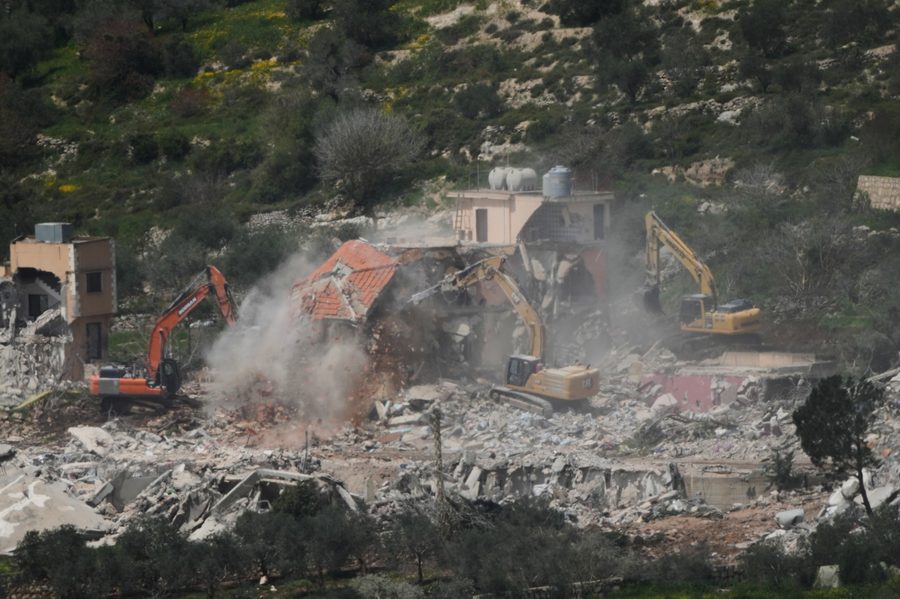
Israeli bulldozers demolish homes in southern Lebanon on Sunday, April 12th. Israel’s defense minister has said that all homes in Lebanon near the Israeli border will be destroyed.
In the summer of 2024, Jewish Currents assistant editor Maya Rosen published a prescient investigation of Uri Tzafon, the far-right movement pushing for Jewish settlement of southern Lebanon. Now, with Israeli forces deep in Lebanon and the military establishment asserting plans to hold parts of the country indefinitely, the Jewish Currents news desk asked Maya for an update on Uri Tzafon. Read Maya’s original report from August of 2024 here.
Uri Tzafon’s vision of establishing Israeli settlements in Lebanon has advanced significantly over the last six weeks. What was considered a fringe curiosity in 2024 is transforming into the new Israeli conventional wisdom—backed by an organized movement with broad support from politicians and the media. Even as negotiations could force Israel to halt its bombardment of Lebanon, the next time Israel attacks, Uri Tzafon will be one step closer to building civilian settlements atop the ruins of Lebanese villages.
Uri Tzafon’s informal, oft-repeated motto is “occupation, expulsion, settlement.” It has advanced the idea that Israel must move its northern border to the Litani River—which bisects Lebanon about 15 miles north of the current Israeli boundary—and occupy a depopulated southern Lebanon, comprising some 10% of Lebanon’s total territory.
That idea is now a “broad and troubling consensus” in Israel, as the journalist Moshe Gilad wrote in Haaretz on April 9th. In early March, soon after Hezbollah launched attacks on Israel in response to the joint US and Israel war on Iran, Israeli public figures began calling for the occupation and depopulation of southern Lebanon—a claim repeated again and again by mainstream Israeli media personalities. Retired military leaders and politicians also voiced their support, and members of Knesset soon joined the call for occupation. On April 7th, 20 members of Knesset (MKs) wrote to the Israeli cabinet advocating for “occupation and full control” of southern Lebanon alongside “the complete displacement of the population.” One poll found that 62% of Israelis now support the idea of occupying all of Lebanon south of the Litani River.
These aspirations are being translated into policy: On March 24th, Defense Minister Israel Katz announced that the military would control southern Lebanon up to the Litani, and prevent the return of hundreds of thousands of residents. A week later, he said that all homes near the border would be destroyed, “like in Rafah and Beit Hanoun,” in order “to permanently remove border-adjacent threats.” Israel has now issued evacuation orders for about 15% of Lebanon’s territory, part of its campaign to ethnically cleanse the southern part of the country, specifically of Shiite Muslims. (Hezbollah is a Shiite organization.) “Every home in southern Lebanon, the Shiite homes, are control command centers, they hold weapon supplies, they have tunnels going beneath them,” Israeli military spokesperson Doron Spielman recently said, in comments chillingly reminiscent of Israel’s justification for the destruction of Gaza. Over a million people have already been displaced from southern Lebanon, and over 2,000 people have been killed, with nearly 6,000 injured.
This sets the stage for Uri Tzafon’s final horizon—civilian settlements—another idea which is gaining steam. Rabbis, families of fallen soldiers, and pundits have called for settlements in Lebanon over the last weeks. In 2024, the sole Knesset member who had expressed support for civilian settlements in southern Lebanon was Avigdor Lieberman, the leader of the conservative, nationalist Yisrael Beitenu party. Now, that is changing. Religious Zionist MK Ohad Tal posted that he supported “annexation and Israeli settlement” of southern Lebanon, while Jewish Power MK Yitzhak Kroizer announced that “sovereignty and settlement are the keys for peace and security.” Likud MK Ariel Kallner joined with Uri Tzafon in leading a tour of the northern border in March, and on April 9th, Finance Minister and Religious Zionist MK Bezalel Smotrich called for settlements in Lebanon at an event inaugurating the illegal settlement of Maoz Tzur in the West Bank, saying, “There will be a political step in Lebanon that expands our borders.”
On April 8th, hours after the US and Iran announced a shaky ceasefire, Israel launched the deadliest attack in Lebanon in decades. The campaign, which the military termed “Operation Eternal Darkness,” used thousand-pound bombs to strike densely populated residential neighborhoods of Beirut, killing over 350 people and injuring at least 1,165 in ten minutes. The message seemed to be: Our work here isn’t done. In a poll the following day, 82% of Israelis said they wanted the war with Lebanon to continue.
In 2024, I had been hesitant to profile Uri Tzafon. I worried that writing about them gave a platform to a group so marginal that they simply didn’t matter. But as Natasha Roth-Rowland, a scholar of the Israeli far right, told me at the time: “There is a fairly well-established track record of even the most fringe parts of the Israeli settler movement becoming not so fringe over a period of decades or even years.” Roth-Rowland seemed to anticipate the current moment in pointing out that the settler movement has “made political gains over the last several decades by outflanking the government from the right.” It was this perspective that convinced me to write the piece.
In the meantime, this dynamic of the right upping the ante continues, as some of the movement’s leaders have begun setting their sights even further north. The Hottest Place in Hell, an Israeli news site, reported this month that Amos Azaria, one of Uri Tzafon’s co-founders, said on a recent Zoom call that as the military has continued its operations in south Lebanon, Uri Tzafon has decided “to start talking a bit more about the Zaharani, and not just the Litani,” referring to a river another dozen miles deeper into Lebanon. There is nothing surprising in this. “That’s how the settlement movement started,” Akiva Eldar, an Israeli settlement historian, told me in 2024. “They planted seeds, which grew into trees, which grew into a jungle.” In our current political reality, there’s nothing to contain that jungle, as it swallows everything in its path.

I’m Arielle Angel, editor-at-large of Jewish Currents. Before you go, there’s something I need to ask.
We’ve seen over and over how the mainstream media falters in telling stories on our beats—whether it’s antisemitism, Israel/Palestine in American politics, Jewish identity, or the American left. At Jewish Currents we’re committed to uncompromising analysis and longform reporting on these issues and more—stories you won’t find anywhere else. In a media landscape that obscures injustice and flattens discussion, we’re changing the conversation. But we need you.
If you believe in this work, please consider making a donation—or even better, a recurring one—to ensure that we are able to keep publishing stories like this one. We can’t do it without you.

Maya Rosen is an assistant editor at Jewish Currents.