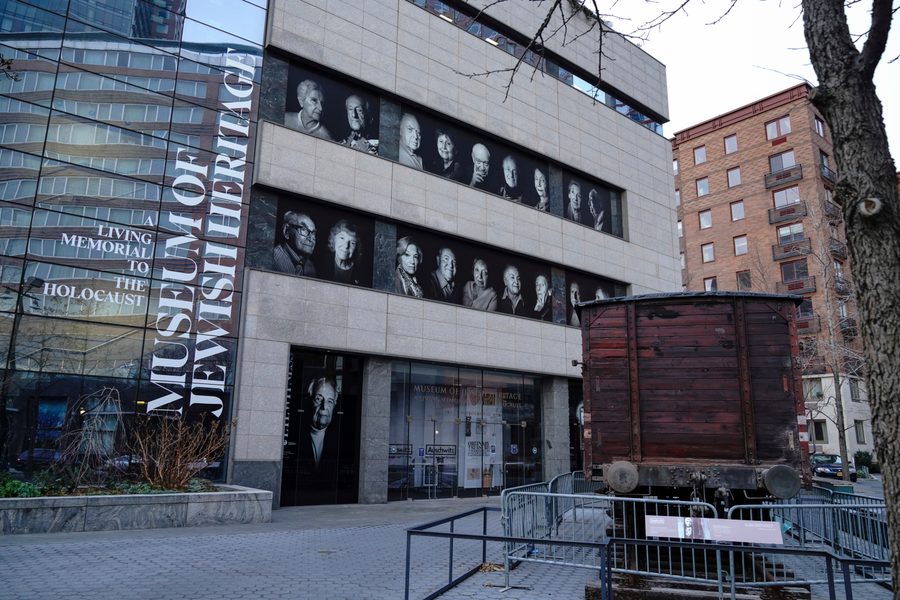
The Museum of Jewish Heritage in Manhattan.
Last September, New York City’s Museum of Jewish Heritage opened “Speaking Up! Confronting Hate Speech,” an exhibit on how hate speech leads to violence that originated at Houston’s Holocaust Museum. One video on display featured civil rights advocate Eric Ward speaking about white nationalism, interspersed with stills of Donald Trump. But only one day after the exhibition launched, the video went dark. Later that week, a new version was installed—this time, without the images of the former president.
The stills of Trump were removed after museum vice chair Regina Skyer walked through the display with Josh Mack, the museum’s vice president for marketing, soon after its opening. According to a person with direct knowledge of the incident, Skyer, an attorney for children with special education needs and a financial supporter of the museum, objected to the images’ inclusion. After the walk-through, Mack directed his team to remove the Trump stills, said two sources who requested anonymity to protect their jobs. According to these sources, Mack told staff that Skyer—whose only public political donations have gone to Democrats—intervened to avoid angering right-wing museum board members. (Jeff Simmons, a spokesperson for the museum, disputed that Mack said this.) Skyer denied that her objection was meant to appease pro-Trump board members, telling Jewish Currents that the exhibit opened just “prior to the election” and that she felt the museum “should not have any political candidates in any of our exhibits.”
Skyer said “there was no pushback” from the museum to her request, but according to sources, some museum employees were alarmed. “It feels antithetical to the museum’s mission to [remove] someone who’s famously used hate speech [from an exhibition] for fear of retaliation or fear of what funders will say,” said a third source with knowledge of the incident who also requested anonymity to protect their job. According to former museum employees, the removal of Trump from the hate speech exhibition was not the only recent instance in which museum leadership catered to or courted the right. In March, after tech entrepreneur Elon Musk gave a Nazi-like salute at Trump’s inauguration, the head of development for the museum asked a development team staffer to reach out to Musk for a donation; the former staffer said they were told the donation would be “a great way for Musk to remediate his image.” The staffer said they did not try to reach out to Musk. (Simmons called the former staffer’s account “unequivocally false” and said “there was never any internal directive to pursue a donation from Elon Musk.”) While this new amenability to the right has played out behind closed doors, it has coincided with a more visible shift: In the wake of October 7th, the museum has more publicly embraced Zionism—a stance that former employees said threatens the museum’s credibility as an educational institution.
In this political moment, “the museum is in a bind,” said Lila Corwin Berman, a professor of Jewish history at New York University and the author of the book The American Jewish Philanthropic Complex. Any meaningful analysis of antisemitism and extremism, she explained, implicates the MAGA movement, creating tension with right-wing donors. (The current board comprises both Democrats and Republicans, including board chair Bruce Ratner, a real estate developer who has mostly donated to Democrats; George Klein, who also sits on the board of the Republican Jewish Coalition; and Ingeborg Rennert, a GOP donor.) Further, Berman said, because antisemitism and extremism “are at the heart of this moment in American politics,” it’s impossible for the museum to stay politically neutral. “The museum’s fundamental mission is undercut if it is unable to address antisemitism regardless of possible political fallout,” she said.
Other Holocaust museums have recently found themselves caught in the political crosshairs. In April, President Trump fired five Democrats appointed to the board of the US Holocaust Memorial Museum in Washington, DC, and replaced them with figures aligned with him. One remaining Biden appointee on the board accused the institution, which said only that it “welcomes” the new appointments, of staying “silent in the wake of acts of retribution and messages of hate emanating from an administration that has systematically torn at the fabric of our society’s protections and norms.” Holocaust museums have also drawn criticism for their handling of Israel’s bombardment of Gaza, which many experts say is a genocide. In January 2024, 50 Holocaust and genocide scholars called on Yad Vashem, Israel’s Holocaust memorial, to condemn incitement by Israeli officials and media personalities to commit “war crimes” and “crimes against humanity” in Gaza. (Dani Dayan, the museum’s chairman, said in response that Yad Vashem’s area of concern was “only the Holocaust.”) In February, Martin Oliner, a Trump-appointed board member of the US Holocaust Memorial Museum, wrote in The Jerusalem Post in favor of the president’s plan to forcibly remove Palestinians from Gaza, saying that Gazans are “fundamentally evil,” which prompted the Council on American-Islamic Relations to call for his removal from the board.
Jelena Subotić, a political science professor at Georgia State University who writes about Holocaust remembrance politics, said that Holocaust museums have always tried to strike a balance between using the lessons of the Holocaust to point to contemporary atrocities and containing the political pushback such gestures often generate. Before Trump’s return to office, they were more comfortable with highlighting contemporary human rights abuses. “There was a push for inclusivity at Holocaust museums as recently as five years ago,” she said, pointing to exhibitions like one at the DC museum that focused on the Assad regime’s crimes in Syria. But the spirit of inclusivity is “now gone,” she said. “These institutions are survivalists, and so they’re seeing the mood change. They’re terrified of the Trump administration, and they do not want to get on the administration’s radar.”
Former employees say that the Museum of Jewish Heritage used to be more willing to tangle with the MAGA movement. The museum condemned the January 6th attack on the Capitol, and hosted Alexander Vindman, the army colonel who alerted his superiors to Trump’s request that Ukraine investigate Joe Biden. In May 2022, the museum even declined to rent its space to the Tikvah Fund, which was hosting Florida Governor Ron DeSantis and other conservative leaders at a conference they were planning. Jack Kliger, the museum’s president and CEO, explained that the conference would have required too many resources from the museum, and a level of security that would have been difficult to accommodate. But the decision sparked a backlash among some museum supporters, who saw it as a move to censor DeSantis. “A lot of right-wing donors were really upset about it, and the museum lost members,” said the former marketing department employee.
According to the employee, the backlash marked a turning point, contributing to the museum’s more conciliatory stance toward the right to avoid losing more money or supporters. But former employees and other sources familiar with the museum’s dealings say that the October 7th attacks on Israel—and the protest movement that arose to condemn Israel’s destruction of Gaza—exacerbated this shift as museum leadership moved further right, and began to publicly take a much more avowedly Zionist stance.
After October 7th, the museum posted pro-Israel statements—a departure from the pre-October 7th era, in which the institution largely avoided discussing contemporary Israeli policies. They also began displaying the Israeli and American flags in the museum lobby last November “as a symbol of solidarity and heritage,” according to Simmons. At one staff meeting last fall, Kliger announced that the museum was adopting the International Holocaust Remembrance Alliance definition of antisemitism, which conflates anti-Zionism with anti-Jewish bigotry. (The definition is referenced in an FAQ for educators that the museum published last March.) This shift also modified the hate speech exhibit: Before its opening, the board directed museum staff to add in photographs of contemporary antisemitism that were not part of the original Houston exhibition. Those photos—displayed at the entrance to the exhibit—feature images of neo-Nazi rallies alongside images of pro-Palestinian demonstrators burning the Israeli flag and holding up a sign that used a swastika to depict the “s” in “Israel”—a move some former employees say risks conflating strident anti-Zionist activism with anti-Jewish bigotry. This seemed to reflect the personal views of at least one board member: In January 2024, Skyer gave an extemporaneous speech during a tour of an exhibition for members of the New York City Council, during which she referenced a pro-Palestine protest that day at City Hall. She gestured out the windows of the museum and said, “Hamas is right there,” according to two sources with direct knowledge of the incident. (Skyer did not respond to a request for comment on this anecdote.)
The museum has also hosted events that celebrated Israeli militarism or pushed for crackdowns on pro-Palestinian protests. Last November, the museum rented space to the American Friends of the Israel Navy Seals, a nonprofit that raises money for an elite Israeli naval commando unit. The event included large images of Israeli soldiers walking through the ruins of Gaza, which were still on display when museum-goers visited the next morning, according to two sources. In January 2025, the museum hosted a training for the New York Police Department, during which a pro-Israel nonprofit told officers that Palestinian symbols like the watermelon and the keffiyeh were antisemitic. Former employees say that in taking these actions, museum leadership is damaging the museum’s credibility as an educational space about the Holocaust for all New Yorkers—and particularly for the thousands of public school students who go to the museum every year. “The museum’s unquestioning support of Israel and its government—which has been perpetrating its own genocide against Palestinians—undermines and erodes the power of the institution’s mission and the community’s understanding of what the lessons of the Holocaust should be,” said the former marketing employee. Simmons rejected the suggestion that the museum had been politicized. “To suggest that the museum has aligned itself with a political agenda is not only unfounded, it’s also dismissive of the professionalism and dedication of our staff and educators,” he said.
The private grumblings among museum staffers turned into an organized show of dissent last December, when 14 museum staffers sent a collective letter, obtained by Jewish Currents, to the president and the board expressing their dismay at the continued display of the Israeli and American flags in the museum lobby. They wrote that the flags “[signify] an endorsement of Israeli politics” and that they were “concerned that flags at the entrance may alienate visitors who are interested in learning about the Holocaust and the Jewish people, but who may not agree with current Israeli or American political leaders and policies.” They ended the letter by requesting that the flags be removed. The board and the president never responded to the staffers, and the flags still remain.

I’m Peter Beinart, editor-at-large of Jewish Currents. Before you go, I need to ask something of you.
In recent years, I’ve watched as mainstream Jewish institutions and media have chosen ethnonationalism over liberal democracy and mass slaughter over the pursuit of a just peace. Jewish Currents offers something different. It’s a magazine built on intellectual curiosity and respect for the dignity of all people.
But a project like this doesn’t sustain itself, and we can’t do it without your help. If you share my belief in the importance of this mission, please consider making a donation—or even better, a recurring one. We need you with us.