Mamdani is Showing the Way
If Democrats want to beat the populist right, they should follow the New York City mayor on Israel.
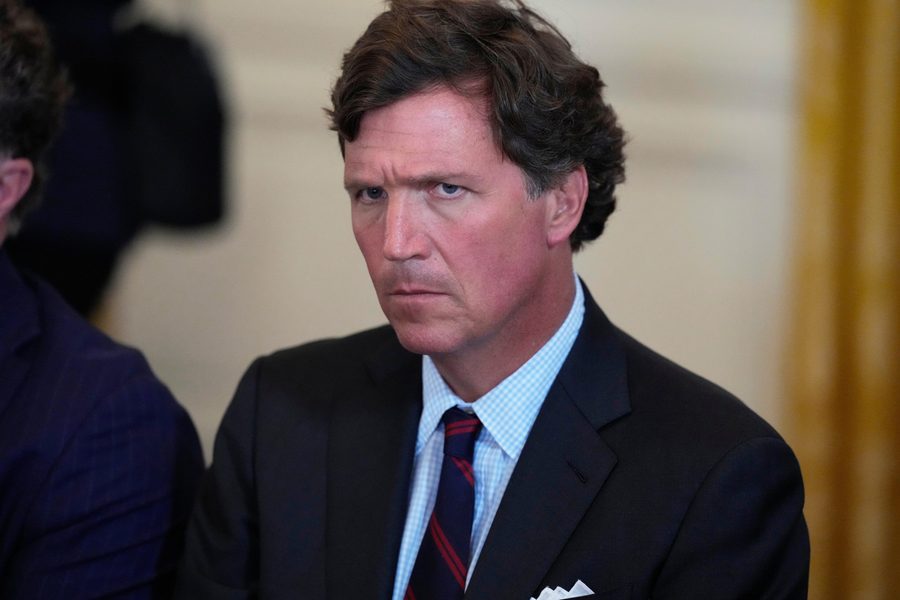
Tucker Carlson, pictured at the White House in January, has emerged as a leading critic of Israel on the right.
This article first appeared in the Jewish Currents news desk newsletter. Subscribe here.
Centrists, and even some progressives, fear that New York City Mayor Zohran Mamdani is pushing the Democratic Party too far left. The day after last week’s primaries, in which Mamdani-backed insurgents won three US House seats, Howard Wolfson, an advisor to former mayor Michael Bloomberg, warned that “Every Democrat in a competitive race will have to answer for our most extreme voices.” New York Times columnist Michelle Goldberg worried that Darializa Avila Chevalier, the furthest left of last week’s victors, may become “the face of the Democratic Party.”
These anxieties aren’t entirely irrational. Avila Chevalier’s opposition to prisons and border enforcement enjoys little public support, and Republicans have already been quick to pounce, portraying her and her fellow primary victors as “dangerous” radicals intent on destroying the country. It’s a playbook that Donald Trump and his Republican acolytes used to great effect in 2024: As Goldberg points out, swing voters in 2024 viewed even Kamala Harris—a former prosecutor whose views are far less radical than Avila Chevalier’s—as too soft on crime and immigration. If Republicans once again try to gin up the kind of anti-immigrant, tough-on-crime fury they did two years ago, they could use Avila Chevalier’s views to undermine other Democrats.
But if Team Mamdani’s victories pose a potential electoral risk, they also offer a potential boon when it comes to Israel. American public opinion is turning dramatically against the Jewish state. It’s possible that Tucker Carlson—or even J.D. Vance—might try to seize that populist energy in 2028. Mamdani’s success last week helps protect Democrats against being outflanked. By accelerating the party’s move toward a full-throated defense of Palestinian rights, he’s moving Democrats closer to where the American people already are.
Increasingly, the American divide over Israel no longer pits left against right but the establishments of both parties against their base. The Republican and Democratic leaders in Congress all remain staunch backers of the Jewish state. But among voters of both parties, as well as among independents, that view is hemorrhaging support. Over the last two years, according to a February Gallup poll, sympathy for Israel has dropped 18 points among Democrats, 14 points among independents, and ten points among Republicans. Between 2022 and 2025, according to the Pew Research Center, Israel’s standing among Republicans under the age of 50 fell by an even larger margin than it did among younger Democrats.
That bipartisan hostility toward Israel is starting to resemble the populist anger over forever wars and free trade that convulsed American politics a decade ago. Back then, both grassroots Democrats and Republicans resented their party elites for supporting the invasion of Iraq and a corporate-led globalization that de-industrialized parts of the United States. In the 2016 presidential primaries, Trump became the voice of that anger in the Republican Party; Bernie Sanders did among Democrats. Trump won his party’s nomination, Sanders lost. Facing Hillary Clinton, who had voted for the Iraq War and was associated with her husband’s free trade deals, Trump harnessed this populist energy, and seized the presidency with particularly strong backing in counties where job losses from international competition and wartime casualties were high.
Now there’s a risk that something similar could happen to Democrats on the subject of Israel. If they nominate a candidate in 2028 with a record of unconditionally backing the Jewish state—like Pennsylvania Governor Josh Shapiro, Kentucky Governor Andy Beshear, or New Jersey Senator Cory Booker—while Republicans nominate a fierce critic of Israel and the Iran war, like Tucker Carlson, Democrats could again find themselves on the wrong side of the elite-populist divide. A Carlson nomination may strike some as far-fetched—but if it’s not Carlson, it could be J.D. Vance, who over the last week has sharply rebuked Benjamin Netanyahu’s government and reportedly begun consulting with Trita Parsi, an influential critic of the war on Iran who helps run the anti-interventionist Quincy Institute. As one Trump official told Puck magazine, “J.D. very clearly knows that being anti-Israel is the most politically profitable thing to be right now.”
Last week’s elections in New York make it less likely that Democrats will let Vance or another Republican seize that mantle. By helping unseat two incumbent Democratic Congressmen who accepted money from AIPAC, Mamdani has shown politicians in his party that clinging to a pro-Israel line could imperil their jobs. That doesn’t mean the Democratic presidential contenders in 2028 will endorse BDS or support transforming Israel from a Jewish state into one based on equality under the law, as Mamdani does. But last week’s results increase the pressure on Democratic hopefuls to end US military aid, restrict US arms sales, and demand that Israel comply with international law.
Those aren’t just popular positions among Democrats. They’re popular among voters who usually support the GOP. This May, a poll by the Institute for Middle East Understanding found that 17 percent of Republicans would back a Democrat who prioritized lower prices at home over unconditional funding of Israel. This is what the media misses when it describes Mamdani as pushing the Democrats too far to the left: Because the American debate on Israel pits the masses against the elites of both parties, views that the media characterizes as left-wing also appeal to many on the right.
The bipartisan collapse of American support for Israel creates an opportunity for a presidential candidate of either party in 2028. After last Tuesday, Democrats are more likely to seize it. In New York, Mamdani has shown the way.

I’m Arielle Angel, editor-at-large of Jewish Currents. Before you go, there’s something I need to ask.
We’ve seen over and over how the mainstream media falters in telling stories on our beats—whether it’s antisemitism, Israel/Palestine in American politics, Jewish identity, or the American left. At Jewish Currents we’re committed to uncompromising analysis and longform reporting on these issues and more—stories you won’t find anywhere else. In a media landscape that obscures injustice and flattens discussion, we’re changing the conversation. But we need you.
If you believe in this work, please consider making a donation—or even better, a recurring one—to ensure that we are able to keep publishing stories like this one. We can’t do it without you.

Peter Beinart is the editor-at-large of Jewish Currents. He is the author of The Beinart Notebook on Substack.