The Healthcare System Is Collapsing in the West Bank
As Israel chokes the Palestinian Authority, patients can’t get basic medical services in the West Bank.
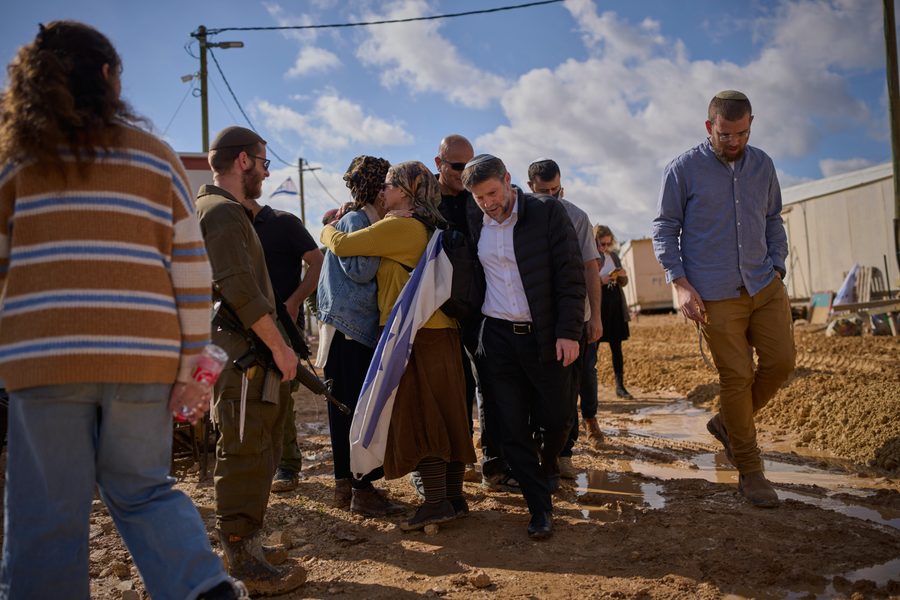
Israeli finance minister Bezalel Smotrich (center), pictured at a West Bank settlement, has cut off the transfer of tax revenues to the Palestinian Authority.
This article first appeared in the Jewish Currents news desk newsletter. Subscribe here.
Najaj Shuf, a Palestinian woman in her 50s, has suffered for months from a painful condition that causes gallstones. In most countries, she would have already undergone a cholecystectomy—a common, low-risk surgery to remove the gallbladder. But Shuf lives in Burqa, a village just south of Nablus in the West Bank, where an increasingly acute funding crisis has devastated the medical system: primary healthcare services have largely disappeared; hospitals are open only for life-threatening interventions; and pharmacies are quickly running out of basic medication.
Since October 7th, Israel has been withholding a significant portion of the Palestinian Authority’s tax dollars—some $5 billion, according to the PA. The dramatic shortfall has meant that it has been unable to pay medical staff their full salaries, import medicine, or reimburse insurance claims for procedures and prescriptions. With the West Bank’s already-shaky public health infrastructure now in a state of collapse, patients have been forced to turn to private hospitals and providers—which cost too much for the average person—or else seek help from NGOs. For many, simply managing a chronic condition can now mean scrambling to ration the little medication they can find, buying it on the black market, or simply not taking it at all.
This crunch has grown particularly severe in recent months, since March, when doctors at public hospitals, who haven’t been paid their full salaries since October 2023, went on strike refusing to provide non-critical services. For Shuf, this has meant waiting for weeks for her doctor to schedule her surgery while also waiting for the medications she relies on to become available. In the meantime, she continues to suffer painful gallstone attacks. “Once, I had three attacks on the same day, and went to the ER. They examined me but didn’t complete the full treatment since the doctors were on strike. So I left,” she told Jewish Currents. “I had two more attacks at home, and just gave up.”
Shuf has been told that her gallstones aren’t life-threatening, and thus treating them is not possible during the doctors’ strike. If her gallbladder isn’t removed soon, though, it could increase her risk of cancer. The only immediate option is getting the surgery done at a private West Bank hospital, but that would cost upwards of 4,000 NIS (nearly $1,400)—money that she doesn’t have. Her husband, formerly the family’s breadwinner, is bedridden while recovering from emergency brain surgery, and her son has been in an Israeli prison for five years. “I can’t cover the costs myself,” she said. “I’m waiting.”
While the crisis has grown severe in recent years, its roots extend all the way back to the Oslo era. Under the terms of the 1994 Paris Protocol on Economic Relations, Israel has collected customs duties and related taxes on behalf of the Palestinian Authority at the borders and ports it controls. But in 2019, Israel began systematically withholding some of this revenue, deducting the amount that it calculated the PA was spending on support payments to the families of Palestinian prisoners and those killed by Israeli forces. After October 7th, Israel increased its deductions, before cutting off all tax remittances to the PA in May of 2025. The loss of those remittances has contributed to a serious financial crisis for the PA, which has been forced to borrow billions from foreign and domestic banks, and to withhold payments to public workers. It owed public workers $2.9 billion in unpaid salaries as of the end of 2025, according to the World Bank.
This crisis has pushed the PA’s healthcare system, among other sectors, to the breaking point. Before October of 2023, while wait times were long and specialty medicine largely unavailable, public health clinics in the West Bank offered services six days a week; basic medications were generally stocked; and doctors were paid consistently. The situation has deteriorated dramatically since then. By June 2024, according to the World Health Organization, 45% of medicines were already out of stock across the West Bank while clinics had reduced their operations to just two days a week and hospitals were operating at 70% capacity. By the end of 2025, the United Nations reported that just 63% of clinics remained open, most for just one day a week. Now, barely a quarter of the Palestinian Ministry of Health’s 590 branches continue to operate, while just 20% of the 1,260 medicines it generally keeps in stock are available (and even then, the quantities are limited quantities). The Ministry owes 3.6 billion NIS (over $1.2 billion) to private hospital and pharmaceutical suppliers.
“People are suffering more with chronic illnesses, living life not having the proper medicine or the proper medical treatment,” said Milena Ansari, the head of Physicians for Human Rights - Israel’s department for the occupied territories. “It’s not only physical agony from the chronic illnesses or diseases, but agony from feeling helpless.”
NGOs like PHR are mobilizing their limited resources to fill the gap left by a failing public health system. Since October 7th, the organization has operated a mobile clinic that travels to underserved West Bank villages twice a week to offer medical services and a pharmacy. The Palestinian citizens of Israel who run the program load a van full of medicine and supplies and drive to an Israeli gas station in the Galilee where they pick up volunteer Israeli and Palestinian doctors, some of whom have offered their time since the First Intifada. Then they cross through a checkpoint into the West Bank, gather a group of Palestinian nurses and doctors, and drive onto the village they’re scheduled to visit that day. During an early June visit to Kafr Ra’i, a northern village near Jenin, the clinic treated nearly 800 patients. When the team arrived in Burqa in mid-June, they found 500 people waiting to receive services. Within a few hours, the makeshift pharmacy had run out of nearly all its medications.
Samah Masoud, a woman originally from Anata, just outside of Jerusalem, was among those waiting to see a doctor at the PHR clinic in Burqa, which was set up in the village’s elementary school. Masoud was suffering from nerve problems—her fingers and legs often go numb and spasm, she said. For months, she has been waiting for an appointment at a public hospital, but with her husband out of work—he is among the West Bank’s surging unemployed, after 150,000 West Bank Palestinians had their permits to work inside of Israel were cancelled following October 7th—she can’t afford a private doctor.
“Insurance is gone, healthcare is gone, because the situation is deteriorating all over Palestine. There are no medicines,” she said. “So on a day like this, everyone takes advantage of it and comes.”
Yet even as people like Masoud have become increasingly reliant on humanitarian aid, NGOs cannot compensate for a failing public health system—especially as the Trump Administration has cut funding for international development to a fraction of what it once was.
Practitioners are most worried about the severe shortage of medicine. They warn that patients with chronic conditions could die preventable deaths. “There are medicines that are unavailable for cancer patients; there are medicines for multiple sclerosis that are unavailable,” said Salam Abu Shamar, an official with the Kidney Failure Patients Association from Tulkarem. “The Ministry of Health cannot even provide the simplest things like aspirin.”

I’m Arielle Angel, editor-at-large of Jewish Currents. Before you go, there’s something I need to ask.
We’ve seen over and over how the mainstream media falters in telling stories on our beats—whether it’s antisemitism, Israel/Palestine in American politics, Jewish identity, or the American left. At Jewish Currents we’re committed to uncompromising analysis and longform reporting on these issues and more—stories you won’t find anywhere else. In a media landscape that obscures injustice and flattens discussion, we’re changing the conversation. But we need you.
If you believe in this work, please consider making a donation—or even better, a recurring one—to ensure that we are able to keep publishing stories like this one. We can’t do it without you.

Charlotte Ritz-Jack is an editorial fellow at +972 Magazine living and writing in Jerusalem.