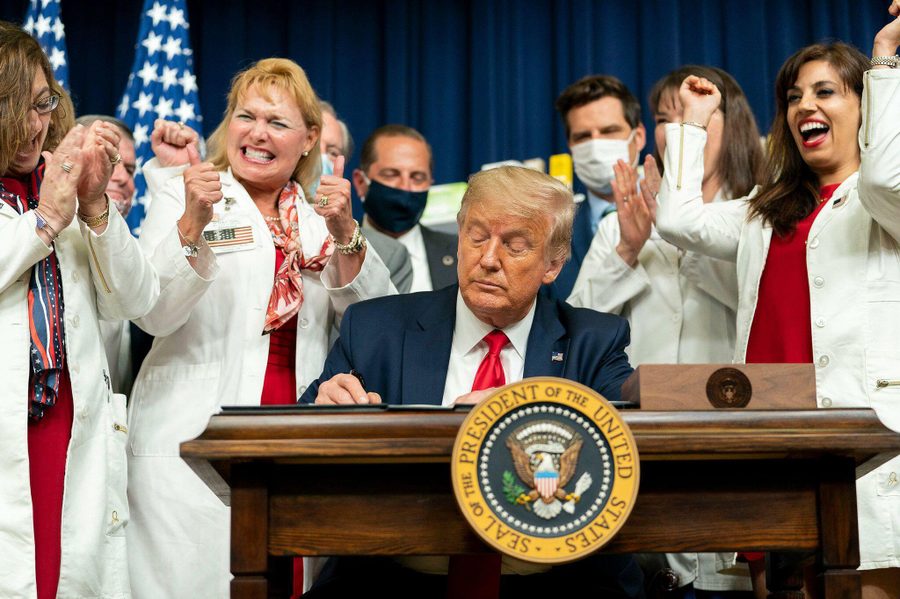
President Trump with HHS officials and medical workers as he signs executive orders on lowering drug prices in July 2020.
On April 1st, Katrina Armstrong, the former Columbia University president, sat down in a Washington, DC, office building for a deposition. Her interview was part of a federal investigation into months of campus protests opposing Israel’s perpetration of what experts call a genocide in Gaza. The Trump administration had opened the case in February under Title VI of the 1964 Civil Rights Act, which bars schools that receive federal funding from permitting a “hostile environment” for students on the basis of race, national origin, or other protected identity classes. By March, the administration had already cut $400 million in federal grants to Columbia due to the school’s alleged violations of Title VI; the threat of further cuts to Columbia’s federal funding now hung over Armstong’s deposition.
There was much about the administration’s use of Title VI that was unusual, including the fact that they had cut funds to the university before the conclusion of their investigation and that they had publicized provocative accusations in similar civil rights investigations in ways that experts said hinted at a predetermined outcome. But another particularly notable shift concerned the agency that was spearheading these efforts: the Department of Health and Human Services (HHS). For most of its history, HHS’s core aim has been promoting public health by, for example, eliminating smallpox, providing vaccines for children, and researching new viruses. (Some of this work is now imperiled under HHS Secretary Robert F. Kennedy, Jr.) The National Institute of Health—a subagency of HHS—has likewise focused mainly on disbursing billions of dollars in federal funds to thousands of medical institutions, including universities, for medical research. Typically, the enforcement of Title VI in educational environments has been the purview of the Department of Education’s (DOE) Office of Civil Rights (OCR), Katy Joseph, a former chief of staff in the Biden administration DOE OCR, told Jewish Currents. But it was HHS that cut $250 million in grants to Columbia in March, and it was Sean Keveney, the acting general counsel for the agency under Donald Trump, who questioned Armstrong during her deposition in April.
Keveney said he was brought in to depose Armstrong because of his past experience as a Department of Justice attorney. “I have a lot of experience investigating and trying civil rights cases,” he said in an interview with Jewish Currents. “I’ve taken hundreds of civil rights depositions.” But, according to Joseph, an HHS attorney taking the lead in such proceedings represents a significant shift. “I can’t think of a precedent for HHS taking point in investigating universities,” Joseph said. “It’s concerning because it looks like new political leadership coming in and injecting partisan aims into the enforcement of civil rights law.” Keveney said that in the past HHS had indeed “not been as aggressive” as the DOE in investigating Title VI in educational institutions. That has definitively changed in the second Trump term, with the agency playing a major role in investigating universities over pro-Palestine activism.
HHS assumed its leading role in the Trump crackdown on universities in February, when the agency became a member of the Trump administration’s Joint Task Force to Combat Antisemitism, which combines officials from HHS, the DOE, the General Services Administration, and the Department of Justice (DOJ). “Antisemitism—like racism—is a spiritual and moral malady that sickens societies and kills people with lethalities comparable to history’s most deadly plagues,” Kennedy, Jr. said in March, when the Joint Task Force to Combat Antisemitism first threatened Columbia with a cut-off in grants. “The censorship and false narratives of woke cancel culture have transformed our great universities into greenhouses for this deadly and virulent pestilence.” The task force has drawn criticism for its politicization of antisemitism claims to serve the Trump agenda. “The Task Force has spearheaded the government’s weaponization of spurious antisemitism charges against higher education,” the Middle East Studies Association board said in March; Jewish Voice for Peace’s Academic Council said the task force’s “true aim is to coerce universities to suppress public protest in solidarity with Palestinians in Gaza, penalize dissent against Israel and Zionism, and violate scholarly autonomy.”
Through the task force, HHS began opening investigations into universities that had prominent pro-Palestinian protests, publishing findings that cast the protests as antisemitic, and cutting funding to universities. At Columbia, for instance, a month after the Armstrong deposition, the task force published their conclusion that Columbia violated Title VI, by allowing pro-Palestinian protests and chants such as “‘Globalize the Intifada’ and ‘Death to the Zionist State,’” among other incidents. HHS has also found Harvard in violation of civil rights law on similar grounds; on July 30th, the department referred the investigation to the DOJ “to initiate appropriate proceedings to address Harvard’s antisemitic discrimination.” (HHS’s civil rights investigations into Northwestern and Johns Hopkins are still ongoing.) Separately, the agency froze billions of dollars in grant money to at least six universities that had student protests, including UCLA, Brown, and Harvard, and in April it announced that it would cut funding to any future grant recipients from the National Institute of Health who participated in boycotts of Israel.
Critics say that HHS has become the leader of a broader campaign to crack down on criticism of Israel, not only at universities, but also within the medical field—a campaign that has been buoyed by the efforts of Israel advocacy groups, Zionist medical school faculty, and university administrators. In the process, HHS—which has the biggest budget of any federal agency and the largest grant-making program—has used its funding of university medical research as a key source of leverage. In 2023, the agency gave universities over $33 billion in research and development funding, which amounts to just over half of all federal expenditures for research at universities. “The White House is using HHS as a weapon to advance a political agenda,” said Laura Durso, who served as a chief of staff in HHS’s OCR during the Biden administration. “This is part of a larger strategy to undermine civil society, and in doing so HHS is veering from its historical position as a protector of civil rights.” Joseph Howley, an associate professor of classics at Columbia, put it more bluntly: “This is part of the Trump administration’s gangsterism. They’ve got their soldiers in all parts of the federal government, and they activate the one that gives them the most leverage over whoever they want to shake down,” Howley said. “In this case, that’s HHS.”
In the process, critics say that HHS is undermining its own mandate to promote public health, by disrupting research into everything from how to detect breast cancer earlier to the connections between diabetes and dementia to the development of drugs to treat chemotherapy exposure. The HHS funding cuts helped put Columbia at a “tipping point,” with scientists facing “the decimation of decades of research,” according to a June statement by the school’s president. “They are ultimately throwing away research that they had asked for—that HHS had decided was helpful,” said Adam Sychla, a postdoctoral fellow at Harvard Medical School whose NIH-funded grant to research medicines for diverse maladies that might produce fewer side effects was canceled in April by the Trump administration. Keveney defended HHS’s actions. “The attempt to turn this back on NIH or HHS to portray the agency as anti-science is a smoke screen to hide the fact that these universities have to comply with their responsibilities when they accept those funds,” he said. But Durso disagreed. “Defunding billions of dollars of federally-funded research endangers public health and will hamper scientific advancement for generations,” she said. “The agency cannot be taken seriously if it is trying to reverse-engineer a justification for those cuts by rushing to find universities in violation of federal law.”
The federal government has long used its public health agency to advance civil rights within the health care field, even under Republican administrations. For instance, both Ronald Reagan’s and George H. W. Bush’s HHS secretaries sought to address racial disparities in healthcare, and George W. Bush’s HHS secretary implemented policies that allowed more disabled people to receive health services in their own homes, rather than in institutions. At the same time, HHS policies have reflected the political priorities of the presidents who staff them: Reagan’s HHS implemented a rule barring federally-funded family planning clinics from providing advice or assistance to help women obtain abortions—a policy that Democratic presidents have reversed, only for it to be re-implemented in similar form by Republican presidents, including Trump.
The restriction on abortion information was only one of a slew of conservative policies implemented by Trump’s HHS. In his first term, Trump appointed Roger Severino, a Catholic conservative with anti-trans and anti-abortion views, to head HHS OCR. During his tenure, Severino’s office threatened to withhold federal funds from California because the state required that private insurers cover abortion care. They also published a rule allowing employers to opt out of covering birth control as part of employee health insurance plans, and amended regulations to exclude transgender patients from prohibitions on health care providers discriminating on the basis of sex. Severino notably created a new division in the HHS civil rights office called the Conscience and Religious Freedom Division whose mandate was to ensure that health care providers could not be forced into providing abortion or assisted suicide if they have a religious objection to such practices—a move that Durso called “the clearest evidence at the time of how the agency was going to prioritize its work.”
While the Biden administration reversed many of Severino’s policies, many federal employees that Severino hired remained behind. “A lot of the leadership that was put in place in the first administration was preserved,” said Severino. As a result, when Trump returned to office earlier this year with the priority of repressing pro-Palestine speech on campuses, HHS was ready—staffed with what a former HHS attorney, who requested anonymity for fear of professional consequences, called “loyal foot soldiers” for Trump’s agenda. Severino—who said he was part of the team that worked on Trump’s first-term executive order on combatting antisemitism—said he was “very proud” that the employees he hired have become central players in the current campaign. “HHS was first out of the gate to enforce the civil rights of Jewish Americans because we created such a well-running machine under the first Trump administration,” he said. “The infrastructure was ready to go.” HHS also received help from outside the agency: In the spring, eight civil rights attorneys from the Department of Justice were sent to HHS’s OCR to work on antisemitism investigations, according to the former federal attorney. The result of this influx of capacity, according to Durso, is that university investigations, alongside efforts to “threaten schools and dismantle public education” are proceeding at an astounding “speed and scale.
The Trump HHS was looking to target medical schools that had seen activism for Palestine in the past year. There was no shortage of possible targets. Like their peers in liberal arts schools, medical school students around the country have joined rallies, organized teach-ins, and participated in student encampments to protest Israel’s destruction of Gaza. Many medical students have focused on Israel’s mass destruction of Gaza’s health infrastructure and its arrests and killing of doctors, with students at a range of medical schools organizing panels on public health in Gaza. As early as November 2023, medical students at Virginia Commonwealth University began holding weekly vigils for medical workers killed in Gaza. In March 2024, after the Israeli military invaded the grounds of al-Shifa hospital in Gaza, Harvard public health students participated in a vigil for those killed during the raid, where they decried the deaths of healthcare workers, patients, and displaced families sheltering on hospital grounds. Harvard medical students and faculty have also protested the American Medical Association’s refusal to call for a ceasefire in Gaza.
From the start, this activism alarmed pro-Israel medical school faculty, who quickly began to cast the dissent as antisemitic, with some advocating for administrators to clamp down on the protests. Last May, dozens of Harvard Medical School faculty and alumni signed a letter to Harvard’s president calling for “significant consequences” for leaders of the pro-Palestinian encampment at the school. In February, medical faculty at Columbia joined colleagues from the business and engineering schools for a meeting with the university president, at which they called on Columbia to get ahead of federal government action by restricting protests.
Administrators at medical schools have responded to claims of antisemitism by embarking on a campaign of censorship targeting Palestine activism. In April 2024, the University of California, San Francisco (UCSF) removed a talk from their website about trauma-informed care by Leigh Kimberg, a professor in their medical school, which discussed Israel’s bombing of hospitals, killing of healthcare workers and children, and the training of US police officers in Israel. When Kimberg objected to the removal of her talk, the UCSF administration informed Kimberg she was permanently banned from speaking in the continuing medical education program at UCSF, where the talk took place. (Months later, after Kimberg got a free speech lawyer involved, UCSF lifted the ban, but the school continues to refuse to return her talk to the website.) That same month, Umayma Mohammed, an Emory University medical student, appeared on Democracy Now!, where she said that an Emory professor of medicine who had recently volunteered with the Israeli army was “aiding and abetting a genocide.” Emory suspended Mohammed for a year for violating codes of “professional conduct”; Mohammed later revealed that during her disciplinary hearing, three Emory medical school faculty testified in favor of her being expelled.
Pro-Israel advocacy in the medical field has not remained limited to case-by-case pressure campaigns. Instead, criticism of Israel from within medical institutions has also sparked the creation of new advocacy organizations such as the nonprofit American Jewish Medical Association (AJMA). Michelle Stravitz, AJMA’s CEO, said in an interview that the group started as an ad-hoc convening of medical professionals helping to coordinate sending medical volunteers to Israel after the October 7th attacks, and who were also taken aback at what they saw as “antisemitism in the health care space.” They formally founded the group in December 2023. Stravitz said that, as the conflict in Gaza continued, members of her group observed Jewish medical school students dealing with “hateful comments” that made then “feel uncomfortable.” She said Jewish students were being told they “support genocide,” an example that Stravitz said was “targeting Jews because of either the state of Israel, their connection to it, or a perceived connection to it.” Since its founding, AJMA has focused on helping organize rallies, lobby medical schools about the need to combat antisemitism, and develop antisemitism trainings for medical care centers. The organization has also lobbied members of Congress to its cause. Last December, AJMA co-sponsored a Capitol Hill hearing on alleged antisemitism in the medical field, which featured testimonies from medical professionals and Israel advocates about the creation of a “blacklist” of Zionist therapists and medical providers wearing Palestinian political paraphernalia, among other incidents.
Such advocacy by medical school faculty bolstered the brewing HHS crackdown. “When medical schools make students out to be the bad guys and crack down on their own students, that lays the groundwork for Trump to pursue his own anti-Palestinian agenda,” said Sabiya Ahamed, a staff attorney at Palestine Legal. “Trump can point to universities’ own criticisms and say, ‘you said yourself that there is an antisemitism problem, therefore the government is justified in pursuing harsh consequences.’” For example, HHS has extensively cited reports produced by campus antisemitism task forces, like those at Harvard and Columbia, as evidence that the universities permitted a “hostile environment” for Jews on campus. Medical professors have joined such task forces at multiple schools, including Harvard, Columbia, the University of Pennsylvania, and the University of Washington.
In some cases, the link between members of groups like AJMA and repression from the Trump administration has been explicit. At Harvard, for instance, HHS’s investigation was prompted, at least in part, by a January 2025 article on alleged antisemitism in medical programs authored by two AJMA members: Steven Roth, an anesthesiologist and professor at the University of Illinois College of Medicine, and Hedy Wald, a clinical professor of family medicine at Brown. In the Israeli medical journal Rambam Maimonides, the authors reviewed medical school graduation commencement footage at the 25 highest-ranked medical schools in the US, and found that at 13 of them, students wore “symbols representing antisemitic themes”—pointing only to expressions of Palestinian identity like stoles featuring the Palestinian flag, a keffiyeh, and a map of historic Palestine, in addition to political speech like “stop bombing hospitals.” The study was picked up by the New York Post, which caught HHS’s attention, according to a letter from HHS obtained by the Harvard Crimson. The agency then announced civil rights investigations into the Harvard medical school, along with three others mentioned in the journal article. (Roth said he “didn’t expect” his journal article to play a role in sparking federal action, but that he’s “very pleased that it went that way.”)
Some medical school faculty at Columbia and Harvard have seen the Trump administration’s scrutiny of the school as an opportunity to push for internal changes aimed at tamping down criticism of Israel. “Most of us don’t think it’s right for the government to use federal funding as a cudgel to change the university,” said a professor at Columbia’s medical school who requested anonymity due to fears of further government retaliation. But the professor pointed to “a small number of faculty” who are comfortable with the Trump approach to dealing with what they perceive as Columbia’s “antisemitism problem.” A Harvard professor, who also spoke on condition of anonymity to protect themselves from professional retaliation, echoed the Columbia scholar. “Those who are part of this loud minority are finding that the Trump administration’s investigations are producing the right cultural environment for them to air their concerns,” they said. Now, these demands “are getting [more] air time from leadership, because everyone is afraid.”
The present alignment between Zionist medical faculty and the Trump administration is animated by a broader shared vision of what medical education should look like, one that goes beyond just criticism of Israel. “Most of us do not want to concentrate on issues of race and hatred and oppression and privilege,” said Roth, one of the authors of the Rambam Maimonides article that triggered an HHS investigation at Harvard. Roth lamented that since the 2020 George Floyd uprisings, “the pendulum swung too far” in the direction of “critical race theory” inside medical schools, which in turn has influenced how medical students see Israel/Palestine. “Many of the top schools now have what they call an anti-racist curriculum,” he said. “In some schools, they even have coursework on this idea of oppressed and oppressor and privilege,” which then leads to “the false narrative that Israel is the oppressor and the Palestinians are the oppressed.” The perceived link between diversity, equity, and inclusion (DEI) and Palestine solidarity activism has also been picked up by Trump administration officials, who told The Washington Post this month that “antisemitism and DEI are inextricably linked.” In fact, the Trump administration’s Task Force on Antisemitism has often started out by targeting universities with widespread pro-Palestine protests, only to follow up with demands to root out DEI in universities.
Such attempts to leverage federal funding to silence both Palestine activism and anti-racist education at medical schools are paying off. At Columbia, the loss of HHS funding has helped the Trump administration secure a series of changes from the university, formalized in a July 23rd agreement. In it, the university agreed to pay a $200 million fine to the federal government to resolve the Title VI investigation into alleged antisemitism, to hire law enforcement with arrest powers, and to appoint a new provost to review Columbia’s Middle East studies programs. The week before the deal, the university agreed to adopt the controversial International Holocaust Remembrance Alliance definition of antisemitism—a demand the Trump administration had made in March—and to partner with the increasingly right-wing Anti-Defamation League on antisemitism training. In addition, the university agreed to “not maintain programs” that promote “diversity” and to cease taking race or sex into account when making hiring decisions. In exchange, the federal government agreed to restore federal research funding from HHS and NIH, which one group, Grant Witness, estimated to total $1.2 billion—far more than the $400 million the administration cut off initially. “It is our hope that this is going to be a template for other universities around the country,” Linda McMahon, Trump’s education secretary, told a conservative TV outlet.
Indeed, the week after the Columbia deal, Brown struck its own accord with the administration to resolve civil rights inquiries—including the HHS Title VI investigation into alleged antisemitism—and to restore its federal research funding. To secure the deal, Brown agreed to renew partnerships with Israeli academics, hire an outside organization to conduct a survey on the campus climate for Jewish students, adopt the Trump administration’s anti-trans definition of “male” and “female,” and ensure that its programs do not promote “unlawful DEI goals.” The administration also continues to expand its targets: On August 1st, the federal government froze over $500 million in research funds to UCLA over allegations that it is promoting illegal affirmative action, failing to combat antisemitism, and discriminating against women for allowing transgender athletes to compete. “Via NIH grants, HHS has found an extremely powerful point of pressure for the administration to exert unprecedented control over universities,” said Emma Saltzberg, the US deputy director for Diaspora Alliance, a group that fights antisemitism and its weaponization. This allows them “to weaken the medical and scientific research apparatus, impose transphobic ideas about gender, and reduce racial diversity on campuses—all in the name of protecting Jewish students.”

I’m Arielle Angel, editor-at-large of Jewish Currents. Before you go, there’s something I need to ask.
We’ve seen over and over how the mainstream media falters in telling stories on our beats—whether it’s antisemitism, Israel/Palestine in American politics, Jewish identity, or the American left. At Jewish Currents we’re committed to uncompromising analysis and longform reporting on these issues and more—stories you won’t find anywhere else. In a media landscape that obscures injustice and flattens discussion, we’re changing the conversation. But we need you.
If you believe in this work, please consider making a donation—or even better, a recurring one—to ensure that we are able to keep publishing stories like this one. We can’t do it without you.