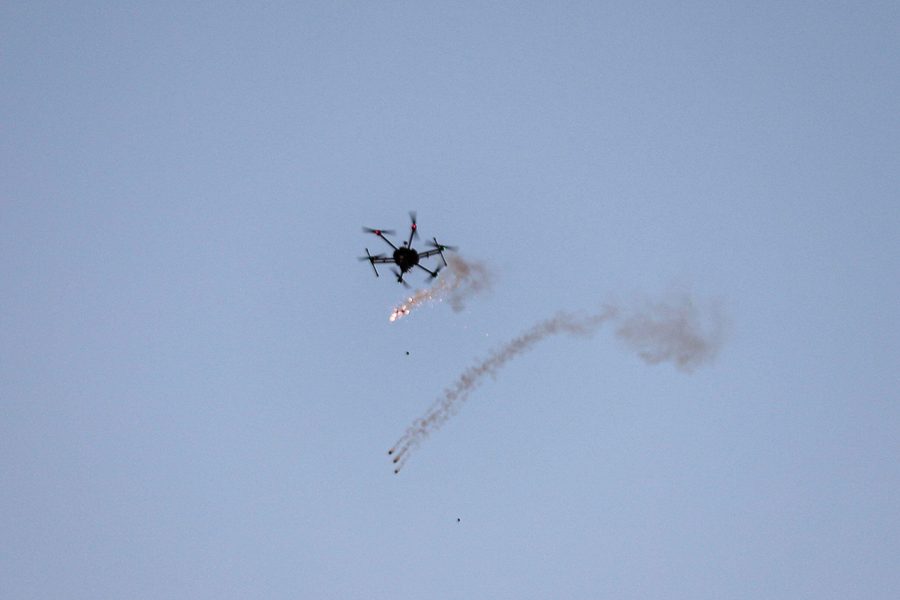
An Israeli drone dropping tear-gas grenades in Khan Younis, Gaza Strip, August 25th, 2021.
Momen Faiz/NurPhotoHigher Ed’s Bad Bargain
To salvage academic freedom amid Trump’s attacks, universities must break from their Cold War compromise with US militarism.

On June 16th, 2025, the Association of Public and Land-Grant Universities, the Association of American Universities, and the American Council on Education joined with 12 institutions of higher education to sue the United States Department of Defense (DOD). At issue was what the coalition characterized as yet “another attempt to slash funding for critical American research” by the Trump administration. In May, the DOD had announced that it would significantly reduce the rate at which it reimburses the recipients of its research grants for “indirect costs” (such as facilities and administrative expenses), which would represent a colossal hit to the budgets of affected universities. The overhead expenses the DOD was asking schools to shoulder, the coalition wrote, “are the real and necessary costs of conducting groundbreaking research that has made our nation the world’s leading military superpower.”
The day after the joint lawsuit was filed, a federal judge issued a temporary restraining order blocking the DOD policy change. For now, universities will continue to receive the accustomed overhead reimbursement rate for their military research, like those projects at MIT that have equipped “drones used by Israel” with “automated weapons systems and the ability to fly in swarm formation,” according to a recent report by Francesca Albanese, the United Nations Special Rapporteur for the Palestinian territories. Other proposed DOD funding cuts may be more difficult to block, to the chagrin of partner universities. After Defense Secretary Pete Hegseth announced the termination of his department’s support for social science research, Columbia’s Sabin Center for Climate Change Law warned that the move could “harm national security by cutting DOD off from critical information and the ability to understand and respond to current and emerging threats.”
In pleading the case for continued DOD funding, university leaders who had spent the past year and a half denying the charge by campus activists that their institution was complicit in the genocide in Gaza have pivoted to celebrating the research that forms the clearest site of their complicity, even more so than the financial assets targeted by campus divestment campaigns. Where once they shook their heads at the naivete of the students whose chants asked them how many kids they’d killed today, now they are practically submitting their tallies to the DOD, one last desperate gambit to maintain the status quo. The fact that much of the federal research funding affected by the Trump administration’s offensive against higher education is not disbursed by the military and has no explicit connection to the defense industry makes it all the more striking that so many scientists have chosen to emphasize their contributions to American imperial glory. “NSF [National Science Foundation] investments have made America—and American science—great,” a University of Vermont environmental scientist wrote in June, criticizing the cuts with self-consciously Trumpian diction. An open letter published in March by nearly 2,000 scientific and medical professionals warned that Trump’s “wholesale assault” on research means that other countries “will surpass us in business, defense, intelligence gathering, and monitoring our planet’s health.” In the face of Trump’s cuts to climate funding, the Salata Institute for Climate and Sustainability at Harvard urged universities to “tell the story of . . . the economic and national security benefits of basic science research” more persuasively. “The federal government has been the world’s largest investor in science research since the Second World War,” the Institute’s post noted, implicitly affirming that federal funding for research depends upon the extent to which it follows dutifully in the footsteps of the Manhattan Project.
It would be relieving to dismiss this rhetoric as a strategic concession to our reactionary moment: If a little jingoism is what it takes to shore up popular support for lifesaving research on cancer and climate change, perhaps that’s a price worth paying, distasteful as it may be amid a US-funded genocide. The more disturbing possibility is that the entire academic research enterprise does, in fact, play a vital role in helping the United States to project its strength around the world, with the intolerable consequences of that strength on full display today in Gaza. At MIT, one of the 12 universities that joined the lawsuit to block the DOD’s overhead reimbursement rate cut, some students and researchers have taken a less rosy view of the school’s entanglement with US imperial might. In its 2024 report “MIT Science for Genocide,” the MIT Coalition for Palestine demonstrates the university’s prominent place within the US military-industrial complex, noting that MIT receives over 17% of its research revenue from the DOD alone. The school also partners with a wide range of private weapons manufacturers as well as the Israeli Ministry of Defense, whose research grants are, in turn, frequently underwritten by the US military. “These collaborations,” the coalition writes, “legitimize abuse of political, human, and civil rights in Palestine. They also recruit MIT faculty and students into militaristic activity and bias scientific research agendas toward belligerent instead of life-affirming applications.” Properly understood, the advocacy of the MIT Coalition for Palestine and its allies on campuses across the country entails much more than simply pruning some unethical practices or structures from the otherwise healthy trunk of American higher education. The call by Palestine solidarity activists to end institutional complicity in human rights violations would, if taken seriously, require a reconfiguration far vaster than anything that could be captured in a protest chant, or even a letter of demands. The movement opens Pandora’s box.
The call by campus activists to end institutional complicity in human rights violations would, if taken seriously, open Pandora’s box.
Now, as Trump’s top-down attack on universities throws their operations into disarray, it is tempting to judge that we should keep the lid closed, at least temporarily. This past spring, after the university where I teach rebuffed Trump’s most extortionate demands, signs reading “Thank You Harvard!” began to appear at rallies that had once excoriated the university for its repressive treatment of protesters and cooperation with US and Israeli militarism. The calculation is clear and, on its own terms, logical: We can make common cause with our institutions against the Trump administration, return to the status quo ante, and then, once our academic freedom is secure from outside interference, get to work unraveling our bloody entanglements.
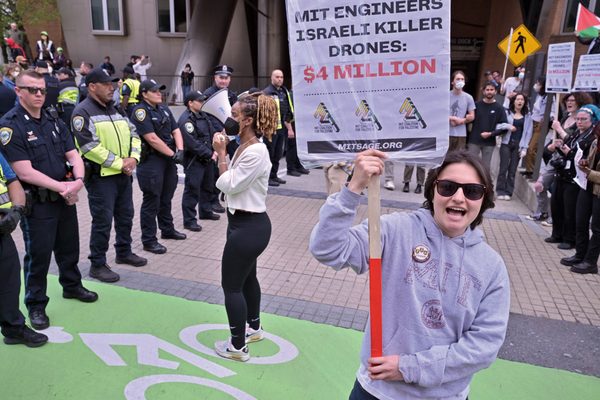
Demonstrators protest military research used by the Israeli military at MIT in Cambridge, May 9th, 2024.
The problem with this approach is that the academic freedom it defends is one that has already been compromised by the bargain universities struck with the federal government in the mid-20th century, during the construction of the modern military-industrial complex. According to this agreement, academics could govern their own affairs as long as they remembered who was paying them and what their benefactors hoped to gain. The exercise of academic freedom reaches its limit when it threatens what higher education does to bolster American power. Within this circumscribed freedom, criticizing the academy’s service to militarism and imperialism is itself a destabilizing transgression; asking critics to hold their tongues until their institutions are more secure belies the fact that universities entwined with the military can only ever purchase security at the price of subservience.
When Franz Boas called the first meeting of the American Committee for Democracy and Intellectual Freedom (ACDIF) to order on March 17th, 1939, the 80-year-old anthropologist was nearing the end of one of the most distinguished careers in the history of American science. Born in 1858 in Prussia to a Jewish family, Boas settled in the US in the late 1880s, bouncing from one scientific institution to another before finally securing a professorship at Columbia University. His revolutionary approach to anthropology, which turned to culture to explain much that his contemporaries reduced to biology, brought Boas into the political fray, where he emerged as one of the first and most vocal opponents of scientific racism in the white-dominated academy. As the name of the ACDIF reflects, Boas understood democracy and scientific freedom to be interdependent. Scientific truth bolstered democracy by undermining racist ideologies, but scientists needed autonomy to arrive at truth.
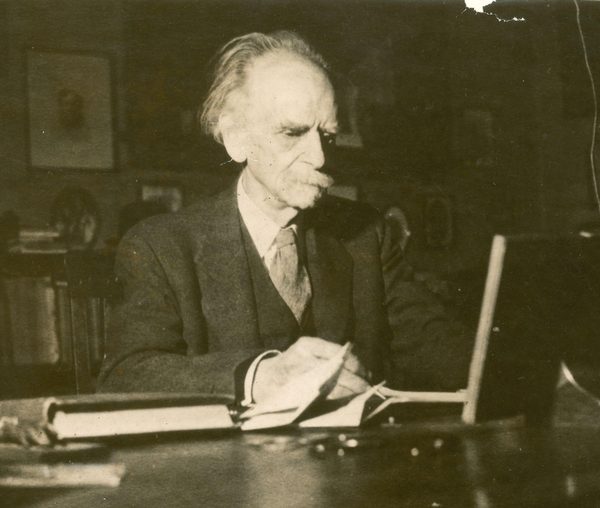
Franz Boas at work
Over the first decades of the 20th century, Boas had come to believe that militarism—and the willingness of his professional peers to lend their services to it—was one of the most pressing threats to intellectual freedom. In 1919, after learning that four American anthropologists had agreed to spy for the US while working in Mexico during World War I, Boas wrote an incendiary letter to The Nation in which he declared that anyone “who uses science as a cover for political spying . . . prostitutes science in an unpardonable way and forfeits the right to be classed as a scientist.” The mutilation of Italian and German science following the rise of fascism confirmed for Boas that science could not thrive when subordinated to military purposes. That meant that militaristic but not yet fascist countries, including the United States, needed systemic transformation if they were to truly safeguard scientific autonomy. “Fascism, we know, will mean the end of all intellectual freedom and our main task is to stop it,” Boas told the Communist newspaper Daily Worker in 1938. “The ultimate solution, to my personal way of thinking, is Socialism.”
By that point, Boas was far from alone in these judgments. In 1937, a group of radical scientists in Philadelphia, dissatisfied with what they perceived as the political timidity of existing professional organizations, formed the American Association of Scientific Workers (AASW), modeled on the recently founded British Association of Scientific Workers (BASW). The AASW and the BASW were explicitly antifascist, anti-militarist, and economically progressive, allied with the labor movement and the era’s Popular Front between social democrats and communists. By the end of 1938, a Boston-Cambridge chapter had joined the Philadelphia group, and the organization debuted to the public with support from a roster of prominent scientists (most famously Robert Oppenheimer, who would go on to lead the Manhattan Project). One of the AASW’s first major initiatives was a boycott of scientific materials, including laboratory equipment, imported from Germany; a policy of financial noncooperation with fascism was, the Harvard biologist Kenneth Thimann felt, “the least action which the Association, if it stands for anything real, could take.”
“Everything which tends to strengthen national industry and improve the efficiency and economy of its processes increases its military strength. To this extent all national industrial research is potentially war research.”
Those scientists who shared Boas’s conviction that fascism was latent wherever militarism and nationalism could be found hoped that taking action against European fascism would help prepare their colleagues to work for radical transformation at home. Writing in 1939, BASW leader and Irish scientist J.D. Bernal observed “a much greater reluctance than heretofore among scientists voluntarily to assist in military research, and a strong feeling that in doing so they are violating the spirit of science.” Bernal, an outspoken activist in the Communist Party of Great Britain, maintained it was imperative that such acts of individual refusal be linked to the broader fight against capitalism and imperialism. “Everything which tends to strengthen national industry and improve the efficiency and economy of its processes increases its military strength,” Bernal argued. “To this extent all national industrial research is potentially war research.” The implication was that no one’s hands were clean until everyone’s were. Bernal, who continued to work as a scientist, wasn’t demanding that his colleagues put down their pipettes until war was abolished, but he maintained that even scientists doing “basic” research still had an obligation to join political efforts working toward that horizon. Given the contributions of even quite theoretical work in thermodynamics and electromagnetism to the development of modern industry, scientists could only ensure their work didn’t find military application by ending militarism itself.
By the late 1930s in the US and United Kingdom, even those scientists committed to the long-term struggle against war were also increasingly convinced of the necessity of military struggle against the Nazis in the short term. That conclusion wasn’t incompatible with Bernal’s arguments in principle; Bernal himself ended up cooperating enthusiastically with the British war effort, despite the low security clearance to which his Communist affiliations condemned him. Most radical scientists in the US, like Oppenheimer, eventually followed the same trajectory—but in the meantime the advent of war plunged their movement into bitter recriminations. Within the ACDIF, tensions mounted after the national executive committee found itself divided on a petition that would have committed the group to opposing American entry into the war, on the grounds that “the war threatens to destroy intellectual freedom and the rights of free men” and “will inevitably entail death, permanent physical or spiritual injury to millions of people, and serious interference in cultural and scientific progress.” Boas supported the petition, but many of his key collaborators did not. When Boas died, exactly two weeks after Pearl Harbor, the ACDIF had already folded. The AASW still persisted on paper, but a similar fissure about supporting US entry into the war marked its end as an influential organization in American science. Those who believed that the external threat of fascism needed to be repelled with force before scientists could redress their professional collaboration with military-industrial devastation won the debate.
The postponed reckoning finally arrived in 1945, after scientists helped the US build the most destructive weapon ever devised. A new mass movement of scientists erupted to advocate for international civilian control over atomic technology and to preempt the arms race looming on the horizon. Many of the movement’s leading figures, echoing their prewar predecessors, urged scientists to work for the radical political and economic change without which they could find themselves responsible for the total annihilation of civilization. In his essay in the 1946 book One World or None, published by a weapons control advocacy group founded by former Manhattan Project scientists, Albert Einstein argued that to avert nuclear catastrophe, it was necessary to create “a supranational organization” to which the world’s superpowers turned over their military resources, so it could then prevent individual states from making war.
This efflorescence of anti-militarist advocacy after the end of the war suggests that Boas’s opponents within the ACDIF were correct that taking up arms against fascism would not necessarily prevent scientists from organizing for peace once the fight was done. But the genie of military patronage, once released to grant scientists’ every funding wish, would not so easily return to its bottle. The Manhattan Project had integrated American science more fully into the war apparatus than ever before, and some scientists found that they quite enjoyed the nearly unlimited resources now at their disposal. In the late 1940s the US federal government allocated some 2% of its total outlays to scientific research, especially within the national lab system that emerged from the Manhattan Project. By the mid-1960s that figure had swollen to 12%—some of which was channeled through officially non-military institutions like the National Science Foundation (founded in 1950), but much of which continued to be routed through military bureaucracies like the Office for Naval Research (founded in 1946). And it was channeled not merely to laboratories under formal governmental or military operation, but increasingly to universities, whose enrollments were spiking, with federal encouragement, at the same time.
As this Cold War science regime crystallized, scientific anti-militarism largely withered to the posture that sociologist Kelly Moore calls “moral individualism”—lone courageous researchers, often motivated by Quakerism or other pacifist belief systems, refusing to cooperate with the military, even as they watched their profession as a whole embrace its status as an appendage of the American war machine. The movement of atomic scientists, bereft of the relationships that prewar Popular Front organizations like the AASW had developed with the labor movement and other forces struggling for broader social transformation, abandoned a confrontational posture toward the state, preferring instead to dispense expert advice about the mechanisms that would reduce the risk of nuclear apocalypse. That meant these activists needed to keep the peace with their more conservative colleagues so that “science” could appear to speak with a single voice, which drove their advocacy toward the lowest common denominator. While the scientists succeeded, with the McMahon Act of 1946, in securing formal civilian control over nuclear weapons and energy development, this control became a closely guarded prerogative of the executive branch, with vast swaths of information about the nation’s nuclear infrastructure shrouded in secrecy. The consolidation of the Cold War eventually confirmed the defeat of the movement, at least in its radically internationalist form, although its legacy lives on in the Bulletin of the Atomic Scientists and its famous Doomsday Clock, ticking down to an apocalyptic “midnight.”
In a brutal piece of irony, many postwar scientists justified their embrace of military funding with the concept that to Franz Boas was practically synonymous with scientific anti-militarism: intellectual freedom. Influential scientists like MIT vice president Vannevar Bush and Harvard president James B. Conant, both former Manhattan Project leaders, distinguished the American system from the Soviet project of “planning” science to achieve predetermined social goals, arguing that American institutions displayed a characteristic commitment to freedom as their central principle of operation. Funders identified “really first-class men,” in Conant’s phrase, and equipped them with the money they needed to pursue their creativity wherever it led them, secure in the faith that the results of such free inquiry would ultimately redound to the benefit of the United States and its military. True scientific freedom was not, as Boas believed, freedom from military oversight. It was the freedom of military support. “There’s no such thing as tainted money,” the Cold War-era quip went, “except ’t’ain’t enough.”
In a brutal piece of irony, many postwar scientists justified their embrace of military funding with a concept that to radical scientists was practically synonymous with anti-militarism: intellectual freedom.
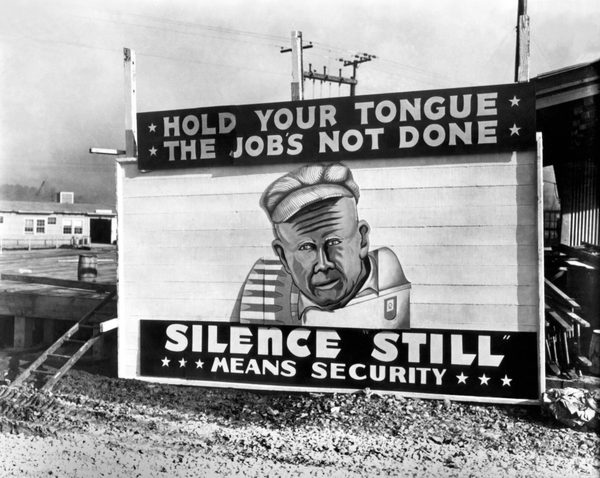
A billboard urging silence at the Hawley Plant in Milwaukee, a sister site of the Manhattan Project, 1943.
The natural sciences were not the only fields to benefit from the Cold War bonanza in research funding. The era now romanticized as a golden age by many academics in the humanities and social sciences was made possible because policymakers and government strategists calculated that investments in those fields would pay off, believing that the “softer” disciplines could help the US outmaneuver its adversaries and demonstrate to the world America’s intellectual and cultural achievements. Money from the Office of Strategic Services and its successor, the Central Intelligence Agency, helped underwrite the groundbreaking postwar work of anthropologists such as Margaret Mead, Clifford Geertz, and Clyde Kluckhohn, as well as some of the early work of the anarchist political scientist James C. Scott; the literary achievements of the Iowa Writers’ Workshop in the 1950s and 1960s; and the transnational network of philosophical luminaries coordinated by the Congress for Cultural Freedom, to name just a few examples. The beneficiaries of such funds were not just hacks and propagandists, in other words; many were not even fully aware of where their funding was coming from. In the mid-century decades, Cold War largesse was the water in which everyone was swimming.
The radical agitation that erupted on college campuses in the early 1960s and intensified with the escalation of the Vietnam War disrupted this complacent status quo. The student movement, and its allies among faculty and research staff, forced the denizens of the Cold War university to clarify which side they were on. In 1969, more than 80 scientists convened in San Francisco by the organization Science for the People pledged that they would “not participate in war research or weapons production” and that they would “counsel [their] students and urge [their] colleagues to do the same.” This was a marked break from the era of individual refusal, as Science for the People saw its boycott as a pathway to collective action against the military conscription of American science.
Many of the university-based activists seeking to purge their institutions of military influence recognized that severing direct financial ties to the US military would redress only one axis of the academy’s relationship to the violence of American empire. As researchers in the 1960s and ’70s grappled with the place of knowledge production in a fundamentally destructive political-economic order, the more structural critique of J.D. Bernal—who used the phrase “science for the people” in his 1952 book Marx and Science—returned as an inspiration. In 1970, the Harvard Medical School professor Jon Beckwith made headlines for announcing he would donate the money he received from a prestigious award for his groundbreaking work on gene isolation to the Black Panther Party. He had previously explained that he was troubled that his research could someday be used against his intentions for bioweapons production, since “we see work in biology used by our government in Vietnam and in devising chemical and biological weapons.” Mitigating this possibility, in Beckwith’s view, required “changing society so that it serves the people,” a task that revolutionary groups like the Panthers were undertaking. The 1973 Science for the People-aligned manifesto “Toward an Anti-Imperialist Science” similarly proclaimed, “As scientists and revolutionaries we unite with anti-imperialist scientists of the world and with popular movements of our countries.” This declaration, drafted in collaboration with left-wing Mexican scientists, wasn’t just a promise, but a description of how activists in Science for the People had been conducting themselves for years, traveling around the globe, often at great personal risk, to lend aid to revolutionary forces in the Global South, including North Vietnam. In May 1971, the Boston-based Red Crate Collective, an affiliate of Science for the People, published a pamphlet on “Science for Vietnam,” a program for coordinating scientific aid and soliciting donations of textbooks, medicines, and physical equipment useful to the continued development of scientific and medical capabilities in North Vietnam.
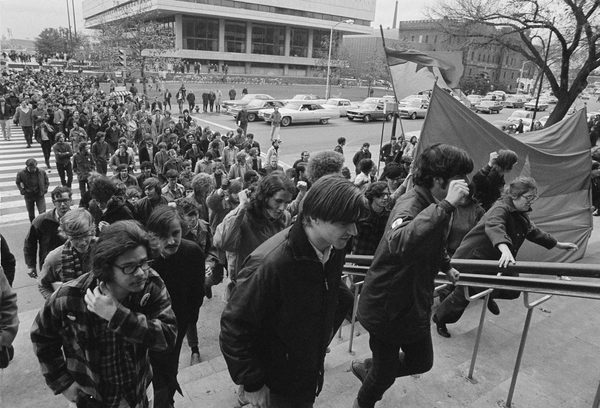
Students and supporters demanding a halt to military research at
MIT in Cambridge, November 6th, 1969.
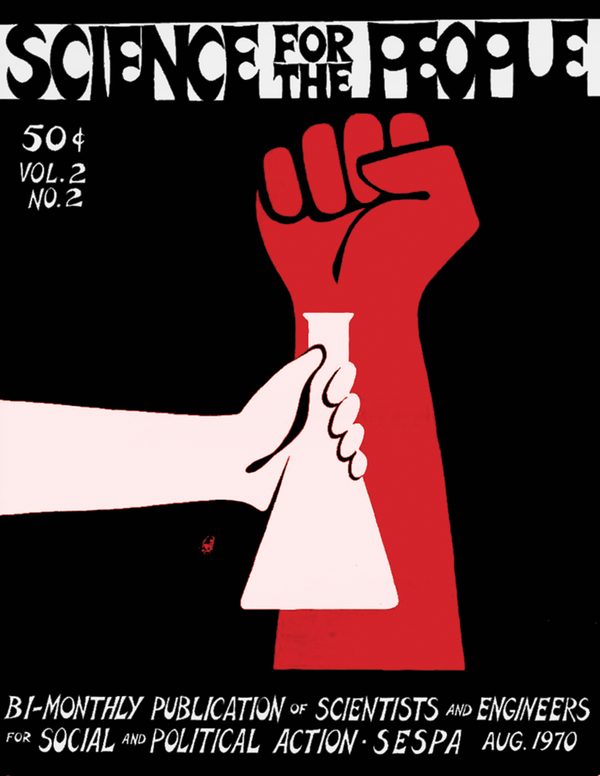
Science for the People cover, August 1970
Throughout the late ’60s and early ’70s, anti-war students and faculty picketed military-funded labs at dozens of schools; they also occupied, vandalized, and in one case, bombed the sites of war research. The suppression of such protest was often carried out under the cover of the denatured Cold War conception of academic freedom. In 1972, Stanford fired tenured English professor H. Bruce Franklin for suggesting at a rally the year before that the crowd should forcibly shut down the university’s military-funded Computation Center, with university administrators and conservative faculty insisting that Franklin didn’t deserve institutional protections like tenure, because of the threat he was mounting to free inquiry. “When students try to stop, interfere with, or even question too closely, some university function (class, lecture, research project) that has a connection to some political controversy,” wrote a group of Science for the People affiliates in 1972, “they are accused of violating the academic freedom of those who scheduled the activity in question.” The group juxtaposed this accusation with the response of the Caltech physicist Murray Gell-Mann when questioned by young scientists in France about his work advising the Pentagon: “I am not free to answer.” The secrecy that military research nearly always required made the free exchange of ideas impossible by design. But it was in the name of freedom that universities clamped down on scholars who interrogated their colleagues’ choice to submit to the yoke of secrecy.
The universities’ repression of protest in the late ’60s and early ’70s was only a pale shadow of the state violence inflicted on off-campus revolutionaries, and by the end of the 1970s radical academics were left to contend with the awareness that the broad societal transformation they understood as an indispensable condition for the full redemption of their institutions was off the table, at least in the short term. During the Reagan administration, DOD science funding exploded. When the Cold War ended, fears that the federal gravy train would end along with it sent universities scrambling to expand their partnerships with private industrial partners, including in the defense sector. (These fears ultimately proved unfounded: The train may have slowed in the 1990s, but it was back to running full speed following the 2001 declaration of the War on Terror.) Under the Clinton administration, the federal government began the practice of funneling grants toward universities with formal industry partnerships in place. Lockheed Martin has been particularly aggressive in establishing a host of American universities as “strategic partners,” a designation which entails research collaboration as well as recruitment initiatives. As Penn State’s Corporate Engagement Center puts it, the defense giant and its academic collaborators establish “a holistic relationship that grows, evolves, and spans a remarkable breadth,” including research, classroom education, and post-graduation student recruitment.
When today’s anti-war activists protest their universities’ ties to defense contractors and the military, administrators defending these collaborations still draw upon an idea that was forged in the Cold War and has only calcified since: A commitment to intellectual freedom requires academics to acquiesce to the military-industrial takeover of their institutions, while challenging military research in the university is tantamount to a violation of this freedom. “Calls to deprive fellow students of their choice of where to work and to prevent researchers from choosing whom to work with are deeply troubling,” a New York University spokesman told the student newspaper in 2024, after a protest targeting the engineering school’s research and recruiting partnerships with institutions like the US Navy and Lockheed Martin. “NYU rejects calls for academic boycotts,” the spokesman explained, “because they are at odds with the receipts [sic] of the free exchange of ideas and academic freedom.” Eighty years after academic researchers wagered that the necessity of defeating fascism justified the short-term sacrifice of their intellectual freedom, the logic of military collaboration has revealed itself as an Orwellian monstrosity. War is freedom; dissent is repression.
Under the second Trump administration, anti-militarist activists in the academy face an organizing landscape that looks less like that of the Vietnam era and more like a twisted version of the dilemma radical scientists faced on the eve of World War II. When the fight looked something like the campaign against the Vietnam War, the beats could feel almost comfortingly scripted. We knew what the demands were and to whom and how best to pose them: take up physical space, disrupt business as usual, pull every possible lever to make the higher-ups uncomfortable. Now college and university leaders are more uncomfortable than we ever managed to make them, because their alliance with the federal government, including the Department of Defense, has broken down. The clear battle lines of last year, which pitted activists on and off campus against an unholy alliance of university administrators, weapons manufacturers, and military bureaucrats, have dissolved and been replaced by a three-way standoff between The Good (anti-imperialist activists), The Bad (our new fascist president), and The Ugly (American higher education).
As in the late 1930s, intellectual freedom seems threatened simultaneously by far-right authoritarianism and by the subtler constraints of mundane collaboration with military partners. Once again, there is an argument to be made that the former threat needs to be confronted first, in order to ensure that scholars have stable footing on which to grapple with the latter, more complex menace. We would do well to learn from past capitulations to this logic. Accommodating militarism in higher education for the sake of fighting Trump will not do anything to prepare the academic profession to eventually confront its complicity in American-sponsored atrocities. It is time, instead, to imagine a more robust academic freedom, one that draws on the vision of Boas, Bernal, and other radical antifascists of the interwar period and breaks from the perverted Cold War formulation—the freedom of academics to sell their services to the highest bidder, without bureaucratic interference or ethical challenges from their peers. How might we, as academic organizers and committed anti-militarists, begin to enact this more expansive notion of academic freedom?
Accommodating militarism in higher education for the sake of fighting Trump will not do anything to prepare the academic profession to eventually confront its complicity in American-sponsored atrocities.
A 2007 lecture by Science for the People veteran Richard Levins might help us grapple with the challenges confronting us today. Delivered to the Socialist Caucus of the American Public Health Association, and aptly titled “One Foot In, One Foot Out,” the lecture charts the options available to the politically committed researcher facing the dire circumstances of the 21st-century university. The first is to push the envelope—taking bold stands, challenging professional orthodoxies, and making principled decisions about which funding sources to pursue. This approach entails joining the struggle to defend and strengthen academic job security (“Here is where unions are important,” Levins notes). The second is to focus on advancing one’s research career in conventional terms while also building relationships with organizations outside the academy that could deploy one’s findings to advocate for legislative change or other reforms. The last option is “to leave the institutions that are so frustrating and increasingly demoralized,” devoting oneself full-time to activism and figuring out how to “make a living in some other way.” Levins acknowledges that there is no perfect approach, and that an individual might incorporate elements from each path.
Although nearly two decades have passed since his address, this schema remains useful for understanding the forms that political engagement in academia has taken in the 21st century. The academic labor movement, especially unions of graduate students and non-tenure track teachers and researchers, has grown considerably since 2007, winning contracts that have protected hundreds of thousands of academic workers from retaliation and harassment. At the same time, academics have gotten more comfortable writing for a general readership, helped in part by an expanding ecosystem of advocacy groups that help scholars share their most salient research findings with policymakers and the public at large. And the accelerating collapse of the academic job market has made defecting entirely for a life of full-time political work more tempting for countless unemployed and underemployed radical scholars.
The movement that emerged after October 7th to protest the complicity of American higher education in the Israeli genocide in Gaza exemplifies how the three strategies Levins gestures to could work together productively. The academic labor movement has played an indispensable role in supporting campus activism, whether by defending individual workers from punishment for their advocacy or by coordinating protest directly. Researchers have also lent their expertise to the solidarity movement, sharing their insights on Palestinian history, genocide, famine, and the American military-industrial-academic complex in essays, reports, and teach-ins, while also contesting the obfuscations that many of their co-workers have peddled. And the campus struggle has always relied on movements outside the American academy for support, leadership, and inspiration, be it organizations of socialists, anti-imperialists, pacifists, anti-Zionist Jews, or, most importantly, Palestinians themselves, both in the US and in occupied Palestine. At the peak of their power, during the encampment wave of spring 2024, student activists succeeded in prefiguring a radically different kind of university, one where “civil discourse and critical inquiry are not abstract concepts” but rather “active principles,” as my Harvard colleague Walter Johnson put it. The encampments, at their best, showed how a movement grounded in the university could also point beyond it.
Though now dismantled, this liberated educational zone in the belly of the beast offers a site from which to affirm the vision of those scientists and academics who have insisted, against immense pressure, that true academic freedom lies beyond the militarized university. Franz Boas was right when he warned the ACDIF that scientific cooperation with the war effort would threaten its ideals in the long run. Since militarism and imperialism are themselves the seeds of fascism, an antifascist science must always orient itself toward a world without war and without empire. And while we may sympathize with the decision of scientists like J.D. Bernal to temporarily compromise their anti-war ideals for the sake of defeating Hitler, the pragmatic case for short-term collaboration is weaker when the fascist threat in question is not the official enemy of our military but rather its commander-in-chief. If we understand Donald Trump as akin to the dictators of interwar Europe, then we must aspire to more than just forcing his regime back into tolerantly financing our institutions.
As Israel perpetrates its extermination campaign in Gaza not only with technologies developed by American scientists but also with American power—the power that has prevented global actors from coming to the aid of the Palestinians and that has enabled, through the precipitous inequality in wealth and military capability that it sustains, the slaughter to proceed so rapidly—we might conclude, as Daniel Ellsberg did about the Vietnam War, that the US isn’t simply on the wrong side; it is the wrong side. That leaves even the good things we academic workers do in American universities—everything that makes America healthier, wealthier, safer, and smarter—stained in blood. This implication may have been one reason why so many academics and administrators, even those without a strong commitment to Zionism, found the Palestine solidarity movement that spread across American campuses last year so threatening. And it is why, as university leaders boast of American higher education’s role as an appendage of the national security machine, opponents of that machine in academia have no choice but to confront their schools and their government simultaneously.
There were academics whose careers flourished in Nazi Germany, scientists who made groundbreaking discoveries and scholars whose historical and philosophical insights still endure. Most of us regard them, justly, as criminals, disgraces to our profession. The more resolutely our nation commits itself to a genocidal project of its own, the more unsparingly we must look inward: If our scholarly contributions do in fact aid the cause of American greatness, are they worth making in the first place?

I’m Arielle Angel, editor-at-large of Jewish Currents. Before you go, there’s something I need to ask.
We’ve seen over and over how the mainstream media falters in telling stories on our beats—whether it’s antisemitism, Israel/Palestine in American politics, Jewish identity, or the American left. At Jewish Currents we’re committed to uncompromising analysis and longform reporting on these issues and more—stories you won’t find anywhere else. In a media landscape that obscures injustice and flattens discussion, we’re changing the conversation. But we need you.
If you believe in this work, please consider making a donation—or even better, a recurring one—to ensure that we are able to keep publishing stories like this one. We can’t do it without you.
Erik Baker is a historian at Harvard, the senior editor of The Drift, and the author of Make Your Own Job: How the Entrepreneurial Work Ethic Exhausted America.