Auditing the Hindu American Foundation’s Claims of “Hinduphobia”
The group regularly misclassifies anti-Asian racism, anti-Muslim violence, and criticism of Hindu nationalism as anti-Hindu hate.
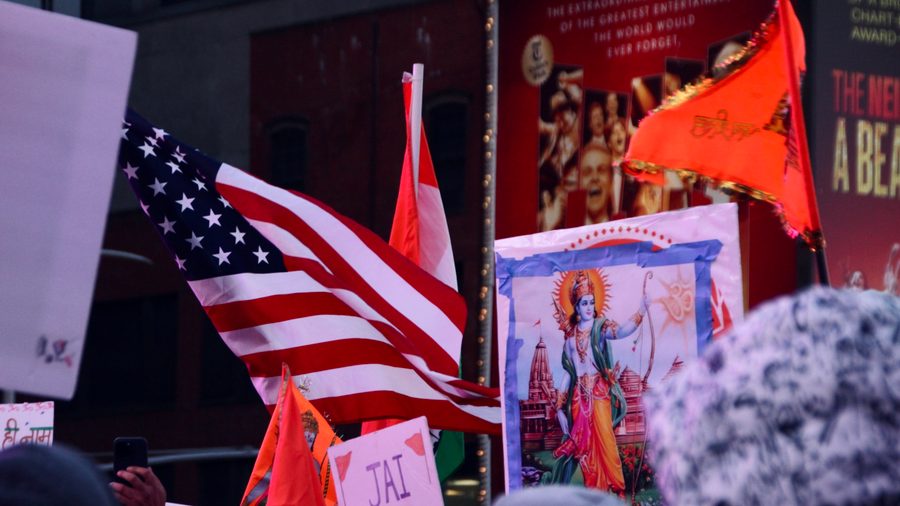
Hindu Americans gather in Times Square to celebrate the consecration of the Ram Temple in Ayodhya, India, January 21st, 2024.
On a summer evening in 2022, a group of Bengali-speaking Indian American women wrapped up dinner at a restaurant in Plano, Texas. They had just stepped into the parking lot to head back home when they were accosted by a non-Indian woman who began to verbally abuse them, mocking their accents and telling them to “go back to India,” saying, “We don’t want you here.” When the women told her to “get lost,” she began hitting one of them, shouting racist profanities. “Were you born here?” she can be heard asking one of the women in a video of the incident that went viral online. When asked in return, “How do you know we weren’t born here?” the harasser responded, “Because of the way you speak.”
Among the many reacting with outrage to this instance of harassment—which resulted in the perpetrator being charged with hate crimes—was the Hindu American Foundation (HAF), the largest and most vocal organization advocating for Hindus in the United States. The group posted a tweet denouncing the incident, and, notably, lumping it together with another viral occurrence from the same week, this time from Fremont, California. There, a Hindu man waiting in line at a Taco Bell was verbally abused by a fellow Indian American, who called him a “dirty ass fucking Hindu” and a “cow-piss drinker,” and taunted him about not eating beef. HAF wrote that the Plano and Fremont incidents represented the same “seething hatred,” both involving “racist & #Hinduphobic invectives.”
But some have objected to the events being rolled together under one blanket characterization. An immediate family member of one of the Bengali women, who asked to remain anonymous fearing retaliation from the Hindu right, told Jewish Currents that the Plano attack “wasn’t ‘Hinduphobia.’” Instead, the attack on the women targeted “the color of their skin, and the language they were speaking,” they said. The family member expressed concern that defining the incident as specifically anti-Hindu—rather than primarily about anti-Indian racism—could thwart efforts to prevent such harassment: “If the diagnosis is wrong, misguided, or politicized for an agenda, then the solution won’t be successful.”
HAF’s 2022 tweet was just one among scores of claims of “Hinduphobia” that right-wing Hindu American groups have made in recent years. According to a Jewish Currents review of HAF’s public communications, the group labelled more than 200 separate incidents as “Hinduphobic” or anti-Hindu in press releases, website text, and social media posts between 2019 to 2024. Of the flagged incidents, 161 took place in the United States, and 51 were in other countries, mostly Muslim-majority areas of South Asia. “Stop the bigotry. End #Hinduphobia,” HAF posted in December 2021, in response to widespread criticism of American Chargé d’Affaires Atul Keshap’s visit to the headquarters of a Hindu nationalist organization in India. In 2019, when New York Magazine published an article exploring the influence of a fringe, Hinduism-inspired new-age group on Tulsi Gabbard’s life, HAF tweeted a response post by a right-wing Hindu academic called “Today in Hinduphobia . . . New York Magazine’s Sly Attack on Hindus.” Dozens of other HAF communications followed this pattern, and other groups have joined in: The Coalition of Hindus of North America (CoHNA), for example, began collating incidents of “hate and violence against Hindus” on their website in 2020, and a student-led group called Hindu on Campus set up a “Hinduphobia tracker” focused on campus incidents starting in 2021.
Over time, these groups’ attempts to raise the alarm about alleged Hinduphobia have translated into policy. In the past few years, HAF has promoted multiple successful resolutions recognizing Hinduphobia at city and state levels. Recently, Rep. Shri Thanedar (D-MI) introduced House Resolution 1131, a first of its kind attempt to get the US Congress to recognize Hinduphobia. Speaking to Jewish Currents in February, Thanedar confirmed that he had engaged with HAF as well as CoHNA in generating the resolution. “I have been observant about the rise of hate against Hindus over the last couple decades,” he said. “That’s why I approached some of the Hindu groups, and we had a very meaningful discussion with their policy people. That resulted in me taking it upon myself to represent them as strongly as I can in the US Congress.”
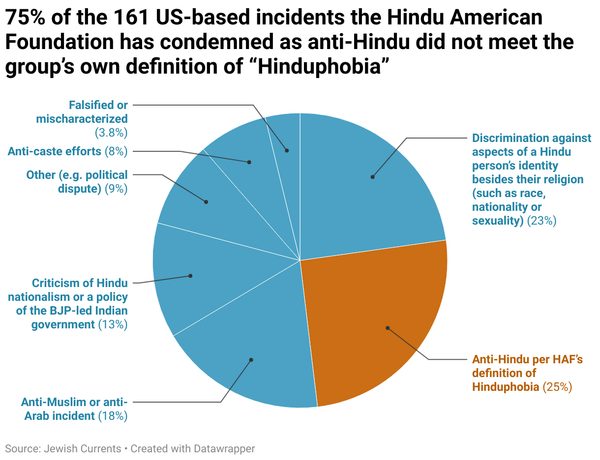
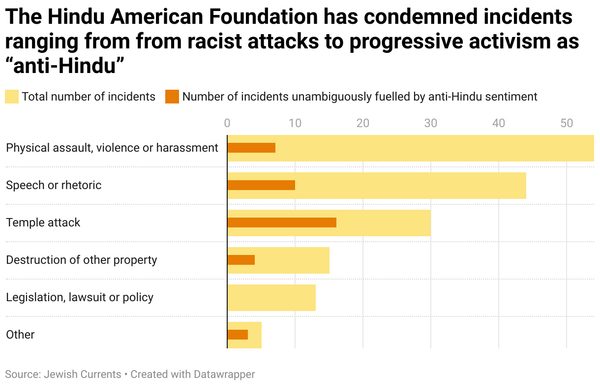
However, even as HAF’s narrative around rising Hinduphobia has reached lawmakers, independent verification by Jewish Currents found that a full 75% of the 161 incidents that HAF has condemned as Hinduphobia in the United States did not meet the group’s own definition of the term. Twenty of the incidents involved criticisms of Hindu nationalism or Hindutva—the virulently anti-Muslim ideology that dominates Indian politics both in the subcontinent and diaspora—many of them by academics and journalists. An additional 12 allegations of Hinduphobia were leveled at activists aiming to ban caste discrimination in the US, a move that some diaspora Hindus, adherents of the caste supremacist ideology of Hindutva, brand as biased against Hinduism. Furthermore, while 93 incidents highlighted by HAF did appear to be unambiguously fueled by hateful and discriminatory attitudes, 36 of those featured hate directed not at a person’s religious identity but rather their race, immigrant status, or national origin. An additional 29 of the hateful incidents HAF presented as evidence of systemic Hinduphobia consisted of anti-Muslim and anti-Arab language, many occuring in the immediate aftermath of 9/11. (Jewish Currents was unable to find more information about an additional 24 allegedly Hinduphobic incidents in the US that HAF has condemned. Despite the events still being mentioned on its website, HAF declined to provide sources, with spokesperson Mat McDermott writing: “We don’t have the staff resources to go back and do this research for you, about incidents, for some of them, [sic] are more than two decades ago.”)
According to the more than a dozen scholars, experts, and activists Jewish Currents spoke to for this story, HAF has political incentives to describe as many incidents as anti-Hindu as possible. For decades, the positions of the group’s founders have been aligned with Hindu nationalism. As such, HAF has consistently supported supremacist policies of Narendra Modi’s government in India, eventually earning a place on the Congressional Research Service’s list of Hindu nationalist groups operating in the United States in 2024. Pratik Sinha, co-founder and editor of the Indian fact-checking platform Alt News, told Jewish Currents that “the whole Hindu nationalist project is one of misrepresentation and misinformation,” and that groups like HAF create a narrative of Hindu victimhood in order to advance their politics.
Some experts trace this politics to the very definition of Hinduphobia that HAF has adopted. The group defines “Hinduphobia” as “a set of antagonistic, destructive, and derogatory attitudes towards Sanatana Dharma (Hinduism) and Hindus that may manifest as prejudice, fear or hatred.” But Rohit Chopra, a professor in the Department of Communication at Santa Clara University whose research focuses on global Hindu nationalist and far-right online communities, pointed out that HAF’s “Hinduphobia glossary” of terms that supposedly connote anti-Hindu hate includes the words “Hindutvavadi,” which means Hindu nationalist, and “Brahmanism,” which refers to Brahmins, who dominate the caste hierarchy. “This definition of Hinduphobia is applied to silence criticisms of Hindu nationalism and Hindu nationalist policies of the Bharatiya Janata Party (BJP)-led Indian government, critiques of the caste system, and anti-caste measures,” he said. Chopra added that any sweeping definition that categorizes an “antagonistic attitude” towards a religious doctrine as hatred can, if used without nuance, “silence any and all criticism and critical discussion of” the religion in question.
HAF’s attempt to use hate crime allegations to advance right-wing politics has parallels with the work of the Anti-Defamation League (ADL), which “HAF has explicitly modeled itself on,” said journalist Azad Essa, author of Hostile Homelands: The New Alliance Between India and Israel. Specifically, the ADL conflates the criticism of Israel and Zionism with anti-Jewish hate, and, as a result, the group regularly classifies an inflated number of incidents as antisemitic. The ADL’s antisemitism audits “strip out any ideological specificity and history to antisemitism so that it appears ubiquitous and everywhere,” said journalist and filmmaker Shane Burley, one of the authors of Jewish Currents’ 2024 examination of ADL’s antisemitism audit. Yet, he said, the ADL has succeeded in playing a large role in telling the Jewish community what it should feel threatened by and encouraging it to associate its Jewishness with Israel and Zionism. Essa agreed, adding that “both the ADL and HAF employ progressive political language to present themselves as intersectional and inclusive. But they are, in fact, organizations invested primarily in preserving the reputations of India and Israel.”
Experts say that the similarity between the ADL and HAF’s tactics speak to a broader right-wing strategy of weaponizing certain minority identities. “When there were criticisms about structures of exclusion and discrimination affecting Black people, Latinos, and other people of color, the right dismissed those concerns,” said Daniel HoSang, a professor of ethnicity, race, and migration at Yale University. Now, however, the multiracial right, which includes Jews and Hindus, is advancing narratives of anti-racism toward its own purposes, “taking advantage of a depleted media environment where allegations of antisemitism or Hinduphobia are no longer investigated,” HoSang said. The result of this appropriation, he noted, is a new defense of “hierarchical and authoritarian” practices, one framed “in the language of cultural autonomy, liberal multiculturalism—and even anti-racism.”
The multiracial right, which includes Jews and Hindus, is defending “hierarchical and authoritarian” practices “in the language of cultural autonomy, liberal multiculturalism—and even anti-racism.”
HAF’s Hinduphobia analysis begins with events that are more than a century old. On a webpage titled “A History of Hinduphobia in the United States,” which collects 91 of its 161 alleged anti-Hindu incidents in the US, HAF begins its list with the Naturalization Act of 1906, which restricted naturalized US citizenship only to “free white persons” and “persons of African nativity,” and then the Immigration Act of 1924, which prevented additional immigration from South Asia and the Middle East. But far from being specifically “Hinduphobic,” these laws, by HAF’s own admission, also impacted Sikhs, Muslims, and Christians from across Asia and the Middle East. Additionally, the laws were passed “under pressure from the Asiatic Exclusion League”—clearly motivated by general anti-Asian sentiment. “Race is the operative term, and was the basis of exclusion and all of that legislation,” HoSang said. Race also motivated the 1907 Bellingham riots, another early incident on HAF’s website. During these riots in Washington State, a mob of hundreds of white men, led by the Asiatic Exclusion League, violently attacked South Asian immigrants to try and exclude them from the labor force of local lumber mills. Most of the victims were Sikh, but local newspapers reported that “Hindus” were driven out, “because the term ‘Hindu’ historically operated as a shorthand for brown people,” HoSang said. It is a misnomer that HAF has capitalized on, claiming that all of these historical incidents are in fact “Hinduphobic.”
This pattern of characterizing general anti-Asian racism as “Hinduphobia” recurs nearly a dozen times throughout HAF’s allegations. The group counts a racist 2017 campaign mailer sent out around Edison, New Jersey in the Hinduphobia tally on its website, even though the mailer said nothing about Hindus and instead claimed Chinese and Indian populations were taking over local schools while calling to deport two minority school board candidates. In 2020, HAF similarly alleged that Covid-19 related conspiracy theories spread by white supremacist groups were “threats to Hindu Americans,” despite significant evidence that these forms of hate were directed at people of East Asian descent or towards racial minorities as a whole.
Even when incidents are targeted specifically at South Asians, HAF often misclassifies them as being religiously rather than racially motivated. For instance, in 2017, an Indian store owner was found dead outside of his Lancaster, South Carolina home, and it was revealed that the three people charged in his murder allegedly planned to “smash an Indian.” But HAF characterized this incident as Hinduphobic. More recently, in 2023, graffiti was seen in a public restroom in Wilson Park, California that talked about jobs being stolen by Indians. HAF accurately labeled the sentiment “xenophobic,” but also called this xenophobia “the conjoined twin of Hinduphobia” when it shared the incident on its social media. According to Pooja Chaudhuri, a researcher at the Netherlands-based investigative journalism group Bellingcat whose work has focused on misinformation in India, HAF’s continual peddling of such misleading claims create an environment in which it’s difficult to offer an alternate narrative. “When faced with a barrage of lies, a fact-check or correction has little power to change the mind of the average news consumer,” Chaudhuri said.
HAF’s tendency to obfuscate has been particularly notable in its misclassification of 29 explicitly anti-Muslim and anti-Arab incidents as “Hinduphobia.” These incidents, often violent, involved a perpetrator shouting phrases such as “towelhead,” “terrorist,” “relatives of Osama Bin Laden” and “ISIS, get out of my country” at a Hindu or Indian person. Eighteen of these incidents took place in the immediate aftermath of 9/11. “9/11 led to the emergence of a new enemy, and a new target of hate: Muslims and Arabs,” said Ilir Disha, a professor of criminal justice at the Borough of Manhattan Community College and an expert on the politics of hate crimes. “The victim could have been Hindu, they could even be Hispanic and appear to be Muslim—but the hate crimes they faced were likely to be anti-Muslim hate crimes.” Disha noted that such “cases of mistaken identity” could be deadly, as with Balbir Singh Sodhi, a Sikh man from Arizona, who was murdered four days after 9/11 on suspicion of being Muslim. “A broad cultural solidarity could emerge from this sort of demonization and scapegoating,” HoSang said. “But there is an effort on the right to cleave it off—to instead try and distance itself from the groups being demonized.”
Hindu nationalists’ misappropriation of anti-Muslim sentiment into an umbrella of anti-Hindu bias is particularly remarkable given the fact that much of the time, the goal of Hinduphobia allegations is to shore up the deeply anti-Muslim project of Hindutva. “The Hindutva movement has manufactured imaginary grievances of Hindus throughout its history to advance the persecution of Muslims,” said Angana Chatterji, a scholar at the University of California, Berkeley. These efforts have ramped up since 2019, when Modi’s far-right government in India was elected to its second term in office and its actions started coming under widespread scrutiny in human rights spaces. This led to growing attempts by diaspora Hindu nationalists to redirect such criticism. “If anything happens in India, be it communal riots, lynchings in the name of cow protection or caste violence, the reflex and default response of most Indian Americans is to defend India’s reputation,” wrote Varghese K. George, an editor of the Indian daily The Hindu, in 2020. “Quite often, this leads to defending activities of the Hindutva brigade.”
For HAF, this has often meant classifying criticisms of Hindu nationalism or the anti-minority policies of the BJP-led Indian government as anti-Hindu. The group has slapped that label on 20 incidents, including US House resolutions urging India to end its human rights violations against minorities; public criticisms of US politicians receiving funding from Hindutva organizations; critiques of US officials visiting the headquarters of the BJP’s parent organization; press coverage of discriminatory citizenship laws in India; scholarship critical of Hindutva; and pro-Palestine protest slogans calling for an end to Zionism and Hindutva. At the same time, HAF has itself turned to selective human rights advocacy over the years to draw attention to the state of Hindu minorities in Pakistan, Afghanistan, and Bangladesh by releasing reports, seeking condemnations from lawmakers and the international community, and even lobbying congressional offices to ban weapon sales and maintenance packages to Pakistan. Critics, like Sunita Viswanath—founder of the progressive group Hindus for Human Rights—say that HAF does this work “in bad faith.” Viswanath noted that HAF’s appropriation of human rights language is “actively damaging, because their zero-sum framing cheapens and instrumentalizes the pressing cause of Hindu minorities in other parts of South Asia” while using their plight to “oppose the very values of justice and pluralism for others.”
In fact, HAF often levels its “Hinduphobia” accusations against Indian minorities, especially those organizing against Hindu supremacy. In recent years, activists seeking to ban caste discrimination in the US have become a particular target, with 12 incidents of HAF-alleged “Hinduphobia” referring to anti-caste efforts. In 2020, for example, when the California Civil Rights Department filed a lawsuit against the tech firm Cisco for allegedly allowing caste discrimination against an oppressed-caste employee, HAF claimed that the suit “uniquely endangers Hindus & Indians.” This position, according to Karthikeyan Shanmugam, convener of the anti-caste group Ambedkar King Study Circle, categorically excludes oppressed-caste individuals from the very definition of “Hindu” or “Indian.” HAF has similarly claimed that efforts to include caste as a protected category in government and university anti-discrimination statutes are “discriminatory against Hindus,” and has lobbied against such measures. (Sometimes, HAF has condemned anti-caste policies that don’t appear to exist: In a 2022 tweet that was reposted over 200 times, the group claimed that “tech companies like Apple are creating policies that, for example, consider vegetarianism casteist” without providing any sources or justification for the claim.)
Additionally, the group has singled out individual minority activists to smear them as Hinduphobes. This includes Dalits, who come from marginalized castes at the very bottom of the caste hierarchy. Following the publication of a New York Times article about how caste and religion influence the politics of food in India, for example, HAF called Kancha Ilaiah—a Dalit rights activist who was quoted in the article and who has criticized Hinduism for its practice of caste discrimination—an “anti-Hindu ideologue.” But Anantanand Rambachan, a professor of religion, philosophy, and Asian studies at St. Olaf College, said that anti-caste criticisms of Hinduism do not constitute “hate.” “We need critical tools to be aware of the assumptions that inform the interpretation of religious doctrines,” Rambachan said. Shanmugam added that HAF’s framing of anti-caste activism as “anti-Hindu” “makes clear that their campaign to popularize ‘Hinduphobia’ is not about fighting bigotry, but something much more sinister: monopolizing power and advancing the interests of some Hindus over others.”
Some of HAF’s allegations against other South Asian minorities were also leveled at supporters of an independent Sikh state of Khalistan. Five of these cases featured vandalism of Hindu temples, including defacement by black graffiti and expressions of support for the Sikh militant Jarnail Singh Bhindranwale, often accompanied by language such as “Hindus go back” and “Modi is a terrorist.” Such incidents likely have their roots in a broader political context: Many diaspora Sikhs are suspicious of the Indian state, partly due to anti-Sikh violence within India, epitomized by a pogrom in 1984. These anti-Sikh currents have continued to develop under Modi, with the BJP government demonizing Sikh protestors in India as “Khalistani” terrorists in order to justify violence against them, and the Indian government allegedly carrying out the targeted assassination of a Sikh separatist leader in Canada. Such events have only heightened diasporic tensions: As Harman Singh of the New York-based Sikh Coalition told Jewish Currents, even when members of the Sikh community have stood by their Hindu neighbors and helped clean up after the aforementioned vandalism incidents, it hasn’t stopped Hindutva groups from conflating Sikh separatism with the wider Sikh community.
The routine casting of Indian minorities as “Hinduphobic” is evidence of Hindu nationalists’ attempts to reframe political conflicts from the subcontinent as American bigotry; indeed, HAF itself has attributed “increasing Hinduphobic attacks” to “international spillover of domestic Indian political sentiment, ongoing tensions between India and Pakistan, and interreligious tensions in South Asia more broadly.” In August 2022, for instance, six men vandalized a statue of Mohandas Gandhi outside a Hindu temple in Queens, New York, toppling it with a sledgehammer and defacing it with spray paint. Gandhi, a leading figure in the Indian independence movement, is known for his non-violent approach and role in defeating British colonialism, but is also criticized for his anti-Black views, defense of a caste hierarchy, and relationship to some Indian minority groups. As a result, the installation of Gandhi statues in US cities has sometimes faced local opposition from Indian minority groups. The Queens incident was one among several recent vandalisms of Gandhi statues in North America—which were sometimes undertaken as part of protests of Indian government policy, and sometimes with references to Khalistan. Hindu right groups quickly converged on these incidents, claiming they were attacks on the Hindu community. But activist Tushar Gandhi, Gandhi’s great-grandson, called the allegation that the statue vandalism constituted Hinduphobia, “bullshit.” In an interview with Jewish Currents, he said that this was part of Hindu nationalist groups’ longstanding pattern of “selectively adopting and discarding” Gandhi to advance their politics. (Gandhi has been despised by Hindu nationalists for his support of religious pluralism, and it was a Hindu nationalist who assassinated him in 1948.) “Whenever it suits them, they make him a Hindu icon,” Tushar said. “But among themselves, they refer to him as the biggest enemy of Hinduism.”
Ultimately, experts say that what the clamor about Hinduphobia in the West misses is the simple fact that it is not Indian minorities, Hindutva critics, or progressives who pose the greatest danger to Hindu Americans, but the Christian and white supremacist right. Such groups have long considered Hinduism a pagan, heathen, or satanic religion—a belief that has manifested, on many occasions, in abuse and harassment. FBI data reveals that among reported anti-Hindu hate crimes in the past 10 years, 59% of perpetrators have been white, and Jewish Currents’ analysis shows that at least 47% of the incidents that HAF called out in the US that were undoubtedly anti-Hindu came from Christian supremacists, white nationalists, and conservatives. This includes temple attacks that included Nazi and devil worship symbolism, as well as a number of instances of bigotry and harassment directed at Hindu Americans running for public office. “If HAF was genuinely interested in the civil rights of Hindu Americans, they would name Christian nationalism and white supremacy as threats,” said Pranay Somayajula, an organizer with Hindus for Human Rights and the anti-Hindutva Savera coalition.
Scholars and activists suggested that focusing on these threats would not only diagnose the sources of hate correctly, but would also provide Hindu and Indian Americans a basis of solidarity with other oppressed groups. “If you acknowledge that this discrimination is taking place on the basis of race, you could imagine these political solidarities also on the basis of race, and acknowledge obligations and political connections to many other peoples and sites and places,” said HoSang. Instead of cultivating such connections, however, HAF has used its “Hinduphobia” discourse to advance a narrative of specifically Hindu victimhood. In the process, “Hindu supremacists have empowered the very right-wing forces that endanger the South Asian community, and now want us to fight each other,” said Prachi Patankar, also with the Savera coalition. But, she added, “if Hindutva wins, Hindus lose too.”
This story has been updated to include nine additional incidents featured on HAF's website that had previously been missed. Accordingly, the total number of US-based incidents HAF has called Hinduphobic is 161, not 152. All percentages, including in pie charts, have been updated to reflect the higher total number of incidents. Further, since six of the missed incidents were instances of anti-Hindu hate (all perpetrated by Christian supremacists or conservatives), the percentage of incidents that are not anti-Hindu under HAF's definition has been updated from 77% to 75%.

I’m Arielle Angel, editor-at-large of Jewish Currents. Before you go, there’s something I need to ask.
We’ve seen over and over how the mainstream media falters in telling stories on our beats—whether it’s antisemitism, Israel/Palestine in American politics, Jewish identity, or the American left. At Jewish Currents we’re committed to uncompromising analysis and longform reporting on these issues and more—stories you won’t find anywhere else. In a media landscape that obscures injustice and flattens discussion, we’re changing the conversation. But we need you.
If you believe in this work, please consider making a donation—or even better, a recurring one—to ensure that we are able to keep publishing stories like this one. We can’t do it without you.

Mukta Joshi is a lawyer trained in India and an investigative reporter at Mississippi Today.