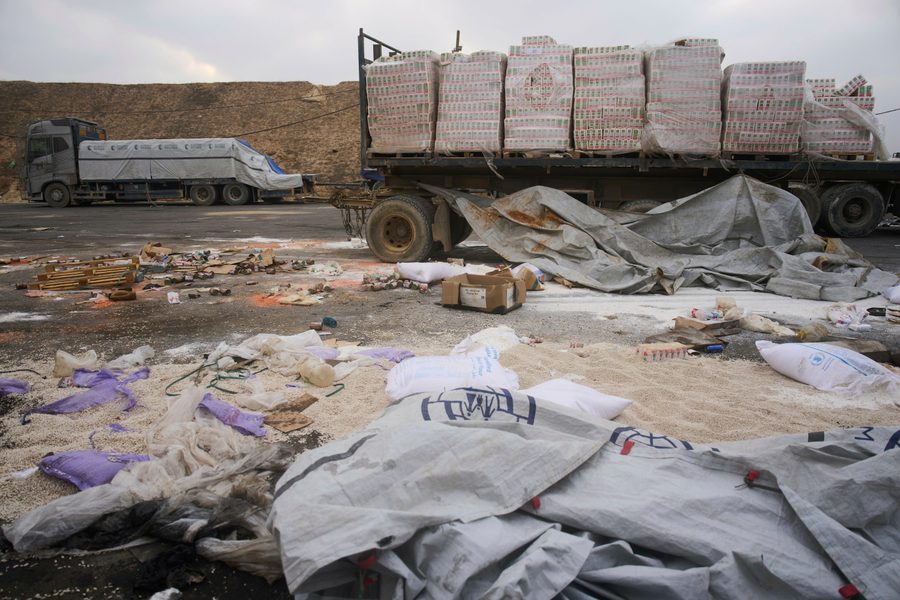
Damaged humanitarian aid trucks park next to the Gaza border crossing in southern Israel on August 13th.
Last month, the United Jewish Appeal–Federation of Jewish Philanthropies of New York (UJA) announced that it had donated $1 million to the Israeli humanitarian organization IsraAID to assist relief efforts in Gaza. In a public statement on August 8th, the major philanthropic group’s CEO Eric Goldstein explained that in light of the “desperate conditions” facing civilians in Gaza, the federation had decided to help fund IsraAID in order to provide food, medicine, and water to displaced Palestinian families. Goldstein reassured his constituents that IsraAID has “built deep working relationships with the IDF unit responsible for aid in Gaza.”
The UJA donation arrived amid increasing Jewish communal criticism of starvation in Gaza, with the Reform movement declaring on July 27th that “denying basic humanitarian aid crosses a moral line,” and over 1,000 rabbis signing a July 24th letter denouncing Israel’s “use and threat of starvation as a weapon of war.” The grant marked a clear shift for groups like UJA that have mostly focused on supporting Israeli civilians and soldiers since October 7th, 2023, with UJA sending over $300 million to the country in the past two years. The gift also highlighted a relatively new endeavor for IsraAID itself, an independent nonprofit which was founded in 2001 and is mostly funded by private donors and foundations, though it has worked with the Israeli foreign ministry to provide relief in particular international contexts. Historically, the group has focused on distributing aid in disaster and war zones outside of the Middle East. Following the October 7th attacks, IsraAID began to work with affected communities within Israel, and then moved to begin providing aid in Gaza in spring 2024.
IsraAID says that it has provided aid to 100,000 Palestinians in Gaza, and that it hopes to increase its work in the Strip. But it has not provided many details about how it carries out this work. Unlike most other aid groups, IsraAID does not have its own staff working directly inside Gaza. Instead, it says it works with other organizations that are vetted and trusted by the Israeli military, but does not name them due to security concerns. “We cannot provide any details about our partners in Gaza for their safety and the safety of the communities we work with,” the group said in a statement. This secrecy, however, has raised concerns among other humanitarian groups. In interviews with Jewish Currents, numerous scholars, human rights advocates, and humanitarian workers affiliated with different aid organizations working in Gaza—all of whom requested anonymity due to concerns of Israeli government retaliation or because they did not have authorization to speak publicly on behalf of their organizations—described having qualms about working with the group due to its lack of transparency and lack of involvement in advocacy for Palestinians. Israel’s “long-term plans” in Gaza include “ethnic cleansing and control that deny Palestinians their right to self-determination,” said one aid worker based in Amman. “History shows that humanitarian actors can, consciously or not, become part of such plans under the guise of ‘helping,’” they explained, citing Russian charities that took Ukrainian children to Russia allegedly to provide them respite from a war zone, only for Russia to refuse to release the children back to Ukraine. “This is why transparency about IsraAID’s funding, governance, strategy, and partnerships is essential to ensure its work is genuinely humanitarian,” the staffer said.
Fears about bad actors are especially acute in the aid community given the notorious activities of the Gaza Humanitarian Foundation (GHF), the nonprofit organization that the US and Israel helped create to distribute aid but which has undermined the UN’s activities in Gaza and whose sites have become places of mass killings at the hands of Israeli soldiers. IsraAID says that it has no connection to GHF and that its approach to aid distribution mirrors that of other established humanitarian groups. Still, unlike some other aid groups, it has been reticent in criticizing Israeli aid policy, which has made it an apt partner for staunchly pro-Israel American organizations now pivoting to sending aid to Gaza. According to Rebecca Vilkomerson, the co-director of Funding Freedom, a group seeking to organize philanthropic support for Palestine, UJA is attempting to respond to a “shift in the mainstream Jewish community” towards increased concern for Palestinians experiencing starvation—without compromising its existing political alignments. “It’s not surprising that [UJA] is going to an Israeli organization, in order to not alienate their constituency, including their donors,” she said. “By focusing on famine and starvation, you can turn it into a humanitarian crisis that doesn’t have a politics behind it, in a way that sanitizes the fact that Israel is starving people in Gaza.”
The prominent American Jewish donation to IsraAID’s Gaza work comes two years into an escalating humanitarian crisis. After the Hamas-led attacks of October 7th, Israel implemented a “complete siege” of Gaza, blocking the entry of all electricity, food, and fuel. Biden administration officials pressured Israel to allow in some amount of aid, arguing that doing so would, in addition to fulfilling a human rights obligation, allow Israel to maintain international support while carrying out its bombardment of Gaza. Following a visit by then-President Biden to Israel on October 18th, Israel agreed to let in a trickle of aid trucks, and under additional US pressure and advocates’ warnings of potential famine, gradually opened more crossings into Gaza for aid in December 2023 and again in April 2024. The UN oversaw the entry of this aid—from groups like Anera, the Middle East Children’s Alliance, and Mercy Corps—and eventually coordinated supplies to flow to 400 distribution sites throughout Gaza until March 2025, when Israel broke a two-month ceasefire and again blocked aid. But throughout this time, Israel imposed a thicket of restrictions on what was allowed in—often blocking or delaying trucks filled with food—which prevented humanitarian groups from bringing in enough supplies to meet Palestinians’ needs. And the Israeli army frequently killed humanitarian aid workers; in 2024, Israeli operations killed 181 people working for such groups, according to the UN.
Perhaps the most prominent attack against aid workers occurred on April 1st, 2024, when Israeli drones killed seven workers who were part of a convoy of the World Central Kitchen, a group which distributes food to Gazans. According to Yotam Polizer, IsraAID’s CEO, it was this drone strike that prompted IsraAID to begin work in Gaza for the first time. “I lost three people that I used to work with in Ukraine and in Puerto Rico. That was the moment for us that we decided to get involved,” Polizer said in a September 4th webinar with the group Democratic Majority For Israel (DMFI). Polizer saw his organization’s new work in Gaza as consistent with the group’s previous humanitarian missions in other countries: “The vision behind IsraAID was to be the humanitarian wing of the startup nation,” Polizer said on the webinar.
Following the drone attack on World Central Kitchen, Polizer said that IsraAID began “working quietly” with eight vetted organizations in Gaza. According to other aid workers, IsraAID has also approached humanitarian groups to pitch their services as an entity that has access to the Coordinator of Government Activities in the Territories (COGAT)—the Israeli military branch that coordinates the entry of humanitarian aid— saying that it could facilitate the entry of aid that would otherwise be held up by the military. However, at least some of those groups have rejected their offer. “Our aid was getting blocked, and they were saying, ‘We’ve got good connections with the Israelis. We could basically enter the goods for you,’” one aid worker based in the occupied Palestinian territories told Jewish Currents. “We said no, because we’d never heard of them. They’d never operated in Gaza. They were just an unknown entity.” IsraAID says that in addition to bringing in food to Gaza, it also supplies medicine; provides funding and technical assistance for a team in Gaza that provides clean drinking water; and funds the travel of foreign doctors entering Gaza to provide medical assistance. IsraAID says it played a particularly significant role during the January–March ceasefire in Gaza. “Two hours after the deal was signed, I got a call from a top commander in the IDF, [suggesting] that we coordinate with them and the humanitarian community,” Polizer said on a recent podcast episode. “He said, ‘We need your help to bring [in] the humanitarian community again.’”
IsraAID is not unique among aid groups in coordinating with the Israeli military—a required step in getting goods into Gaza, as Israel controls all entry and exit points. Organizations also coordinate in order to try and reduce the possibility of aid workers being bombed or shot at by Israeli forces. “Every humanitarian organization delivering aid to Gaza coordinates with Israeli authorities, without exception,” IsraAID said in a statement, an assessment that employees of other aid groups confirmed in interviews. IsraAID also told Jewish Currents that it participates in the United Nations-led “cluster” aid system in Gaza, in which the UN and other humanitarian groups form aid coalitions with different focuses—such as water and health—and coordinate to improve aid delivery.
But that system’s ability to operate in full has been short-lived. On March 2nd, in the midst of the ceasefire, Israel again cut off all aid entry. The humanitarian situation worsened further after Israel broke the ceasefire on March 18th and resumed its bombardment of Gaza. In May, Israel and the US decided to create a new aid system to bypass the UN. Israel has long attacked the UN over its defense of Palestinian human rights, and Israeli officials have also repeatedly claimed that Hamas steals aid from the agency, though anonymous Israeli military officials and an internal USAID analysis have disputed those claims. Jeremy Wildeman, a scholar who has written about the politics of delivering aid to occupied Palestine, said the UN has helped Palestinians “retain control over their land through delivering aid and creating quasi-government institutions like UNRWA that promote their rights and help sustain them to remain there.” Israel, however, has long sought to undermine Palestinian sovereignty through eroding the UN, said Wildeman.
As part of that goal, the US and Israel supported the creation of the GHF, which set up four sites where armed American contractors distributed food to Palestinians, who had to walk long distances and cross Israeli military lines to reach them. On numerous occasions, Israeli troops and American contractors opened fire on Palestinians waiting for aid, killing over 850 people near GHF sites in about two months. Meanwhile, Israel blocked the entry of UN aid until late July, when it announced a daily pause on military operations in some parts of Gaza to assist aid convoys in moving into and around the Strip. However, the UN has continued to report that aid delivery is impacted by “ongoing delays, bottlenecks at holding points, and interference in the loading process.” On August 22nd, the Integrated Food Security Phase Classification—the world’s hunger monitor—declared that parts of Gaza are officially undergoing famine, and that it would soon spread to other parts of the coastal enclave. Still, on August 30th, Israel said it would halt or slow humanitarian aid into northern Gaza as it carries out the forcible evacuation of Palestinians in Gaza City, which the military invaded with a new round of ground troops on September 16th. In a September 11th report, the UN said that over 46% of planned humanitarian deliveries since September 3rd have been blocked or impeded.
Despite the continued blockage of UN aid, IsraAID’s Polizer has praised the Israeli government’s decisions, saying on a September 3rd webinar with a Los Angeles synagogue that Israeli Prime Minister Benjamin Netanyahu had decided to “flood Gaza with aid,” and that “what we’re seeing now is already a much better situation.” In public comments, Polizer has also shied away from criticizing GHF. While he has made it clear that his group is “not part of the GHF mechanism,” he has also said that he believes that “we need” the GHF and that GHF’s “idea to separate Hamas from the civilian population and to deliver aid directly to the people” was “very important and made a lot of sense.” In a statement provided to Jewish Currents, IsraAID described itself as “apolitical” and “committed to the principle of neutrality.” “Our only goal is to ensure we can support as many civilians as possible with urgent aid in the face of a devastating humanitarian crisis,” the group wrote. “To do that, we need all hands on deck.” Their statement stressed their work with “the UN and dozens of international and Palestinian partners,” and insisted that “any suggestion of political motives is not only unfounded but counterproductive to our shared goal of ensuring Gazans receive the aid they need.” In an interview last month, Polizer said that his organization has taken an approach of “extreme pragmatism,” in which “we work with everyone who will work with us . . . including the [Israeli] government, including the IDF.”
But some experts criticized the group’s strategy of praising an army and government that strategically lets in some aid while otherwise allowing starvation. “At the end of the day, it’s not about who has access to the security establishment. It’s not about convincing somebody to let a certain truck through,” one human rights advocate with knowledge of the humanitarian aid sector explained. The only path forward, they argued, was to “pressure the government into changing” its “policy of starvation and vengeance. IsraAID thinks that they can get things done by being more ‘pragmatic’ but really, they’re only tinkering at the edges of the abyss.”
It is perhaps this very quality that has allowed IsraAID to position itself as a trustworthy partner for Jewish groups looking to respond to the mounting outcry over the starvation of civilians in Gaza—without having to question the Israeli military campaign. Indeed, some of the groups that have embraced IsraAID’s work in Gaza have also opposed attempts to pressure the Israeli military through limiting offensive weapons or imposing International Criminal Court sanctions. In addition to the UJA, such groups include DMFI, which held the webinar with IsraAID, and the American Jewish Committee, which hosted IsraAID staff members as keynote speakers at the May event where two Israeli embassy workers were shot and killed. Indeed, in an Instagram post defending its donation to IsraAID from right-wing criticism, the UJA cast its donation to IsraAID as “completely aligned with Israel’s strategy,” writing that, “in the same way the government of Israel funds the Gaza Humanitarian Foundation (GHF) to manage and monitor aid, it has made the strategic decision—through a dedicated IDF unit—to facilitate and scale the distribution of carefully controlled aid into Gaza.” The UJA-Federation added that “providing humanitarian aid in a responsible way is not a side project; it’s part of Israel’s military and diplomatic strategy to sustain international support while denying Hamas’s control of aid flows.”
For critics in the aid sphere, this approach is the exact reason to be wary of IsraAID. Mandy Turner, a senior researcher with the group Security in Context, said the language in the UJA post reflects a “counterinsurgency strategy,” in which Israeli military might is combined with humanitarian aid in an effort to “win the hearts and minds of people.” Typically, such a strategy is aimed at winning over the population under occupation, Turner said. But in the case of Gaza, the audience Israel is interested in appealing to is the international community. Israel “needs to show to the outside world that it is helping Palestinians,” said Turner. According to one international aid worker based in Jerusalem, the Israeli group’s work will remain mostly window dressing without a more political approach: “IsraAID is constantly trying to separate issues of humanitarianism from what caused them in the first place. But if you’re not actually going after the root causes, then the humanitarian issue itself will never actually be alleviated,” they said. “People are not starving due to lack of resources. They’re being starved intentionally. ”

I’m Peter Beinart, editor-at-large of Jewish Currents. Before you go, I need to ask something of you.
In recent years, I’ve watched as mainstream Jewish institutions and media have chosen ethnonationalism over liberal democracy and mass slaughter over the pursuit of a just peace. Jewish Currents offers something different. It’s a magazine built on intellectual curiosity and respect for the dignity of all people.
But a project like this doesn’t sustain itself, and we can’t do it without your help. If you share my belief in the importance of this mission, please consider making a donation—or even better, a recurring one. We need you with us.