A New Playbook for Democratic Critics of Israel
Zohran Mamdani’s primary victory shows pro-Palestine candidates how to win without abandoning their values.
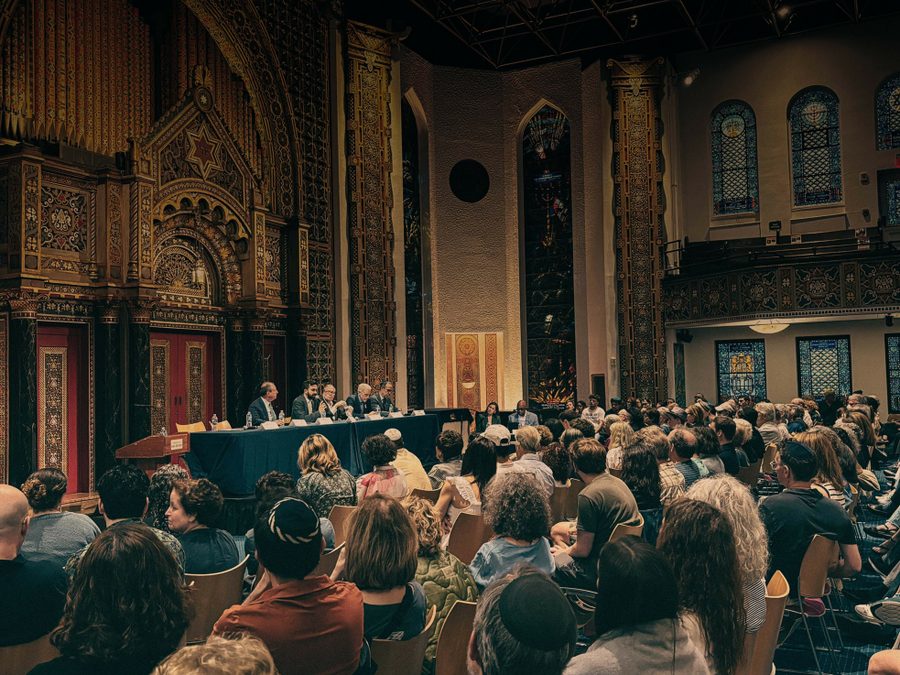
Zohran Mamdani speaking at B’nai Jeshurun, a synagogue on Manhattan’s Upper West Side, at a candidate forum on June 8th, 2025.
In early June, B’nai Jeshurun, a prominent synagogue on Manhattan’s Upper West Side, hosted several Democratic candidates for mayor of New York. Early in the forum, former hedge fund manager Whitney Tilson attacked his democratic socialist opponent, Zohran Mamdani, for accusing Israel of committing genocide in the Gaza Strip. When the moderators gave Mamdani the chance to respond, he cited Noy Katsman, an Israeli whose brother Hayim was killed on October 7th, but who still insisted, in Mamdani’s words, that “we must never give up on the conviction that all life, Israeli and Palestinian, Jewish and Arab, is equally precious.” Mamdani went on to cite two Israeli historians, Amos Goldberg and Daniel Blatman, who have endorsed the genocide charge, as well as former Israeli prime minister Ehud Olmert, who Mamdani said has called Israel’s assault “limitless, indiscriminate, cruel, and criminal.”
Tilson tried a new line of attack. He accused Mandani of ignoring the suffering in Ukraine, Darfur, and elsewhere and having an “obsession [with] the sole Jewish state.” Once again, Mamdani was ready. He said his criticism of Israel “comes from a belief” in “universal values of human rights.” He countered that he has praised Basil Seggos, a former New York State Commissioner of Environmental Conservation, who has volunteered in Ukraine and condemned Russian war crimes. And he added that, as an Indian American, he has been “very critical of the Indian government in betraying its constitutional commitment to a secular republic with dignity for all.” What links all these cases, Mamdani explained, “is the violation of a universal principle. That is what drives me.”
Tilson’s attacks drew cheers. But so did Mamdani’s retorts. Despite speaking in a mainstream synagogue, in a part of New York generally deemed more pro-Israel than the Brooklyn and Queens neighborhoods that form his political base, Mamdani emerged from the exchange unscathed. And he didn’t succeed only in that forum. He garnered substantial Jewish support in the city as a whole. A poll taken in May showed Mamdani running second among Jewish voters, with 20% to Andrew Cuomo’s 31%. And given the state assemblyman’s late surge, and his cross-endorsement with Jewish comptroller Brad Lander—who, according to the same poll, garnered support from 18% of Jewish voters—it’s likely that Mamdani’s final share of the Jewish vote was even higher.
Mamdani’s victory in the Democratic primary last week contains a crucial message for Democrats who want to challenge unconditional US support for Israel but fear that doing so constitutes political suicide: It is possible to win without abandoning your values. It just requires strategic ingenuity. Indeed, Mamdani has written a new playbook for how to avoid the rhetorical traps set by Israel’s defenders. He did not allow pundits to exceptionalize Israel, but instead returned relentlessly to universal principles of justice and equality. Drawing on his deep knowledge of the subject, he has offered an example of how to speak in terms that at least some Jewish voters—and Democratic voters more generally—can hear.
As a Muslim, Mamdani faced particularly harsh—and sometimes racist—attacks from pro-Israel opponents and activists. And he did appear to moderate his message as the campaign went on. In one debate, he affirmed Israel’s “right to exist”—albeit as a “state with equal rights,” as opposed to a “Jewish state”—and dodged questions about whether New York City would divest from the country. Some pro-Palestine activists denounced such concessions. Still, Mamdani continued to embrace positions that go well beyond those of most progressive national Democrats. While both Alexandria Ocasio-Cortez and Bernie Sanders defend Americans’ right to boycott Israel, for instance, neither has endorsed the BDS movement itself. On the campaign trail, Mamdani did endorse it, repeatedly, even as he declined to explain how he would implement divestment as mayor.
His views sparked widespread condemnation. But that criticism proved less effective because Mamdani responded in ways that Democrats generally don’t. Again and again, when his critics sought to exceptionalize Israel, Mamdani invoked universal principles. Asked on Fox News why he had protested Israel’s assault on Gaza a week after October 7th, he replied, “At the core of my position about Israel, Palestine, any place in the world, is consistency, and international law and human rights because I believe that justice, freedom, safety those are things that should be applied to all people.” Asked on Good Day New York why he wouldn’t affirm Israel’s “right to exist” specifically as a Jewish state, he answered, “I’m not comfortable supporting any state that has a hierarchy of citizenship on the basis of religion or anything else. I think that in the way that we have in this country, equality should be enshrined in every country in the world.” Asked at B’nai Jeshurun whether he’d enforce the International Criminal Court’s warrant for the arrest of Israeli Prime Minister Netanyahu, Mamdani said, “Whether we’re speaking about Vladimir Putin or Netanyahu, I think that this should be a city in compliance with international law.” By invoking values that most of his interrogators claim to support, he made it clear that he doesn’t want to treat Israel differently from other countries; they do.
Mamdani also thwarted his antagonists by displaying a firmer grasp of the subject of Israel and Palestine than theirs. In mainstream American politics and media, certain buzzwords dominate discourse about the Jewish state. Most politicians and pundits, for instance, angrily reject charges that Israel is committing genocide. But instead of abandoning the phrase, Mamdani defended it, partially by citing Israeli academics. He also repeatedly invoked former Israeli prime minister Ehud Olmert’s harsh condemnation of Israel’s assault on Gaza. The tactic worked because few of his critics knew enough to explain why Mamdani was wrong.
There were moments when this depth of knowledge backfired. Mamdani’s attempt to bring nuance to the phrase “globalize the intifada” allowed critics to accuse him of whitewashing violence against Israelis, and perhaps even diaspora Jews. He would have been wiser to avoid engaging with the phrase, and to simply restate his commitment to the safety of everyone between the river and the sea. Meanwhile, his chosen tactic for justifying his views—routing them through Israeli sources—acquiesces to the racism that pervades American discourse, in which Israeli critics of Israel are considered more credible than Palestinian ones, even when they’re leveling charges that Palestinians leveled first. In a fairer political environment, Mamdani wouldn’t have to adhere to this discriminatory double standard. But when addressing Jewish voters—few of whom would dare call an Israeli academic or former politician antisemitic—the tactic appears to have worked.
One lesson of Mamdani’s success is that while progressive candidates may resent having to become experts on Israel and Palestine when they are motivated primarily by issues closer to home, knowing the issue well can offer a form of political protection, especially when confronting pro-Israel journalists and politicians who know little about the subject beyond the same tired talking points. In 2018, after Ocasio-Cortez first burst onto the political scene, she got into political trouble by referring to Israel’s “occupation of Palestine” without making it clear whether she meant the West Bank and Gaza Strip, or all of the land between the river and the sea. Mamdani, who co-founded his college’s branch of Students for Justice in Palestine, entered the race with a deeper background, and thus largely avoided such mistakes.
Mamdani also adeptly tackled the subject of antisemitism. Given that politicians often express greater outrage at discrimination against Jews than discrimination against Muslims, let alone Palestinians, progressives can be tempted to answer questions about antisemitism by simply condemning racism writ large, as Jeremy Corbyn sometimes did as head of Britain’s Labour Party—a choice that reinforces critics’ charge that progressives don’t care about Jews’ particular fears. Mamdani did not fall into this vicious cycle. He shrewdly spoke about antisemitism as a problem in its own right rather than a mere subset of the larger problem of bigotry. He explicitly addressed the anxieties of Jewish constituents, repeatedly citing conversations with Jews who fear antisemitic attacks and pledging to dramatically increase funding to fight hate crimes. “Antisemitism,” he told Stephen Colbert, “is not simply something that we should talk about. It’s something we should tackle.” He may never win over voters who equate anti-Zionism with Jew-hatred, but by speaking specifically and concretely about antisemitic violence, he contrasted himself with critics who are more concerned with displaying their pro-Israel bona fides than actually keeping Jewish New Yorkers safe.
Not all Democrats possess Mamdani’s political gifts, and few will face opponents as tainted as Andrew Cuomo and Eric Adams. Nonetheless, Mamdani has now offered his party a manual for how to seek political office as an unapologetic defender of Palestinian freedom and prevail. With any luck, at least one Democratic candidate will consult it when seeking the presidential nomination in 2028.

I’m Peter Beinart, editor-at-large of Jewish Currents. Before you go, I need to ask something of you.
In recent years, I’ve watched as mainstream Jewish institutions and media have chosen ethnonationalism over liberal democracy and mass slaughter over the pursuit of a just peace. Jewish Currents offers something different. It’s a magazine built on intellectual curiosity and respect for the dignity of all people.
But a project like this doesn’t sustain itself, and we can’t do it without your help. If you share my belief in the importance of this mission, please consider making a donation—or even better, a recurring one. We need you with us.

Peter Beinart is the editor-at-large of Jewish Currents. He is the author of The Beinart Notebook on Substack.