A Federal Security Grant Program Popular with Jewish Organizations May Now Require Beneficiaries to Cooperate with ICE
Dozens of Jewish organizations signed a letter denouncing requirements that Nonprofit Security grantees work with immigration authorities and refrain from boycotting Israel.
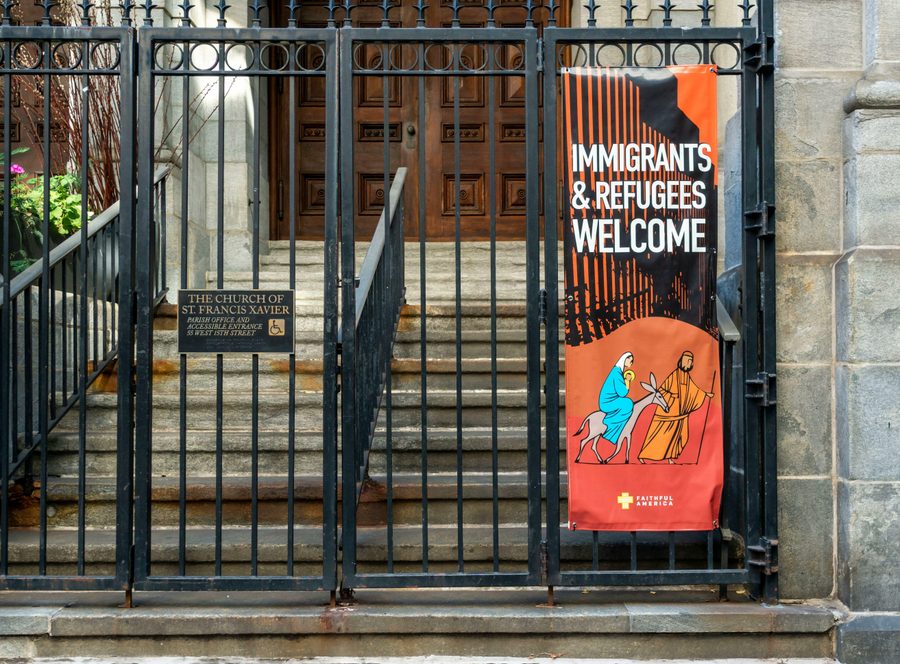
A New York City Church displays a sign welcoming immigrants and refugees.
Synagogues, churches, mosques, schools, and other nonprofits that receive money from a popular Department of Homeland Security (DHS) grants program for increased security may now be required to cooperate with federal immigration enforcement, as well as prohibited from engaging in “discriminatory” boycotts and programs that “advance or promote” diversity, equity, and inclusion (DEI), according to stipulations for grantees published by DHS in April. The Trump administration’s new conditions for the Nonprofit Security Grants Program (NSGP)—which is set to disperse $274.5 million in 2025 to institutions facing security threats to pay for enhancements such as cameras, fences, bulletproof glass, trainings, and guards—could create a bind for many liberal Jewish organizations around the country, which have historically benefited from the lion’s share of the program’s funding, but which also oppose the Trump administration’s Immigration and Customs Enforcement (ICE) offensive and anti-DEI crusade. Already, in response to these new conditions, more than 50 clergy and dozens of progressive Jewish groups, alongside a handful of synagogues and other faith groups, are now pledging not to seek the security grants until the requirements are repealed, according to an open letter published August 22nd. However, few of the major Jewish organizations that have lobbied for increased congressional funding to the NSGP pool have spoken publicly on the changing guidelines.
The new DHS requirements that grantees must follow or risk the termination of their award apparently apply to programs across DHS’s Federal Emergency Management Agency (FEMA) programs, including the NSGP as well as state funds for disaster relief. After the guidelines were initially published, the terms conditioning grants on barring DEI “ideology” and on grantees’ “coordination and cooperation” with immigration officials—including providing access to individuals sought by ICE and refraining from “harboring, concealing, or shielding” undocumented immigrants—were legally challenged by attorney generals of 20 states in an ongoing federal suit. (The administration reportedly walked back on plans to tie FEMA relief to collaboration with immigration enforcement in a June court filing in the case.) The restriction on grantees engaging in “discriminatory prohibited boycott,” which DHS defined as cutting or limiting business ties “specifically with Israeli companies,” received particular pushback, including from prominent right-wing supporters of the administration. While concerns this anti-boycott clause might preclude the handful of municipalities that have voted to cut ties with Israel from receiving disaster relief were sidestepped when DHS quietly edited out the reference to Israel in a new document uploaded in early August, the vague language prohibiting “discriminatory” boycott has remained. Lara Friedman, president of the Foundation for Middle East Peace, which has tracked legislation targeting the Boycott, Divestment, and Sanctions (BDS) movement, argued that DHS is “just playing with language on the margins,” and while it “can’t attack [BDS] frontally, the intent is the same.”
The impacts of these DHS requirements on the NSGP received little attention until the Council for American Islamic Relations (CAIR), the country’s largest Muslim civil rights group, alerted religious institutions and other nonprofits earlier this month. In an August 7th statement, the group called DHS’s updated terms “dangerous and unconstitutional” and warned that imposing them on NSGP grantees would represent “an unprecedented threat to religious freedom, free speech, and the moral independence of civil society groups and houses of worship.” CAIR’s government affairs director Robert McCaw told Jewish Currents that unusual, “really sloppy” mid-grant-cycle revisions to the grant guidelines have made it difficult to clarify the consequences for NSGP beneficiaries. Multiple conflicting versions of FEMA’s notice for the NSGP application period have been live online—an earlier document posted to FEMA’s website granted specific exceptions to the immigration conditions for grantees, as did another version posted on the government’s main grants platform, grants.gov. But the August 13th grant announcement, once again on FEMA’s website, said the conditions in fact “may be material to the Department of Homeland Security’s decision to make this grant award.” (DHS did not reply to requests for clarification on which document applies.) McCaw said that if the new federal expectations do apply, they would “essentially deputize any house of worship into Trump’s ICE programs if they receive funds through the DHS.” Because the terms specify that any action impeding DHS immigration enforcement is a violation, institutions would be barred from notifying their community when they are made aware of ICE agents in the area. Acceptance of the conditions, McCaw said, could serve to “scare congregants away from houses of worship who are fearful because of their immigration status.” The unclear prohibition on boycott could likewise “chill the free speech and political participation of communities organizing around human rights issues.”
Though McCaw said the exact consequences of the unprecedented rules remain opaque—“What would DHS do? Pull out fencing and remove security cameras because a Muslim community dared to boycott Israel’s human rights violations?”—he speculated that organizations that do not comply with DHS’s rules may be denied funding, not receive distributions for which they were approved, or have their grants “clawed back.” In fact, this week conservative outlets reported that the federal government terminated $8 million in grants, including some via the NSGP, to Muslim organizations after the far-right think tank Middle East Forum alleged links to “terror.” (DHS has not yet publicly confirmed the reports.) In light of its concerns, CAIR advised in its statement that “nonprofits and houses of worship should refrain from applying for these grants until DHS restores prior terms that do not contain these coercive requirements.”
Friday’s letter, which cited CAIR’s objections, was organized by the Community Safety Campaign, a group that advocates for Jewish communities to find alternatives to policing and cooperation with national security programs. The institutional signatories included mostly progressive advocacy groups such as Bend the Arc alongside a handful of synagogues—including Reform, Reconstructionist, Conservative, and unaffiliated congregations—as well as Muslim and Christian organizations. Some, the letter said, had been NSGP recipients in the past but now “are unified in refusing to capitulate to conditions that would require us to sacrifice the safety and dignity of our community members, neighbors, and partners in order to receive funding.” The letter called for the grant program to be moved out of DHS and housed elsewhere in the government.
While the NSGP enjoys wide bipartisan support from lawmakers looking to demonstrate their commitment to protecting houses of worship and particularly to fighting antisemitism—Congress has over time increased the program’s budget from $25 million at its launch in 2005 to nearly $275 million at present—it has occasionally also attracted controversy. A 2011 Forward investigation into the NSGP found that Jewish communities had been able to leverage political power to mold the program and enjoy the majority of its distributions, leading even major Jewish institutions like the Anti-Defamation League (ADL), now a staunch supporter of the NSGP, to raise concerns about the separation of church and state. In 2021, when FEMA encouraged grant recipients to share “information and intelligence” with local and federal law enforcement, CAIR briefly recommended Muslim organizations hold off from applying to the program out of concern this could facilitate increased government surveillance on Muslims, as Jewish Currents reported at the time. (Ultimately, in response to CAIR’s pressure, the Biden administration clarified that program funding would not require intelligence sharing with law enforcement.) Last January, another letter by the Community Safety Campaign called on elected officials to reject proposed additional allocations to the program because of its location in DHS, claiming “it provides an insidious cover for the systemic violence caused by the Department of Homeland Security as well as other local, state and federal law enforcement agencies, at the US-Mexico border, in neighborhoods and our houses of worship.”
In the past, the NSGP has “been seen as kind of a benign program” that most people outside of institutions’ administrative staff don’t even know about, said Nadav David, an organizer with the Community Safety Campaign. But the new DHS guidelines have politicized the program to require endorsement of Trump administration priorities, “several of which many liberal and center-left communities are opposed to,” he said. There are a number of Jewish institutions and leaders around the country who have historically sought NSGP grant funding but have also denounced ICE raids or adopted anti-racism programming. And the new requirements are attracting protest from voices who have not necessarily endorsed the Community Safety Campaign’s broader condemnation of the NSGP or the group’s commitment to defending pro-Palestine advocacy. Among the individual clergy who signed the letter supporting abstention from the program was Suzanne Singer, former rabbi of Temple Beth El, a Reform synagogue in Riverside, California, that received a $200,000 NSGP grant through the state, used for building fences and installing CCTV cameras, before her retirement in 2023. After seeing neo-Nazis demonstrate in front of Beth El in 2009, she regards government security aid as a useful protection against violence, she told Jewish Currents. But now, she signed (representing herself and not her former institution), because she believes “a place of worship should be a safe place, not a place where people are worried they’ll be picked up and sent to some horrible detention center or to South Sudan. I don’t see why the security of synagogues should be tied to our willingness to let that happen.”
In response to a Jewish Currents inquiry about criticisms of the new federal conditions, DHS Assistant Secretary Tricia McLaughlin defended the guidelines in an email, writing that “the NSGP is being used as it was always intended—to protect nonprofits from acts of terror or extremism. These grants are allocated according to clear and existing guidelines. Complying with the laws set out by the Constitution and Congress is actually not an infringement on the First Amendment.” She also reiterated the department’s previous statement, after its removal of the language specific to boycotting Israel, asserting that no grant postings expressly include any requirement tied to Israel and that “FEMA grants remain governed by existing law and policy and not political litmus tests.” However, “DHS will enforce all anti-discrimination laws and policies, including as it relates to the BDS movement, which is expressly grounded in antisemitism. Those who engage in racial discrimination should not receive a single dollar of federal funding.” According to McCaw, it’s clear that the anti-boycott clause, despite the mixed messaging, “has the same impact and effect: participating in a boycott of Israel based on its human rights violations will absolutely, according to DHS, disqualify you from receiving federal funds.” (DHS did not respond to request for clarification on whether support for BDS would be grounds for termination of NSGP funding.) As a result, this stipulation is another way for the administration to enforce its intent to “punish anyone who has the decency to speak out against the genocide in Palestine,” according to Fatema Ahmad, executive director of Muslim Justice League, which has organized against counterterrorism programs that disproportionately impact Muslim communities.
Several of the national Jewish organizations, including the Jewish Federations of North America (JFNA) and Anti-Defamation League (ADL), that have long led lobbying to grow the NSGP have supported the administration’s moves to amp up the repression of pro-Palestine advocacy and have remained silent on Trump’s anti-immigrant crackdown. One leading advocate for expanding the NSGP is the Secure Community Network (SCN), which provides security support for Jewish institutions in partnership with law enforcement, and whose CEO, Michael Masters, called for the deportation of noncitizens he claimed “materially support” terrorism—including participants in student protests—an accusation pro-Israel organizations have frequently leveled at campus pro-Palestine groups. In an August 11th webinar in partnership with the JFNA about applying for the NSGP, Masters characterized the program as crucial to respond to “an alarming rise in threats, vandalism, harassment, and violence” against Jews since October 7th, 2023, which he traced to “designated foreign terrorist organizations and of course the Islamic Republic of Iran and its proxies; as an example of such threats, he mentioned “the trauma of a young student who is confronted by masked pro-terror organization agitators barring their entry from a classroom.” During the webinar, JFNA senior manager Rachel Dembo told those asking in the chat about the new immigration and DEI conditions that, in a recent meeting with DHS officials, “they had again reassured us that they are here to support the faith-based community in upholding and promoting their religious freedom.” No other mention was made of the controversial terms. The SCN, JFNA, and Dembo did not respond to requests for comment about their positions on the DHS requirements by press time, though JFNA told the Connecticut Mirror that it would continue to “strongly encourage” nonprofits to apply for funding and that the organization was “working closely with DHS” to support applicants. The Jewish Council for Public Affairs, an NSGP proponent and frequent Trump critic, and the ADL also did not respond to requests for comment.
Mainstream Jewish organizations have recently confronted the administration over delays in administering the NSGP. In July, 11 organizations, including the ADL, American Jewish Committee, and the JCPA, joined other faith groups in sending a letter to Secretary of Homeland Security Kristi Noem pressing DHS to post the 2025 application for NSGP, which at that point was two months delayed. More recently, on August 7th, over 70 congresspeople urged Noem to release information about NSGP funds awarded from last year that were supposed to be dispersed in June, attributing delays to a decision by the administration “to pause the drawdown of funding in order to conduct an additional review of all grant allocations.” (DHS finally announced the June awardees on August 21st.) In response to an August 19th Jewish Currents inquiry, Democratic Representative Josh Gottheimer, an organizer of the bipartisan letter, did not address specific questions about ICE collaboration or DEI programming but said “the Trump Administration should not be adding more red tape that will only delay critical dollars, especially when Jewish communities face such urgent security needs.”
Organizers of Friday’s letter, by contrast, argued that the DHS requirements for cooperation with ICE and restrictions on DEI and boycott lay bare the dangers of materially linking communities’ security to federal law enforcement. The NSGP since its inception has been “one of the ways in which Jewish communities are brought into complicity with” counterterrorism and policing programs that disproportionately target Muslim communities, Community Safety Campaign’s David said. Muslim Justice League director Ahmad was glad to see CAIR advise other organizations against applying, hoping the move “encourages more institutions to question why we were ever working with these agencies.”
Update, 9/8/2025: Shortly after this article was published, on August 26th, the JCPA said it had sent a letter to DHS requesting it remove from the NSGP application “vague and concerning language” about these conditions that could discourage groups from seeking funding. Meanwhile, JFNA, SCN, the ADL, and others urged Jewish groups to apply for this “critical resource” in a statement published September 2nd.
This article has also been updated to clarify that DHS has released multiple contradictory versions of the guidelines for the NSGP and to note that the Trump administration walked back its intention to tie state disaster relief to immigration enforcement in a court filing.

I’m Arielle Angel, editor-at-large of Jewish Currents. Before you go, there’s something I need to ask.
We’ve seen over and over how the mainstream media falters in telling stories on our beats—whether it’s antisemitism, Israel/Palestine in American politics, Jewish identity, or the American left. At Jewish Currents we’re committed to uncompromising analysis and longform reporting on these issues and more—stories you won’t find anywhere else. In a media landscape that obscures injustice and flattens discussion, we’re changing the conversation. But we need you.
If you believe in this work, please consider making a donation—or even better, a recurring one—to ensure that we are able to keep publishing stories like this one. We can’t do it without you.

Emily Wilder is a writer and researcher based in Los Angeles.