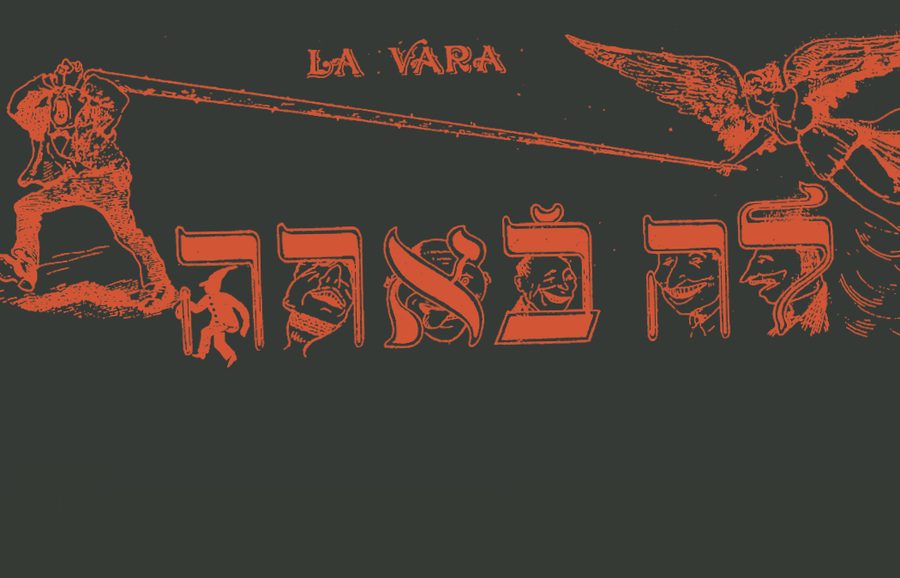
Masthead for the New York-based Ladino newspaper La Vara, 1922.
Reclaiming the Ladino Left
The early 20th century saw a flurry of left activism by Ladino-speaking Sephardic Jews in the US. Recovering their legacy can enrich the Jewish left of today.

On a summer day in 1924, Alberto Moise set up camp by the corner of Madison Avenue and East 115th Street in East Harlem to advocate for the slate of communists on the ballot that fall. New York’s main Ladino newspaper, La Vara, captured the event vividly:
It was quite a scene to see our friend Alberto Moise up on the soapbox, sweating buckets, in the middle of the street, speaking about the putrid and deceitful old parties of Republicans and Democrats and the need for every Sephardic worker, pushcart peddler, and shopkeeper to vote for the Workers Party.
Alberto Moise, who is already known as an orator whose words are as sweet as honey, made everyone’s jaws drop, and even the Yiddishim were amazed, since it was for the first time in the history of the Sepharadim in America that, in the lead-up to elections, a Sepharadi could be seen in the middle of the street speaking in the Judeo-Spanish language.
The newspaper’s pride at seeing this Jewish vernacular, Ladino (also known as Judeo-Spanish or Judezmo), deployed as a language of politics—and radical politics at that—is palpable. The editors take care to note the attention of “los Yiddishim”—Eastern European Ashkenazi Jews, often depicted as aloof or even condescending, who dominated the Jewish political scene at the time, and whose culture and lifeways have long been considered synonymous with the American Jewish experience. Yet here was the nascent Jewish social and political movement I call the “Ladino Left” coming into its own in the public sphere, embodied by Moise and the recently formed Sephardic Branch of the Workers Party (the legal organization through which the Communist movement operated from 1921 to 1929).
If Sepharadim have largely been invisibilized in American Jewish culture, Sephardic left-wing activism has been buried even deeper, hidden entirely from view. The last century has scrubbed the Ladino Left from scholarly and popular consciousness, such that from today’s vantage point, it’s almost impossible to imagine its existence. This apparent obscurity is a result not only of the shame and fear mainstream Jewish communities have felt about Jewish leftist organizing within their ranks, but also of Yiddish history’s monopoly on the story told about early 20th-century American Jewish life—and Jewish left-wing politics in particular. It also stems from the contemporary association of Sepharadim and Mizrahim globally with the right.
Indeed, Sephardic and Mizrahi Jews themselves, like Jews in general, often police the ideological boundaries of their communities. In recent years, as the left has turned to Sephardic and especially Mizrahi history as a political resource—advancing sometimes idealized narratives from centuries of coexistence and cultural exchange between Arabs and Jews—communal gatekeepers have responded by deriding leftist and anti-Zionist Sepharadim and Mizrahim as “tokens,” and claiming that left-wing politics are alien to modern Sephardic and Mizrahi culture. These arguments sometimes promote Islamophobic renderings of Jewish history in Muslim societies, emphasizing the discrimination and violence Jews faced in the period surrounding the formation of the State of Israel and arguing that antisemitism is a permanent feature of Muslim societies. At the same time, they often downplay the profound prejudice Jews from Muslim societies encountered when most fled to Israel. In a 2022 Jewish News Syndicate article attempting to undermine anti-Zionist voices, two employees of the Sephardic and Mizrahi advocacy group JIMENA admitted that “in its early days of independence, Israel sometimes failed the Mizrahim” and that “some of these issues persist today,” but insisted that “those failures pale in comparison to how Israel has helped us.” JIMENA’s 2025 National Demographic Study of Sephardic and Mizrahi Jews in the US asserts that “community members are generally socially and politically conservative,” and locates such conservatism both in domestic issues as well as “their strongly-held connections to Israel and Zionism, and their vigorous sense of belonging to the Jewish people.” (Their report notably leaves out the study of Sephardic communities of Ladino-speaking background, who largely arrived a few generations earlier than American Mizrahi communities and may skew more liberal, mirroring American Jews in general.)
To insist that Sephardic and Mizrahi histories should be understood as reflecting any single worldview or ideology is to flatten once-dynamic Jewish communities animated by a range of political perspectives, including vibrant left-wing movements.
To insist that Sephardic and Mizrahi life should be understood as reflecting any single worldview or ideology is to flatten once-dynamic Jewish societies across North Africa and the Middle East, the Balkans, and the broader Mediterranean region—communities animated by a range of political perspectives, including vibrant left-wing movements. Left politics were particularly prominent in two of the largest Jewish communities of the former Ottoman Empire: In Baghdad, where over a third of the residents were Arabic-speaking Jews, more among them affiliated with the Communist Party than the Zionist movement prior to World War II. Similarly, in Salonica, home to the largest population of Ladino-speaking Jews anywhere in the world before the Holocaust, 39% of Jews voted for the Communist Party in the 1926 Greek parliamentary elections. In the US, too, the Sephardic Jewish Brotherhood of America, the country’s largest Sephardic mutual aid and membership organization—which, although not overtly political, today embraces mainstream institutional Jewish perspectives, including on Israel—was itself an outgrowth of a Salonican organization co-founded in 1915 by the socialist Maurice Nessim. Seven of its first ten presidents were socialists—a fact conveniently overlooked in the organization’s official history. In other words, left-wing politics is hardly inherently anathema to Sephardic and Mizrahi communities, and these groups’ embrace of more conservative politics today must not be understood as inevitable.
By delving into the history of the Ladino Left, we find that only a few generations ago left-wing politics played an outsize—and perhaps even mainstream—role in the communal life of Ladino-speaking Sephardic Jews in the US. It is high time the story of this group be recognized as one of the two Jewish leftist movements operative in the US in the early 20th century, along with the much larger and better remembered Yiddish left. As the first effort to narrate this history, this essay should be considered a prolegomenon, intended to provoke further research, discussion, and debate. What lessons does this occluded world offer an American Jewish left engaged in shaping a communal vision for a future characterized by safety, solidarity, and justice? The shroud of oblivion must be removed so that the Sephardic Jewish leftist—and the Jewish left as a whole—may be reimagined anew.
The Ladino Left emerged in the Ottoman Empire at the turn of the 20th century. As a major industrial port city, Salonica (today’s Thessaloniki, Greece) became a center of labor activism and, beginning in 1909, home to the Federasion Sosialista Lavoradera, or Socialist Workers Federation, the largest workers’ movement in the eastern Mediterranean region. Although half the city’s residents—and workers—were Jews, the Federasion worked across communities in the spirit of internationalism, connecting Ladino-speaking Jews with Turkish-speaking Muslims and Greek- and Bulgarian-speaking Orthodox Christians. Under the leadership of Jewish union organizer Avraham Benaroya, the Federasion organized major strikes in the tobacco industry involving around 10,000 workers, while also contributing to cultural-political life through cafés, theaters, and newspapers. Rather than boycott the organized Jewish community, Benaroya urged socialists to run in Jewish communal elections. He also defended Ladino as the language of the Jewish worker in a moment when it was under attack by Zionists, who promoted Hebrew, and by assimilationists, who championed the state language (first Turkish and then Greek) or French.
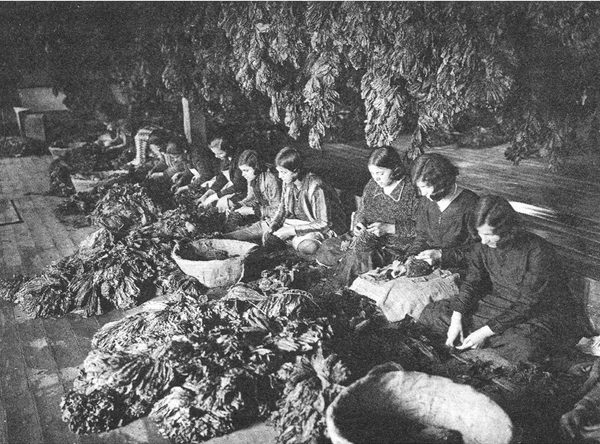
Tobacco workers in Salonica, circa early 20th century.
The shift from Ottoman to Greek rule in 1912 and 1913 injected two previously unknown currents into the political life of Salonica’s Jews: state-sponsored antisemitism and the subsequent increase in Zionist activism. In one of the few documented moments of contact between the major Ladino and Yiddish left-wing organizations at the time, the Federasion wrote in 1913 to the secular Yiddish socialist party in the Russian Empire, the Bund, asking in French for advice on how to respond to the intensifying “daily struggle between Zionists and internationalists” among Salonica’s Jews “unleashed” by the Greek conquest. When World War I engulfed Salonica, opposition to Greece entering the conflict provoked some of the Federasion’s members to flee, with the US—neutral until 1917—emerging as a primary destination.
In New York, Salonican Jews interacted with the other roughly 50,000 Sepharadim from the Ottoman Empire, whose compressed period of immigration stretched from about 1908 to 1924. These new immigrants initially eked out a living in menial jobs, while contending with widespread racism, including from established Jewish communities. An infamous report commissioned by the Jewish Federation of New York in 1926 claimed that Jews from the Ottoman Empire were “almost as alien to their [Ashkenazi] kinsmen as are the negroes to the average white Southerner.” In its coverage of the report, The Jewish Daily Forward described the newcomers as a “considerably inferior” group with “no cultural life of their own worth speaking of,” whose “habits and ways of life” more closely resembled those of “the average Turk or Syrian” than “‘normal’ Jews.” Already in 1913, the longest-running English-language Jewish newspaper in the US, The American Israelite, warned that the arrival of Ladino-speaking Jews provoked “a race problem within a race problem,” as Jews as a whole grappled with their ambiguous position vis-à-vis the American color line. Aware of broader racial tensions and disparities, La Amerika, the first major Ladino newspaper in New York, decried the “white pogromists” who subjected Black people to mass violence. Anti-Black violence also prompted La Bos del Pueblo (The Voice of the People)—a New York Ladino newspaper founded by Federasion militant Maurice Nessim—to declare that “America is not a democracy either,” obliquely comparing its “massacres” to the Armenian genocide undertaken by the Ottoman Empire. Ruing the racial and class oppression that suffused American life, Federasion veteran and prominent journalist Albert Levy infamously punned in his satirical Ladino newspaper El Kirbach Amerikano (The American Whip) that the country should not be called the United States of America (“Estados Unidos”) but rather the Rotten States of America (“Estados Pudridos”).
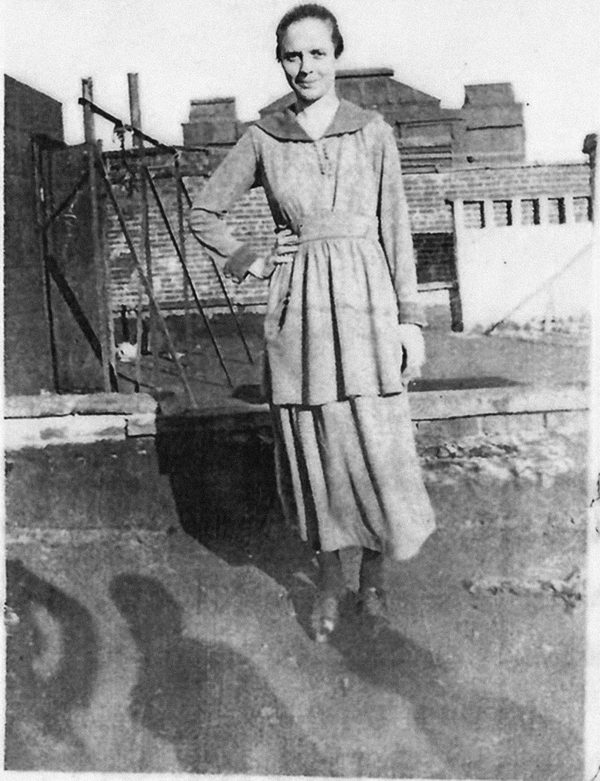
Sarah Aldorati on an East Harlem tenement rooftop, circa 1920s.
Many Ottoman Jewish immigrants worked in factories that produced cigarettes, light bulbs, batteries, and ice cream cones. (The first American Ladino novella, Amerika! Amerika!, written in 1917 by Simon Nessim, dramatized a strike orchestrated by 400 Sephardic Jews in battery factories the previous year.) Both men and women also toiled in poor conditions and for low wages in the garment industry’s kimono, bathrobe, and skirt sweatshops. Their plight became a national story in 1913, when former President Teddy Roosevelt paid women workers a visit during a strike. The New York Times identified the first woman to speak to him, 17-year-old Sarah Aldorati, as a “beautiful Spanish girl.” Roosevelt soon learned that Aldorati and about 100 other women on strike were “Turkish Jewesses” and their “Spanish” was Judeo-Spanish. He concluded that because they could speak neither English nor Yiddish they remained “peculiarly helpless under our conditions here” and “the lowest and poorest paid workers” in the industry.
The International Ladies Garment Workers Union (ILGWU) initially sought to recruit these “Spanish and Turkish” girls, as The Ladies Garment Worker described them in 1913 (notably, the heavily Yiddishist union did not readily identify them as “Jewish”) before deeming them too difficult to organize. But Ladino-speaking workers soon began organizing in their own language. During World War I, Maurice Nessim’s La Bos del Pueblo galvanized the emergent Ladino Left in New York. Moise Gadol, the older editor of the more moderate, Zionist La Amerika, the first Ladino newspaper in New York, denounced the new competition as “la bos del guerko” (the voice of the devil) for opposing Jewish nationalism and criticizing the government. In letters to the Post Office Department in Washington, DC, which determined which newspapers were suitable to be mailed and which were “subversive” enough to be censored, Gadol pled that this “dirty paper,” which aimed to “demoralize the loyalety [sic] of the good people of Spanish Jewish origin,” be shut down. Despite these denunciations, Nessim’s newspaper gained subscribers across the country, from New York to Chicago to Seattle, not only by advocating for unionization and women’s rights and opposing capitalism, nationalism, and imperialism, but also by defending the interests and public image of Sephardic Jews. When a sensational 1918 exposé in the American Weekly Jewish News defamed Sephardic Jews for not “looking” like Jews, for exhibiting “aimlessless” and “sluggishness” in their demeanor, and for being “docile and submissive because of the stagnating influence of Turkey,” Nessim repudiated these claims in a bold letter to the editor and began publishing articles focused on communal self-defense strategies in his own newspaper.
The International Ladies Garment Workers Union initially sought to recruit these “Spanish and Turkish” girls before deeming them too difficult to organize. But Ladino-speaking workers soon began organizing in their own language.
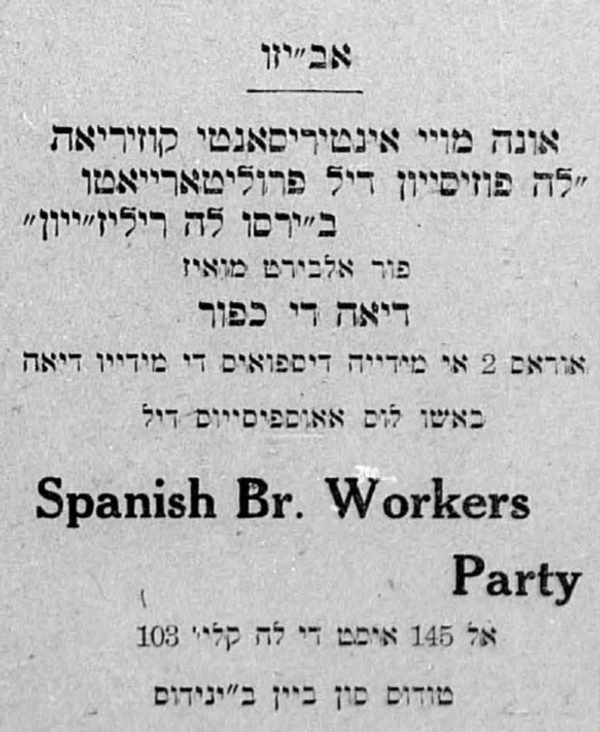
An announcement in the Ladino newspaper La Luz for Alberto Moise’s lecture on “The position of the proletariat in relation to religion,” to be delivered on Yom Kippur Day, hosted by Spanish Branch of Workers Party in East Harlem, October 1922.
Unlike the Yiddish left, often defined by strictly secular trends, the Ladino Left did not reject religious observance. In addition to extolling the promise of socialism at cafés on the Lower East Side, Albert Matarasso, a Talmudic scholar and secretary of the Sephardic Brotherhood, officiated weddings according to rabbinic law while pragmatically advocating for travel on Shabbat if a synagogue was beyond walking distance. Fellow Federasion militant Raphael Hasson, who organized with Greek radicals in Chicago and later in New York, regularly attended synagogue. But a secular strand was also alive within the Ladino Left, as embodied by Moise, who held political meetings on Yom Kippur.
During World War I, the Ladino Left entered the American mainstream. Nessim and his circle convened at cafés, formed a socialist literary club, participated in May Day parades, hosted costume balls, and supported popular Ladino theater productions by playwrights like Elie Mushabac that promoted class consciousness and anti-war sentiment. In 1915, Nessim convened a meeting that led to the establishment of the Salonician Brotherhood of America, the organization that later evolved into today’s Sephardic Brotherhood. During the Russian Revolution, the Sephardic Social Club—founded on the Lower East Side by Jews from Castoria, Greece—transformed itself into the Sephardic Branch of the Socialist Party of America in 1918. Moise began issuing El Proletario as the Party’s official Ladino organ, which later published a Ladino socialist songbook, excerpted in this pamphlet.
The Bureau of Investigation—which would soon become the FBI—surveilled this “extremely radical” newspaper and eventually shut it down. But the real blow came during the Palmer Raids in 1919, during the First Red Scare, when the government arrested thousands of suspected socialists and anarchists—mostly immigrants, with many Jews among them. By then, Nessim and Moise had abandoned the more moderate Socialist Party and established the Sephardic Branch of the Communist Party of America (sometimes identified as the Spanish-Jewish Branch, or even just the Spanish Branch, depending on the context). Nessim was arrested for distributing revolutionary flyers. While out on bond and awaiting deportation proceedings, he fled to France; with his departure, La Bos del Pueblo closed.
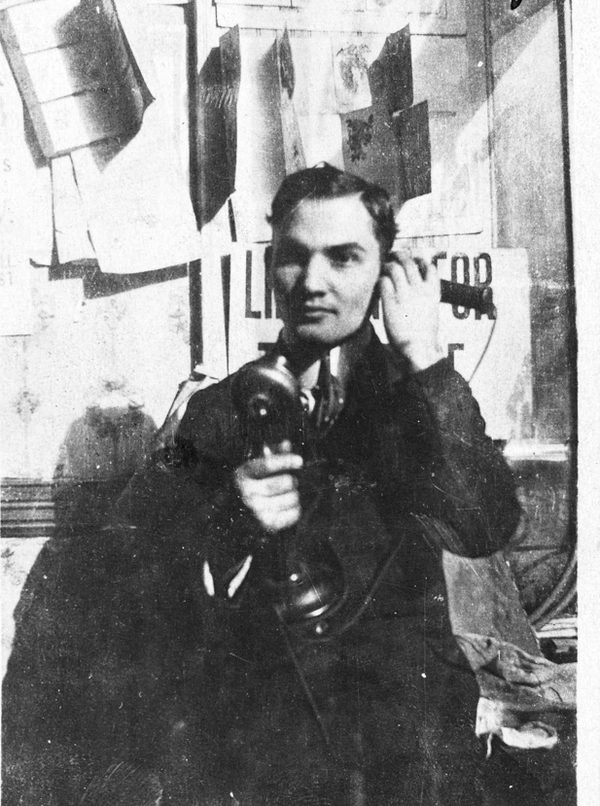
Maurice Nessim at the office of La Bos del Pueblo on the Lower East Side of Manhattan, 1919.
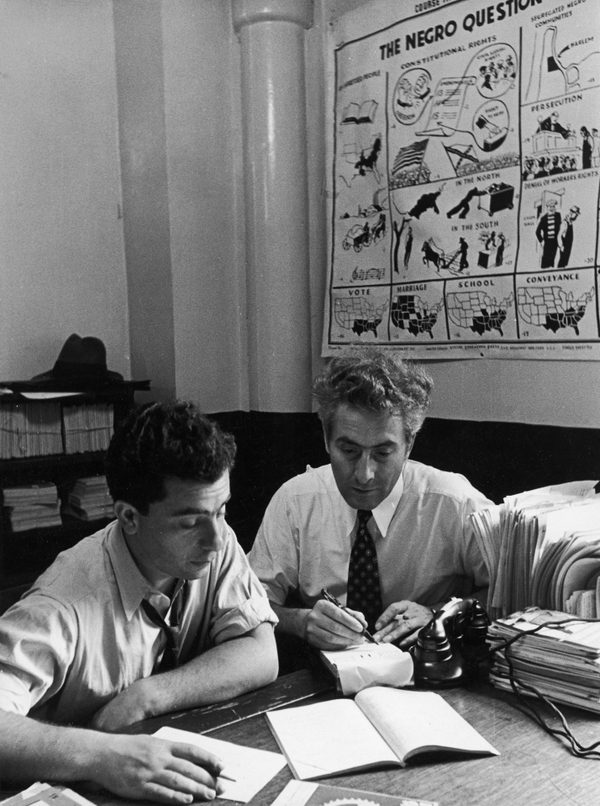
Alberto Moise/Moreau with a communist student, December 1936.
But within a few years, Nessim’s comrades, including fellow Salonicans Albert Torres, Albert Levy, and Moise Soulam, launched several new Ladino publications—most significantly, La Vara. Established in 1922, La Vara featured news and political commentary, alongside literature and satire. Its circulation soon reached 16,800, an impressive showing considering the relatively small population of Ladino speakers; this made it the most widely read newspaper in the history of Ladino publishing. Its name, which means “the staff,” alluded to the one wielded by the prophet Moses, which the editors figuratively brandished to beat the hypocrisy out of so-called leaders—especially those of the Sephardic community, whom the periodical regularly denounced as “ish bitiridjis” (self-aggrandizing “go-getters”) capable of nothing but “kornazlikes” (cunning tricks).
La Vara helped to foment radical action in Sephardic life. It advertised meetings of the new Sephardic Branch of the Workers Party—the cover for the Communist Party (CP)—and launched a major campaign, led by Louis Mizrahi from Izmir, to unionize hundreds of Sephardic laborers in the garment industry in 1923. When Shabetay Djaen, chief rabbi of Monastir in present-day Macedonia, visited New York in 1925, the publication reported sympathetically on the talk he delivered to the 300 mostly Monastir-born members of the Sephardic Progressive Club, in which he insisted that Jewish “national” culture and socialism are linked: “Marx, Engels and Lasalle and other socialists agree with the social order proposed by Moses,” Djaen said, according to the paper.
The 1920s marked a high point for the Ladino Left, simultaneous to what historian Tony Michels has called a “golden age” for Yiddish-speaking Communists. La Vara’s editors endorsed the Workers Party in 1924, writing that if Alberto Moise’s aspirations were realized, “very soon the Republican and Democratic parties will be completely eviscerated, and the poor of this nation will finally be saved.” (In the lead-up to the elections, and on the eve of Rosh Hashanah, editors Moise Soulam and Albert Levy published a new year’s wish, modeled after Avinu Malkeinu: “Avinu malkeinu, destroy the capitalists / Avinu malkeinu, may the fascists disappear / Avinu malkeinu, bring an end to the KKK / Avinu malkeinu, which is against our nation.”) Announcements for the activities of the Sephardic Branch of the Workers Party, which held regular open-air meetings on the streets of the Lower East Side and East Harlem, appeared in both La Vara and The Daily Worker, the CP’s English-language organ. In 1928, Alberto Moise, now known as Alberto Moreau, ran for New York State Assembly on the CP ticket, the first time in US history a Ladino-speaking Sephardic Jew ran for elected office. La Vara endorsed his (unsuccessful) candidacy, and left-wing Sepharadim rallied behind him—although, significantly, much of his support came from Puerto Ricans. Much as German socialists had helped initiate Yiddish activists into American radicalism through the mutual intelligibility of their mother tongues, Sephardic radicals forged strong bonds of solidarity with Puerto Rican workers through language.
Much as German socialists had helped initiate Yiddish activists into American radicalism through the mutual intelligibility of their mother tongues, Sephardic radicals forged strong bonds of solidarity with Puerto Rican workers through language.
Much had changed by the time of the Great Depression. By the 1930s, a middle-class lifestyle had gradually become attainable for some Sephardic Jews, as they began to own their own businesses or even attend university, leaving behind factory work and the crammed living conditions of the Lower East Side and Harlem for Brooklyn and the Bronx. Around this time, the Ladino Left splintered into roughly three groups. A more upwardly mobile segment—including figures like Levy, Torres, and Matarasso—increasingly moderated their politics, moving with the rest of the Jewish community toward the Democratic Party, especially during FDR’s New Deal, which appeared to realize their desire for a social safety net. In a bid to appear more “American,” the Sephardic Club of the Democratic Party, which had chapters on the Lower East Side, in Brooklyn, and in the Bronx, distinguished themselves from the radical Sephardic organizations by conducting meetings in English rather than Ladino.
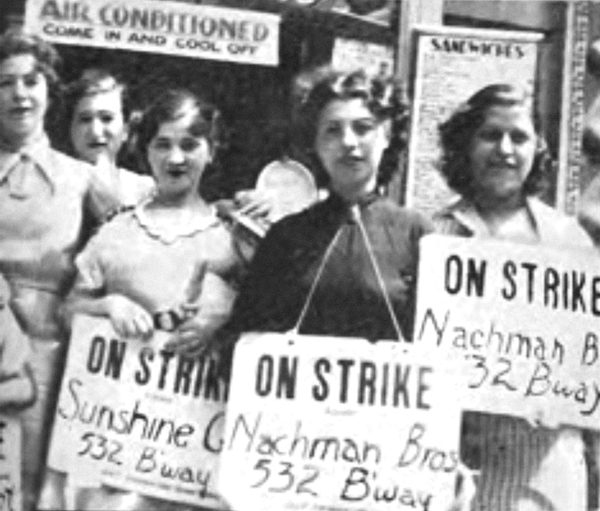
Women workers picketing with the ILGWU at the Sephardic-owned Nachman Bros. shop and others in the cotton goods industry, 1937.
Those who remained engaged with left-wing politics split into two additional camps, following the broader rift within the CP between its more moderate and radical factions, leading some among the former to join splinter groups and other parties. For Sephardic leftists, which side of the debate they found themselves on was a matter not only of ideology but also of language and identity. Some in the moderate group ultimately tied their fate to the broader Jewish community through anti-Communist organizations like the ILGWU, where they used English—or sometimes had to learn Yiddish—to work with the union’s significant Ashkenazi membership. (While the labor movement generally served as a path of Americanization for Jews, for Sephardic Jews it also offered an on-ramp into the organized Ashkenazi-dominant Jewish community, and to whiteness more broadly.) In 1937, for instance, 3,000 Sephardic Jews in the cotton goods industry, organized by ILGWU Local 91 and its new Sephardic leaders, went on strike against their Sephardic bosses.
Another more radical group cast their lot with other Spanish-speaking working people, confirming their solidarity and identification with nonwhite people from Latin America and the Caribbean. Moreau and another Salonican Jew named Saby Nehama, both founders of the Sephardic Branch of the Workers Party, played leading roles in establishing the Centro Obrero de Habla Español, the Spanish Speakers’ Workers Club, a central Communist community center that catered to the growing contingent of Latine workers in Harlem, especially Puerto Ricans. When the CP split in 1929 amid factional disputes, Moreau expelled Nehama from the Centro, prompting Nehama to leave the CP for the ILGWU. The ILGWU’s Ashkenazi leadership appointed Nehama as their Spanish liaison to the increasing number of Puerto Rican women entering the needle trades in the 1930s, weaponizing his ability to speak “Spanish” to block Puerto Ricans from ascending the ranks of the organization. Soon, however, Nehama endorsed the demands of Puerto Ricans to serve in leadership positions themselves.
Meanwhile, the Comintern in Moscow appointed Moreau to organize a New York Spanish Bureau of the party in 1929, which supplanted the Sephardic Branch of the Workers Party. Following the model of the Centro Obrero de Habla Español, Moreau brought together all Spanish-speaking workers—Sephardic, Puerto Rican, Cuban, Venezuelan, and others—within the new bureau; according to historian Jocelyn Olcott, he became “the indispensable intermediary between Spanish-speakers and the CPUSA.” That same year, Moreau co-authored the influential Marxist pamphlet Los Latino-Americanos en los Estados Unidos, the first study of the plight of Latine workers in the US. In his longtime role as secretary of the Anti-Imperialist League, he advocated for Puerto Rican independence and for the extraction of the US from the affairs of Latin American and Caribbean countries, and he also helped draft the Communist Party charter in Venezuela. In addition to allying with Spanish speakers, Moreau organized with Afro-Caribbean radicals like Richard B. Moore and Cyril Briggs. While he never denied being a Jew from Salonica, Moreau’s peers increasingly saw him as “Latin American,” as The Daily Worker noted in 1930.
Moreau was joined in the core leadership of the American CP by fellow Salonican David Amariglio, who began serving as the New York State CP treasurer in the 1930s. Following Moreau, Amariglio became the second Sephardic Jew to run for elected office when he ran (also unsuccessfully) for New York State Senate in 1932 on the CP ticket—touting a platform “against hunger, lynching, and war”—and again in 1935 for New York Supreme Court Justice. As with Moreau, La Vara praised Amariglio’s candidacy. In 1938, he negotiated the repatriation of members of the Abraham Lincoln Brigade, a group of Americans—mostly Communists and anarchists, some of them from the Ladino Left—who volunteered to fight facism in Spain in the 1930s. As a founder and managing editor for the CP Spanish-language organ, La Vida Obrera, he became so close to Latine radicals that the US military classified him as Mexican in 1943. Yet unlike Moreau, who broke with organized Sephardic life, Amariglio remained a lifelong member of the Sephardic Brotherhood and is buried in its cemetery.
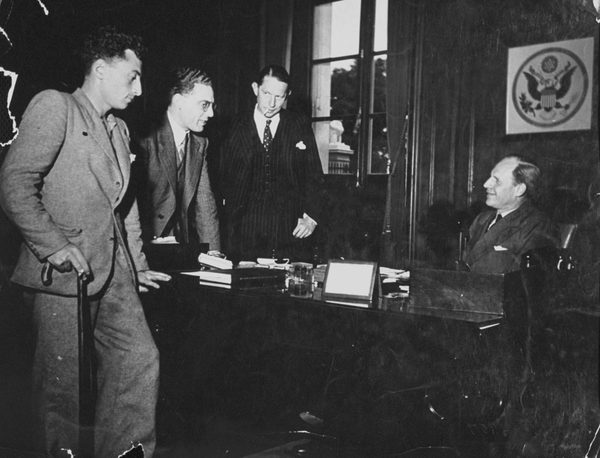
David Amariglio (center left) accompanying an American who was wounded after volunteering to fight fascism in the Spanish Civil War to speak to Consul General Robert Murphy (right) in December 1938. Amariglio assisted the veterans in reclaiming their American citizenship after fighting in Spain.
In short, in the 1930s, the Ladino Left largely ceased to function as an organized movement with its own institutions and publications. Sepharadim who continued to engage in leftist politics generally did so as part of larger groups. Whether they opted for the more moderate ILGWU or the more militant CP, their identities as Sepharadim from the Ottoman Empire tended to be subsumed by broader categories—whether Jewish or Latine—that rendered them invisible, even as the Ladino Left planted some of the seeds that ultimately bloomed into a movement of Spanish-speaking leftists. Over the following decades, where leftist attitudes remained part of Sephardic life, it was mostly among individuals—particularly within a cohort of US-born children of Ottoman Jews coming of age in the 1940s. Historian Victor Silverman has recounted how his Brooklyn-born mother Rachel Benjoya and her sisters joined the CP as an expression of their internationalist Americanism, speculating that Party membership may have enabled them to overcome the stigma of being outsiders: as women, Jews, Sepharadim, and children of immigrants who had learned English only at school. Sometimes radicalism persisted within families, even under duress: Rae Sevy, the US-born niece of La Vara editor Moise Soulam, served as the switchboard operator at CP headquarters and spent much of her adult life being surveilled by the FBI.
But as long as La Vara remained in print—which it did until 1948—the Ladino-speaking masses were exposed to leftist perspectives in their own language, equipping them to understand political developments of the 1930s and ’40s through that lens. As fascist movements gained strength in Europe, one contributor advocated a popular-front approach to fighting it, arguing that workers should join forces with the middle class. He emphasized that fascist movements were undergirded by capitalism and imperialism, two forces that had to be uprooted. During the Harlem riots of 1943, another writer vociferously defended his Black neighbors, recognizing that the violence was the result of deeply entrenched racism and that Jewish safety was linked to the well-being of fellow minorities. When La Vara shuttered after more than two decades of publication—reflecting an American-born generation increasingly abandoning Ladino—Ladino leftists lost their last crucial, communal platform.
As long as La Vara remained in print—which it did until 1948—the Ladino-speaking masses were exposed to leftist perspectives in their own language.
Throughout this period, Zionism was a point of contention within the Ladino Left, and debates about it shaped the trajectories of the organized Sephardic community more generally. The question came to the fore in 1917 as New York’s Sephardic organizations were deciding whether to support the American Jewish Congress’s call for the creation of a “Jewish commonwealth” in Palestine under the auspices of the British. Significantly, the largest Sephardic umbrella organization, New York’s Federation of Oriental Jews, representing over 20 institutions, boycotted the congress. Even Sephardic Zionists, who had already formed their own association in New York, expressed skepticism about the idea of establishing an exclusive Jewish state.
Such reservations among Sepharadim did not stem from a sense of distance from Palestine, but rather from their proximity. After all, as an Ottoman province, Palestine was already part of their country; it was a place where some had relatives or had visited. Ladino was a major Jewish language there into modern times: Visitors to the region noted that it was the main Jewish language in Hebron in the 1820s and was necessary to communicate with much of Jerusalem Jewry in the 1840s, and it continued to be widely spoken in the Old City into the 20th century, including by some Palestinian Muslims. Sephardic Jews viewed efforts to extract Palestine from the Ottoman Empire as treason against the state that had protected their community since the 1492 expulsion from Spain. The chief rabbi of the Ottoman Empire, Haim Nahum, and the main Ladino newspapers in Salonica and Istanbul all opposed political Zionism (though at least in part because of pressure from Ottoman authorities). Thus, New York’s Federation of Oriental Jews argued in its 1917 statement on the issue that the American Jewish Congress’s proposal threatened the well-being of their Jewish brothers and sisters in Palestine and throughout the Ottoman Empire. “The blood that will be spilled by our loved ones will be the result of [Zionists’] flawed efforts,” the statement declared, “and only they will be held responsible for having played with the lives of our siblings in the Ottoman Empire who will suffer due to the sins of others.” That same year, debates over Zionism nearly fissured the new Salonician Brotherhood of America. When the organization tried to remain neutral on both Zionism and socialism, its co-founder, Maurice Nessim—who opposed the former and supported the latter—resigned in protest.
Once the Ottoman Empire collapsed in the wake of World War I, some of the reservations American Sephardic Jews had expressed about Zionism became moot. The ideology became ascendant among those Sepharadim who embraced the Democratic Party; Sephardic Democratic Club meetings included the singing of both the American national anthem and “Hatikva.” But even as Sephardic Jews warmed up to Zionism, American Ladino newspapers continued to express doubts about its progression through the 1930s, worrying that rampant discrimination meant they had no place in the movement. The Zionist newspaper La Amerika published the complaints of a group of Salonican Jews who concluded after a 1925 visit that “Palestine is not the homeland of the Jews, in general, it is the homeland of the Ashkenazi Jews alone.” In 1937, writing in La Vara, Nessim Mehoudar, an Ottoman-born Palestinian Jew who settled in New York, blamed the instigation of conflict between Arabs and Jews principally on the Jewish Agency’s predominantly Ashkenazi representatives in Palestine, who he said acquired land through “intrigue.”
Even these reservations began to fade in the 1940s, as prominent communists like Leon Trotsky came out in favor of a Jewish homeland, and as the devastation of the Holocaust became known. Just as those who participated in the Ladino Left experienced a process of Americanization and accommodation to Ashkenazi norms by joining organizations like the ILGWU, the Zionist movement (which the ILGWU increasingly supported in the 1930s) became an on-ramp into the organized Jewish community. The Sephardic Brotherhood of America renamed itself the Sephardic Jewish Brotherhood of America in 1947, precisely as the organization’s leaders nominally adopted Zionism, as a way of insisting on their inclusion in a newfound conception of Jewish peoplehood. In 1945, for the first time, Sephardic Jews in the US served as delegates to the World Jewish Congress to promote the creation of a Jewish state. Ironically, the article describing this event in La Vara used the very orientalist rhetoric that the newspaper had once so fervently rejected: “The Sepharadim have finally awoken from the profound slumber imposed by the soporific flower of the Orient.”
Virtually no trace of the Ladino Left has been transmitted to us today. Part of the erasure stems from the broader surveillance and repression of the American left by the government throughout the early- to mid-20th century, culminating in McCarthyism in the 1950s. Many of the aforementioned figures adopted aliases to protect themselves and their families from being targeted by the federal government. After escaping to France, Maurice Nessim returned to the US under an assumed name, Maurice Lacoste; Alberto Moise became known as Alberto Moreau and also wrote under the pen name John Bell; David Amariglio became David Leeds. Several of these men appeared in the proceedings of McCarthy’s House Committee on Un-American Activities. Anxieties around the key roles that radicals played in the founding and development of the Sephardic Brotherhood resulted in the organization scrubbing Nessim from its official narrative.
Meanwhile, leaders of early to mid-century left-wing Jewish movements fused Jewish identity with the Yiddish language, fueling the marginalization and erasure of Ladino. Indeed, Jewish branches of the Socialist and later Communist parties were so-defined by language: They were Jewish because their members spoke “Jewish,” the meaning of the term “Yiddish.” The equivalence of Jewish and Yiddish alienated Sephardic Jews from the organized Jewish community in general, and from the Jewish labor movement and Jewish radical politics in particular. The elevation of Yiddish as the Jewish language par excellence was an ideological imperative among some leaders. For Jewish socialists like Chaim Zhitlovsky, the concept of the “pintele yid,” an essential—even racially constituted—Jewishness was expressed through Yiddish, such that “even a convert to Christianity could still be viewed as Jewish as long as he spoke Yiddish,” as historian David Weinberg explains. Zhitlovsky was well aware of Ladino but demeaned it as part of his defense of Yiddish; in a 1912 article, he argued that only the latter could serve as “the language of the Jewish nation.” Discussions of Ladino in Yiddish publications often replicated the very critiques foisted upon Yiddish by the dominant Eurocentric, orientalist attitudes of the era. In a 1913 piece in Zhitlovsky’s New York monthly Dos Naye Leben, contributor M.A. Herbert denigrated “Shpanyolish” as a mere “dialect” lacking “its own literature” and “its own characteristics,” rather than a legitimate “language.”
While robust scholarship on Jewish radicalism has emerged in recent decades, not a single study acknowledges the presence or participation of Ottoman Jews as a group in the labor movement or in radical politics in the US.
The suppression of leftist narratives by the state and within the general Jewish community, alongside ignorance and marginalization of Sepharadim within the Jewish left, have been replicated in Jewish collective memory and scholarship across the generations. While robust scholarship on Jewish radicalism has emerged in recent decades, correcting for the erasure resulting from repression, not a single study acknowledges the presence or participation of Ottoman Jews as a group in the labor movement or in radical politics in the US, neither in the Socialist or Communist Parties nor in institutions like the ILGWU. The reticence partially reflects the weaknesses of the field of Jewish studies, which scholars of Sephardic history like Sarah Abrevaya Stein have accused of “laziness” and a “profound resistance to reconceptualize.” A couple of studies on Jewish labor mention ILGWU leader Saby Nehama in discussions of Jewish–Puerto Rican relations, but misidentify him as being from Spain, rather than Ottoman Salonican. Similarly, Alberto Moise/Moreau has received attention not in Jewish studies, but in Latine studies. In an article in American Communist History, scholar Kenneth Burt describes him as the “first radical Latino voice in the electoral arena in the Northeast,” identifying him as an Argentine. Benjamin Balthaser’s 2025 study Citizens of the Whole World: Anti-Zionism and the Cultures of the American Jewish Left does include Moreau—and is the first book to highlight his anti-Zionism—but otherwise neglects the Ladino Left.
The primary exceptions to this near-total erasure are Joseph Papo’s 1987 communal history, Sephardim in Twentieth Century America, in which he acknowledges Ottoman Jewish participation in the Socialist Party and labor movement, as well as activist and writer Melanie Kaye/Kantrowitz’s 2007 book The Colors of Jews: Racial Politics and Radical Diasporism, in which she observes that “radicals abound among those who emigrated to the US and edited the Ladino press” and refers to editors Maurice Nessim and Moise Soulam by name. For Kaye/Kantrowitz, preserving this history was a part of an essential “de-Ashkenization” of Jewish cultural and political expression, embodied in projects like the 1989 feminist anthology she co-edited, The Tribe of Dina, which included a significant representation of Jewish women’s voices of Ladino- and Arabic-speaking background. In The Colors of Jews, she is both adamant about this aspiration and candid about the imperfection of her own attempts to realize it. She describes a 1993 teach-in led by her then-nascent organization Jews for Racial and Economic Justice (JFREJ): Though it featured a talk by Edward Alcosser—the chairman of the board of New York’s American Sephardi Federation, whose father had served on the executive board of the ILGWU—entitled “Outside Yidishkayt: Sephardic Progressive Thought,” the teach-in bore only a Yiddish name: “In Gerangl,” meaning “In Struggle.” For the next teach-in, JFREJ tried but failed to find an adequate Ladino equivalent, reinforcing the sense of non-Ashkenazim as outside the normative Jewish left. (The organization has since made significant headway, founding a Mizrahi and Sephardi Caucus in 2014.)
As Kaye/Kantrowitz understood, suppressed non-Ashkenazi lineages—like the history of New York’s Ladino Left—ought to compel us to rethink not only the Jewish left’s past, but also its future. A first step is to begin to reckon with the factors that have contributed to the erasure, including the deeply rooted intra-Jewish prejudice at play, itself partly a symptom of living under white supremacy, and to begin to redress the issue by reconsidering the very terms used to describe the movement. Jewish Currents offers a valuable case study. According to its mission, it is “committed to the rich tradition of thought, activism, and culture on the Jewish left,” but it has never served as a voice of the Jewish left in all its breadth, largely permitting the Yiddish and Yiddish-descended left from which it emerged to stand in for the Jewish left as a whole.
From its early days, while Jewish Currents readily commented on the plight of North African and Middle Eastern Jews in the new State of Israel, it failed even to acknowledge the presence of Sepharadim and Mizrahim within the American Jewish community, let alone the Jewish left. Already in 1956, Jewish Currents published a letter from a disgruntled reader who complained about the magazine’s centering of Yiddish in progressive Jewish education: “The Ladino of the Sephardic Jew is disregarded completely.” (Other Jewish languages like Judeo-Arabic or Persian were not even considered.) Not until 1972 did Jewish Currents publish an article on Ladino-speaking Jews, focusing on the innocuous theme of Ladino music but grappling for the first time with the very forms of exclusion the magazine practiced. Reviewing an album of Ladino folksongs, Sonya Schappes, spouse of Jewish Currents editor Morris, asked why “progressive Jewish folk singers persistently overlooked the wealth of Jewish folk music” beyond the shtetl while non-Jewish musicologists and performers took great interest in Ladino songs, concluding that the only explanation was a “narrow-minded approach” to Jewish self-conception. In response, Salonican union organizer Sabetay “Edward” Ayash—who served as the founding treasurer of SEIU 1199 in the 1930s and worked as a pharmacist in Harlem, where Schappes was one of his clients—wrote a letter to the editor in which he, too, wondered why “we don’t sing the songs of this minority of the minorities,” and also why fascist Spain dedicated more resources to promoting Sephardic culture than did “our Ashkenazi communities in the USA.” (Perhaps not wanting to be too strident, he surmised that this phenomenon was “unexplainable.”) He suggested that Sephardic culture had been so ignored by dominant American Ashkenazi Jewish society that even Sepharadim themselves internalized the irrelevance or nonexistence of their own culture.
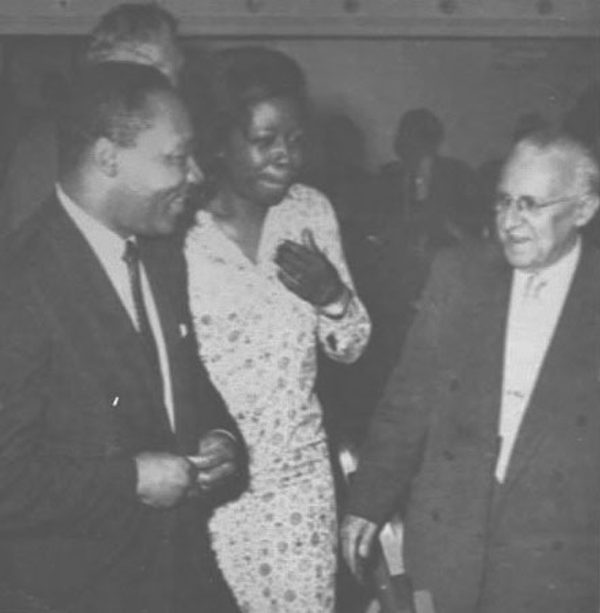
Sabetay “Edward” Ayash with Martin Luther King, Jr. in the early 1960s.
Ayash appears to have been the only figure active in the Ladino Left to contribute to Jewish Currents. When he died in 1973, a group of fellow union leaders eulogized him in the magazine as “a life-long champion of democratic trade unionism, social justice, equality and peace.” But the publication did not implement any structural changes to expand its purview and embrace the experiences, traditions, and insights of Sephardic Jews in the US. If the Jewish left of today, as expressed in organizations like Jewish Currents and others, is to warrant that title, then it must make more space for multiple Jewish cultures, without which the Jewish left will remain stunted by internalized Eurocentrism and white supremacy.
For readers of Jewish Currents, the Ladino Left also offers an additional path into the question of a just future in Israel/Palestine. Lately, the Jewish left has sought to reclaim Arab Jewish identity as a way of refusing Zionism’s dichotomy between Arab and Jew. The project can be enhanced by similarly attending to the Ladino-speaking Jew—and indeed by reconnecting this figure with the Arab Jew—in order to recuperate a lost map of the former Ottoman Jewish world wherein deep Jewish religious and cultural links to Palestine need not translate into a project of exclusivist nationalism or settler colonialism. This work can similarly facilitate coalition-building in the fight for Palestinian liberation, helping Jews connect with Muslim communities through shared culture. For instance, groups like the Egalitarian Sephardi Mizrahi Kehilla of NYC employ the shared Middle Eastern, North African, and Ottoman musical modes known as makam as part of their services, providing for an expanded sense of political imagination.
The recuperation of the figure of the Ladino-speaking Jew also offers an additional possibility of bridge-building in the American context, particularly to Spanish-speaking immigrant communities currently under attack by the federal government. Spanish is the second-most spoken language in the US, and “Hispanics” constitute nearly 20% of the population. (These include about 300,000 Latine Jews, representing a variety of ancestries.) While Ladino functions today almost exclusively as a post-vernacular, deployed to consciously symbolize an identity rather than to communicate, the language—its idioms or its socialist anthems—could be deployed in the service of solidarity. Yiddish is often deployed this way by today’s Jewish left, but Ladino has the benefit of being largely intelligible to communities actively facing immigration exclusion, the militarization of the border, and the deportation state.
We can look to the profound hybridity of Ladino—long met with suspicion or confusion—as a generative resource for articulating a Jewish horizon beyond political Zionism.
We can also look to the profound hybridity of Ladino—long met with suspicion or confusion—as a generative resource for articulating a Jewish horizon beyond political Zionism. In his History of the Jews, famed Russian Jewish diaspora nationalist Simon Dubnow criticized Jews from Istanbul and Salonica for suffering from a “superficial cosmopolitanism of the Levantine type” because they failed to become either Turks or Europeans, while also supposedly failing to adopt a Jewish national consciousness (his claim notably rhymes with Joseph Stalin’s antisemitic canard that Jews in general were “rootless cosmopolitans”). But some thought about their Levantine condition quite differently. Richard Kostelanetz, a New York-born anarchist critic with roots in Izmir, views the Ladino-speaking experience as a “declassé” and “alternative Jewish heritage” ripe with cultural and political potential.
Similarly, the philosopher, resistance fighter, and former communist Edgar Morin (né Nahoum), born to Salonican Jews in Paris in 1921, considers his family’s multiple affiliations across the generations—as Salonican, Sephardic, Jewish, Turkish, Greek, Spanish, Portuguese, Italian, French, and Mediterranean—not as a sign of irrevocable alienation, but rather as a promise of “multi-rootedness” (in French, “poly-enracinement”). For Morin, this multi-rootedness manifests as a transdisciplinary worldview that embraces relationality, complexity, anti-essentialism, and contradiction as the foundations of human knowledge. This paradigm offers a complementary approach to the Bundist, Yiddish concept of “doikayt” (“hereness”), which has become a rallying cry of the Jewish left: Whereas doikayt risks reinforcing the very centrality of Israel/Palestine it means to disrupt by situating the “here” of diaspora in relation to the “there” of Eretz Yisrael, Morin’s framework helps us to embrace a multiplicity of different “homelands” with no hierarchy whatsoever. This powerful concept finds concrete expression in a grand mosaic map that appeared in Brooklyn’s Sephardic Home for the Aged—which stood from 1951 until 2014 as the most visible communal landmark of American Ladino heritage—showing the eastern Mediterranean geography of the Balkans, Greece, Turkey, Israel/Palestine, and Egypt, with the line: “In These Lands Our People Dwelled for 500 Years.” This declaration, though intended as a description of historical reality rather than an expression of radical politics, can nevertheless serve a vision of Jewish flourishing across borders.
To incorporate this expansive principle of multi-rootedness into our politics, we must not only acknowledge and raise up the history of the Ladino Left, but also integrate it into the contemporary culture of the Jewish left, undoing the oppressive power dynamics that have excluded it until now. There is enough space for Chaim Zhitlovsky and Maurice Nessim; for Clara Lemlich and Sarah Aldorati; for “doikayt” and “poly-enracinement”; for protest songs in all of our Jewish languages. Already in 2007, Melanie Kaye/Kantrowitz emphasized that Jewish histories invisibilized by a “hegemonic Ashkenazi community are often best equipped to help the Jewish world reckon with our multiculturality, and to know that this multiculturality is an enormous asset when it comes to combating racism and antisemitism and to building social justice coalitions.” Though the Ladino Left must be reclaimed for its own sake, si kere el Dio, if it can also help strengthen the Jewish left, zay gezunt. There are other radical Jewish American histories waiting to be reclaimed, too—whether of early 20th-century Greek-speaking Romaniote Jews from Ioannina or Arabic-speaking Syrian Jews who joined the ILGWU or the CP. A wider range of Jews must see their heritages reflected, and activated, in our liberation movements to make it clear that they, too, are poised to play an essential role in them.

I’m Peter Beinart, editor-at-large of Jewish Currents. Before you go, I need to ask something of you.
In recent years, I’ve watched as mainstream Jewish institutions and media have chosen ethnonationalism over liberal democracy and mass slaughter over the pursuit of a just peace. Jewish Currents offers something different. It’s a magazine built on intellectual curiosity and respect for the dignity of all people.
But a project like this doesn’t sustain itself, and we can’t do it without your help. If you share my belief in the importance of this mission, please consider making a donation—or even better, a recurring one. We need you with us.
Devin E. Naar is an associate professor of Jewish studies, Sephardic studies, history, and international studies at the University of Washington in Seattle and the author of Jewish Salonica: Between the Ottoman Empire and Modern Greece.