Trump’s Imperial Fantasy Begins With Gaza
As his Board of Peace bids to become an alternative United Nations, the president plans to rule the Strip and reap the profits.
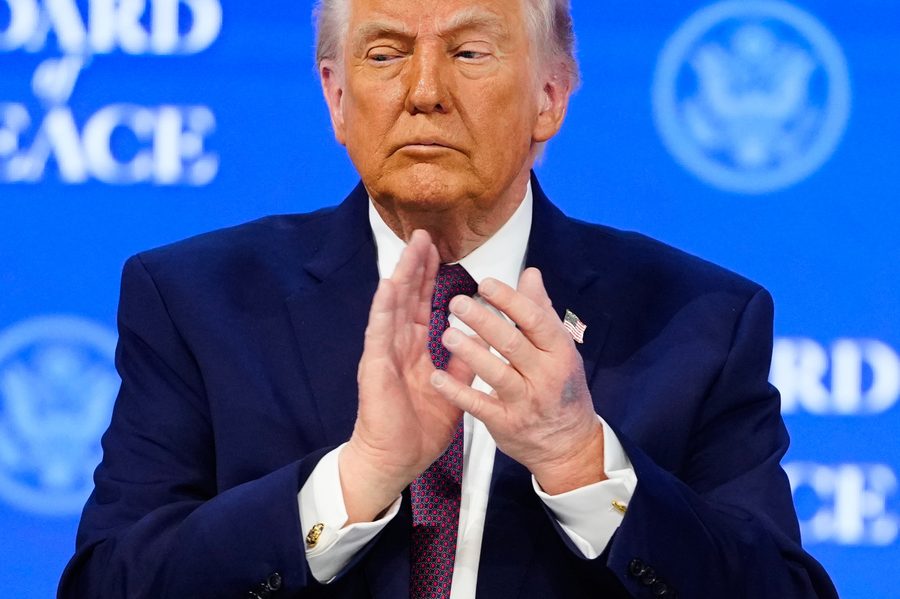
President Donald Trump applauds during a signing ceremony for his Board of Peace initiative at the Annual Meeting of the World Economic Forum in Davos, Switzerland, January 22nd, 2026.
In 1945, the United States stood at the apex of its global dominance. It comprised half the world’s GDP, owned 80% of its hard currency, and possessed the only nuclear weapons on earth. So, it’s hardly surprising that, in the spring of that year, Americans designed the logo for the new organization tasked with keeping world peace: the United Nations. With diplomats from across the globe set to arrive in San Francisco for the UN’s inaugural meeting, a State Department committee deputized Donal McLaughlin, the chief graphic designer at the Office of Strategic Services, the predecessor to the CIA, to create an insignia that delegates could wear on their lapel pins. With some modifications, it later became the UN’s official seal.
The insignia depicts a map of the world as seen from the North Pole, encompassing all the continents. It reflects the scale of America’s postwar ambition. President Franklin Roosevelt imagined “four policemen”—Britain, the USSR, China, and the US—together patrolling every segment of the globe. Since Britain and China were in different ways US subordinates, the US would be the most powerful policeman of all. At the UN Security Council, these four great powers—joined by France—would work together to solve problems. Weaker nations could voice their opinions at the UN’s General Assembly. But those opinions would carry little weight. McLaughlin’s insignia depicted the entire world because American leaders felt that with their unparallelled might, and willingness to cooperate with other powerful nations, they could manage the globe as a whole.
The insignia for Donald Trump’s new Board of Peace imitates the UN’s, but with one crucial difference: Its map shows only the Western Hemisphere. In particular, it depicts the US, Canada, Mexico, Central America, the Caribbean, Venezuela and other countries on the northern rim of South America, and Greenland—territories Trump has threatened to dominate or even conquer as part of his “Donroe” Doctrine.
This visual myopia is telling. In 1945, the US fashioned a logo of the entire globe because Washington enjoyed both the might and the appetite for cooperation among great powers necessary to dominate the world. Today, the US no longer does: Its power has declined and so has its willingness to work collaboratively with other powerful nations. So, through the Board of Peace—in which the US presides over weak and corrupt sycophants—Trump has conjured a fantasy. Rather than adapt to the multipolar world that actually exists, he is maintaining the illusion of American supremacy by fashioning an illusory world. It’s fitting that the Board of Peace’s first project is overseeing the Gaza Strip: Although Gaza does not appear on the Board’s map, its brutalized, subjugated, and largely defenseless population makes it one of the few places on earth where Trump can implement his vision of nearly absolute imperial control.
Economically and militarily, the US is much less dominant than it was when the UN was born. It now accounts for only one-quarter of the world’s nominal GDP, with China not far behind. And while Washington still spends three times as much as Beijing on the military, it spent six times as much only 14 years ago. This shifting power balance is present within the United Nations, where China—which funded less than one percent of the institution’s budget in the year 2000—now funds 20%, almost as high a share as the US. That’s why Trump wants an alternative. Working through the UN would require working on roughly equal terms with China, something Trump rejects. In its National Security Strategy issued last November, the White House does not mention cooperation with Beijing once.
The Board of Peace, by contrast, offers an almost parodic vision of national and personal omnipotence. It contains no equivalent of the UN Security Council, which gives other great powers a veto. Its highest authority is Trump, chairman for life, who holds the sole power to determine which countries can join, when the Board will convene, and what it will discuss. Trump selects the eight-member Executive Board, a majority of whose members are American. And if he invites a country to join the Board of Peace, their membership lasts only three years. To make it permanent, they must pay $1 billion to the Board. In other words, to Trump.
Maintaining the fiction of American omnipotence requires pretending that countries are eager to enlist as America’s vassals. When he announced his new organization, Trump called it “the Greatest and Most Prestigious Board ever assembled at any time, any place” and claimed that “everyone wants to be a part” of it. But so far, neither Britain, France, Japan, India, South Korea, nor Australia have joined. The governments that have fall into three categories: Trump-style authoritarians like Hungary’s Viktor Orbán and El Salvador’s Nayib Bukele, Arab and Muslim governments that appear to hope the Board will grant them some influence over Gaza’s future, and states so illegitimate or reviled that they will join any institution that lets them in. One of the Board’s members is Kosovo, which broke away from Serbia in 2008 but can’t join the UN because Belgrade doesn’t recognize its independence. Another is Belarus, whose dictator could not attend the announcement ceremony because he’s under sanction by the European Union.
The Board’s charter vows that it will “secure peace in places where it has for too long proven elusive.” But there aren’t many countries on earth where you can impose a diplomatic solution without involving other powerful nations. Any deal to stop the fighting in Ukraine would require the consent of Russia and influential European nations like Germany, France, and Poland—not to mention Ukraine itself. Resolving Myanmar’s civil war is impossible without China, which offers its regime crucial economic and military support. Trump claims to have ended hostilities last May between India and Pakistan, but the real decision-maker was India itself, which has not joined his Board of Peace.
What distinguishes Gaza from those other war-torn regions is that it’s not a country. Like the West Bank, it’s a colonial possession, whose residents are subjects—but not citizens—of Israel. As a colony, it can’t forge normal relations with foreign powers, who might shield it from Israeli and American domination. Its weakness, which has long made it a “laboratory” for the Israeli military, is now making it a laboratory for Trump’s fantasies of imperial omnipotence. Only in a colony could the US establish governing institutions—an Executive Board and a Gaza Executive Board—that contain Trump cabinet members, Trump in-laws, and Israeli and American Jewish businessmen, and relegate Palestinians to a National Committee for the Administration of Gaza that performs only technical functions. Some commentators have suggested that Gaza is now under “international trusteeship.” But it’s worse than that. It’s under Trump’s individual trusteeship. The Board of Peace authorizes him and his cronies to plunder the Strip for personal gain. What is emerging in Gaza may resemble less Mandatory Palestine between 1917 and 1948, which was ruled by the British government, than the Congo between 1885 to 1908, which was the personal property of one man, King Leopold II of Belgium.
The political scientists Stacie Goddard and Abraham L. Newman have dubbed Trump’s foreign policy “neoroyalism.” It aims less to solve global problems, or even advance American national interests, than to enrich and empower Trump and his circle. The Board of Peace—which requires governments to bribe Trump to attain permanent membership—gives this ideology institutional form. But in most of the world, neoroyalism has its limits. When Trump demanded Greenland and prepared to deliver its mineral wealth to his cronies, he encountered strong resistance from Denmark, which administers the territory, and other members of NATO. In Venezuela, Trump abducted Nicolás Maduro, farmed out oil deals to his campaign donors, and declared himself the country’s “acting president.” But he’s still constrained by the fact that Venezuela is nominally a sovereign state. It’s impossible to imagine Trump proposing deporting Venezuela’s entire population to clear space for his real estate fantasies, as he suggested doing in Gaza last February.
Unlike Venezuela, Gaza isn’t even nominally sovereign and, unlike Greenland, it’s a member of no powerful club. So it may be in Gaza that, through the Board of Peace, Trump’s neo-royalism will gain its fullest expression. The US may no longer be able or willing to “police” the world. But in a 25-mile-long prison along the Mediterranean, where Washington has just helped oversee a genocide, Trump can truly crown himself king.

I’m Arielle Angel, editor-at-large of Jewish Currents. Before you go, there’s something I need to ask.
We’ve seen over and over how the mainstream media falters in telling stories on our beats—whether it’s antisemitism, Israel/Palestine in American politics, Jewish identity, or the American left. At Jewish Currents we’re committed to uncompromising analysis and longform reporting on these issues and more—stories you won’t find anywhere else. In a media landscape that obscures injustice and flattens discussion, we’re changing the conversation. But we need you.
If you believe in this work, please consider making a donation—or even better, a recurring one—to ensure that we are able to keep publishing stories like this one. We can’t do it without you.

Peter Beinart is the editor-at-large of Jewish Currents. He is the author of The Beinart Notebook on Substack.