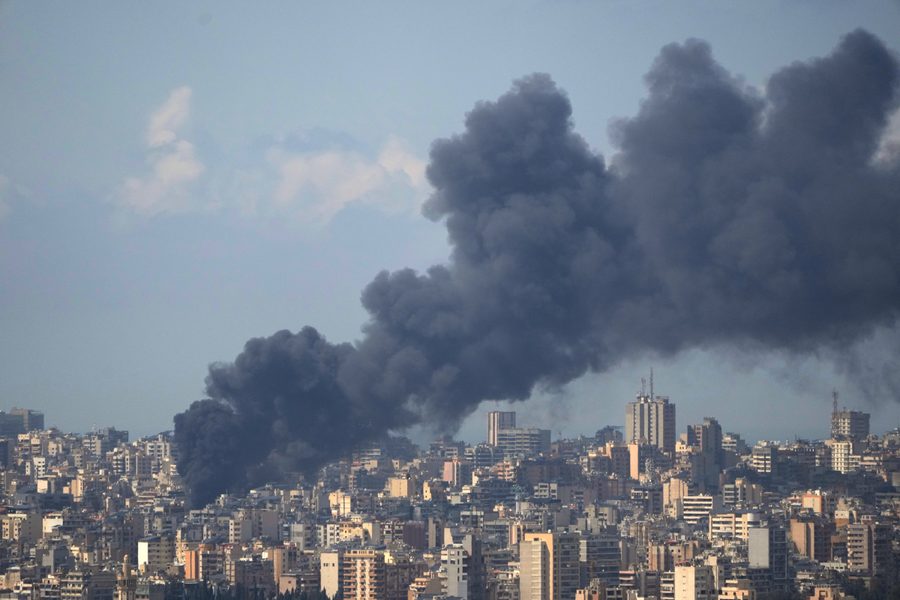
Despite a Tuesday night ceasefire agreement between the US and Iran, Israel continued attacks on Beirut, Lebanon on Wednesday.
This article first appeared in the Jewish Currents news desk newsletter. Subscribe here.
The US war on Iran halted Tuesday night in a fashion far different from the one promised at the outset by leaders in both the US and Israel. The Iranian government remains in place, its military remains capable, and it still appears to have hundreds of pounds of highly enriched uranium. Iran is in a position of relative strength: The basis for planned negotiations, according to President Trump, is an Iranian proposal whose terms include an end to all sanctions against the country, and permanent Iranian control of the Strait of Hormuz. (An anonymous White House official claimed to the New York Times on Wednesday that the terms Trump was referring to come from some other, unspecified Iranian proposal.)
The Israeli leadership, for its part, is reeling. Benjamin Netanyahu helped push the White House to start this war, but appears to have been nowhere near the agreement to end it. Israel has stopped its attacks on Iran, but continues to bombard Lebanon, where Israeli military incursions have displaced more than a million people in recent weeks. Late in the day on Wednesday, Iran reportedly closed the Strait of Hormuz in response to Israeli strikes in Lebanon, and the state of the ceasefire grew uncertain as Iranian officials accused the US and Israeli side of violations, including Israel’s continuing attacks.
To understand the wobbly ceasefire and what it means for the US, Iran, and Israel, Jewish Currents spoke early Wednesday with Trita Parsi, an Iran expert who is the executive vice president of the Quincy Institute and former president of the National Iranian American Council. The interview has been edited for length and style.
Josh Nathan-Kazis: Trump posted wild threats on Tuesday, saying “a whole civilization will die.” Then, late in the day, he announced a ceasefire. What do you make of the sequence of events?
Trita Parsi: You can go back to Tuesday morning and look at the tweet that I wrote, in which I said that there’s a likelihood that Trump is issuing these bombastic threats precisely because he’s going to cave, and so he needs to create a narrative that covers up that fact. By issuing these threats, he wants to leave the impression that it was the Iranians that caved because they were terrified. But when you scratch the surface and you see what was actually agreed upon, I think it’s very clear exactly what happened: Trump caved.
JNK: One of the points on Iran’s list of demands is a ceasefire between Israel and Hezbollah in Lebanon. As of this morning, Israel continues to bomb Lebanon. Does the US have the leverage to bring Israel to heel?
TP: I think the Iranians are putting forward this demand partly because they want to signal solidarity with the people of Gaza and Lebanon, but also because they believe that if the Israelis continue to bomb Gaza and Lebanon, there’s a likelihood of this spilling over into yet another war between Israel and Iran. So from their standpoint, addressing this linkage is important. I do believe that the US has the capability to rein in the Israelis. The question is if the President is willing to pay the political price to do so.
JNK: We’ve seen significant reporting just in the past couple of days that the Israelis were very involved in the decision to begin this war. But this ceasefire seems to have happened behind their backs.
TP: There is no deal that could have been reached in which the Israelis were included, because the Israelis are dead set against any type of ceasefire; right now they’re trying to figure out how they can sabotage it. The only way this could work is for the US to strike its own deal, and then pressure Israel into accepting it.
JNK: But if the Israelis are not on board, what are the prospects for a ceasefire remaining in place? What’s to stop Israel from restarting hostilities on their own terms?
TP: They’re doing it right now: You see massive bombing in Beirut just in the last couple of hours. Israel is trying to be an independent state that acts on its own and does not take orders from the US, while at the same time being overwhelmingly dependent on US political, diplomatic, and military support. It cannot have it both ways, and the US has to make a decision: Does Israel decide whether the US holds to a ceasefire, or does America decide? If the US is not capable of or unwilling to rein in the Israelis, then a deal with the US really loses much of its value. War will recur, which means these ceasefires should only be used to rearm as much as possible and prepare for the next war. That’s very different from an actual peace; that’s just a pause.
JNK: Right. What’s to prevent a cycle of conflicts between the US, Israel, and Iran every six months?
TP: That cycle is the Israeli preference. This is how Israel deals with Lebanon, how it deals with Gaza, how it has dealt, in the past, with Syria. This is not the way the US does things. Part of the reason why other presidents did not agree to go to war with Iran is because all of the planning showed that this is the end state: perpetual war. That’s not particularly attractive to the United States. Trump made the mistake of accepting this path. Now he’s pulled himself out, and the question is, is he going to stick to that decision or cave to the Israelis, inviting a Forever War, the very thing Trump said he would absolutely not do?
JNK: President Trump wrote that Iran’s ten-point ceasefire proposal, which demands, among other things, an end to sanctions and permanent Iranian control of the Strait of Hormuz, is a “workable basis on which to negotiate.” What does it mean that this Iranian plan appears to be the starting point for negotiations? And who controls the Strait of Hormuz?
TP: This is essential for understanding who caved and who didn’t: The Iranians continue to control the strait. They decide who passes and who doesn’t, and they continue to charge $1 million to $2 million per tanker, to be shared with Oman. And this has essentially been accepted by the US as part of the ceasefire.
The US had its own 15-point plan, which was essentially a list of terms for Iran’s capitulation. The fact that the Iranian plan is the framework for negotiations is a huge diplomatic victory for the Iranians. Sanctions relief is crucial for Iranians. They’ve had probably $1 trillion in damages as a result of this war. They need investments to be able to rebuild. If they don’t get sanctions relief, if they’re going to be in a state of continuous weakening, in their view, that is only going to invite another Israeli or American attack. So on sanctions relief, I think they’re going to bargain extremely hard.
JNK: Trump is posting about how Iran underwent “a very productive Regime Change.” What do you make of that claim?
TP: Trump is in dire need of a narrative of success that tells his base that he achieved something. He’s grasping at straws. A lot of [what the White House is doing] is accounting for how much has been blown up in Iran. Whether that amounts to strategic success or not depends on your perspective. From the Israeli standpoint of “mowing the lawn,” yes, that is part of the metric of success. If you destroyed a lot on this round, it may take more than six months before you have to go at it again.
Regime change is more of an enduring change, so it’s not surprising that he wants to claim that. But the reality is that the change within the regime has been a change in the opposite direction of what the US should have wanted. We’re now seeing an Iranian theocracy that is more hawkish, is probably going to be more repressive, and has already shown itself willing to be much more aggressive within the region. A new generation of leaders are coming into power since Israel assassinated their predecessors, and their view is that the only way to stop Iran from being attacked like this is to strike back really, really hard. For some time, Iran took a lot of hits from Israel without responding, and when they responded, they tended to respond in more of a symbolic manner. The new decision-makers in Iran are highly critical of that approach. They believe this is part of why Iran ended up being attacked, because it created the impression that Iran is much weaker than it is. They’re aggressively trying to change that perception.

I’m Peter Beinart, editor-at-large of Jewish Currents. Before you go, I need to ask something of you.
In recent years, I’ve watched as mainstream Jewish institutions and media have chosen ethnonationalism over liberal democracy and mass slaughter over the pursuit of a just peace. Jewish Currents offers something different. It’s a magazine built on intellectual curiosity and respect for the dignity of all people.
But a project like this doesn’t sustain itself, and we can’t do it without your help. If you share my belief in the importance of this mission, please consider making a donation—or even better, a recurring one. We need you with us.
Josh Nathan-Kazis is the news director at Jewish Currents. Previously, he was a senior writer at Barron’s, where he covered healthcare companies, and a staff writer at The Forward, where he investigated Jewish communal institutions.