The Recognition Trick
By making Palestinian disarmament a prerequisite for statehood, Western countries are still facilitating Israel’s goals.
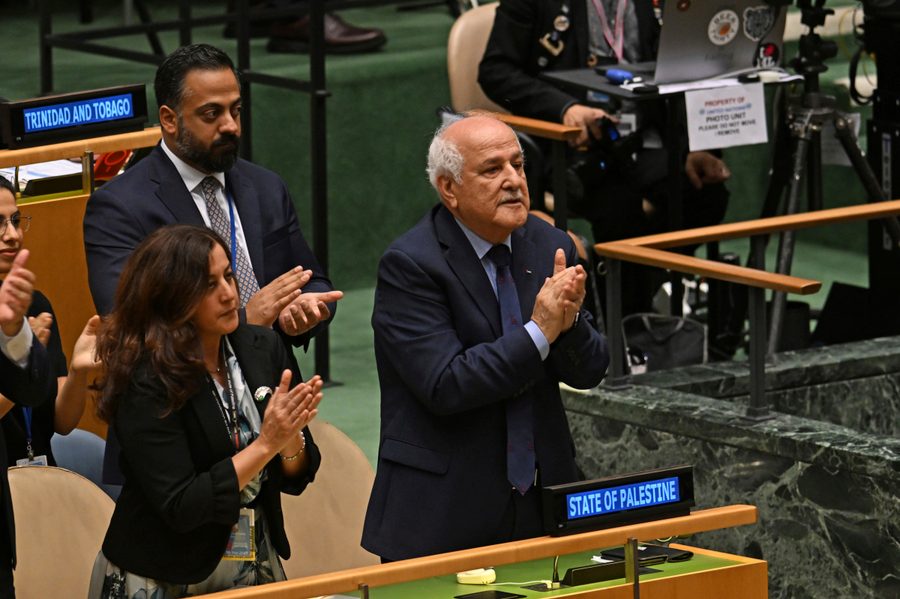
Palestinian UN Ambassador Riyad Mansour applauds after French President Emmanuel Macron announces that France has formally recognized the Palestinian state, New York, September 22nd.
On September 22nd, France’s President Emmanuel Macron made an announcement that even last year had seemed off the table: His country would recognize a Palestinian state. “The time has come for peace, because in an instant it may be beyond our grasp,” Macron said in the opening to his speech explaining the move. France was one of 11 nations to recognize a “State of Palestine” at a special United Nations summit in late September, alongside the United Kingdom, Canada, Australia, and other European states. The declarations drew praise from certain quarters: The Palestinian Authority (PA) called them “historic and courageous”; Arab states praised the moves as hastening progress toward peace; and more progressive European governments that already recognized a Palestinian state hailed the announcements for, in the words of Spain’s Prime Minister Pedro Sanchez, “protect[ing] what [Israeli Prime Minister Benjamin] Netanyahu is trying to destroy.”
State recognition, however, has never been the core demand of the movement for Palestinian liberation. In fact, in response to the consensus that Israel is carrying out a genocide in Gaza, Palestinians and those amplifying their message have made a uniform call for an immediate ceasefire, a halt in weapons aid and sales to Israel, and the imposition of sanctions. Absent these concrete measures, critics have argued that recognition is little more than a trick—a sleight-of-hand meant to placate restive Western publics while perpetuating the same conditions that enabled a genocide against the Palestinian people in the first place. Macron, who co-convened the recent UN summit with Saudi Arabia, exemplified this deceptive approach. From the dais in the assembly hall in New York, he recognized Palestine while omitting any mention of cutting off French arms sales to Israel, which have continued unchecked since October 7th. British Prime Minister Keir Starmer, similarly, recognized a Palestinian state while leading a government that continues to use workarounds to evade its own partial ban on sending weapons to Israel. Starmer has also met senior Israeli officials on British soil as recently as September 10th, and has led a massive crackdown on solidarity activism by designating the direct action group Palestine Action as a terror organization and arresting hundreds of peaceful protesters. Three of the other countries that recently recognized Palestine—Australia, Canada, and Luxembourg—likewise continue to sell weapons to Israel and refuse to sanction it.
Beyond just letting Western leaders off the hook for abetting genocide, these recognition announcements also impose a set of conditions on the so-called Palestinian state that essentially hollow out the possibility of Palestinian self-determination under the guise of reviving it. This orientation was plain in the New York Declaration, the communique produced by the co-chairs of the French–Saudi UN conference prior to its convening. Even as the document asserted that statehood for Palestinians was “an essential and indispensable component of the achievement of the two-State solution,” it made such recognition contingent upon requirements that burden the new state while favoring its occupier. The document calls on both Israel and Palestine to combat “radicalization, incitement, dehumanization” and “discrimination” in education and public programming, but only Palestine faces such conditions as a requirement for statehood: There is no way to enforce their application on Israel. Even more significantly, the New York Declaration demands that, as a prerequisite to statehood, Hamas disarm and hand over its weapons to the Palestinian Authority under an approach called “One State, One Government, One Law, One Gun.” Other recognition announcements have gone even further by pushing the PA disarm too, and the foreign ministers of 15 Western countries that had either recognized or planned to recognize a Palestinian state hailed the PA for accepting the principle of a demilitarized state from the start.
In enshrining these conditions as part and parcel of their “recognition” of Palestine, Western nations are amplifying the longstanding racist assumption that any actions of an armed Israeli state constitute “self-defense” or “security,” while a Palestinian equivalent will only ever engage in “violence” that must be prevented. This reverse logic holds that it is ultimately Palestinian resistance to colonialism, occupation, and genocide—and not Israeli perpetration of these crimes—that is the primary driver of ongoing instability and violence. The result is the conditioning of Palestinian self-determination on a disarmed and defanged entity that would be sovereign in name only. In a situation of radical asymmetry, and without any external guarantors to step forward in defense of Palestinians, such a state would be helpless in the face of Israeli violence. More broadly, the disarming of rebel groups would strip Palestinians as a whole of any form of deterrence or leverage, guaranteeing the continuation of Israel’s impunity. History testifies to the horrors that can emerge in such a situation: After Palestinian Liberation Organization (PLO) leader Yasser Arafat and his armed forces agreed to leave Beirut in 1982, for instance, Israeli-supported Phalangists carried out an infamous massacre of unprotected Palestinian civilians in Sabra and Shatila.
In fact, in disarming Palestinians, the recognition trick may be hastening a concession that Israel has not thus far been able to achieve on the battlefield or through negotiations. Originally, the call for Hamas’s disarmament was rejected as a non-starter in ceasefire talks. But as the unwavering support of the White House has shown Israel that it can dictate the terms of negotiations, Hamas’s disarmament has become a core Israeli sticking point. Such a demand has little precedent in ceasefire talks: The Irish Republican Army, for example, only agreed to disarm gradually and as part of the comprehensive political solution laid out in the Good Friday Agreement, not before. In the same vein, Hamas has maintained that it would be willing to lay down its arms as part of a genuine two-state solution which, in the words of a high-ranking Hamas official last spring, would involve “a fully sovereign Palestinian state in the West Bank and Gaza Strip and the return of Palestinian refugees.” But rather than building toward this reality, Western powers have acted to extract the wholesale surrender of Palestinians’ right to self-defence as a prerequisite to any comprehensive solution—essentially throwing the weight of international consensus behind the Israeli position.
Such a recognition sets up a future for the Palestinian territories that appears eerily similar to Israel’s ultimate endgame: fragmented cantons under a compliant local authority that is tasked with administration but stripped of sovereignty, all while Israel retains its demographic and military dominance. The occupied West Bank already offers a grim preview of what this sort of “State of Palestine” would look like. From the Oslo years onward, Israel and its Western allies have used the PA’s lack of sovereignty over its land, borders, and resources, and its dependence on economic aid, as a lever to secure the body’s compliance. As a result, Mahmoud Abbas—the most pliant Palestinian leader in history—has responded to Israel’s displacement of tens of thousands of Palestinians, surging settlement expansion, and growing settler and military violence by policing Palestinians instead of their occupiers. In recent years, PA security forces have killed many dissenting Palestinians including, this year, a young female journalist; they have also shut down critical media and crushed non-violent and armed resistance alike. And even this appeasement has only resulted in the tightening of the leash. Today, the main purpose of the PA appears to be to consistently strive to prove that it is not a threat to Israel while simultaneously devaluing Palestinians’ own security—a situation the recent recognition announcements look to continue. Indeed, in his speech at the UN conference last week, delivered via video link after the US revoked his travel visa, Abbas embraced the conditional recognition the West had to offer, called on Hamas to comply, and rushed to embrace a demilitarized state.
The fact that the recent Western recognitions of Palestine facilitate Israeli goals became clearer than ever last week, when US President Donald Trump released his 20-point-plan to end the war on Gaza. Netanyahu has previously protested Western countries’ recognition of Palestine as an “absurd prize for terrorism,” and his American patrons have echoed this rejection. However, Israel and the US’s “peace plan” builds precisely on the conditional recognition framework—calling for Palestinian disarmament, brushing aside any concrete consequences against Israel, and imposing “reforms” on the Palestinian Authority (the only one of these that has any real Palestinian backing is the holding of democratic elections.)
To be sure, the Trump plan goes further than Western states’ conditional recognition announcements by decoupling its conditions from even an elusive offer of statehood and instead making them prerequisites for a ceasefire, while also adding new hurdles (such as allowing Israeli troops to retain security control of Gaza, placing Palestinians under colonial rule by Trump and ex-British Prime Minister Tony Blair, and insisting the PA withdraw its cases against Israel at the international courts). These expansive conditions reflect 11th-hour changes Netanyahu reportedly secured to the document, clarifying the extent to which the 20-point-plan is an Israeli one. But not even Netanyahu’s open boasts that Israel set the terms of the plan has been enough to deter Palestine’s new recognizers from embracing it. Despite their show of bucking Netanyahu in the statehood arena, countries like France, the UK, Australia, and Canada have uncritically welcomed the Trump–Netanyahu blueprint of indefinite occupation—clarifying that their recent gestures of recognition are not new steps toward accountability but consistent with their broader pro-Israel politics.
All that said, the recognition that Palestinians are indeed a people and have the right to self-determination does hold some meaning. As a minority of countries like Spain have shown, the recognition of the State of Palestine can be used as a springboard to follow through on commitments with concrete action by ending arms sales or pushing for Israel’s international isolation. For activists in the West, too, advocating on behalf of a sovereign state rather than a stateless people opens up more avenues for legal action. In Britain, for instance, the 1870 Foreign Enlistment Act prohibits citizens from serving in armies against “foreign states at peace” with their country. This could mean that British politicians are no longer able to elude questions about prosecuting British dual nationals serving in the Israeli army on the grounds that Palestine is not a state.
But the biggest opening may be a counterintuitive one. From Netanyahu and his likely successor Naftali Bennett to the liberal figureheads Yair Lapid and Yair Golan, the entire Israeli political spectrum has been unanimous in rejecting the new international move for a two-state solution, claiming that recognizing Palestine is a reward for terrorism. Others in the Israeli government want to go further, looking to use Israeli anger at the recognition as a pretext to formalize the de facto annexation of the West Bank. Macron conceded in his UN speech that such annexation would be an “irreversible event” (even as he opted to ignore measures by Israel’s government that have already embarked on this shift). Israel’s brazen rejectionism on this point may thus eventually turn the world’s belated buy-in to the two-state project into an appetite for some kind of alternative.
There are some small stirrings in this direction. It is exceedingly rare for mainstream broadcast news in the West to ever suggest that visions beyond a two-state solution even exist, whether that is a confederation or a one-state solution. But paradoxically, the return to the two-state solution to mainstream political discourse, and Israel’s loud rejection of it, has cracked this wall of silence. Responding to a journalist from Britain’s Channel 4 reading out Netanyahu’s absolute denial of Palestinian self-determination, Jamal Zahalka, a former lawmaker from Israel’s left-wing Arab nationalist party Balad, offered a simple but seductive rebuttal: “If he doesn’t want a Palestinian state, so let’s go for a binational state all over for Palestine-Israel, one state for two people with equal rights for the group and individuals.” As long as people around the world reject a return to the slow violence of apartheid as an acceptable end to the Gaza genocide, and especially if Israel continues on its rejectionist path, one hopes Zahalka’s answer will start to sound less utopian and more common sense.

I’m Arielle Angel, editor-at-large of Jewish Currents. Before you go, there’s something I need to ask.
We’ve seen over and over how the mainstream media falters in telling stories on our beats—whether it’s antisemitism, Israel/Palestine in American politics, Jewish identity, or the American left. At Jewish Currents we’re committed to uncompromising analysis and longform reporting on these issues and more—stories you won’t find anywhere else. In a media landscape that obscures injustice and flattens discussion, we’re changing the conversation. But we need you.
If you believe in this work, please consider making a donation—or even better, a recurring one—to ensure that we are able to keep publishing stories like this one. We can’t do it without you.

Jonathan Shamir is contributing writer at Jewish Currents and the former deputy editor of Haaretz.com.